E-invoicing in Rwanda: EBM and the electronic invoicing system
Overview
Rwanda requires every person who carries out a taxable activity to issue invoices from an electronic invoicing system certified by the Rwanda Revenue Authority (RRA). The law calls it the "electronic invoicing system" (EIS). RRA and businesses call it EBM, for Electronic Billing Machine. [1] [3]
Three names come up:
- Electronic invoicing system — "an invoicing system that is certified by the tax administration for the purposes of invoice issuance" (Ministerial Order N° 006/26/10/TC, Art. 2(f)). The tax administration is RRA (Art. 2(g)). [2]
- EBM — in RRA's 2018 technical specification, "a system comprising of Certified Invoicing System and Virtual Sales Data Controller connected together". [5]
- SDC / VSDC — the Sales Data Controller (a device) or Virtual Sales Data Controller (software) that signs each receipt and sends the data to RRA. The VSDC is how a business connects its own invoicing software or ERP. [4]
Legal basis in one line. Law N° 020/2023 of 31/03/2023 on tax procedures, Arts. 17–18 (the duty) and Arts. 84, 88 and 89 (the fines); Ministerial Order N° 006/26/10/TC of 24/09/2026 on the use of the electronic invoicing system (the rules of use), in force since 25/09/2026. [1] [2]
| Rwanda | |
|---|---|
| System | Electronic invoicing system (EIS), known as EBM; certified invoicing system (CIS) plus a Sales Data Controller (SDC) or Virtual Sales Data Controller (VSDC) |
| Model | Fiscalisation: each invoice is signed by the SDC/VSDC and the sales data is sent to RRA's EBM server. RRA does not approve invoices before they are issued |
| B2B, B2C and B2G | One rule for every sale, with no split by type of buyer. Same rule since Law 026/2019 (in force 10 October 2019); current legal basis Law 020/2023 (in force 31 March 2023); current rules of use under Order 006/26/10/TC since 25 September 2026 |
| Phases | None. No phased roll-out and no future phase announced |
| Non-residents | Not addressed by Order 006/26/10/TC or by Order 004/26/10/TC on online supplies (see Scope) |
| Format | VSDC API: REST web service, JSON data (RRA VSDC documentation v1.0.5). Not Peppol, UBL or CII |
| Network | No exchange network. The buyer gets a printed or electronic receipt; a buyer's system can pull the seller's reported sale from RRA's EBM server |
| Integrity | SDC date and time, SDC ID, receipt number, internal data, receipt signature and QR code |
| Authority | Rwanda Revenue Authority (RRA); the Order is issued by the Minister of Finance and Economic Planning |
| Penalty | VAT-registered: 10 times the evaded VAT (20 times on repeat). Not VAT-registered: 2 times the transaction value (doubled on repeat). Other EIS user obligations: FRW 200,000 (FRW 400,000 on repeat) |
For the VAT rate, registration and the general invoice rules, see the Rwanda VAT guide.
Mandate status & timeline
Status (as at 15 November 2026): mandatory for every taxable sale, and in force. Rwanda has no phased roll-out. Article 17 of Law 020/2023 says: "A person who carries out any taxable activity issues an invoice generated by an electronic invoicing system certified by the Tax administration." The Law came into force on publication (Art. 106), in Official Gazette n° Special ter of 31/03/2023. The rule itself is older: Article 17 of the previous Law N° 026/2019 of 18/09/2019 on tax procedures already said "A person who carries out any taxable activity must issue an invoice generated by an electronic invoicing system certified by the Tax administration." That Law came into force on publication (Art. 99), in Official Gazette nº Special of 10/10/2019. Law 020/2023 re-enacted the rule and repealed Law 026/2019 (Art. 105). [1] [8]
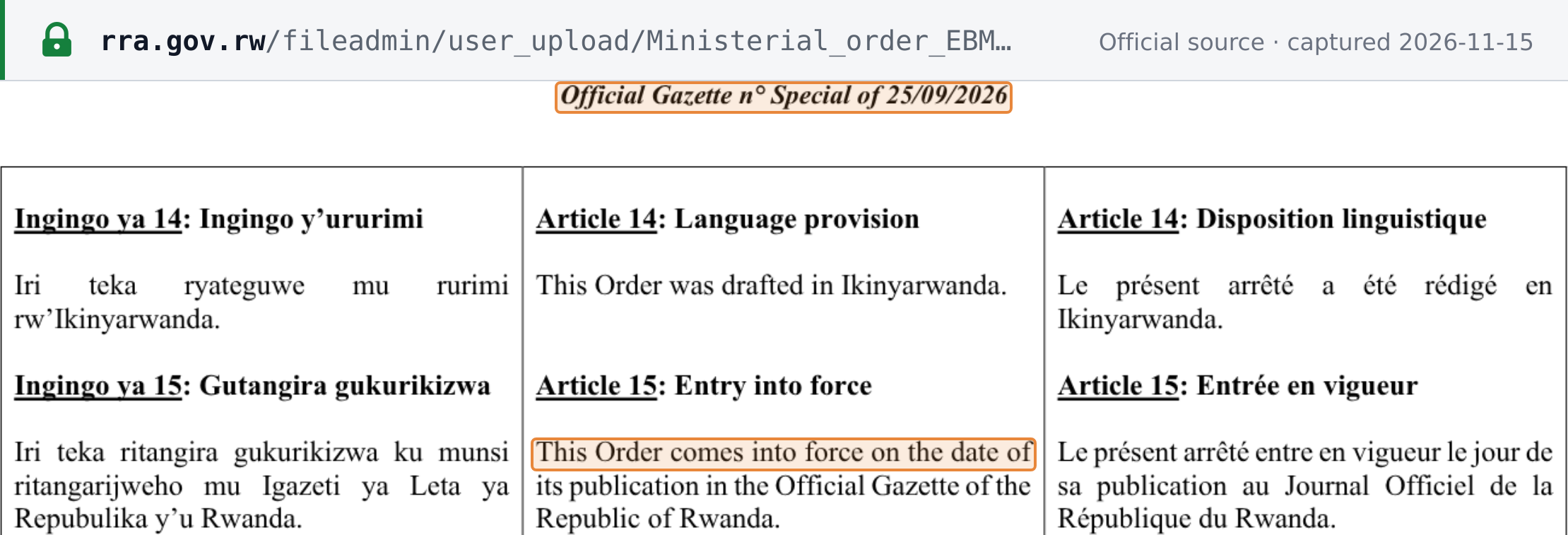
The latest instrument: Ministerial Order N° 006/26/10/TC. Signed in Kigali on 24/09/2026 by the Minister of Finance and Economic Planning and published in Official Gazette n° Special of 25/09/2026. Article 15: "This Order comes into force on the date of its publication in the Official Gazette of the Republic of Rwanda." So it applies from 25 September 2026. The Order has no transitional article, so its new duties (ERP integration in Art. 4, the minimum invoice data in Art. 6) carry no stated grace period. [2]
 Source snapshot captured 2026-11-15 — original
History of the instruments. The table lists instruments, not waves: each one applied to every taxpayer in scope from its date.
| Date | Instrument or step | Status |
|---|---|---|
| 31/07/2013 | Ministerial Order nº 002/13/10/TC on modalities of use of a certified electronic billing machine | Repealed from 25/09/2026 (Order 006/26/10/TC, Art. 13) |
| 01/11/2016 | Ministerial Order Nº 008/16/10/TC amends Art. 11 of the 2013 Order (user obligations). Published in Official Gazette nᵒ 45 of 07/11/2016 | Part of the 2013 Order, which was repealed from 25/09/2026 (Order 006/26/10/TC, Art. 13) |
| 2017 | RRA upgrades the EBM back end "to enable the supply chain management capability and integrate EBM with other RRA data sets (i.e. Importation)" | Historical |
| 2018 | RRA introduces Virtual Sales Data Controllers (VSDC) for taxpayers' own invoicing systems (CIS for VSDC specification, Ver. 1.0, March 2018) | Current route for own systems |
| 10/10/2019 | Law N° 026/2019 of 18/09/2019 on tax procedures in force (Art. 99): Art. 17 requires every person carrying out a taxable activity to issue an invoice from an RRA-certified electronic invoicing system | Repealed by Law 020/2023 (Art. 105); rule re-enacted |
| 31/03/2023 | Law 020/2023 on tax procedures in force: Arts. 17–18 re-enact the duty for every person carrying out a taxable activity; current legal basis | In force |
| May 2023 | RRA introduces the Purchase Code, used when a business buys goods for resale | In use |
| 25/09/2026 | Ministerial Order 006/26/10/TC: rules of use, minimum invoice data, ERP integration, buyer-initiated invoices; repeals the 2013 Order | In force |
RRA's About EBM page still lists the 2016 Order amending the 2013 Order under "Useful documents" as a law "governing the use of EBM". The 2013 Order it amended was repealed from 25 September 2026 (Order 006/26/10/TC, Art. 13), taking the amendment with it. The current rules are in Order 006/26/10/TC. [3] [2]
Pilot or voluntary phases: none published. Postponements: none. No Order or RRA notice has moved a date.
Still to come from RRA. Order 006/26/10/TC leaves two procedures "as determined by the tax administration": the "prescribed manner" for ERP integration (Art. 4) and the buyer-initiated invoice (Art. 5). RRA had not published either on its EBM pages, its laws page or its news page as at 15 November 2026. See Onboarding.
Legal basis
| Instrument | Publication | In force | What it does |
|---|---|---|---|
| Law N° 020/2023 of 31/03/2023 on tax procedures | Official Gazette n° Special ter of 31/03/2023 | 31/03/2023, on publication (Art. 106) | Art. 17 duty to issue EIS invoices; Art. 18 user obligations; Arts. 84, 88, 89 fines. Repeals Law n° 026/2019 on tax procedures (Art. 105) |
| Law N° 026/2019 of 18/09/2019 on tax procedures | Official Gazette nº Special of 10/10/2019 | 10/10/2019, on publication (Art. 99) | Art. 17 first imposed the duty on every person carrying out a taxable activity. Repealed by Law 020/2023 (Art. 105) |
| Ministerial Order N° 006/26/10/TC of 24/09/2026 on the use of the electronic invoicing system, waiver of tax and the award given to a person for reporting a case of tax evasion | Official Gazette n° Special of 25/09/2026 | 25/09/2026, on publication (Art. 15) | Made under Law 020/2023 Arts. 17(2), 76(5) and 102(2); approved by the Cabinet on 30/06/2026. Sets users' obligations, ERP integration, buyer-initiated invoices, minimum invoice data, the exemption in Art. 8. Repeals Order 002/13/10/TC (Art. 13) |
| Ministerial Order nº 002/13/10/TC of 31/07/2013, amended by Order Nº 008/16/10/TC of 01/11/2016 | 2016 amendment: Official Gazette nᵒ 45 of 07/11/2016 | — | Repealed from 25/09/2026 |
The Order's preamble: "Pursuant to Law nº 020/2023 of 31/03/2023 on tax procedures, especially in Articles 17(2), 76(5) and 102(2)" and "After consideration and approval by the Cabinet, in its meeting of 30/06/2026". The Order is published in Kinyarwanda, English and French; Art. 14 says "This Order was drafted in Ikinyarwanda." [2]
Technical standards. RRA publishes two technical documents, both linked from its About EBM page: the VSDC API documentation (RRA_VSDC_DOC v1.0.5; document dated 16 April 2022, last revised 16/05/2023) and the Technical Specification of CIS for VSDC (Ver. 1.0, March 2018). Neither is a gazetted instrument. They bind in practice because RRA certifies a business's own system against them before it may connect (see Onboarding), and Order 006/26/10/TC Art. 4 requires ERP integration "through a prescribed manner determined by the tax administration". [4] [5] [3] [2]
Scope
Who. Every person who carries out a taxable activity (Law 020/2023 Art. 17), whether or not registered for VAT. RRA's summary: "According to the Tax Procedure law of 2023, every person who carries out any taxable activities (whether registered on VAT or not) should request and use EBM to issue tax invoices to their customers on every transaction they make." [1] [3]
B2B, B2C and B2G. Neither Law 020/2023 (Arts. 17–18) nor Order 006/26/10/TC sets separate rules or dates for sales to businesses, consumers or the government. Every user must "issue an electronic invoice to every buyer regardless request thereof" (Law 020/2023 Art. 18(2)). A buyer is identified "by a TIN, telephone number or nine zeroes" (Order Art. 2(b)), so a consumer with no TIN still gets an invoice. RRA's EBM pages describe no separate e-invoicing platform for sales to the government. [1] [2]
The one exemption (Order Art. 8). "A taxpayer is not required to use the electronic invoicing system on each transaction when they are not obliged to file an annual tax declaration as per income tax; however, the taxpayer is required to approve an invoice initiated by the buyer." Which taxpayers have no annual income-tax declaration is set by the income tax law, not by the Order. The Order does not equate it with being outside VAT. [2]
Non-established businesses. Not addressed. Order 006/26/10/TC and Law 020/2023 Arts. 17–18 do not mention non-residents. Ministerial Order 004/26/10/TC of 29/04/2026, which makes non-resident suppliers of online goods and services register for VAT, contains no reference to an "electronic invoicing system" or EBM; its invoice articles cover adjustment and cancellation only. No RRA text published as at 15 November 2026 says whether a VAT-registered non-resident online supplier must issue EBM invoices. For the VAT rules themselves, see the Rwanda VAT guide. [2] [7]
Simplified invoices. None. Order 006/26/10/TC sets one minimum data list for every invoice (Art. 6) and no value threshold for a simplified invoice. An unidentified buyer is recorded as nine zeroes (Art. 2(b)). [2]
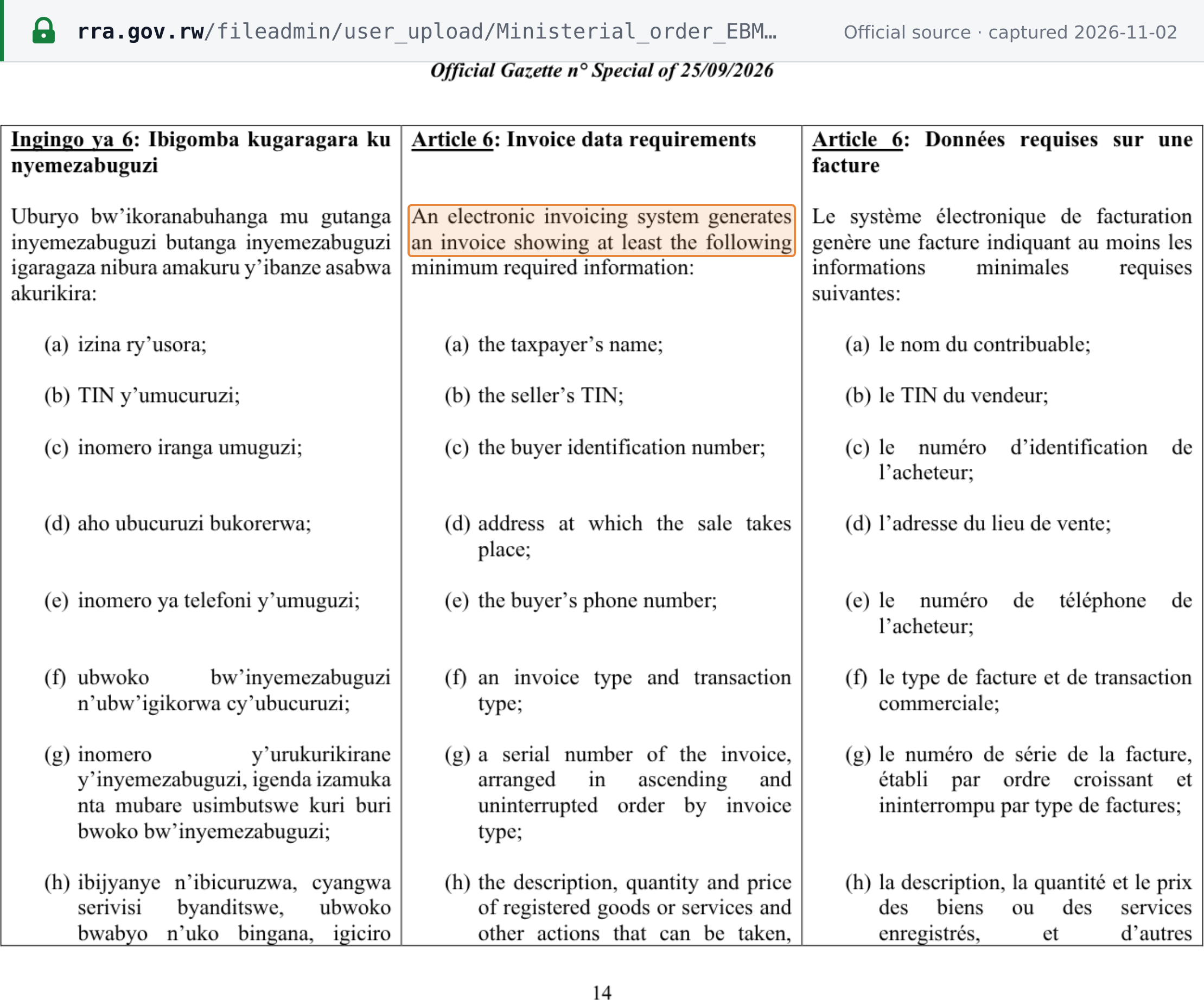
What every invoice must show (Order Art. 6). "An electronic invoicing system generates an invoice showing at least the following minimum required information": [2]
- (a) the taxpayer's name; (b) the seller's TIN; (c) the buyer identification number; (d) the address at which the sale takes place; (e) the buyer's phone number;
- (f) an invoice type and transaction type; (g) a serial number of the invoice, in ascending and uninterrupted order by invoice type;
- (h) the description, quantity and price of registered goods or services, and other actions that can be taken, such as invalidating or correcting the invoice;
- (i) the total sales amount; (j) tax rates applied; (k) the rate of tax added to the price of the product; (l) means of payment; (m) the discount offered;
- (n) SDC information: the date and time stamped by the SDC; a sequential invoice type number; the SDC identification number; the invoicing system number; the date and time stamped by the electronic invoicing system.
Article 7: "The transaction types generated by electronic invoicing system are sale and cancellation of an invoice." and "The invoice types are normal receipt, copy and pro forma." [2]
 Source snapshot captured 2026-11-02 — original
Format & network
The model: fiscalisation, not clearance. Every invoice comes from a Certified Invoicing System (CIS: a till, POS or business software) connected to a Sales Data Controller. RRA's CIS specification: "A CIS shall not be able to receive importation and purchase data or produce invoices unless connected to a functional Virtual Sales Data Controller unit assigned for the same TIN. This VSDC preserves in an irrevocable and secure manner all relevant data of the outbound transactions, uses this data to calculate an encrypted value that must be printed on the final receipt". The (V)SDC signs the receipt and sends the sales data to RRA's EBM server. RRA does not validate or approve the invoice before it is issued, and the invoice's validity does not depend on the buyer accepting it. The VSDC does give the buyer's system a purchase-confirmation function (see Network, below), but it is a bookkeeping step, not a condition of the invoice. "Fiscalisation" is this page's label for that model, not RRA's term; see Fiscal devices and certified cash registers and CTC e-invoicing models. [5]
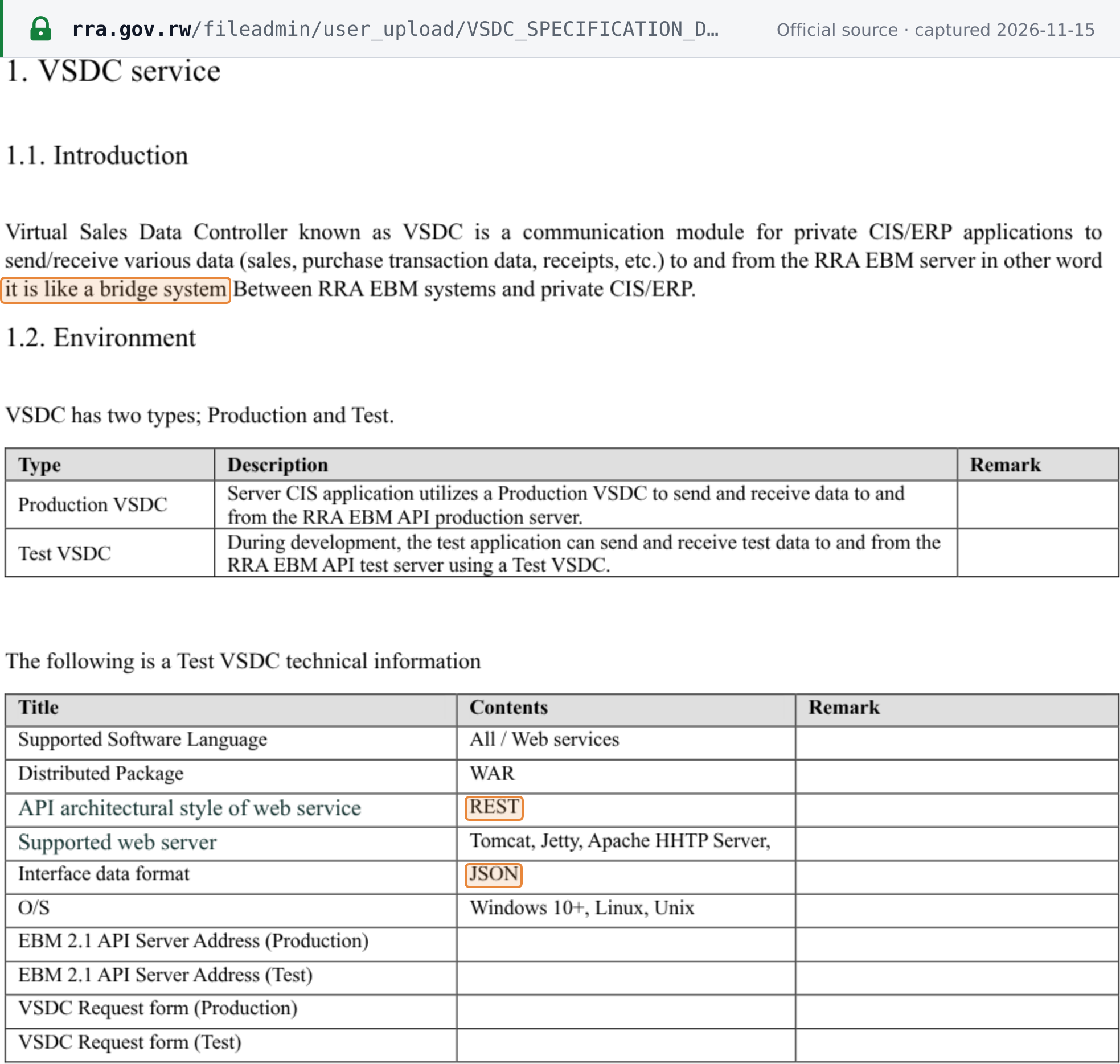
Format: the VSDC API is REST with JSON. RRA's VSDC documentation v1.0.5 describes the VSDC as "a communication module for private CIS/ERP applications to send/receive various data (sales, purchase transaction data, receipts, etc.) to and from the RRA EBM server in other word it is like a bridge system Between RRA EBM systems and private CIS/ERP." Its environment table gives "API architectural style of web service: REST" and "Interface data format: JSON". The VSDC is delivered as a WAR package that runs on the taxpayer's own web server (Tomcat, Jetty or Apache HTTP Server). [4]
 Source snapshot captured 2026-11-15 — original
Not Peppol, UBL or CII. RRA's VSDC API documentation and CIS specification define RRA's own interface to the EBM server. Neither refers to Peppol, UBL or UN/CEFACT CII. [4] [5]
An older spec says XML. The 2018 CIS for VSDC specification describes the commands between the VSDC and the CIS: "They are sent in XML format. The data flow transmission should be schedule to a maximum of 15 min." Both documents are current downloads on RRA's About EBM page. The newer VSDC API documentation (v1.0.5) specifies JSON over REST. The 15-minute figure is a 2018 technical line; Order 006/26/10/TC sets no transmission deadline. [5] [4]
Network. There is no document-exchange network. The seller hands the buyer a receipt. The closest thing to B2B exchange is a data pull through RRA: "When a seller registers sales transaction and Invoice data to EBM server, buyer can request such data for purchase confirmation and stock adjustment purpose" (VSDC documentation §3.1, item 7). [4]
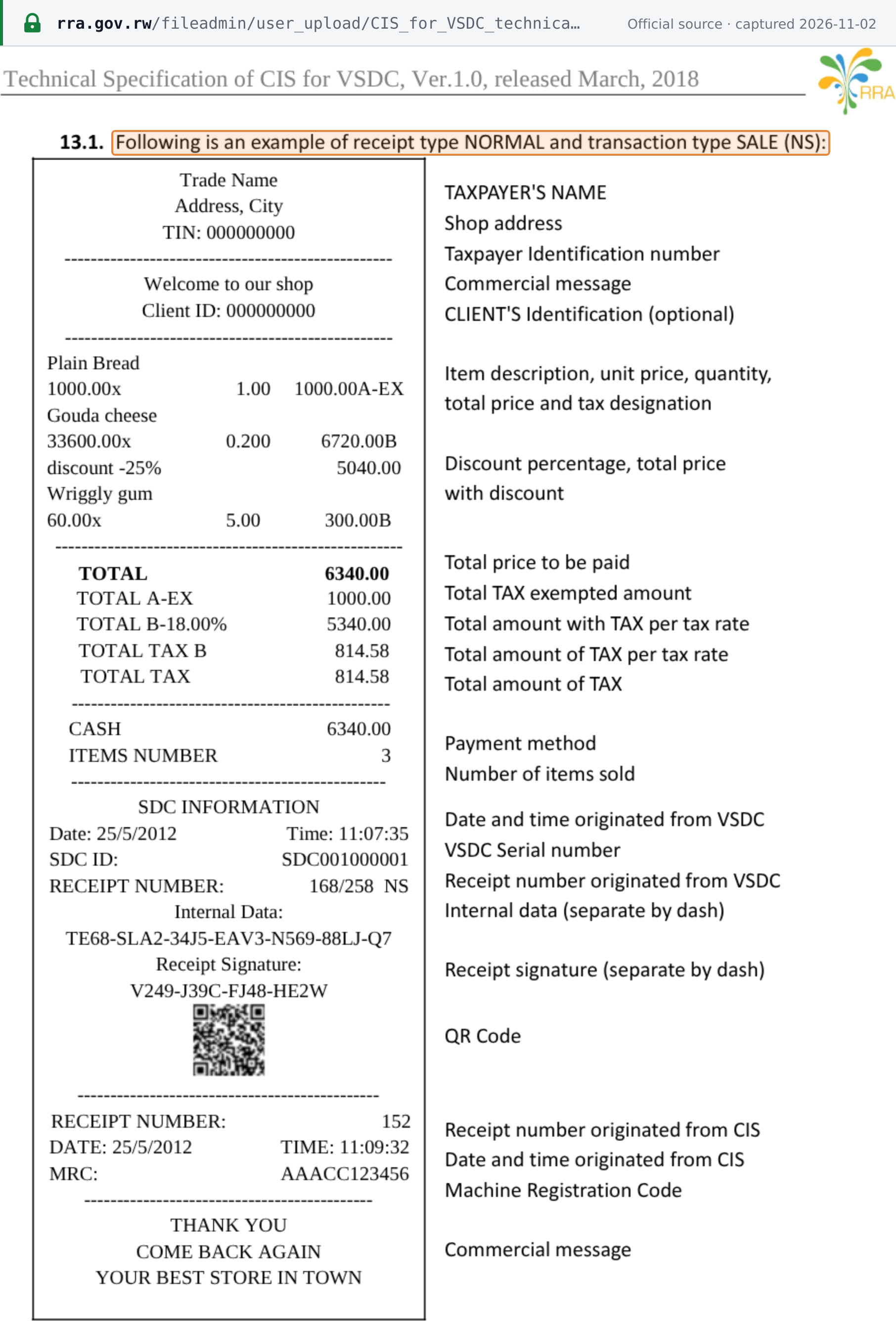
Integrity mechanics. The receipt carries the SDC date and time, the SDC ID, the receipt number, the internal data, the receipt signature and a QR code. The CIS specification builds the QR code from "invoice_date(ddmmyyyy)#time(hhmmss)#sdc number#sdc_receipt_number#internal_data#receipt_signature", and prints the signature in groups of four characters separated by dashes. TRAINING and PRO FORMA receipts carry no digital signature. [5]
 Source snapshot captured 2026-11-02 — original
Offline operation. "If there is no internet connection for 24 hours after VSDC issues a receipt signature and an internal data, VSDC stops issuing a receipt number" (VSDC documentation §2.2). [4]
When the system fails or is stolen (Order Art. 3(i)–(j)). Notify RRA "within 12 hours in case of theft of the electronic invoicing system and within six hours in case of damage to this system", with a copy of the report from the competent authority. If the business continues, "a taxpayer must get a new electronic invoicing system within five working days". Meanwhile, "issue manual invoices in two specimens" and print the corresponding invoices once the system is restored. Law 020/2023 Art. 18(5) separately requires notice of a failure of the system "within a time not exceeding six (6) hours". [2] [1]
Reporting alongside. No separate e-reporting obligation is set by Order 006/26/10/TC. RRA notes that EBM sales data can be copied into the "Sales" tab of the VAT annexures. [3]
Onboarding: how to comply
1. Pick an EBM system. RRA offers four, and says who each one is for: [3]
| System | Who it is for (RRA) |
|---|---|
| EBM version 2.1 for Windows computer or tablet | "any taxpayer who has a computer or a tablet device only" |
| EBM version 2.1 for Android smartphone | "non-VAT registered taxpayers and micro or small new registered taxpayer" |
| Online EBM (web-based) | taxpayers "operating in service sector who do not issue more than 10 invoices per month", e.g. rental property owners, transport providers, consultants, lawyers; no physical device needed |
| Virtual Sales Data Controller (VSDC) | "taxpayers who have their own invoicing system who need to integrate it with EBM" |
RRA lists Windows 10 and above and Android 8.1 and above as supported, and says "EBM is not compatible for MAC computers/IOS operating systems." Remote support: install TeamViewer and call 3004. [3]
2. Request and install it. Order 006/26/10/TC Art. 3(a): a taxpayer must "request and obtain the electronic invoicing system as determined by the tax administration". [2]
3. Own invoicing system or ERP: get RRA certification for the VSDC route. RRA's steps: read the CIS4VSDC technical specification, the VSDC technical specification and the "Excel sheet Checkpoints"; gather the Business Registration Certificate, a valid RSSB clearance certificate, a valid RRA tax clearance certificate, the product brochure, warranty statement, physical address, user manual, installation guide and programming and configuration manual; then "submit your application for certification by sending an email to cis_sdc_certification@rra.gov.rw". If the application meets the requirements, "RRA will provide you a certificate allowing you to integrate your system with EBM." The VSDC documentation adds: "To use VSDC, a taxpayer must apply for VSDC service and get approval from RRA." After approval, the WAR file is deployed on the taxpayer's web server and activated through the initialisation service. [3] [4]
ERP integration is now mandatory. Order 006/26/10/TC Art. 4: "A taxpayer who uses an Enterprise Resource Planning “ERP” to make invoices is required to integrate their ERP with the electronic invoicing system through a prescribed manner determined by the tax administration." It applies from 25 September 2026 with no transition article. RRA had not published the "prescribed manner" as at 15 November 2026; the only integration route RRA publishes is VSDC certification, above. [2]
Testing environment. RRA runs a Test VSDC: "During development, the test application can send and receive test data to and from the RRA EBM API test server using a Test VSDC." The server addresses are not printed in the published documentation. [4]
Suppliers. Order 006/26/10/TC defines a "supplier" as "a company or natural person registered in Rwanda licensed by the tax administration for selling certified electronic invoicing system or computing devices" (Art. 2(h)). A taxpayer who outsources an invoicing system other than RRA's must "have a valid service contract with a supplier" (Art. 3(b)). RRA's EBM pages publish no list of licensed suppliers. [2]
Buyer-initiated invoices. Order Art. 5: "In circumstances where the seller is unable to issue an invoice, the buyer initiates the invoice processing. In that case, the seller has an obligation to approve the initiated invoice as determined by the tax administration." RRA had not published the procedure as at 15 November 2026. [2]
Purchase Code. "In May 2023, RRA introduced the Purchase code as the security feature added in the EBM to prevent misuse of Taxpayers Identification Number (TIN)." A business buying goods for resale requests the code through MyRRA or by dialling *800# and gives it to the seller, who uses it to generate the EBM invoice. [3]
Ongoing duties (Order Art. 3; Law 020/2023 Art. 18). Keep the system at the sales location where customers can reach it; post a notice with the taxpayer's name, address and TIN, the SDC serial number, whether the business is VAT-registered, and the statement "do not pay if an invoice is not issued"; approve buyer-initiated invoices; print delivery notes from the system for stock moved between the company's own stores; issue a certified cancelled receipt to cancel an invoice; ask RRA to deactivate the system on cessation of business; and never delete an invoice "except for sound grounds". [2] [1]
Penalties
The fines are in Law 020/2023 and depend on whether the seller is registered for VAT: [1] [1]
| Breach | Fine | Repeat within two years | Article |
|---|---|---|---|
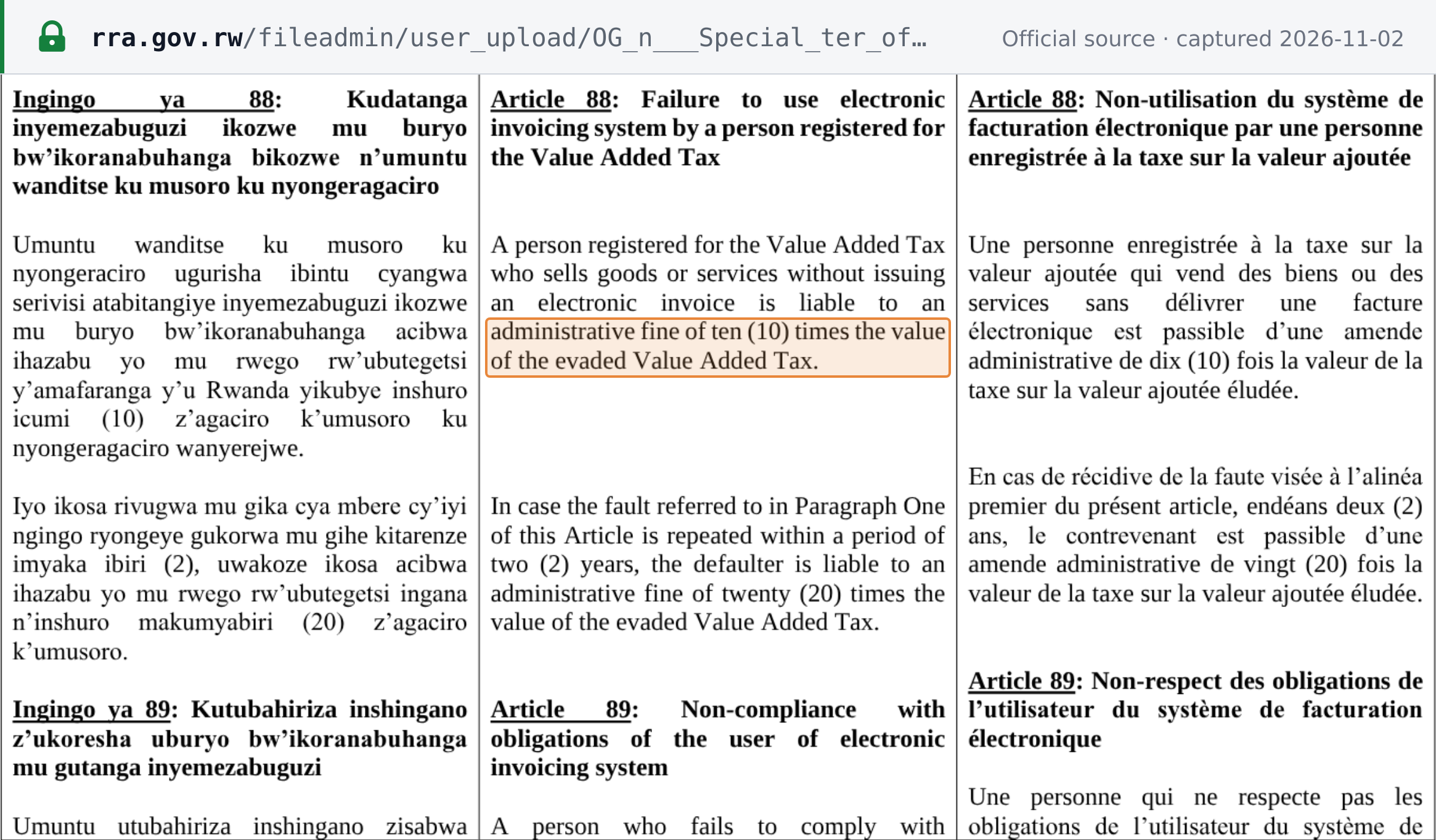
| VAT-registered person sells without issuing an electronic invoice | 10 times the evaded VAT | 20 times the evaded VAT | Art. 88 |
| Person not registered for VAT fails to issue an EIS invoice | 2 times the value of the transaction | 2 times that fine | Art. 84 |
| Person not registered for VAT under-values price or quantity | 2 times the value of the under-valued transaction | 2 times that fine | Art. 84 |
| VAT-registered person under-values price or quantity | 10 times the evaded VAT | 20 times the evaded VAT | Art. 89 |
| Breach of the Art. 18 EIS user obligations | FRW 200,000 | FRW 400,000 | Art. 89 |
Article 84: "Except for taxpayers registered for the Value Added Tax, any person who is required to issue an invoice generated by an electronic invoicing system recognized by the Tax Administration who fails to do so is liable to an administrative fine of two (2) times the value of the transaction." Article 88: "A person registered for the Value Added Tax who sells goods or services without issuing an electronic invoice is liable to an administrative fine of ten (10) times the value of the evaded Value Added Tax." [1] [1]
 Source snapshot captured 2026-11-02 — original
RRA's web page gives different figures for sellers outside VAT. RRA's About EBM penalty table says the fine for selling without an EBM receipt "will be 200,000Frw for non-VAT registered taxpayer", and ten times the underpriced amount for under-valuing. Law 020/2023 Art. 84 sets two times the transaction value and two times the under-valued transaction. The statute governs; the FRW 200,000 figure in the law is the Art. 89 fine for breaching the Art. 18 user obligations. [3] [1]
Accessory sanctions (Law 020/2023 Art. 92). Anyone who commits a fault or offence under the Law may also face: "closure of business activities for a period not exceeding thirty (30) days depending on the seriousness of the fault"; a bar from bidding for public tenders; withdrawal of the business register; and publication in the media. Closure and media publication are imposed by the Commissioner General; the tender bar and the withdrawal of the business register are imposed by a court. RRA's About EBM page lists the same four sanctions. [1] [3]
Enforcement posture. Order 006/26/10/TC Art. 9: "the tax administration uses data analytics to detect non-compliance behavior or deploys inspectors across business centers or both." No grace period or tolerance has been announced for the 2026 Order. [2]
Frequently asked questions
We are not registered for VAT. Do we still have to issue EBM invoices?
Yes. Law 020/2023 Art. 17 applies to every person who carries out a taxable activity, and RRA says the duty covers taxpayers whether registered for VAT or not. The only exemption is in Order 006/26/10/TC Art. 8: a taxpayer not obliged to file an annual income-tax declaration need not use the system on each transaction, but must still approve buyer-initiated invoices. The fine for a person outside VAT who fails to issue an EIS invoice is 2 times the value of the transaction (Art. 84). [1] [2] [3]
We invoice from our own ERP. What changed on 25 September 2026?
Order 006/26/10/TC Art. 4 requires a taxpayer who uses an ERP to make invoices to integrate it with the electronic invoicing system through a prescribed manner determined by RRA, from 25 September 2026 with no transition article. RRA had not published that prescribed manner as at 15 November 2026. The integration route RRA publishes is the Virtual Sales Data Controller (VSDC): apply for certification by email to cis_sdc_certification@rra.gov.rw with the documents RRA lists. [2] [3]
Is Rwanda's e-invoice Peppol or UBL?
No. Rwanda uses RRA's own interface: the VSDC API documentation (v1.0.5) specifies a REST web service with JSON data, between the business's invoicing system and RRA's EBM server. RRA's older CIS for VSDC specification (March 2018) describes XML commands between the VSDC and the invoicing system. Neither document refers to Peppol, UBL or CII. [4] [5]
What happens if our internet connection drops?
Under RRA's VSDC documentation, if there is no internet connection for 24 hours after the VSDC issues a receipt signature and internal data, the VSDC stops issuing receipt numbers. If the system is damaged or stolen, notify RRA within six hours (damage) or 12 hours (theft), issue manual invoices in two specimens meanwhile, and get a new system within five working days if the business continues (Order 006/26/10/TC Art. 3(i)-(j)). [4] [2]
RRA's website says the fine for a non-VAT seller is FRW 200,000. Is that right?
Law 020/2023 says otherwise. Art. 84 fines a person not registered for VAT who fails to issue an EIS invoice 2 times the value of the transaction, doubled on a repeat within two years. FRW 200,000 (FRW 400,000 on repeat) is the Art. 89 fine for breaching the other EIS user obligations in Art. 18. A VAT-registered seller who sells without an electronic invoice is fined 10 times the evaded VAT (Art. 88). [1] [1] [3]
Is the 2013 EBM order still in force?
No. Order 006/26/10/TC Art. 13 repeals Ministerial Order 002/13/10/TC of 31/07/2013 on modalities of use of a certified electronic billing machine, from 25 September 2026. RRA's About EBM page still lists the 2016 amendment of that order under useful documents; the current rules are in Order 006/26/10/TC. [2] [3]
Our supplier asks for a purchase code before issuing the invoice. Why?
RRA introduced the Purchase Code in May 2023 to prevent misuse of taxpayers' TINs. A business buying goods for resale requests the code through MyRRA or by dialling *800# from the phone registered with its TIN, entering its TIN and the seller's TIN, and gives the code to the seller, who uses it to generate the EBM invoice. [3]
Recent changes
- 2026-09-25 — Ministerial Order 006/26/10/TC on the electronic invoicing system takes effect: minimum invoice data, buyer-initiated invoices, mandatory ERP integration, 12-hour theft and 6-hour damage notices; it repeals the 2013 EBM order. (RRA) — see event
- 2023-03-31 — Law 020/2023 on tax procedures in force, replacing Law 026/2019 (in force since 10/10/2019, whose Art. 17 set the same rule): Art. 17 requires every person carrying out a taxable activity to issue an invoice from an RRA-certified electronic invoicing system; Arts. 84, 88 and 89 set the fines. (RRA)
Related resources
- Rwanda VAT guide — rates, registration, invoice requirements and RRA's specimen receipt
- E-invoicing status and networks by country — compare Rwanda with Uganda (EFRIS), Kenya (eTIMS) and Zambia
- Fiscal devices and certified cash registers explained
- CTC e-invoicing models explained
- VAT on digital services by non-resident suppliers
- Rwanda TIN validator
- Rwanda tax changes on Lookuptax
Important websites
- RRA — About EBM — EBM systems on offer, VSDC certification steps, Purchase Code, penalties table
- RRA — EBM (Electronic Billing Machine)
- MyRRA — taxpayer portal (sign-in required)
- RRA VSDC API documentation v1.0.5 (PDF)
- RRA Technical Specification of CIS for VSDC, Ver. 1.0 (PDF)
- RRA — Laws, policies and rulings
- VSDC and own-system certification: cis_sdc_certification@rra.gov.rw; RRA support line 3004
Reference links
- RRA — Law N° 020/2023 of 31/03/2023 on tax procedures (Official Gazette n° Special ter of 31/03/2023)
- RRA — Ministerial Order N° 006/26/10/TC of 24/09/2026 on the use of the electronic invoicing system, waiver of tax and the award given to a person for reporting a case of tax evasion (Official Gazette n° Special of 25/09/2026)
- RRA — About EBM
- RRA — VSDC API documentation, RRA_VSDC_DOC v1.0.5
- RRA — Technical Specification of CIS for VSDC, Ver. 1.0, March 2018
- RRA — Official Gazette nᵒ 45 of 07/11/2016, Ministerial Order Nº 008/16/10/TC of 01/11/2016 modifying Ministerial Order nº 002/13/10/TC
- RRA — Ministerial Order Nº 004/26/10/TC of 29/04/2026 on VAT on goods and services provided online
- Official Gazette nº Special of 10/10/2019 — Law N° 026/2019 of 18/09/2019 on tax procedures (gazettes.africa archive)