E-invoicing in Burundi: OBR's EBMS
Overview
Burundi's tax authority, the Office Burundais des Recettes (OBR), runs the Electronic Billing Management System — EBMS (OBR also writes "Ebms" and "eBMS"). Taxpayers issue invoices either from an OBR-approved electronic invoicing machine (machine de facturation électronique, MFE) or from their own invoicing system connected to OBR's web services. Each invoice is sent to EBMS as it is issued. [1] [2]
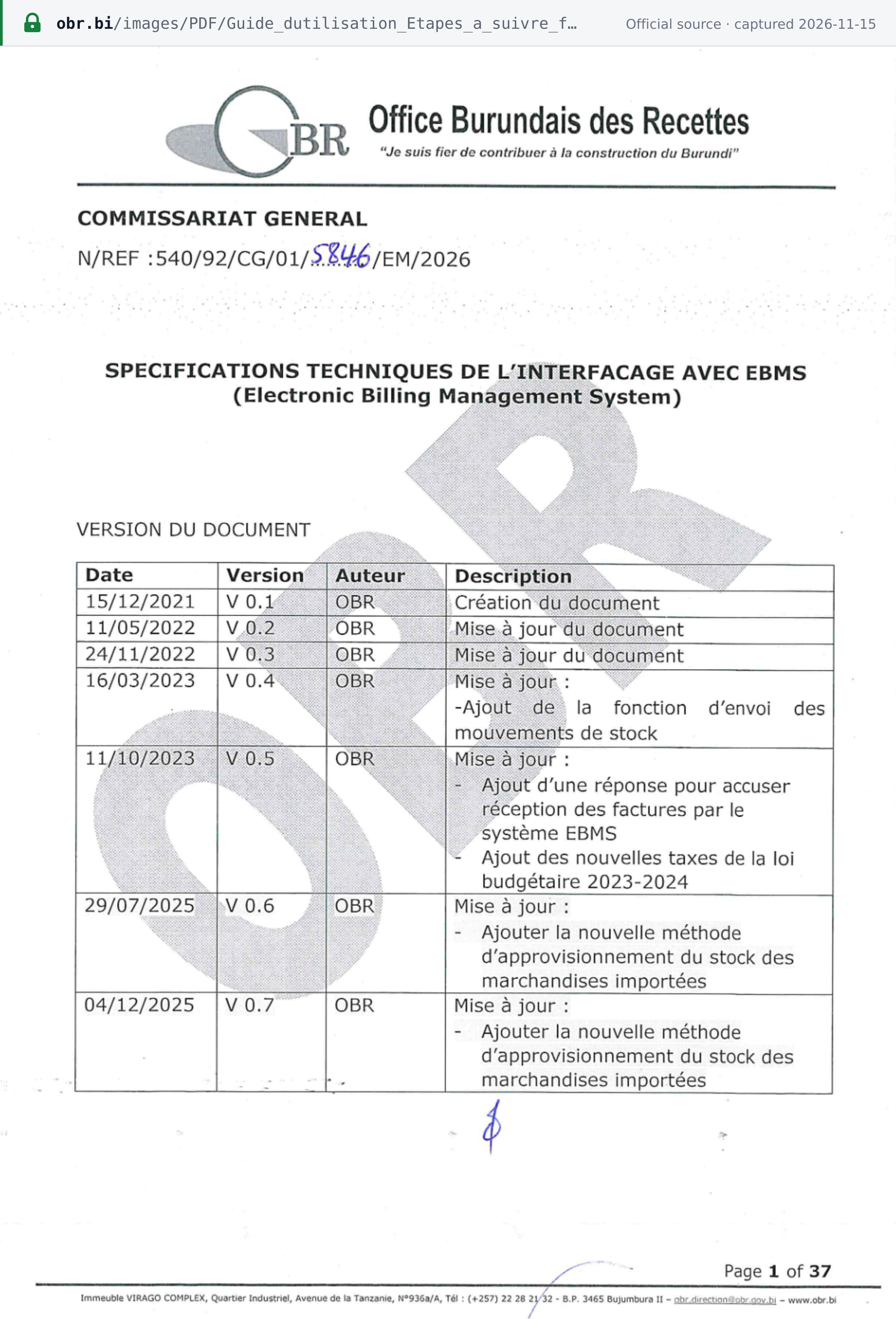
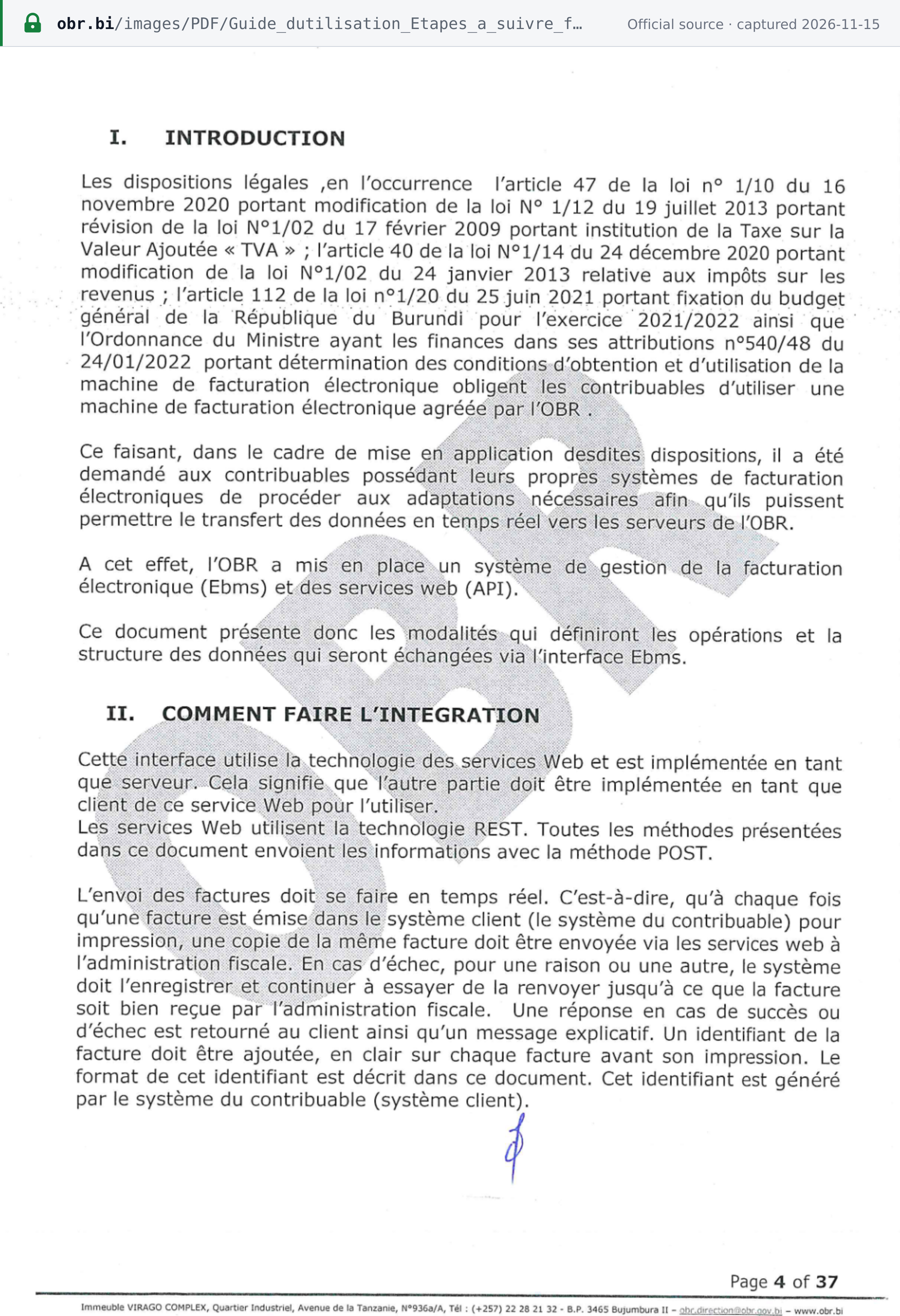
OBR's interfacing specification describes the arrangement in its introduction: "il a été demandé aux contribuables possédant leurs propres systèmes de facturation électroniques de procéder aux adaptations nécessaires afin qu'ils puissent permettre le transfert des données en temps réel vers les serveurs de l'OBR. A cet effet, l'OBR a mis en place un système de gestion de la facturation électronique (Ebms) et des services web (API)." (Taxpayers with their own e-invoicing systems were asked to adapt them so that data is transferred in real time to OBR's servers; to that end, OBR set up the EBMS and web services.) [2]
Legal basis in one line. VAT law n°1/10 of 16 November 2020, art. 47 (approved machine for every VAT taxpayer); the account-keepers' machine duty and the EBMS-only input-VAT rule, carried since Loi n°1/27 of 30 December 2024 (arts. 199 and 71) through Loi n°1/09 of 31 December 2025 (arts. 243 and 97); Finance Law 2026/2027, Loi n°1/10 of 30 June 2026, arts. 99, 100, 200 and 268 (in force 1 July 2026). [10] [3] [4] [5]
| Burundi | |
|---|---|
| System | EBMS (Electronic Billing Management System), run by OBR |
| Model | Real-time reporting: every invoice sent to EBMS when issued; EBMS returns an acknowledgement signed by OBR. OBR's specification describes no approval step before the invoice is issued |
| Who must comply | Every VAT taxpayer (VAT law 2020, art. 47); since 2025 at the latest, every person required to keep simplified or full accounts (Loi n°1/27 of 30 December 2024 art. 199; now Finance Law 2026/2027 art. 268) |
| B2B / B2C / B2G | No separate phases: the duty attaches to the seller and covers all of its sales; State services must require an e-invoicing-machine invoice from their suppliers (OBR, 18 September 2025) |
| Non-residents | A non-established supplier's fiscal representative must use an e-invoicing machine (VAT law art. 47) |
| Importers | Must prove a recognised e-invoicing system (Finance Law 2026/2027 art. 100), checked at customs clearance since OBR's communiqué of 17 September 2026 |
| Format | JSON over REST web services (POST) at ebms.obr.gov.bi, per OBR's interfacing specification v0.7. No UBL, CII or Peppol |
| Integrity | Invoice identifier printed on each invoice; OBR's acknowledgement signature (SHA-256 hash, RSA-encrypted, base64) |
| Input VAT | Deductible only if the VAT appears on an invoice sent to EBMS when issued; above BIF 500,000, bank or electronic traceability also required from 1 July 2026 |
| Authority | Office Burundais des Recettes (OBR) |
| Penalties | 100% of the VAT evaded or of the invoice amount; BIF 3,000,000 for tampering or an unreported breakdown; no deduction of non-EBMS expenses or input VAT |
For VAT rates, registration and the general invoice rules, see the Burundi VAT guide.
Mandate status & timeline
Status (as at 15 November 2026): mandatory and in force. The machine duty for VAT taxpayers dates from the 2020 VAT law. Since 2025 at the latest it also covers everyone required to keep simplified or full accounts, and from 1 July 2026 the Finance Law 2026/2027 restated it and added rules for large invoices, importers and public bodies with commercial revenue. [10] [3] [4] [5]
| Date | Who | What applies | Instrument | State |
|---|---|---|---|---|
| 2020 VAT law (in force six months after promulgation, so from 2021) | Every VAT taxpayer; the fiscal representative of a non-established supplier | Use an OBR-approved electronic invoicing machine | Loi n°1/10 of 16 November 2020, art. 47 | In force |
| 15 December 2021 | Taxpayers with their own invoicing systems | Connect to EBMS for real-time transfer (specification v0.1 created) | OBR specification version table | Passed |
| 11 October 2023 (spec v0.5) | Taxpayers with their own systems | Handle EBMS's acknowledgement of receipt (addInvoice_confirm replaces the old addInvoice) | OBR specification | In force |
| 29 July 2025 and 4 December 2025 (spec v0.6, v0.7) | Importers using their own systems | New method for entering imported stock into EBMS | OBR specification | In force |
| 2025 at the latest | Everyone required to keep simplified or full accounts | Approved machine; an expense on an invoice not sent to EBMS when issued is not deductible; 100% fine; input VAT only on EBMS invoices | Loi n°1/27 of 30 December 2024 (revised Finance Law 2024/2025), arts. 199 and 71, as quoted by OBR (April 2025); carried by Loi n°1/09 of 31 December 2025, arts. 243 and 97 (in force 1 January 2026) | In force |
| 1 July 2026 | The same | Restated (Finance Law 2026/2027 arts. 99, 268); new: an invoice above BIF 500,000 needs bank or electronic traceability for its VAT to be deductible | Loi n°1/10 of 30 June 2026, arts. 99, 268, 277 | In force |
| 1 July 2026 | Importers of goods for resale or industrial use; defence and security corps, the prison administration and other public services with commercial revenue | Must have an e-invoicing system recognised by the tax administration | Finance Law 2026/2027 arts. 100, 200 (provisions for the 2026/2027 budget year) | In force; implementing orders not published |
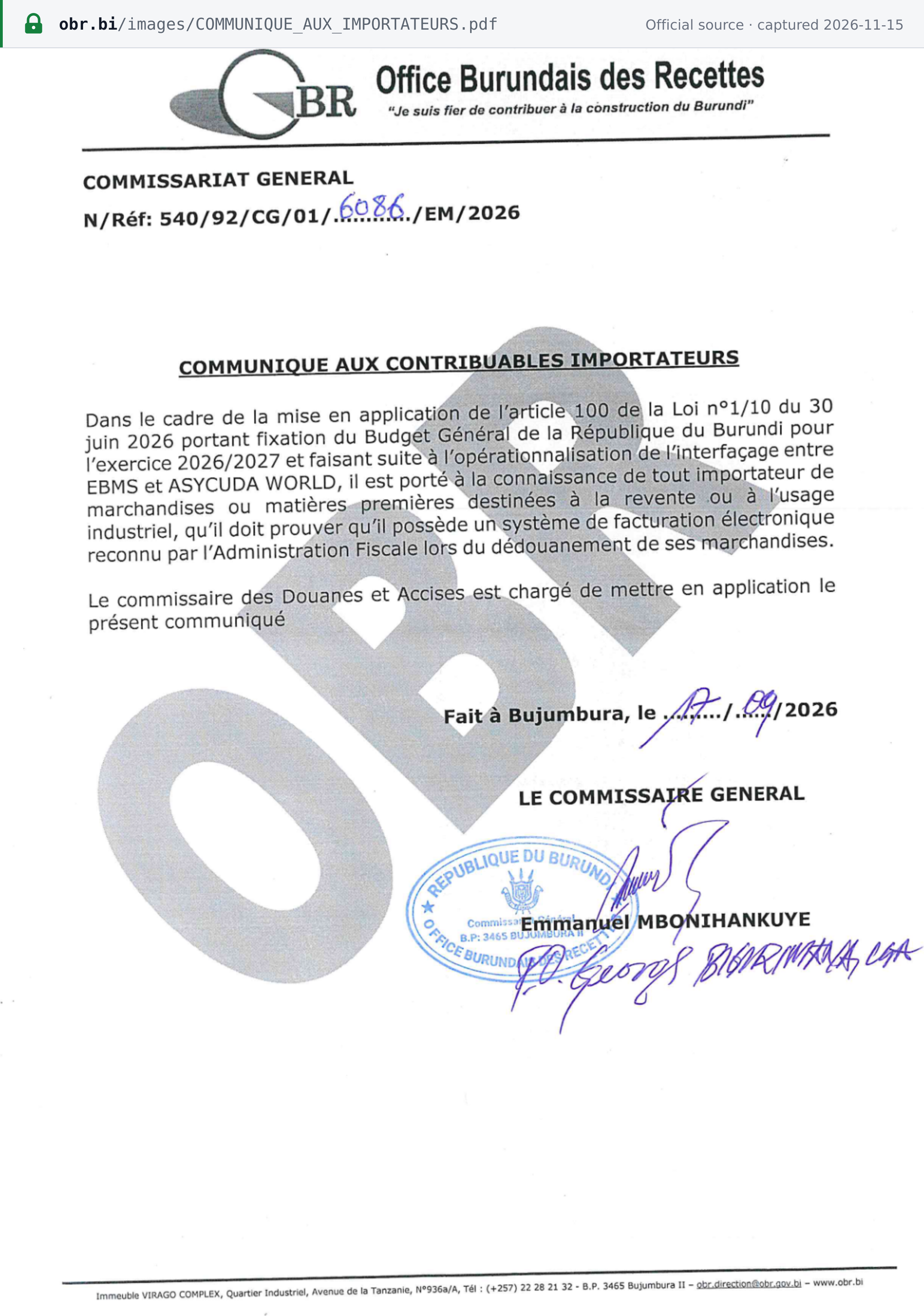
| 17 September 2026 | Importers | Proof of a recognised e-invoicing system demanded at customs clearance, following the EBMS–ASYCUDA World interface | OBR communiqué 540/92/CG/01/6086/EM/2026 | In force |
 Source snapshot captured 2026-11-15 — original
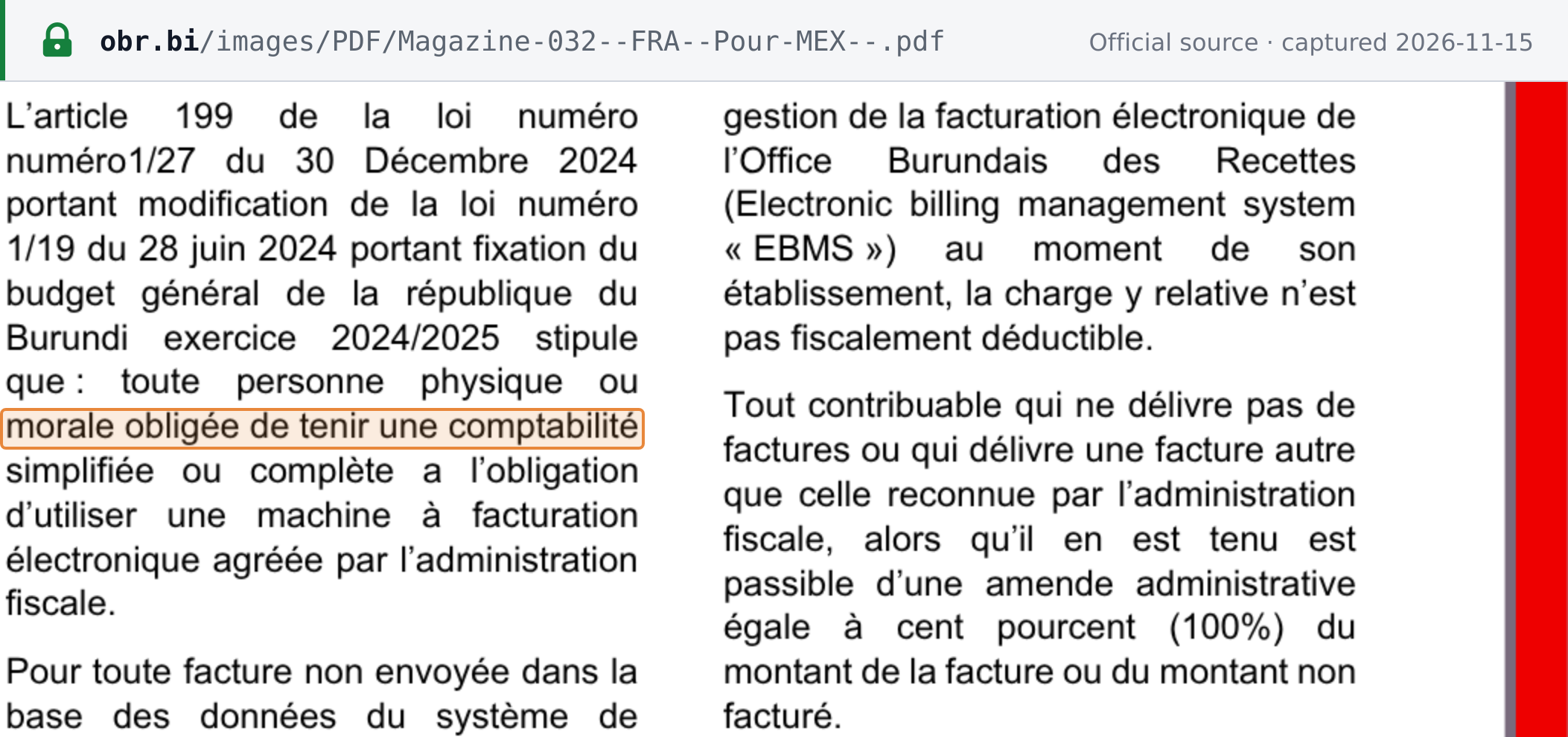
Since 2025 at the latest, not 1 July 2026. OBR's magazine La Voix du Contribuable N°032 (April 2025) quotes article 199 of Loi n°1/27 of 30 December 2024, which amended the 2024/2025 budget law: everyone keeping simplified or full accounts must use an approved machine, an expense on an invoice not sent to EBMS when issued is not deductible, and the 100% fine applies. The same issue quotes article 71 of that law: VAT is deductible or refundable only if it appears on an invoice sent to EBMS when issued. The rules were carried forward as articles 243 and 97 of Loi n°1/09 of 31 December 2025 (in force 1 January 2026 under its art. 252), and articles 268 and 99 of the Finance Law 2026/2027 repeat them; article 99 adds only the BIF 500,000 traceability sentence. [10] [10] [4] [5]
 Source snapshot captured 2026-11-15 — original
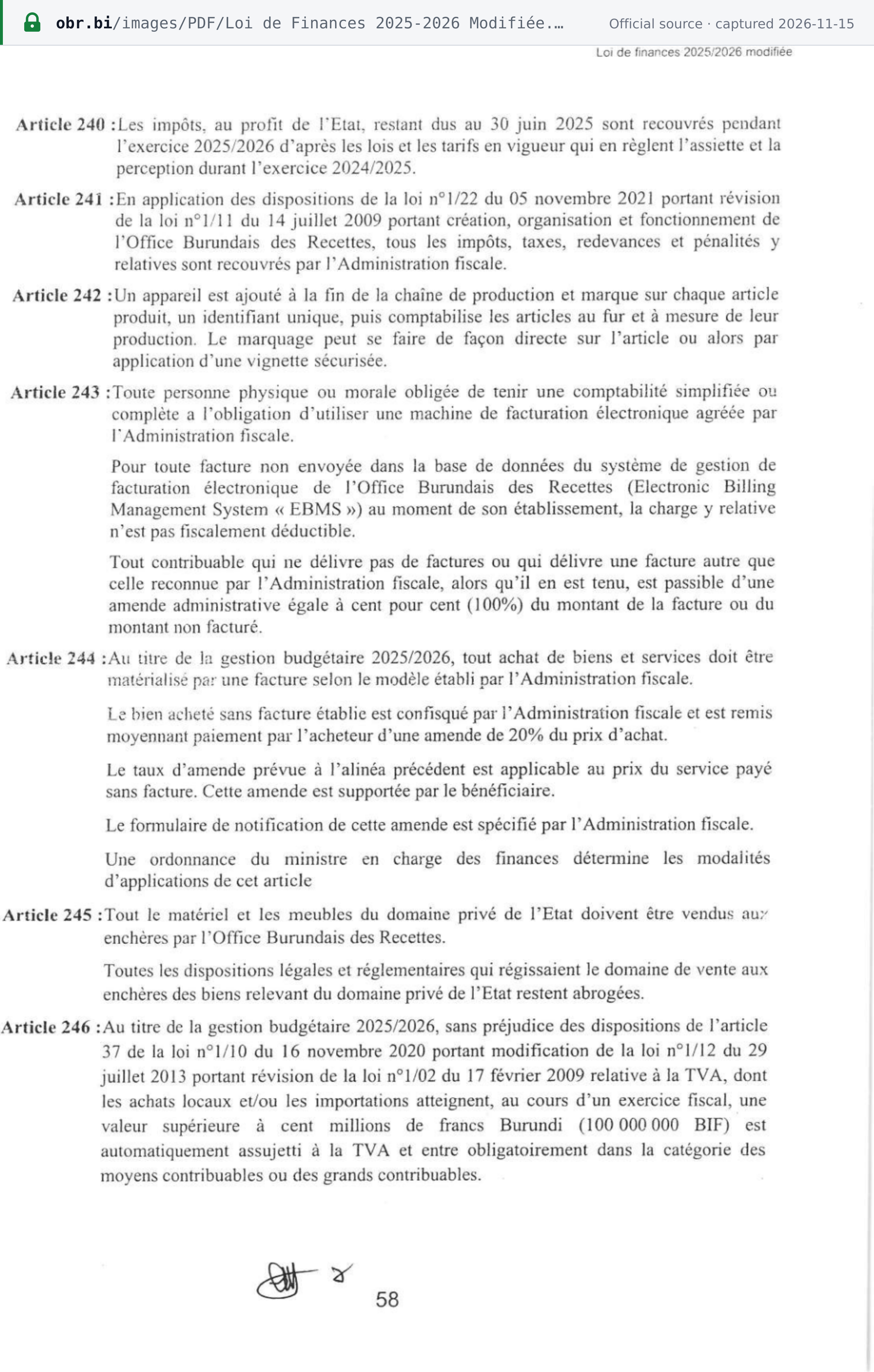
"Toute personne physique ou morale obligée de tenir une comptabilité simplifiée ou complète a l'obligation d'utiliser une machine de facturation électronique agréée par l'Administration fiscale. Pour toute facture non envoyée dans la base de données du système de gestion de facturation électronique de l'Office Burundais des Recettes (Electronic Billing Management System « EBMS ») au moment de son établissement, la charge y relative n'est pas fiscalement déductible." — Loi n°1/09 of 31 December 2025, art. 243
(Every natural or legal person required to keep simplified or full accounts must use an e-invoicing machine approved by the tax administration. For any invoice not sent to the EBMS database when it is drawn up, the related expense is not tax-deductible.)
 Source snapshot captured 2026-11-15 — original
An OBR news item of 18 September 2025 likewise called the machine "une obligation légale contenue dans l'article 234 de la loi budgétaire en cours". [7]
Latest announced step: importers at customs, 17 September 2026. OBR's communiqué to importing taxpayers applies Finance Law 2026/2027 art. 100 at the border: "il est porté à la connaissance de tout importateur de marchandises ou matières premières destinées à la revente ou à l'usage industriel, qu'il doit prouver qu'il possède un système de facturation électronique reconnu par l'Administration Fiscale lors du dédouanement de ses marchandises." (Every importer of goods or raw materials for resale or industrial use must prove, when clearing its goods through customs, that it has an e-invoicing system recognised by the tax administration.) The communiqué cites "l'opérationnalisation de l'interfaçage entre EBMS et ASYCUDA WORLD" and charges the Commissioner for Customs and Excise with enforcing it. [6]
 Source snapshot captured 2026-11-15 — original
Further phases. OBR's EBMS page and its communiqués list announce no further phase as at 15 November 2026. No pilot or voluntary phase is documented. [1]
Legal basis
| Instrument | Date / in force | What it does for e-invoicing |
|---|---|---|
| Loi n°1/10 of 16 November 2020 (VAT law), arts. 45, 47, 55–58 | Promulgated 16 November 2020; in force six months later | Approved machine for every VAT taxpayer and for fiscal representatives (art. 47); fines (arts. 55–58) |
| Ministerial order on obtaining and using the machine | 2022 | Required by VAT law art. 47. OBR's specification (p. 4) cites order n°540/48 of 24/01/2022 "portant détermination des conditions d'obtention et d'utilisation de la machine de facturation électronique"; OBR's EBMS page lists order n°540/1457 of 29/09/2022 on the same subject |
| Loi n°1/27 of 30 December 2024 (revised Finance Law 2024/2025), arts. 71, 199 | 2024/2025 budget year | Input VAT only on EBMS invoices (art. 71); machine for everyone keeping accounts, non-deductible expenses, 100% fine (art. 199) — text quoted in OBR's magazine N°032 |
| Loi n°1/09 of 31 December 2025 (Finance Law 2025/2026 as amended), arts. 97, 243, 244 | In force 1 January 2026 (art. 252) | Carries forward the EBMS rules: input VAT only on EBMS invoices (art. 97); machine for everyone keeping accounts, non-deductible expenses, 100% fine (art. 243); 20% fine for buying without an invoice (art. 244) |
| Loi n°1/10 of 30 June 2026 (Finance Law 2026/2027), arts. 99, 100, 200, 268, 269 | In force 1 July 2026 (art. 277) | Restates arts. 97, 243 and 244 (as arts. 99, 268, 269) and adds the BIF 500,000 traceability rule; importers (art. 100); public bodies with commercial revenue (art. 200) |
| OBR, Spécifications techniques de l'interfaçage avec EBMS, v0.7, ref. 540/92/CG/01/5846/EM/2026 | v0.7 dated 4 December 2025; signed 3 September 2026 | OBR's technical standard for connecting a taxpayer's own system to EBMS. An OBR document, not a legal instrument |
| OBR communiqué 540/92/CG/01/6086/EM/2026 | 17 September 2026 | Importers must prove a recognised e-invoicing system at customs clearance |
Both finance laws are promulgated Acts, signed by the President at Gitega (31 December 2025 and 30 June 2026). The articles on importers (art. 100) and public bodies (art. 200) are provisions of the 2026/2027 finance law for that budget year; each leaves their modalities to an order of the Finance Minister; none had been published on OBR's site as at 15 November 2026. [4] [5]
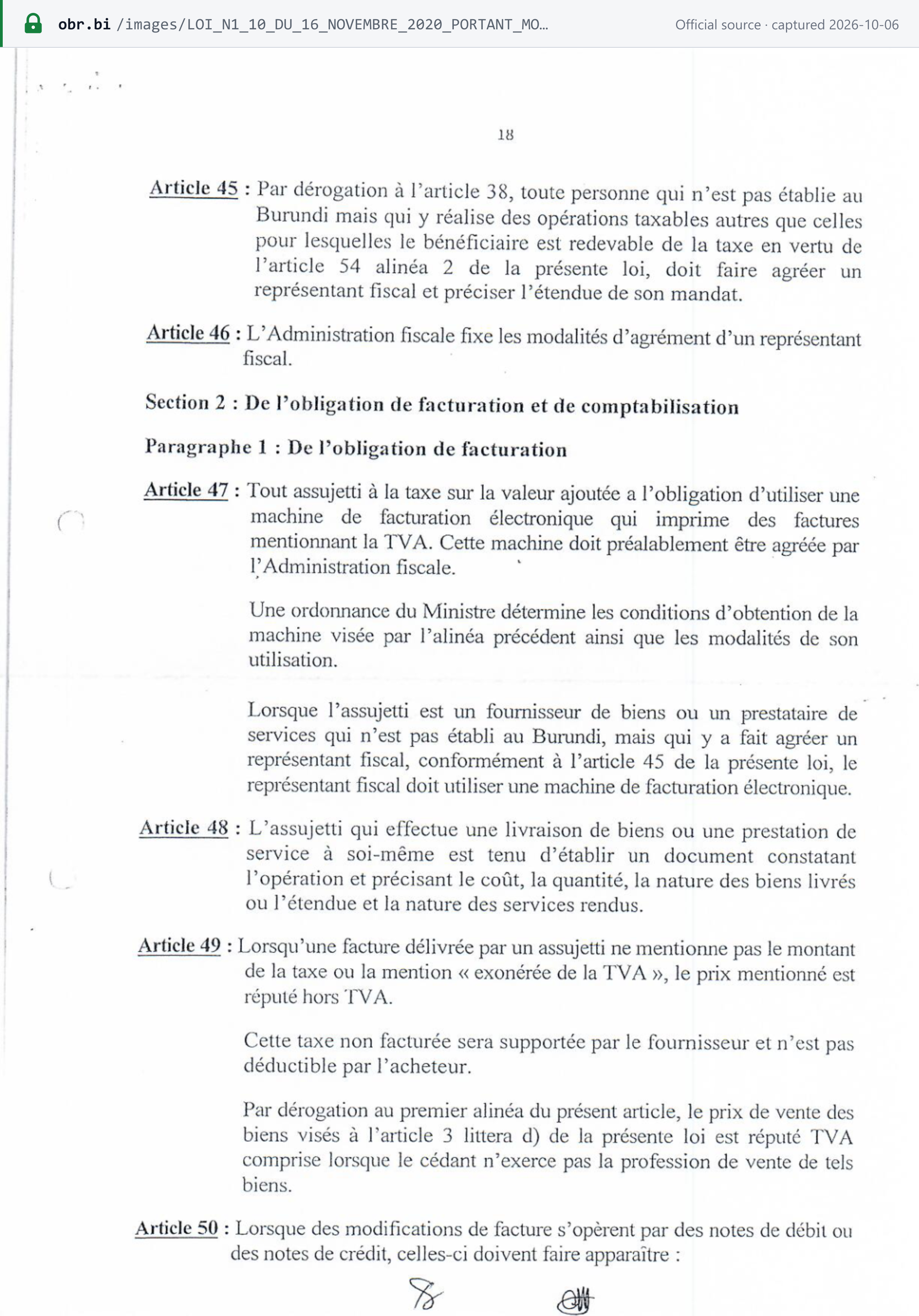
The base rule. VAT law art. 47: "Tout assujetti à la taxe sur la valeur ajoutée a l'obligation d'utiliser une machine de facturation électronique qui imprime des factures mentionnant la TVA. Cette machine doit préalablement être agréée par l'Administration fiscale." (Every VAT taxpayer must use an electronic invoicing machine that prints invoices showing VAT; the machine must first be approved by the tax administration.) [3]
 Source snapshot captured 2026-10-06 — original
Scope
Who. The duty attaches to the seller, not to the type of customer: every VAT taxpayer (VAT law art. 47) and, since 2025 at the latest, every natural or legal person required to keep simplified or full accounts (Loi n°1/27 art. 199; Loi n°1/09 art. 243; Finance Law 2026/2027 art. 268). [10] [3] [4] [5]
Micro-taxpayers. OBR's enforcement message of 18 September 2025 exempts them: "à l'exception des micro-contribuables, l'utilisation de la machine à facturation électronique constitue une obligation fiscale". The statute itself does not use the micro-taxpayer category; it keys on the duty to keep simplified or full accounts. [7]
B2B and B2C. Covered together, with no separate phases: every sale by a seller in scope goes through EBMS. In the specification the buyer's tax number (customer_TIN) is optional on an invoice ("Ce champ n'est pas obligatiore dans la fonction addInvoice mais si le NIF est fourni, il doit être valide"), so invoices to unregistered consumers are reported as well. [2]
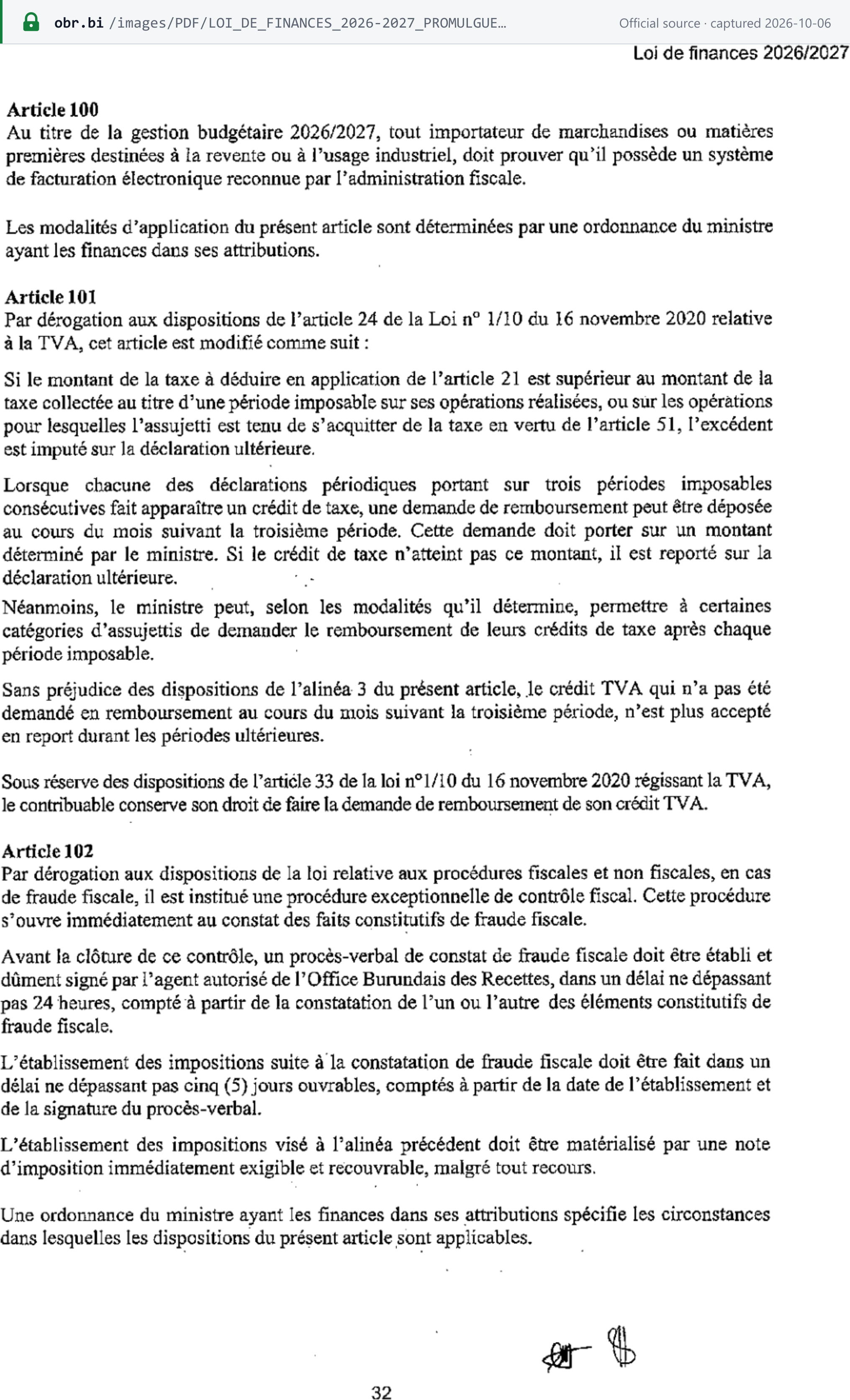
B2G. No separate platform. OBR told State services that manage public funds, at a meeting on 18 September 2025, that they must require an invoice issued by an e-invoicing machine from their suppliers of goods and services. VAT on supplies to the State falls due when the price is collected (Finance Law 2026/2027 art. 98). [7] [5]
Public bodies as sellers (from 1 July 2026). Finance Law 2026/2027 art. 200, a provision for the 2026/2027 budget year: "les corps de défense et de sécurité, l'administration pénitentiaire et les autres services publics qui réalisent des revenus provenant des opérations à caractère industriel, commercial et/ou agricole, doivent être immatriculés et utiliser un système de facturation électronique reconnu par l'administration fiscale." (Defence and security corps, the prison administration and other public services earning revenue from industrial, commercial or agricultural operations must register and use a recognised e-invoicing system.) [5]
Non-established businesses. In scope through a fiscal representative. A person not established in Burundi that makes taxable supplies there (other than those on which the customer accounts for the VAT under the reverse charge) must have a fiscal representative approved (VAT law art. 45), and "le représentant fiscal doit utiliser une machine de facturation électronique" (art. 47). See reverse charge for supplies where the customer accounts for the VAT. [3]
Importers. Covered: art. 100 of the Finance Law 2026/2027 (for the 2026/2027 budget year) and OBR's communiqué of 17 September 2026 (see the timeline). Imported goods must be entered into EBMS stock before they are sold (see Format & network). [5] [6]
 Source snapshot captured 2026-10-06 — original
Simplified invoices. Not applicable: neither the VAT law, the finance laws nor OBR's specification provides a value threshold below which a simplified or non-EBMS receipt is allowed. OBR's official invoice model only tells sellers not registered for VAT to leave the last two lines blank ("Les non assujettis à la TVA ne remplissent pas les deux dernières lignes"). [9]
Format & network
The model: real-time reporting with a signed acknowledgement. OBR's specification (p. 4): "L'envoi des factures doit se faire en temps réel. C'est-à-dire, qu'à chaque fois qu'une facture est émise dans le système client (le système du contribuable) pour impression, une copie de la même facture doit être envoyée via les services web à l'administration fiscale. En cas d'échec, pour une raison ou une autre, le système doit l'enregistrer et continuer à essayer de la renvoyer jusqu'à ce que la facture soit bien reçue par l'administration fiscale." (Each time an invoice is issued for printing, a copy must be sent through the web services to the tax administration; on failure, the system must store it and keep retrying until it is received.) EBMS receives and registers invoices; OBR's specification describes no approval step before an invoice is issued, so this is reporting, not clearance. See CTC e-invoicing models. [2]
 Source snapshot captured 2026-11-15 — original
Technical format: JSON over REST. "Les services Web utilisent la technologie REST. Toutes les méthodes présentées dans ce document envoient les informations avec la méthode POST" (p. 4), and "Toutes les demandes et réponses sont au format JSON" (p. 10). The methods sit under https://ebms.obr.gov.bi:9443/ebms_api/: [2]
| Method | What it does |
|---|---|
login | Returns the token every other call must carry |
addInvoice_confirm | Adds an invoice and returns OBR's acknowledgement; replaces the older addInvoice, which had no acknowledgement |
getInvoice | Returns an invoice's details |
checkTIN | Checks whether a tax number (NIF) is valid |
cancelInvoice | Cancels an invoice |
AddStockMovement | Reports stock movements, including local purchases |
AddStockMovementImporters | Enters imported goods into stock before sale |
getDmcItems | Looks up the items of a customs declaration (DMC) |
The specification names no UBL, CII or other XML standard, and EBMS is not Peppol-based: there is no exchange network between businesses. The seller prints or hands over the invoice; OBR holds the reported copy. [2]
Acknowledgement and signature. "Lorsqu'une facture arrive dans le système Ebms, ce dernier génère un message de confirmation et une signature électronique." The taxpayer's system must store both as its acknowledgement of receipt. The result field (invoice number, OBR reference number, registration date and time) is hashed with SHA-256, encrypted with RSA using OBR's private key, base64-encoded and returned in electronic_signature. "Cette signature servira de preuve que la facture envoyée a bien été reçue par l'OBR." If it does not arrive, the taxpayer's system must resend the invoice automatically. [2]
Invoice identifier. Each invoice carries, printed in clear before printing, an identifier generated by the taxpayer's system in the form <NIF>/<system identifier>/<date and time of invoicing>/<invoice number> (invoice_identifier, up to 90 characters). [2]
QR codes. The specification pages on invoice data, the acknowledgement and printing (pp. 4–13) mention no QR code, and neither finance law nor the VAT law requires one. The integrity mechanics are the printed identifier and OBR's signed acknowledgement.
Document types, numbering and corrections. [2] [2] [2]
- Types: FN (facture normale, a sale invoice), FA (facture d'avoir, a credit note), RC (remboursement caution, a deposit refund) and RHF (réduction hors facture, a reduction granted after the sale; listed in the field definitions, p. 10).
- Numbering is free-format, at most 30 characters (p. 5), but (p. 6) "Chaque type de facture ou document doit avoir une numérotation différente des autres types de facture et constituée d'une séquence de chiffre suivant un ordre chronologique, continue et sans rupture."
- A cancelled invoice is not deleted: a replacement invoice references it in
cancelled_invoice_ref, orcancelInvoicecancels it outright. - A credit note states its reason in
cn_motifand the original invoice ininvoice_ref, and "Le montant de la facture d'avoir ne doit pas être supérieur au montant de la facture dont il fait objet."
Currency. invoice_currency accepts "BIF", "USD" or "EUR"; if nothing is sent EBMS assumes BIF. [2]
Stock reporting alongside invoicing. Taxpayers' systems must send stock data each time there is a stock movement. Entries and exits are coded (normal entries EN, returns ER, inventory EI, normal sales SN, losses SP, theft SV and others). Importers must enter imported goods through AddStockMovementImporters before selling them, and local purchases go through AddStockMovement. The VAT law separately makes issuing an invoice with no stock a criminal matter (art. 58). [2] [3]
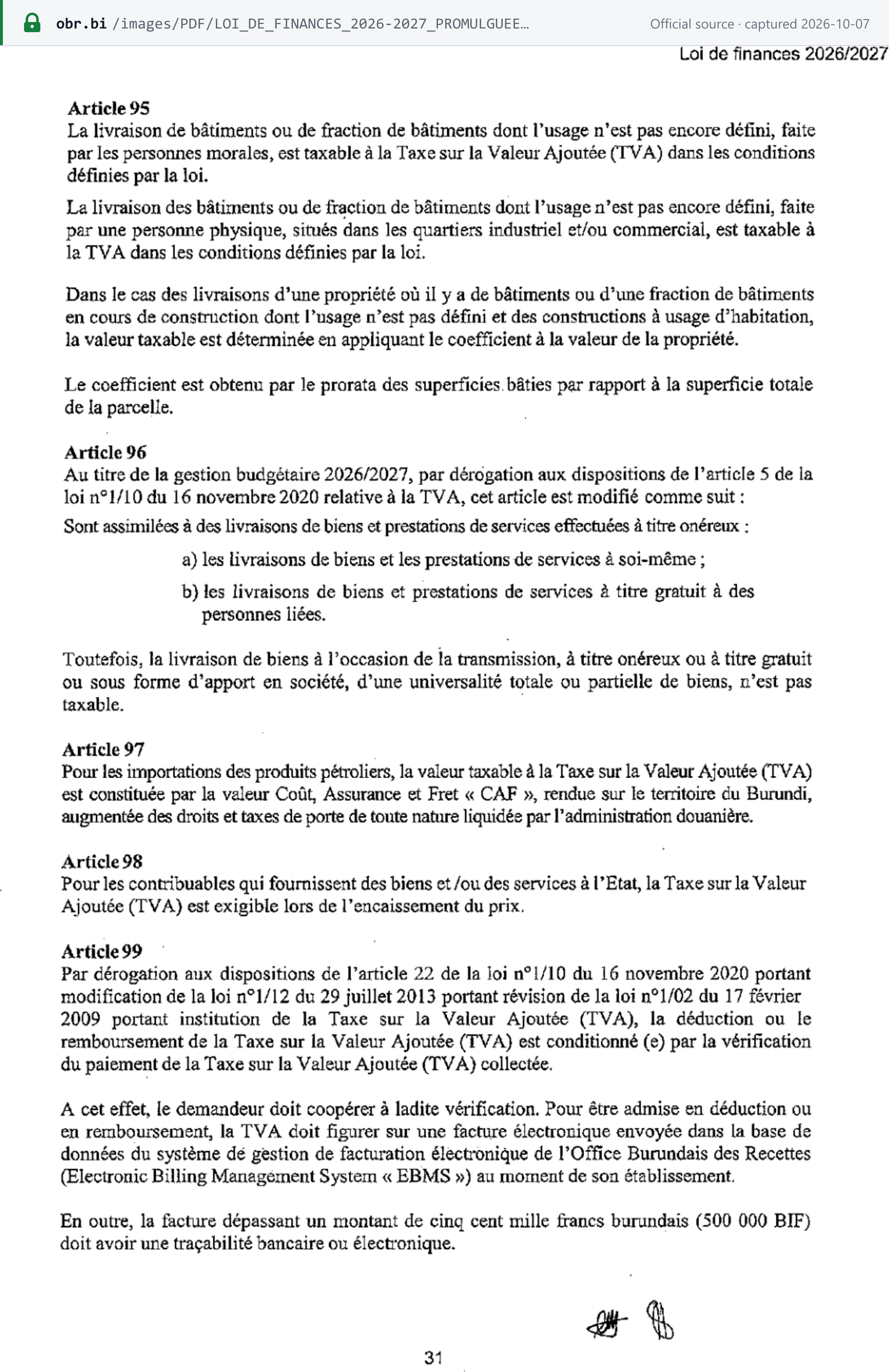
Input VAT depends on EBMS. Finance Law 2026/2027 art. 99: "Pour être admise en déduction ou en remboursement, la TVA doit figurer sur une facture électronique envoyée dans la base de données du système de gestion de facturation électronique de l'Office Burundais des Recettes (Electronic Billing Management System « EBMS ») au moment de son établissement. En outre, la facture dépassant un montant de cinq cent mille francs burundais (500 000 BIF) doit avoir une traçabilité bancaire ou électronique." The first sentence has applied since 2025 at the latest (Loi n°1/27 of 30 December 2024 art. 71, then art. 97 of the amended Finance Law 2025/2026); the BIF 500,000 sentence applies from 1 July 2026. [5] [4] [10]
 Source snapshot captured 2026-10-07 — original
Onboarding: how to comply
Two routes. Buy an OBR-approved electronic invoicing machine, or connect your own invoicing system to EBMS through OBR's web services. [2]
Connecting your own system.
- Credentials. Every call carries a token obtained from
loginwith an identifier and password "fournis par l'administration fiscale. Ces identifiants sont obtenus auprès de la direction où le contribuable est géré" — the large-, medium- or small-and-micro-taxpayer office (DGC, DMC or DPMC). - Testing. The links in the specification point to OBR's test servers.
- Production. "Les liens vers le serveur de production vous seront communiqué si les tests sont concluants et un autre identifiant et un mot de passe vous seront fournis".
- Stock. Set up stock reporting, and for importers the imported-stock method, before going live (see above).
Software vendors. OBR's communiqué on approval of e-invoicing software tells suppliers of e-invoicing software that "ils sont tenus de les faire agréer" with the tax administration "afin d'obtenir une attestation de conformité". OBR publishes no list of approved machines or software, no approval term and no rule on withdrawal of approval (as at 15 November 2026). [8]
Machine breakdowns. Report a malfunction to the tax administration within three working days (VAT law art. 58). [3]
Penalties
| Breach | Consequence | Article |
|---|---|---|
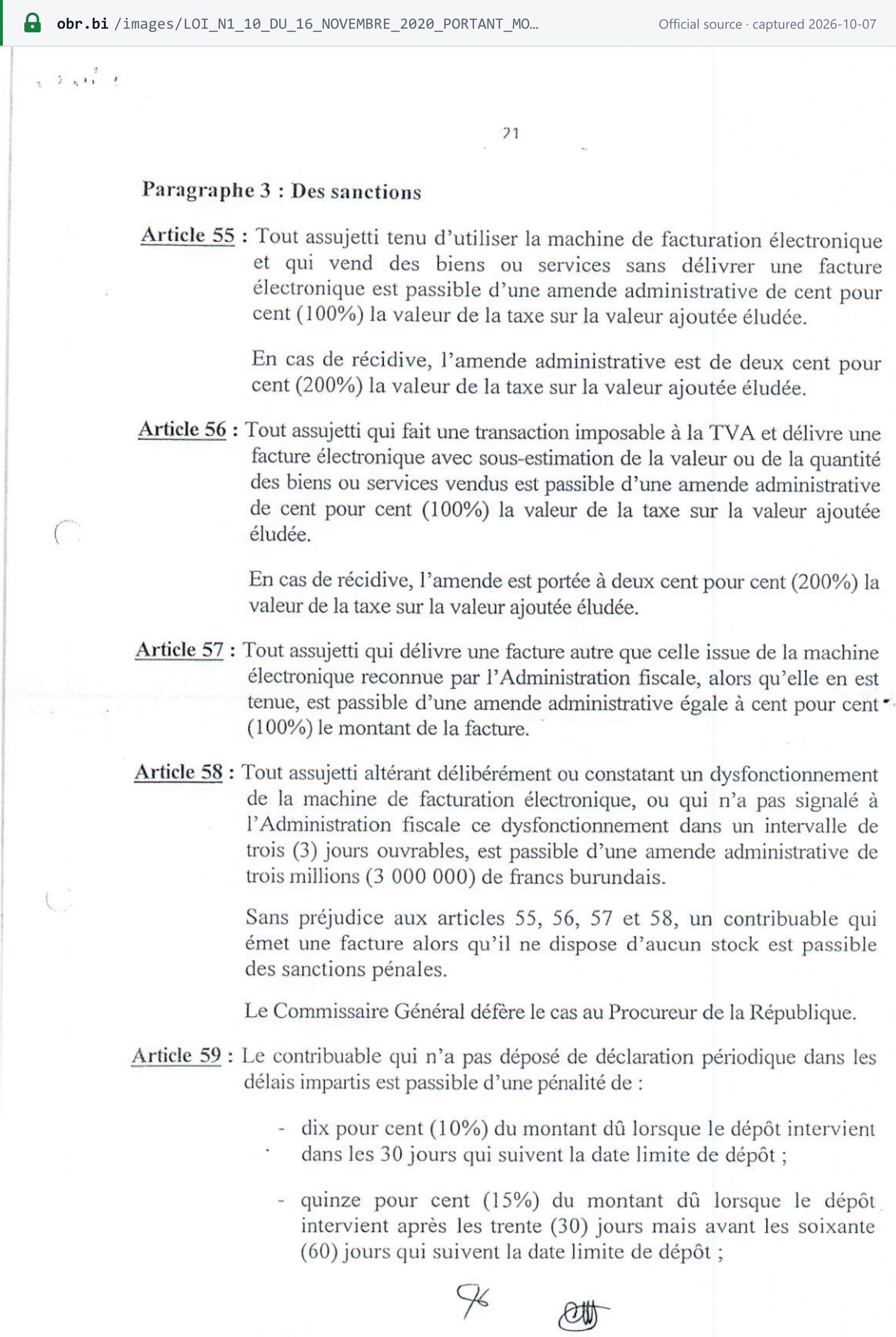
| A taxpayer required to use the machine sells without issuing an e-invoice | 100% of the VAT evaded; 200% on a repeat | VAT law art. 55 |
| E-invoice understating value or quantity | 100% of the VAT evaded; 200% on a repeat | VAT law art. 56 |
| Invoice not issued from the recognised machine | 100% of the invoice amount | VAT law art. 57 |
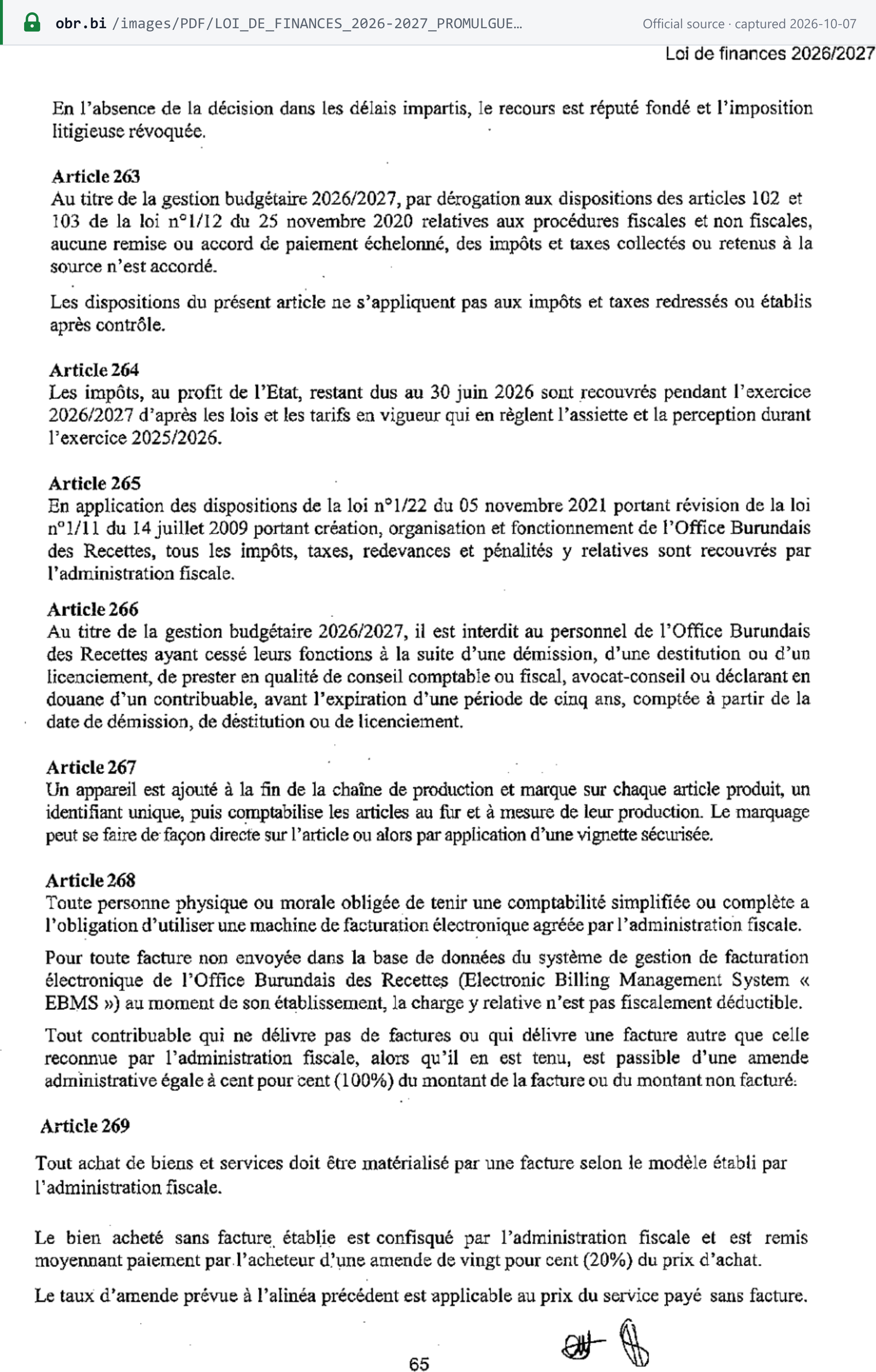
| Not issuing invoices, or issuing a non-recognised invoice (anyone keeping accounts) | 100% of the invoice or uninvoiced amount | Loi n°1/09 art. 243; Finance Law 2026/2027 art. 268 |
| Deliberately altering the machine, or not reporting a malfunction within three working days | BIF 3,000,000; an invoice issued with no stock leads to criminal sanctions and referral to the public prosecutor | VAT law art. 58 |
| Expense on an invoice not sent to EBMS when issued | Not tax-deductible | Loi n°1/09 art. 243; Finance Law 2026/2027 art. 268 |
| VAT on an invoice not sent to EBMS, or on an invoice above BIF 500,000 without bank or electronic traceability (from 1 July 2026) | Not deductible or refundable | Loi n°1/09 art. 97; Finance Law 2026/2027 art. 99 |
| Buying goods or services without an invoice (buyer) | Goods confiscated and returned on payment of a 20% fine on the purchase price; 20% of the price of a service | Loi n°1/09 art. 244; Finance Law 2026/2027 art. 269 |
 Source snapshot captured 2026-10-07 — original
 Source snapshot captured 2026-10-07 — original
Enforcement posture, dated. On 18 September 2025 OBR told officials managing public funds who had accepted or paid non-electronic invoices before learning of the rule to consult the tax administration, and promised awareness sessions. No formal grace period has been announced. Since 17 September 2026, customs checks importers' e-invoicing systems at clearance. [7] [6]
Frequently asked questions
Our supplier's invoice never reached EBMS. Can we still deduct the VAT?
No. VAT is deductible or refundable only if it appears on an invoice sent to EBMS when the invoice was drawn up (Finance Law 2026/2027 art. 99; the same rule has applied since 2025 at the latest, under Loi n°1/27 of 30 December 2024 art. 71). The related expense is not tax-deductible either (art. 268). An EBMS invoice carries a printed identifier of the form NIF/system identifier/date and time/invoice number. [5] [4]
Did the EBMS deduction rule start on 1 July 2026?
No. The rule that input VAT is deductible only on invoices sent to EBMS, and the duty for everyone keeping simplified or full accounts to use an approved machine, have applied since 2025 at the latest: OBR's magazine of April 2025 quotes them as articles 71 and 199 of Loi n°1/27 of 30 December 2024, and Loi n°1/09 of 31 December 2025 carried them forward (arts. 97 and 243). The Finance Law 2026/2027 restated both from 1 July 2026 and added one new rule: an invoice above BIF 500,000 needs bank or electronic traceability for its VAT to be deductible. [10] [10] [4] [5]
Customs is asking for our e-invoicing system. What do they need?
Since OBR's communiqué of 17 September 2026, every importer of goods or raw materials for resale or industrial use must prove at customs clearance that it has an e-invoicing system recognised by the tax administration (Finance Law 2026/2027 art. 100). Imported goods must also be entered into EBMS stock before they are sold, through the imported-stock method in OBR's interfacing specification. [6] [2]
Can we invoice in US dollars or euros through EBMS?
EBMS accepts BIF, USD or EUR in the invoice currency field and assumes BIF when none is given (OBR interfacing specification v0.7). [2]
How do we correct an invoice already sent to EBMS?
Never delete it. Issue a replacement invoice that references the cancelled one, cancel it with the cancellation method, or issue a credit note (type FA) stating the reason and the original invoice number; a credit note may not exceed the original invoice. Each document type has its own continuous number sequence. [2]
Our e-invoicing machine has broken down. What must we do?
Report the malfunction to the tax administration within three working days; failing to do so, or deliberately altering the machine, is fined BIF 3,000,000 (VAT law art. 58). [3]
We are a foreign company making taxable supplies in Burundi. Do we need an e-invoicing machine?
Your fiscal representative does. A non-established person making taxable supplies in Burundi, other than those on which the customer accounts for the VAT, must have a fiscal representative approved (VAT law art. 45), and that representative must use an electronic invoicing machine (art. 47). [3]
Recent changes
- 2026-09-17 — OBR requires importers to prove a recognised e-invoicing system at customs clearance, following the EBMS–ASYCUDA World interface (communiqué 540/92/CG/01/6086/EM/2026). (OBR)
- 2026-09-03 — OBR signs version 0.7 of its EBMS interfacing specification (ref. 540/92/CG/01/5846/EM/2026), with the new imported-stock method. (OBR)
- 2026-07-01 — Finance Law 2026/2027 restates the EBMS-only input-VAT rule and the machine duty, adds bank or electronic traceability for invoices above BIF 500,000 (art. 99), and requires importers (art. 100) and public bodies with commercial revenue (art. 200) to have a recognised e-invoicing system. (OBR) — see event
Related resources
- Burundi VAT guide — rates, registration, invoice requirements, filing
- Burundi tax identification number (NIF) — the number EBMS's
checkTINvalidates - E-invoicing status and networks by country
- CTC e-invoicing models explained
- Fiscal devices and certified cash registers
- Burundi tax changes on Lookuptax
Important websites
- OBR — Système de facturation électronique (EBMS) — legal provisions, connection guide, communiqués
- EBMS interfacing specification v0.7 (PDF)
- OBR official VAT invoice model (PDF, French) and Kirundi version (PDF)
- OBR — laws and regulations
Reference links
- OBR — Système de facturation électronique, EBMS
- OBR — Spécifications techniques de l'interfaçage avec EBMS, v0.7, ref. 540/92/CG/01/5846/EM/2026 (PDF)
- Loi n°1/10 of 16 November 2020 on VAT (PDF)
- Loi n°1/09 of 31 December 2025 — Finance Law 2025/2026 as amended (PDF)
- Loi n°1/10 of 30 June 2026 — Finance Law 2026/2027 (PDF)
- OBR — Communiqué aux contribuables importateurs, 17 September 2026 (PDF)
- OBR — news of the meeting of 18 September 2025 on e-invoicing-machine invoices for public-fund managers
- OBR — Communiqué on approval of e-invoicing software
- OBR — Format Facture TVA (official invoice model, PDF)
- OBR — La Voix du Contribuable, magazine N°032, April 2025 (PDF)