E-invoicing in Uganda: EFRIS
Overview
Uganda's e-invoicing system is EFRIS — the Electronic Fiscal Receipting and Invoicing Solution, run by the Uganda Revenue Authority (URA). URA: "EFRIS stands for “Electronic Fiscal Receipting and Invoicing Solution” . It is a smart business solution that enables businesses to record transactions and share transaction information with the Uganda Revenue Authority in real time." [1]
Legal basis in one line. URA: "Is EFRIS supported by the law? Yes, Sections 92 and 93 of the Tax Procedures Code Act Cap 343." Section 92 (s.73A in the 2014 numbering) lets the Commissioner designate, by notice in the Gazette, the taxpayers who must issue e-invoices or e-receipts; section 93 sets the penal tax. The mechanics are in the Tax Procedures Code (E-invoicing and E-receipting) Regulations, 2020. [1] [4]
| Uganda | |
|---|---|
| System | EFRIS (Electronic Fiscal Receipting and Invoicing Solution), URA |
| Model | Real-time fiscalisation: each sale is sent to the EFRIS server, which adds a Fiscal Document Number (FDN), verification code and QR code and returns it before the document is issued |
| VAT-registered taxpayers | Mandatory since 1 January 2021 (all transactions, in real time) |
| Non-VAT businesses | Mandatory in 12 designated sectors from 1 July 2025, gazetted under s.92(2) according to URA; carve-outs below UGX 10,000,000 turnover and UGX 2,820,000 rental income |
| B2B / B2C / B2G | One obligation covering "all business transactions"; no separate B2G platform |
| Non-residents | Non-resident digital service providers liable to digital service tax are excluded; URA says nothing about other non-residents |
| Format | URA's own system-to-system API; no UBL, CII or Peppol requirement published |
| Channels | EFRIS app, desktop client, web portal, electronic fiscal device (EFD), system-to-system API, electronic dispenser controller (fuel) |
| Penalty | Penal tax of double the tax due or 10 currency points (UGX 200,000), whichever is higher, as applied by URA from 1 July 2026 |
| Authority | Uganda Revenue Authority |
For the VAT rate, registration threshold and the general invoice rules, see the Uganda VAT guide.
URA describes why it introduced EFRIS: to address "Inability to keep accurate and reliable business records", mis-declaration of transactions, "Failure by businesses to correctly declare VAT collected from customers to URA", failure to issue receipts or invoices, and "False refunds for input tax and wrong offset positions." [1]
Mandate status & timeline
Status (as at 20 November 2026): mandatory and in force for all VAT-registered taxpayers since 1 January 2021, and for businesses in 12 designated sectors, whether VAT-registered or not, under a URA notice that states an effective date of 1 July 2025.
| # | Scope | Obligation | Date | Instrument | State |
|---|---|---|---|---|---|
| — | Enabling power | Commissioner designates mandatory users by Gazette notice | — | Tax Procedures Code Act s.73A (now Cap. 343 s.92) | In force |
| — | Mechanics | Issuance channels, fiscal devices, manual fallback, reports | Made 22 June 2020; Gazette 23 June 2020 | E-invoicing and E-receipting Regulations, 2020 (S.I. 2020 No. 82) | In force |
| 1 | All VAT-registered taxpayers | Issue e-invoices/e-receipts "for all transactions in real time" | 1 January 2021; enforcement from 20 September 2021 | s.73A and Gazette General Notice No. 595 of 2020, as cited by URA | Passed — in force |
| 2 | Businesses in 12 designated sectors, VAT-registered or not | Issue e-invoices/e-receipts through EFRIS | 1 July 2025 | Designation under TPC s.92(2), as described by URA; URA public notice "Additional taxpayers required to use EFRIS" | Passed — in force |
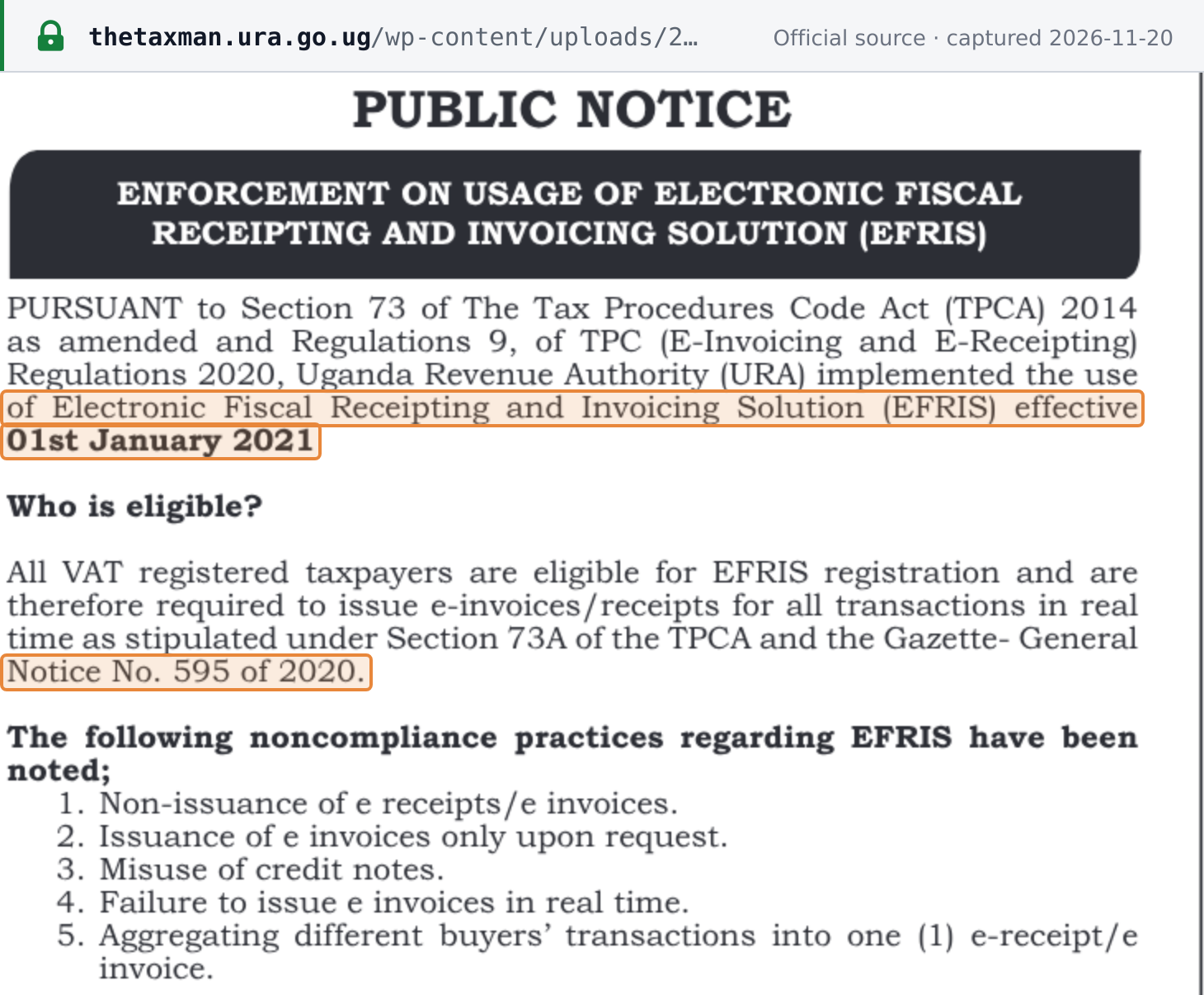
Phase 1: VAT-registered taxpayers, 1 January 2021. URA's public notice on enforcement: "Uganda Revenue Authority (URA) implemented the use of Electronic Fiscal Receipting and Invoicing Solution (EFRIS) effective 01st January 2021" … "All VAT registered taxpayers are eligible for EFRIS registration and are therefore required to issue e-invoices/receipts for all transactions in real time as stipulated under Section 73A of the TPCA and the Gazette- General Notice No. 595 of 2020." The same notice announced that "with effect from 20th September 2021, URA shall commence enforcement operations across all regions in the country". The Gazette text of General Notice No. 595 of 2020 is not available online; the citation is URA's. [3]
 Source snapshot captured 2026-11-20 — original
Phase 2 (the latest announced): 12 designated sectors, stated as effective 1 July 2025. URA's notice: "Uganda Revenue Authority (URA) wishes to inform the general public that, effective July 1st 2025, businesses operating in the sectors listed below are required to use the Electronic Fiscal Receipting and Invoicing Solution (EFRIS) to issue electronic invoices and electronic receipts. This requirement is in addition to the existing mandatory EFRIS obligation for all VAT registered taxpayers." URA's newsletter for July–September 2026 refers to "the twelve newly gazetted sectors" and says: "This obligation is in accordance with section 92(2) of the Tax Procedures Code Act, Cap 343." URA's EFRIS page states the general rule that "A taxpayer specified in the gazette is mandated to issue e-receipts or e-invoices for each transaction." The version of the notice now posted on URA's website is dated 10 August 2026 ("First date of publication: Monday August 10, 2026"). That date is not when the duty was announced: Parliament's Finance Committee report on the Tax Procedures Code (Amendment) Bill 2026, dated April 2026, already records that "EFRIS has now been extended to businesses that are not VAT registered". The sectors and carve-outs are under Scope. [2] [19] [1] [17]
 Source snapshot captured 2026-09-07 — original
Further phases. None announced. The notice excludes passenger land transport "For this phase of EFRIS rollout", which leaves room for later phases without scheduling one. [2]
Pilot or voluntary phase. Voluntary use is open to anyone outside the mandate: "other non-VAT registered taxpayers and non-designated economic sectors can also voluntarily use EFRIS." URA publishes no pilot window. [1]
Postponements. None published by URA. In May 2024 URA waived EFRIS penalties for traders new to the system after a presidential directive of 7 May 2024; the mandate itself was not suspended (see Penalties). [15]
Legal basis
| Instrument | Date / publication | What it does |
|---|---|---|
| Tax Procedures Code Act, Cap. 343, s.92 (s.73A of the 2014 Act) | In URA's consolidated text to July 2021 | Anyone may issue e-invoices or e-receipts or use an EFD; the Commissioner "shall, by notice in the Gazette, specify taxpayers for whom it shall be mandatory"; a specified taxpayer issues them "in all business transactions" |
| Tax Procedures Code Act, Cap. 343, s.93 (s.73B of the 2014 Act) | As amended in 2025 and 2026 (below) | Penal tax for not using an EFD, not issuing an e-invoice/e-receipt, or tampering |
| Tax Procedures Code (E-invoicing and E-receipting) Regulations, 2020 — S.I. 2020 No. 82 | Made 22 June 2020 under TPC s.75; Statutory Instruments Supplement No. 23 to Uganda Gazette No. 38, Vol. CXIII, 23 June 2020 | The "System"; issuance methods (reg. 4); fiscal devices from accredited suppliers (reg. 5); manual receipts (reg. 6); electronic dispenser controllers (reg. 7); taxpayer obligations (reg. 9); Z daily and price look-up reports (reg. 10) |
| Gazette General Notice No. 595 of 2020 | Cited by URA; text not published online | Designation of VAT-registered taxpayers from 1 January 2021 |
| Gazette designation of the 12 sectors under TPC s.92(2) | Effective 1 July 2025; Gazette notice number not cited by URA | 12 sectors, VAT-registered or not (URA describes them as "newly gazetted") |
| URA notice "Additional taxpayers required to use EFRIS" | Posted version dated 10 August 2026 | Restates the 12 sectors effective 1 July 2025; carve-outs; buyer ID on business e-documents |
| Tax Procedures Code (Amendment) Act, 2025 (Act 11 of 2025), s.4 | Assented 30 June 2025; commenced 1 July 2025 | s.93 penal tax becomes "double the tax due on the goods or services", removing the 400 and 300 currency-point alternatives |
| Tax Procedures Code (Amendment) Bill, 2026 (Bill No. 5), cl.4 | Passed by Parliament 21 April 2026; commencement clause 1 July 2026; assent not shown on the Parliament's Bill Tracker | s.93 penal tax becomes "double the tax due on the goods or services or ten currency points whichever is higher" |
| Value Added Tax (Amendment) Bill, 2026 (Bill No. 8), cl.2 and cl.7 | Passed by Parliament 21 April 2026; commencement clause 1 July 2026; assent not shown on the Bill Tracker | As introduced: no VAT withholding where the withholding agent is issued an e-invoice or e-receipt; e-receipt refund threshold cut from five million to two million shillings |
| Income Tax Act Cap. 338, s.22(3)(m), as cited by URA (s.22(2)(n) in URA's 2021 consolidation) | In force | No deduction for an expense bought from a designated supplier unless supported by e-invoices or e-receipts |
| VAT Act s.28(4a) (URA's 2021 consolidation numbering) | In force | Input credit on purchases from a designated supplier only where supported by e-invoices or e-receipts |
The designation power. The consolidated s.73A(2): "The Commissioner shall, by notice in the Gazette, specify taxpayers for whom it shall be mandatory to issue e-invoices or e-receipts or employ electronic fiscal devices which shall be linked to the centralised invoicing and receipting system or devices authenticated by the Uganda Revenue Authority." Subsection (3): "A taxpayer specified by the Commissioner under subsection (2), shall issue electronic invoices or e- receipts or employ an electronic fiscal device in all business transactions." [4]
The 2026 Bills. The Parliament of Uganda's Bill Tracker shows both Bills at third reading on 21 April 2026, with the "Presentation/Waiting Assent" and "Assented by President" stages blank. URA already applies the 10-currency-point penalty on its EFRIS page. URA's EFRIS page does not mention the VAT-withholding or refund-threshold changes. [7] [9] [1]
Technical standards. No technical standard is named in the law. Integrators are tested against URA's "EFRIS Interface User Requirements Specifications (Business Requirements) v1.5", which URA references but does not publish on its website. [13]
Scope
Who must use EFRIS. URA: "All VAT-registered businesses and other businesses which operate in specific designated sectors (( Whether VAT registered or not ) are required to use the Electronic Fiscal Receipting and Invoicing Solution (EFRIS)." [1]
 Source snapshot captured 2026-10-06 — original
The 12 designated sectors (headings from URA's notice): 1) Manufacturing; 2) Mining and Quarrying; 3) Water supply; sewerage, waste management and remediation activities; 4) Electricity, Gas, Steam and Air Conditioning Supply; 5) Construction; 6) Transportation and storage; 7) Accommodation and Food Service Activities; 8) Information Technology and Communication; 9) Real Estate Activities; 10) Professional, Scientific and Technical Activities; 11) Arts, Entertainment and Recreation; 12) Wholesale and Retail of Fuel ("All fuel stations supplying kerosene and/or automotive fuels"). [2]
Carve-outs and exclusions. The notice: persons in these categories "are not required to issue e-invoices or e-receipts through EFRIS for their business transactions, but they may do so voluntarily: – a) Small businesses in the above listed sectors with sales value (turnover) of less than UGX 10,000,000 per year; b) Taxpayers earning rental income less than UGX 2,820,000 annually". Excluded: "For this phase of EFRIS rollout, all providers of passenger land transport are not mandated to use EFRIS. These include; taxis, boda-bodas, shuttles, buses, and other land transport means for passengers." And: "All non-resident digital service providers who are required to pay digital service tax, are not mandated to use EFRIS." URA's EFRIS page repeats the two exclusions but not the UGX 10,000,000 and UGX 2,820,000 floors, which appear only in the notice. [2]
B2B, B2C and B2G. One obligation covers all three: a designated taxpayer issues through EFRIS "in all business transactions" (s.73A(3)). URA's integration readiness checklist asks whether the software caters for "Business to Consumer (B2C), Business to Government (B2G) and Business to Business (B2B)" and validates "the buyers’ TIN for B2B and B2G transactions". URA's EFRIS pages describe no separate B2G platform or network. [4] [13]
Buyer identification. URA's notice: "All e-invoices or e-receipts issued for business purposes should bear the buyer’s Business Registration Number (BRN), National Identification Number (NIN) or Taxpayer Identification Number (TIN)." See the Uganda TIN guide. [2]
Non-established businesses. Non-resident digital service providers liable to digital service tax are expressly out of scope. URA's EFRIS page, its sector notice and its EFRIS handbooks do not say whether other non-residents registered for Ugandan VAT must use EFRIS. [2] [1]
Excluded transactions. URA's EFRIS materials carve out persons, not transaction types: they list no exclusion for imports, exports or exempt supplies. [1]
Simplified invoices. Not applicable as an EFRIS rule. The VAT Regulations allow a simplified tax invoice in narrow cases (see the Uganda VAT guide), but URA's EFRIS materials set no value below which a sale may be left out of EFRIS.
Manual fallback. Regulation 6 allows a manual receipt only where "(a) the System is not available and offline transactions occur; (b) the taxpayer’s system is off; (c) the fiscal device is undergoing maintenance … or (d) there is any other justifiable reason." It must be uploaded within twenty-four hours: after the System is restored in case (a), and after issue in the other cases. URA: "if you issue a manual/unfiscalized receipt or invoice, you are required to upload it onto the System within twenty-four (24) hours." [4] [1]
Consequences for buyers. URA rejects "Entering a purchase expense from a supplier designated to use e-invoices or e-receipts as an allowable deduction but there is no support for such e-invoices or e-receipts" and "Claiming a VAT credit by a taxable person on purchases not supported by e-invoices." The sector notice adds that no income tax deduction is allowed for an expense not supported by an e-invoice or e-receipt where the supplier is required to use EFRIS, "in accordance with Section 22(3)(m) of the Income Tax Act". [1] [2]
 Source snapshot captured 2026-10-07 — original
Format & network
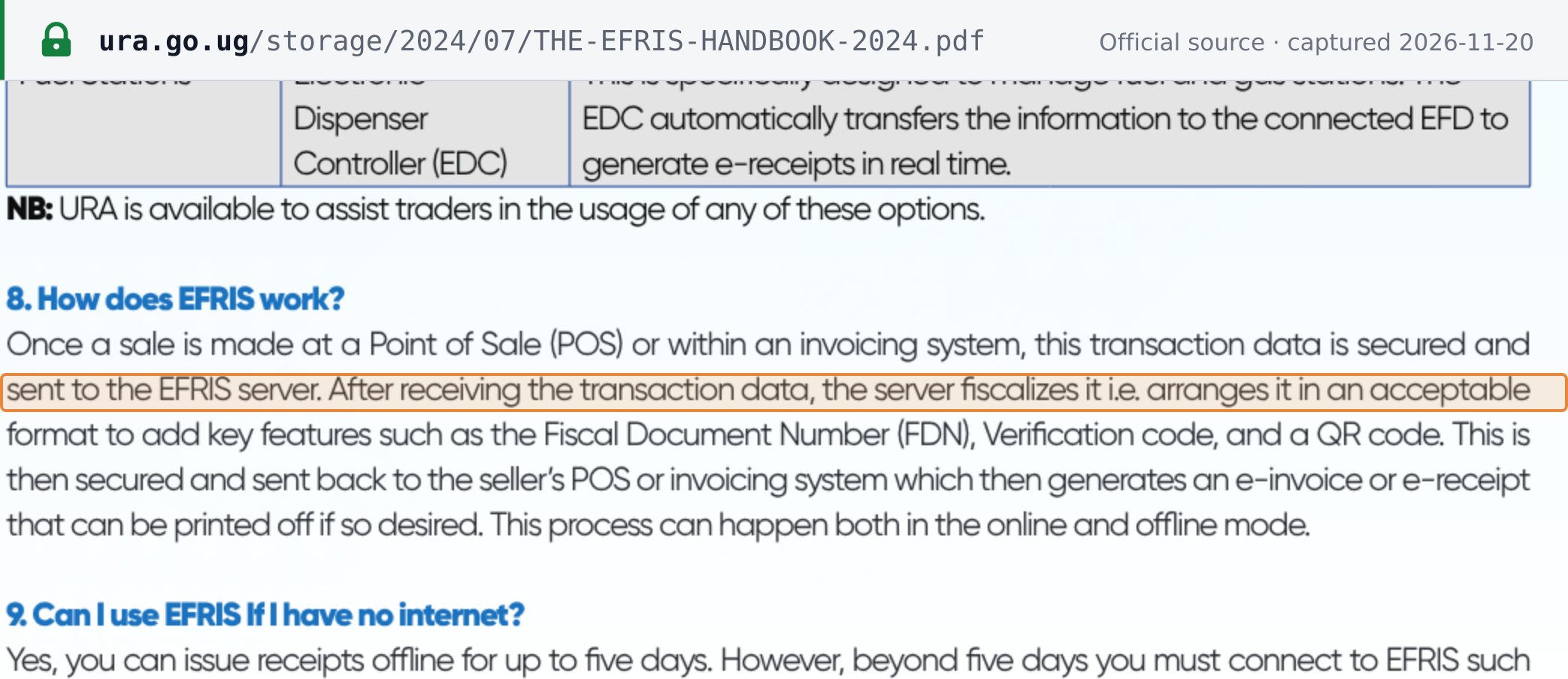
The model: real-time fiscalisation by URA (clearance-type). URA's EFRIS Handbook (2024): "Once a sale is made at a Point of Sale (POS) or within an invoicing system, this transaction data is secured and sent to the EFRIS server. After receiving the transaction data, the server fiscalizes it i.e. arranges it in an acceptable format to add key features such as the Fiscal Document Number (FDN), Verification code, and a QR code. This is then secured and sent back to the seller’s POS or invoicing system which then generates an e-invoice or e-receipt that can be printed off if so desired. This process can happen both in the online and offline mode." The document carries a URA-issued identifier before it is issued, so this works as per-document clearance by a national platform. There is no exchange network and no buyer acceptance step. The Regulations give the System's purposes as "real time transmission and authentication of business transactions and transaction data", "ascertaining accuracy of self assessments" and "facilitating the pre-filing of tax returns" (reg. 3(2)). [10] [4]
 Source snapshot captured 2026-11-20 — original
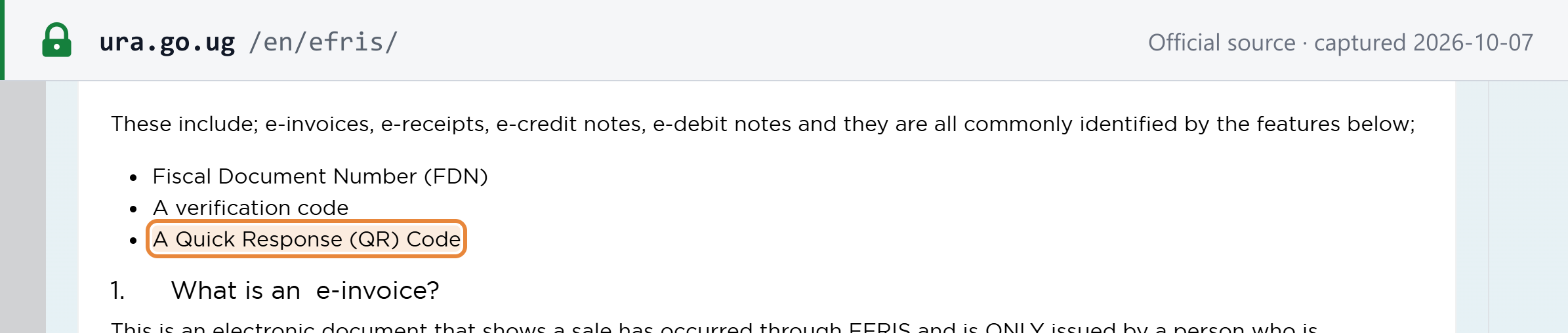
Integrity features. URA: e-invoices, e-receipts, e-credit notes and e-debit notes "are all commonly identified by the features below; Fiscal Document Number (FDN) A verification code A Quick Response (QR) Code". "The Fiscal Document Number (FDN) is an 12-20 digit number given by URA to a transaction for tax purposes." Anyone can check a document by entering the FDN and the date it was generated on URA's FDN validation service or the EFRIS app. [1] [12]
 Source snapshot captured 2026-10-07 — original
XML standard and Peppol. URA's EFRIS page, its two EFRIS handbooks and the 2020 Regulations publish no UBL, CII, Peppol or other open-standard requirement and no public schema. EFRIS is not Peppol-based. The only machine interface URA names is its own: "System to System Connection A trader’s sales system is integrated with EFRIS to generate e-receipts and e-invoices using a special software called Application Programming Interface (API)." The interface specification (v1.5) is not published on URA's website. [1] [13]
Document types.
| Document | Who issues it | URA's description |
|---|---|---|
| e-invoice | VAT-registered persons only | "ONLY issued by a person who is registered for VAT" |
| e-receipt | EFRIS users not registered for VAT, such as non-VAT businesses in the 12 sectors | "issued by a taxpayer who is not registered for VAT" |
| e-credit note | Seller | Cancels or adjusts downwards a previous sale |
| e-debit note | Seller | "issued by a seller to a buyer by way of increasing a previous sale" |
Content and reports. URA: "The e-invoice shows the seller and buyer details, details of goods and services, tax details, and summary sections." The Regulations require the fiscal document to follow Schedule 1 (reg. 4(2)), which URA's consolidated text does not reproduce. Regulation 10(1): "A taxpayer shall, in case of downtime, maintain a Z daily report and a price look up report." The Z daily report is generated at the close of each business day (reg. 10(3)). [1] [4]
Offline mode. "Yes, you can issue e-receipts and e-invoices offline for up to five days. However, beyond five days you must connect to the internet such that the data is uploaded into the system. The offline module works for all platforms except the web portal." [1]
E-reporting alongside: the pre-filled VAT return. URA: "EFRIS enables auto prefilling of purchases and sales information into the VAT returns which enables accurate and timely reporting. When one issues an e-invoice, the e-invoice details are relayed to the VAT return in real time." The return is still filed monthly, within 15 days after the end of the month. [1]
 Source snapshot captured 2026-10-06 — original
Onboarding: how to comply
Registration. "Yes, you are required to have a TIN to register for EFRIS." The steps on URA's EFRIS page and the EFRIS Handbook FY 2026-27: go to the URA web portal, click "Login", select "EFRIS", enter your TIN and password, enter the one-time password sent to your registered email or phone, select "first-time registration", choose e-invoicing or EFDs and any additional places of business, and submit the application to URA for approval. A taxpayer not registered for VAT also selects the registration type and effective date; "If you select EFDs, the application will be subject to approval." [1] [11]
Channels, and who each suits. From URA's EFRIS page:
| Channel | Suits | Cost |
|---|---|---|
| EFRIS mobile app | Shops, mobile distributors, route sales | Free |
| Desktop client | Wholesale and retail with moderate sales | — |
| URA web portal | Only "clients who do not have a billing system, with less than 100 daily transactions, and annual sales below UGX 2 billion"; no offline mode | Free |
| Electronic fiscal device (EFD) | Traders who want a portable POS device | "EFDs are provided by Rank Consult at a cost of Ugx 1.1 m", installation included |
| System-to-system (API) | "businesses having high-volume transactions and with computerized accounting systems (e.g. ERP and POS)" | Paid by the taxpayer |
| Electronic dispenser controller (EDC) | Fuel and gas stations (reg. 7(1) requires them) | Paid by the taxpayer |
URA's 2024 handbook: "the URA web portal, and EFRIS App are free of charge while the system-to-system, EFDs, and EDCs are paid for by the user." URA says the EFD cost "is treated as an allowable expense". The Regulations also list a USSD quick code (reg. 4(1)(d)); URA's current EFRIS page does not offer one. [1] [10] [4]
Accredited integrators and devices. URA keeps a list of accredited EFRIS software integrators, with accreditation start and end dates per integrator, so accreditation is time-limited. URA publishes no standard term and no rule on what happens when accreditation lapses. Integrators that supply software to several taxpayers are told they "will be contacted at a later date to sign a Memorandum of Understanding (MoU) with URA". Fiscal devices must come from "a manufacturer, systems developer or supplier accredited by the Commissioner" (reg. 5(1)). [14] [13] [4]
Testing. URA runs a test environment for system-to-system integration. Its UAT readiness checklist asks: "Have you registered your device on test?", "Have you registered the thumbprint on test?" and "Are you VAT registered on test?" before user acceptance testing. URA's integration pages give no sandbox URL; its July–September 2026 newsletter points to self-help video tutorials and user guides at efristest.ura.go.ug/efrissite. Integration queries go to URA IT through touchpoint.ura.go.ug. [13] [1]
Penalties
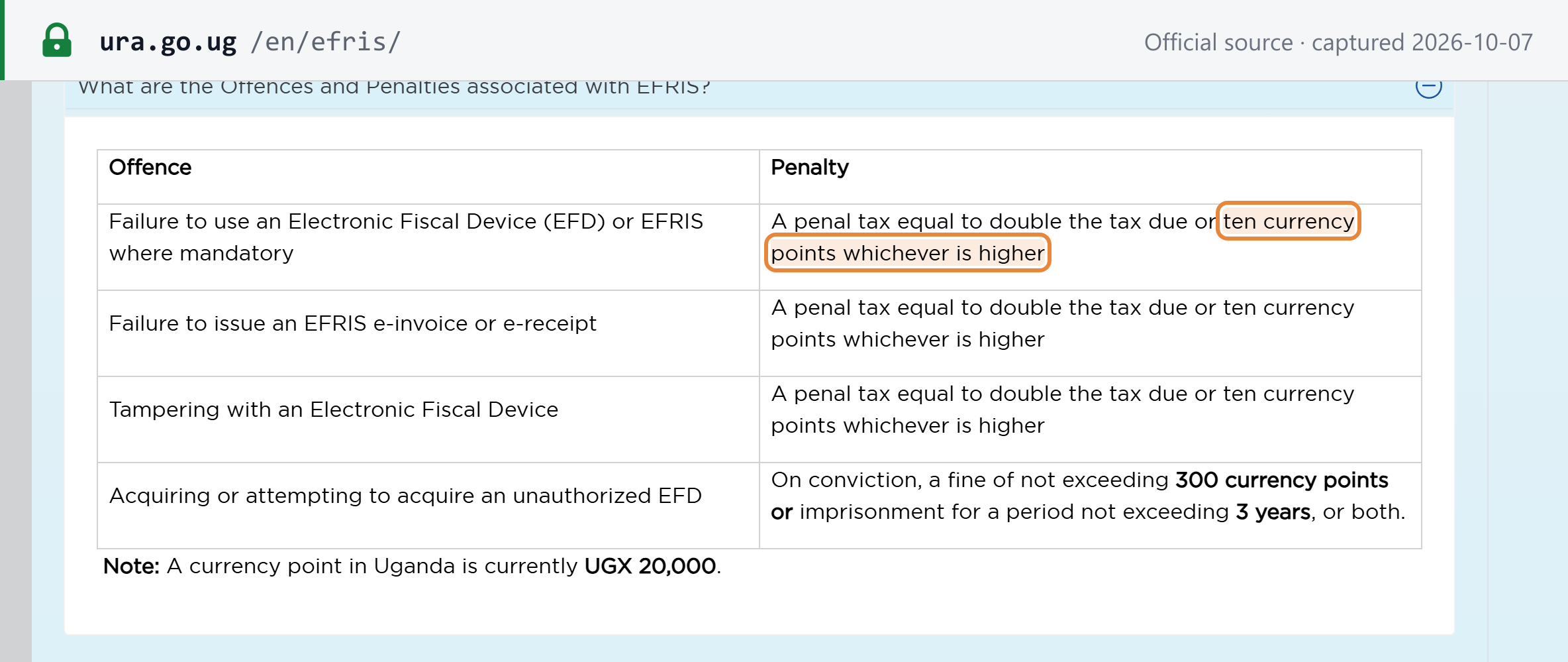
Current penalties (URA's EFRIS page):
| Offence | Penalty |
|---|---|
| Failure to use an EFD or EFRIS where mandatory | "A penal tax equal to double the tax due or ten currency points whichever is higher" |
| Failure to issue an EFRIS e-invoice or e-receipt | The same |
| Tampering with an EFD | The same |
| Acquiring or attempting to acquire an unauthorised EFD | "On conviction, a fine of not exceeding 300 currency points or imprisonment for a period not exceeding 3 years , or both." |
"Note: A currency point in Uganda is currently UGX 20,000." Ten currency points are therefore UGX 200,000 and 300 currency points UGX 6,000,000. [1]
 Source snapshot captured 2026-10-07 — original
How the s.93 penalty has changed:
| Period | Not using an EFD / EFRIS | Not issuing / tampering | Source |
|---|---|---|---|
| Until 30 June 2025 | Tax due or 400 currency points, whichever is higher | Tax due or 300 currency points, whichever is higher | TPC Act s.73B (consolidated text) |
| 1 July 2025 – 30 June 2026 | Double the tax due | Double the tax due | TPC (Amendment) Act 2025, s.4 |
| From 1 July 2026 | Double the tax due or 10 currency points, whichever is higher | The same | TPC (Amendment) Bill 2026, cl.4 (passed 21 April 2026; assent not shown on the Bill Tracker), applied by URA |
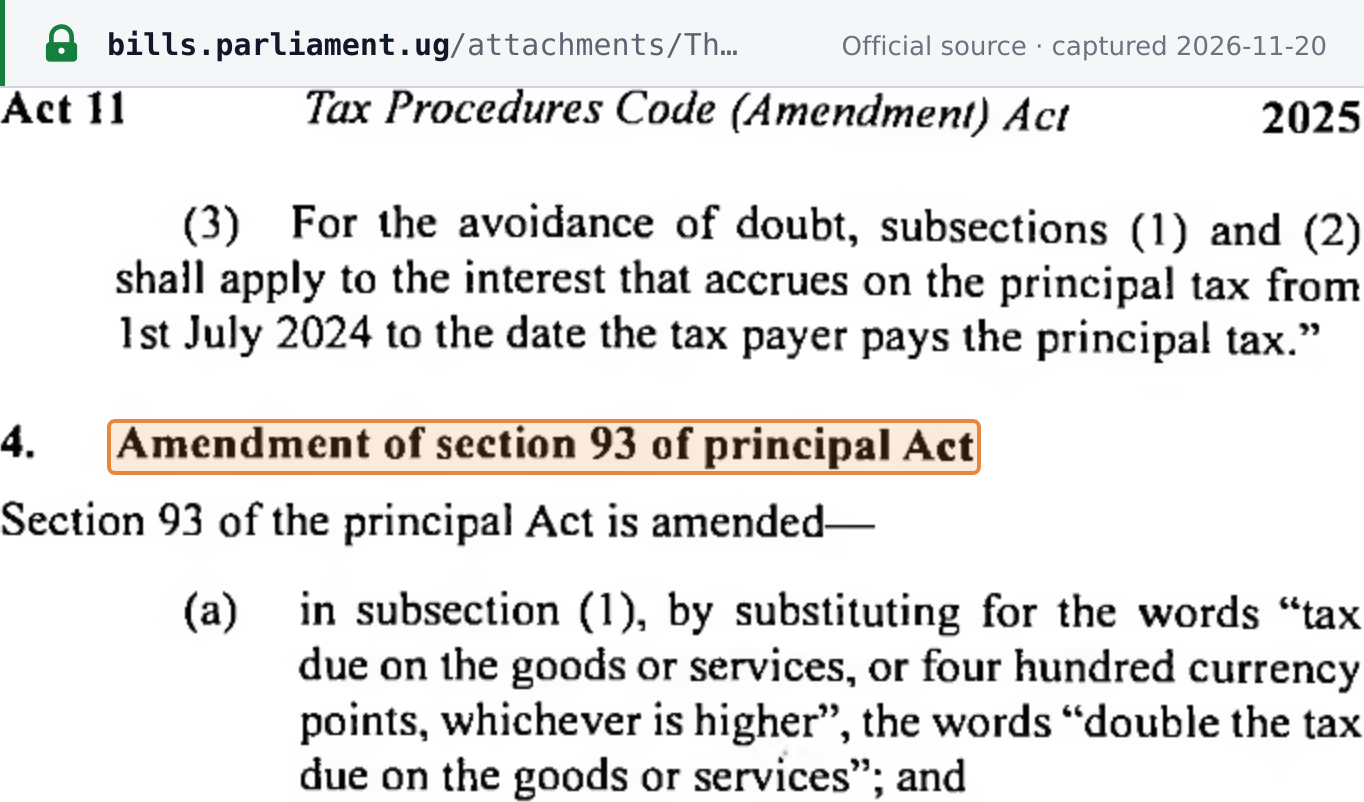 Source snapshot captured 2026-11-20 — original
Why the 10-currency-point floor. Parliament's Finance Committee report on the 2026 Bill records the Finance Ministry's explanation: "The Committee was informed by MoFPED that under the current law, the penalty is tied to "double the tax due on the goods or services." This approach worked when EFRIS applied mainly to VAT registered businesses, where the tax due was VAT. However, EFRIS has now been extended to businesses that are not VAT registered. In these cases, there may be no identifiable tax on the transaction, making it difficult or impossible to apply a penalty based on "tax due."" [17]
Other sanctions. Failing the taxpayer obligations in reg. 9 is an offence carrying "a fine not exceeding one hundred currency points or to a term of imprisonment not exceeding one year or both". Breaching the manual-receipt rule attracts the s.93 penal tax (reg. 6(4)). Buyers lose the VAT credit and the income-tax deduction on undocumented purchases from designated suppliers (see Scope). [4]
Enforcement posture.
- 20 September 2021: URA started enforcement operations countrywide. [3]
- 27–31 May 2024: URA held a waiver week for EFRIS penalties, mainly for traders in Kikuubo and the Central Business District who were new to EFRIS. Its news release of 28 May 2024 says the waiver follows "the President’s directive in his May 7th meeting with traders at the Kololo independence grounds to waive all penalties issued to traders for failure to issue e-receipts." The waiver covered past penalties; it did not suspend the obligation. [15] [18]
- 3 September 2026: URA told tenants to demand an EFRIS receipt when paying rent, and warned that where a landlord does not comply it "will take appropriate enforcement action against the premises, which may include closure of the building, in accordance with the law." [16]
Frequently asked questions
We are not VAT-registered. Do we have to use EFRIS?
Yes, if the business is in one of the 12 sectors in URA's notice Additional taxpayers required to use EFRIS (effective 1 July 2025), unless its turnover is below UGX 10,000,000 a year or, for landlords, rental income is below UGX 2,820,000 a year. Passenger land transport and non-resident digital service providers liable to digital service tax are excluded. A business that is not VAT-registered issues e-receipts, not e-invoices. [2]
Can we claim input VAT or an expense on a supplier invoice that did not come through EFRIS?
Not where the supplier is required to use EFRIS. URA rejects a VAT credit claimed on purchases not supported by e-invoices, and an income tax deduction for an expense not supported by an e-invoice or e-receipt from a designated supplier (Income Tax Act s.22(3)(m), as cited by URA). Check the document's Fiscal Document Number on URA's FDN validation service before booking it. [1] [2]
EFRIS or our own system is down. What do we do?
EFRIS can issue documents offline for up to five days on every channel except the web portal. Otherwise, regulation 6 of the E-invoicing and E-receipting Regulations 2020 allows a manual receipt when the System, your own system or the fiscal device is down, or for another justifiable reason; it must be uploaded to EFRIS within 24 hours (after the System is restored, where the System was down). [1] [4]
Can we use the free URA web portal instead of integrating our ERP?
Only if you have no billing system, fewer than 100 transactions a day and annual sales below UGX 2 billion, according to URA. The portal has no offline mode. Businesses with ERP or POS systems and high volumes are pointed to the system-to-system API, which the taxpayer pays for. [1]
Does EFRIS use UBL or Peppol?
No. URA's EFRIS page, its EFRIS handbooks and the 2020 Regulations publish no UBL, CII or Peppol requirement and no public schema. Integration is to URA's own system-to-system API, tested against URA's EFRIS Interface User Requirements Specifications v1.5, which URA does not publish on its website. [1] [13]
What is the penalty for one missed e-receipt?
URA applies a penal tax of double the tax due or 10 currency points (UGX 200,000), whichever is higher, from 1 July 2026, under the Tax Procedures Code (Amendment) Bill 2026, which Parliament passed on 21 April 2026. From 1 July 2025 to 30 June 2026 the penalty was double the tax due, with no minimum; before that it was the tax due or 300 currency points, whichever was higher. [1] [5] [6]
Our customer is a VAT withholding agent. Does it still withhold VAT if we issue an EFRIS e-invoice?
The VAT (Amendment) Bill 2026, as introduced and passed by Parliament on 21 April 2026 with a commencement date of 1 July 2026, provides that VAT withholding does not apply where the withholding agent is issued an e-invoice or e-receipt. The Bill Tracker does not show assent, and URA's EFRIS page does not mention the change, so confirm with URA before relying on it. [8] [9]
Recent changes
- 2026-09-03 — URA told tenants to demand an EFRIS receipt for every rent payment and warned that enforcement against non-compliant landlords' premises may include closure of the building. (URA)
- 2026-07-01 — EFRIS penal tax becomes double the tax due or 10 currency points, whichever is higher, under the Tax Procedures Code (Amendment) Bill 2026 (passed by Parliament 21 April 2026), as applied by URA. (URA) — see event
- 2025-07-01 — EFRIS extended to businesses in 12 designated sectors, VAT-registered or not, which URA describes as gazetted under s.92(2) of the Tax Procedures Code. (URA) — see event
- 2025-07-01 — EFRIS penal tax set at double the tax due, removing the 300 and 400 currency-point alternatives (Tax Procedures Code (Amendment) Act 2025, s.4). (Parliament of Uganda)
- 2024-05-27 — URA opened a week-long waiver of EFRIS penalties for traders new to the system, after the President's directive of 7 May 2024. (URA)
- 2021-01-01 — EFRIS mandatory for all VAT-registered taxpayers (General Notice No. 595 of 2020, as cited by URA); enforcement from 20 September 2021. (URA)
Related resources
- Uganda VAT guide — rates, registration threshold, invoice requirements, returns
- Uganda tax identification number (TIN) guide — TIN, NIN and BRN on EFRIS documents
- E-invoicing status and networks by country
- Fiscal devices and certified cash registers
- Neighbouring systems URA itself compares EFRIS with: Kenya eTIMS, Rwanda EBM, Tanzania VAT guide
- Uganda tax changes on Lookuptax
Important websites
- URA EFRIS page and FAQ
- EFRIS Handbook FY 2026-27 (English)
- FDN validation — check that an e-invoice or e-receipt is genuine
- Invoice and receipt issuance
- List of accredited EFRIS software integrators
- EFRIS system-to-system integration UAT readiness checklist
- URA Touchpoint — system-to-system integration support
Reference links
- Uganda Revenue Authority — EFRIS
- URA — Additional taxpayers required to use EFRIS (posted version dated 10 August 2026)
- URA public notice — Enforcement on usage of EFRIS (PDF)
- URA — Domestic tax laws, consolidated to July 2021: Tax Procedures Code Act s.73A–73B and the E-invoicing and E-receipting Regulations 2020 (PDF)
- Tax Procedures Code (Amendment) Act, 2025 (PDF)
- Tax Procedures Code (Amendment) Bill, 2026 (PDF)
- Parliament of Uganda Bill Tracker — Tax Procedures Code (Amendment) Bill, 2026
- Value Added Tax (Amendment) Bill, 2026 (PDF)
- Parliament of Uganda Bill Tracker — Value Added Tax (Amendment) Bill, 2026
- URA — The EFRIS Handbook 2024 (PDF)
- URA — EFRIS Handbook FY 2026-27 (English)
- URA — FDN validation
- URA — EFRIS system-to-system integration UAT readiness checklist
- URA — List of accredited EFRIS software integrators
- URA — URA commences waiving of EFRIS penalties (28 May 2024)
- URA — Notice to tenants: demand an EFRIS receipt when paying rent (3 September 2026)
- Committee on Finance, Planning and Economic Development — Report on the Tax Procedures Code (Amendment) Bill, 2026 (PDF)
- URA — Waiver of EFRIS penalties (May 2024)
- URA Newsletter, July–September 2026 (PDF)