E-invoicing in Malawi: the Electronic Invoicing System (EIS)
Overview
Malawi's tax invoices are issued through the Electronic Invoicing System (EIS), which the law calls the electronic tax invoicing system. It is run by the Malawi Revenue Authority (MRA) and replaces the Electronic Fiscal Devices (EFDs) that businesses used before. MRA describes it this way: "The EIS is a software-based solution that enables taxpayers to issue electronic tax invoices, manage stock records and transmit transaction data to MRA in real time." [1]
Legal basis in one line. VAT Act s.11D and s.25, as substituted by the Value Added Tax (Amendment) Act, 2024 (Act No. 14 of 2024), and the Value Added Tax (Electronic Invoicing System) Regulations, 2025 (Government Notice No. 6, Malawi Gazette Supplement No. 2A of 9 January 2026). [2] [3]
| Malawi | |
|---|---|
| System | Electronic Invoicing System (EIS), the "electronic tax invoicing system" of VAT Act s.11D |
| Model | Every sale submitted to MRA in real time and validated; MRA returns a validation URL that the receipt carries as a QR code. Offline receipts are signed on the device and synced later |
| Who (law) | "Any person carrying on business or trade in Malawi" (EIS Regulations reg. 3) |
| Who (MRA rollout) | VAT-registered businesses: about 9,000 targeted, more than 8,260 migrated by June 2026 (MRA) |
| B2B / B2C / B2G | One rule for every supply; the Act and the Regulations make no distinction by customer type |
| Non-residents | Not addressed by the Regulations or MRA guidance (see Scope) |
| Key dates | Regulations gazetted 9 January 2026; EFD invoices allowed until 31 January 2026 and deductible until 31 July 2026 (reg. 15); MRA nationwide rollout effective 1 May 2026 |
| Format | MRA EIS API: REST web services, JSON over HTTPS. No UBL, CII or Peppol |
| Network | None: a single government platform. MRA's own POS apps and web portal, or a certified third-party POS connected by API |
| Integrity | Terminal ID, daily ascending serial number, fiscal logo and QR code (reg. 6(2)(c)); HMAC-signed validation URL for offline receipts |
| Authority | Malawi Revenue Authority (MRA) |
| Penalty | Tax Administration Act s.95: entity 500 currency points (K500,000) for the first month plus 50 points (K50,000) per further month; individual 100 points (K100,000) plus 10 points (K10,000) |
For the VAT rate, registration, the general invoice rules and returns, see the Malawi VAT guide.
Mandate status & timeline
Status (as at 15 November 2026): mandatory and in force. Two timelines apply, and both are official. The gazetted one is in the EIS Regulations: EFDs could issue tax invoices until 31 January 2026. The administrative one is MRA's rollout: MRA extended the transition from 1 November 2025 to 1 February 2026, and then gave 1 May 2026 as the date of its nationwide rollout. [3] [4] [6]
The law: EIS Regulations, regulation 15
| Step | What | Date | Source | State |
|---|---|---|---|---|
| Regulations in force | VAT (Electronic Invoicing System) Regulations, 2025 published; the EFD Regulations are revoked (reg. 14) | 9 January 2026 | G.N. No. 6, Gazette Supplement No. 2A | Passed |
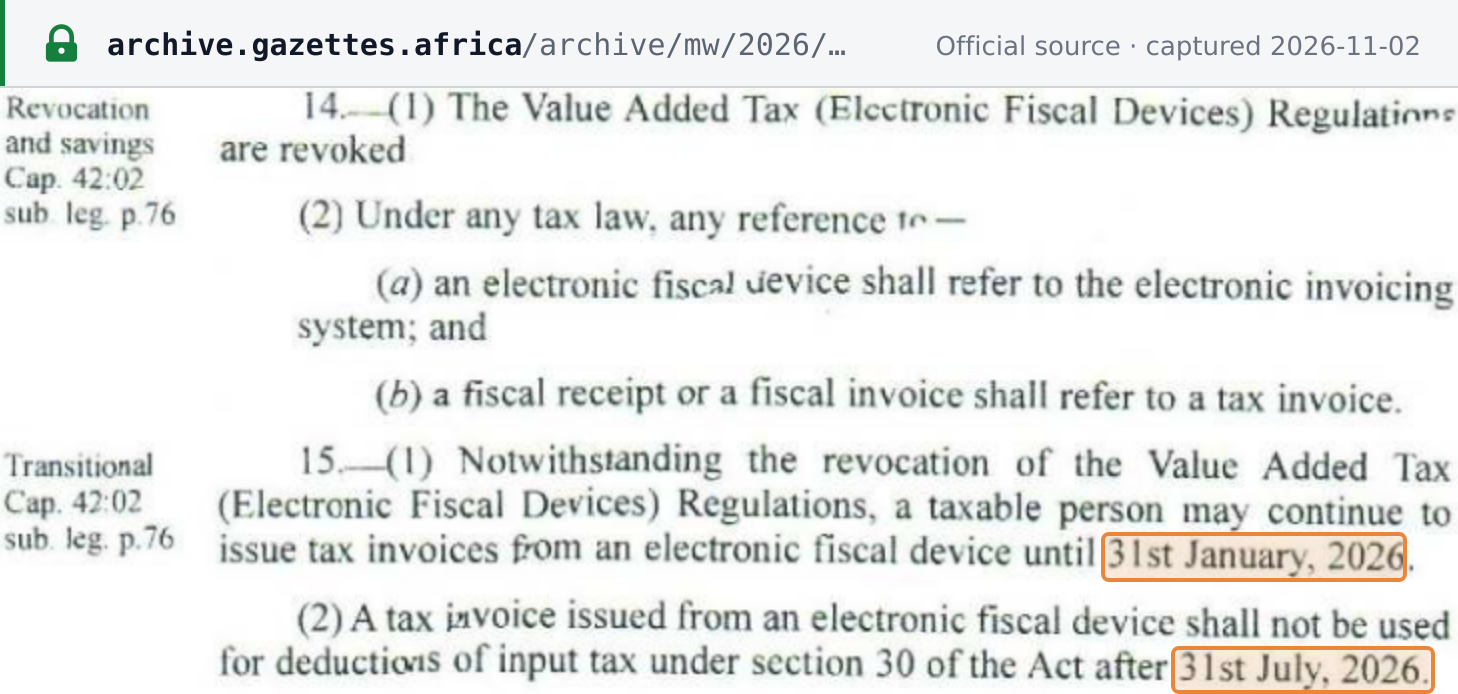
| EFD issuing ends | "a taxable person may continue to issue tax invoices from an electronic fiscal device until 31st January, 2026" (reg. 15(1)) | 31 January 2026 | Reg. 15(1) | Passed |
| EFD input-tax cut-off | An EFD tax invoice "shall not be used for deductions of input tax under section 30 of the Act after 31st July, 2026" (reg. 15(2)) | 31 July 2026 | Reg. 15(2) | Passed |
 Source snapshot captured 2026-11-02 — original
MRA's rollout
| Step | What | Date | Source | State |
|---|---|---|---|---|
| Migration opens | "Taxpayers were required to migrate from EFDs to the EIS from 2 August, 2025" by acquiring or integrating the EIS, registering on the EIS Taxpayer portal and uploading stock records | 2 August 2025 | MRA public notice on the transition | Passed |
| Postponement 1 | Transition extended "from 1st November 2025 to 1st February 2026" after taxpayer feedback | 1 November 2025 → 1 February 2026 | MRA news (undated) | Passed |
| Pilot | During the "pilot phase", stock bought from suppliers still using EFDs is uploaded as "Informal Purchases" with MRA approval | Not dated in the EIS portal FAQ | EIS portal FAQ | — |
| Rollout | "The implementation of the EIS is 1st May 2026 and the Authority is appealing to all VAT registered taxpayers to onboard on the system." MRA: "We have been extending the rollout of the new system" | 1 May 2026 | MRA news, 28 April 2026 | Passed |
| Support window | "a two-month window for targeted technical support"; MRA: "this is not an extension of the implementation deadline and the use of EFDs is no longer permitted" | Announced 6 May 2026 | MRA news, 6 May 2026 | — |
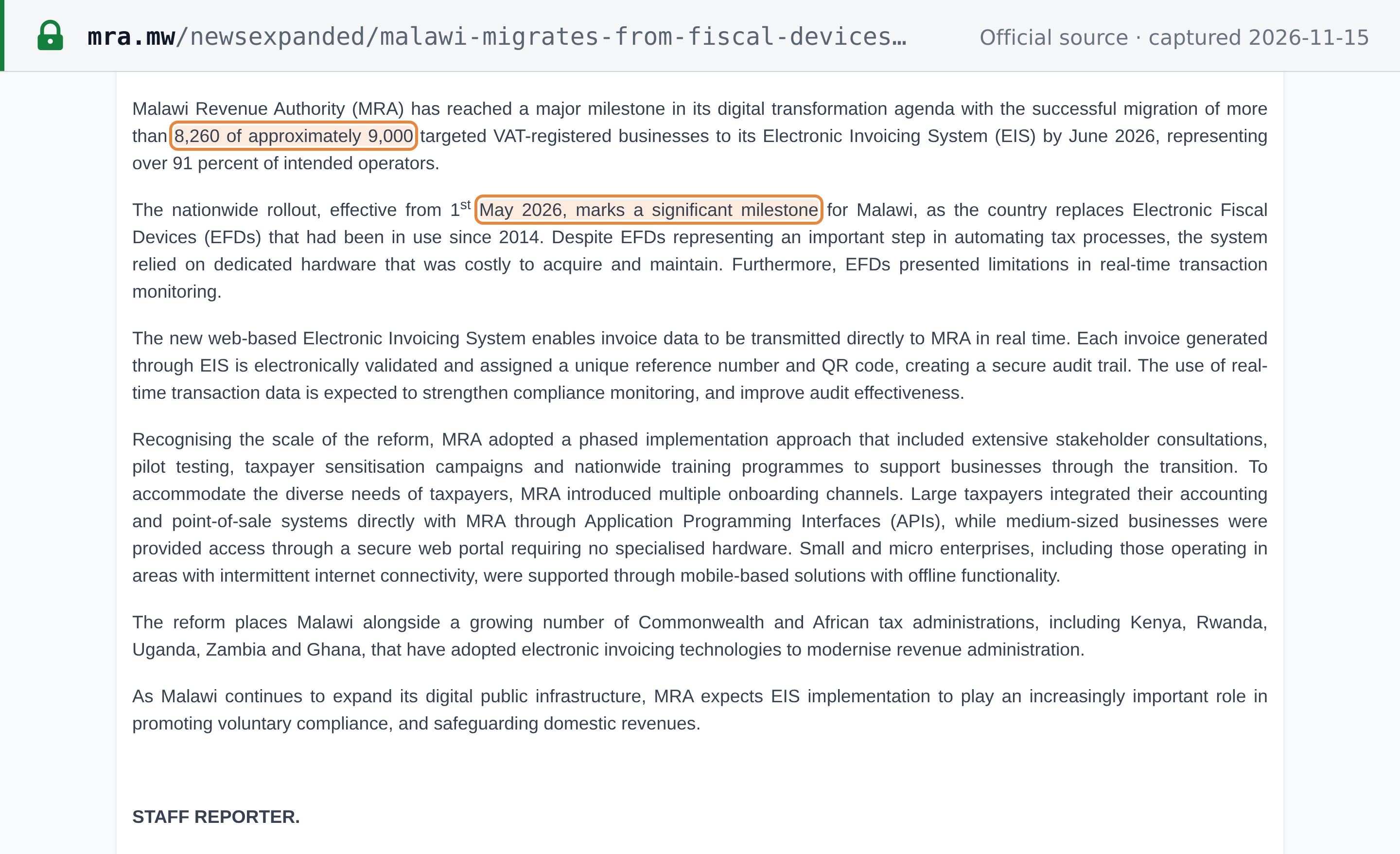
| Progress | "more than 8,260 of approximately 9,000 targeted VAT-registered businesses" migrated by June 2026; "The nationwide rollout, effective from 1st May 2026" | June 2026 | MRA news, 23 June 2026 | Reported |
 Source snapshot captured 2026-11-15 — original
How the two fit together. MRA's public notice, issued after the Regulations were published, followed the gazetted date: "At the end of the transition period on 31 January, 2026 taxpayers will no longer be allowed to use EFDs for issuing tax invoices, and a tax invoice issued from an EFD after 31 January, 2026 shall not be acceptable for claiming of input tax." MRA's later news then fixed 1 May 2026 as the implementation date for VAT-registered taxpayers. Neither date has been withdrawn. After the rollout, MRA's news of 7 May 2026 said the EIS "became fully operational effective 1 May, 2026, marking the end of the use of Electronic Fiscal Devices (EFDs) for issuing VAT tax receipts", and that "VAT operators are now legally required to issue invoices through EIS and EFD-generated fiscal receipts can no longer be used for VAT purposes." On 6 May 2026 MRA announced "a two-month window for targeted technical support to assist businesses experiencing challenges during the transition", adding that "this is not an extension of the implementation deadline and the use of EFDs is no longer permitted." MRA's news does not say how EFD invoices issued between 1 February and 30 April 2026 are treated for input tax; a business holding such invoices should get MRA's position in writing. [1] [5] [20] [19]
Input tax on old EFD invoices. Regulation 15(2) bars the use of any EFD invoice for input-tax deductions after 31 July 2026, and that date has passed. MRA's January 2026 notice added that an EFD invoice issued after 31 January 2026 was not acceptable for claiming input tax at all. MRA's VAT Guide (reviewed 29 September 2026) now lists "invoice not generated from the Electronic Tax Invoicing System (EIS)" among the cases where input tax cannot be claimed, and separately bars tax invoices "dated more than 6 months". [3] [12]
More phases. MRA has announced none. The law already covers every business (see Scope); MRA's announcements so far concern VAT-registered businesses only.
Legal basis
| Instrument | Date / publication | What it does |
|---|---|---|
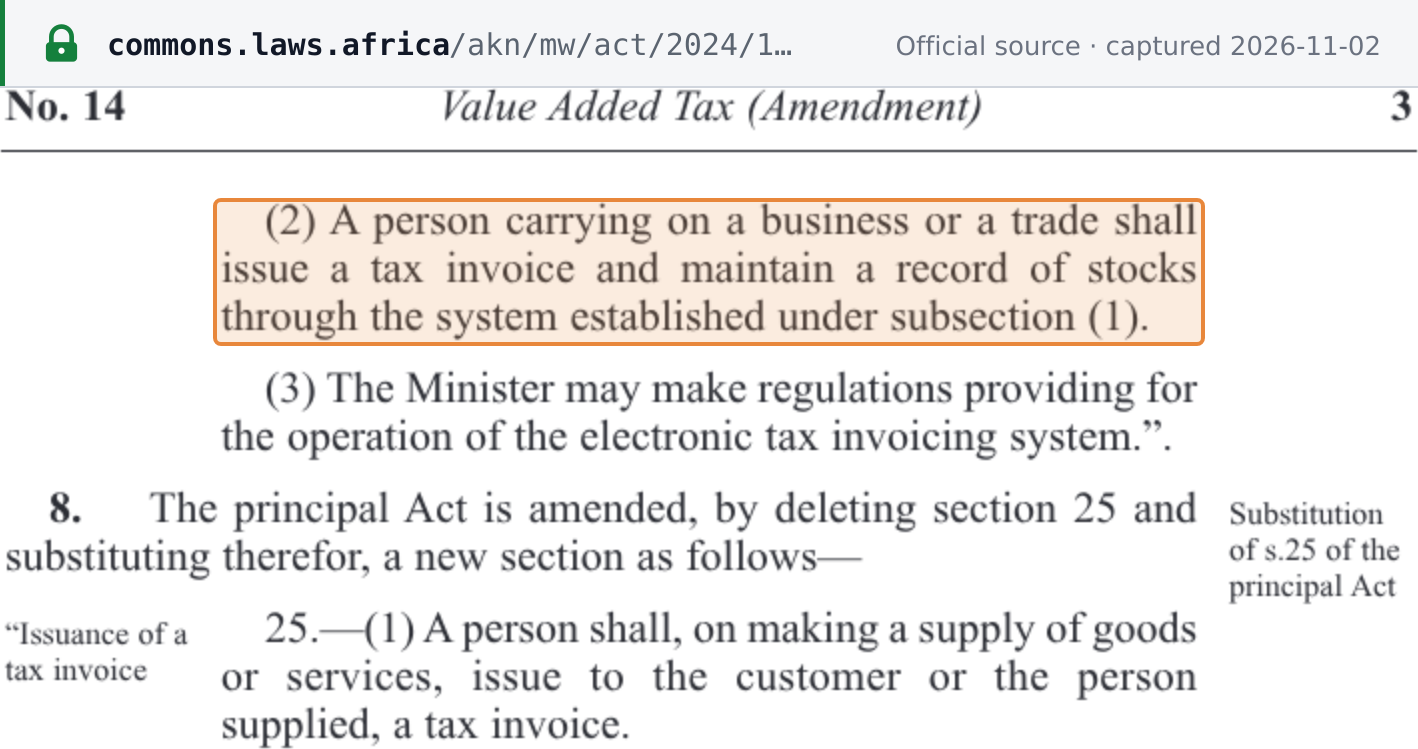
| Value Added Tax (Amendment) Act, 2024 (Act No. 14 of 2024), Part II | Passed 27 March 2024; assented 18 April 2024; published 19 April 2024. Part II "shall come into force on a date to be appointed by the Minister, by a notice published in the Gazette" (s.1(2)) | New s.11D: the Commissioner General may establish an electronic tax invoicing system, and "A person carrying on a business or a trade shall issue a tax invoice and maintain a record of stocks through the system established under subsection (1)". New definition: a "tax invoice" is "a fiscal receipt or invoice generated by an electronic tax invoicing system". New s.25: a tax invoice on every supply, with exceptions on written application. Amends ss.46A–46E and 57 |
| VAT (Electronic Invoicing System) Regulations, 2025, Government Notice No. 6 | Made 19 December 2025 under VAT Act s.63(1); Malawi Gazette Supplement No. 2A, 9 January 2026 | Application (reg. 3), user registration (reg. 4), certification of third-party POS (reg. 5), mandatory use and invoice particulars (reg. 6), maintenance, errors, terminals (regs 7–11), investigation (reg. 12), customers' duty to keep invoices (reg. 13), revocation of the EFD Regulations (reg. 14), transition (reg. 15) |
| Tax Administration Act, 2021 (Act No. 13 of 2021) | Consolidated as at 14 April 2026 | s.95 penalty for failing to comply with an electronic tax system; s.107 offences of impeding tax administration (see Penalties) |
 Source snapshot captured 2026-11-02 — original
Commencement of Part II. MRA's notice does not give the date on which Part II came into force, but states that it is in operation: "As communicated in the Public Notice published on 31st July, 2025, the use of the EIS in place of Electronic Fiscal Devices (EFDs) follows the coming into operation of Part II of the Value Added Tax (Amendment) Act, 2024". [1]
One instrument, two labels. The Regulations cite themselves as the "Regulations, 2025" (reg. 1) because they were made in December 2025; they were gazetted in January 2026, and MRA's VAT Guide of September 2026 calls them the "Value Added Tax (Electronic Invoicing System) Regulations 2026". Both names refer to Government Notice No. 6 of 9 January 2026. [3] [12]
Old references to EFDs. Regulation 14(2) re-points the older laws: "Under any tax law, any reference to — (a) an electronic fiscal device shall refer to the electronic invoicing system; and (b) a fiscal receipt or a fiscal invoice shall refer to a tax invoice." The offences in the Tax Administration Act that still mention electronic fiscal devices therefore apply to the EIS. [3]
Technical standards. The Regulations define the EIS as a system for "the issuance and electronic processing and transmission of a tax invoice in a structured format in accordance with the requirements of these Regulations" (reg. 2), but name no data standard. The format in practice is MRA's EIS API specification (see Format & network); third-party systems are certified against it. [3] [13]
Scope
Who: the law. The Regulations reach every business, not only VAT-registered ones: "These Regulations shall apply to any person carrying on business or trade in Malawi" (reg. 3). Each of the following must create an EIS user account: "(a) a taxable person; (b) any person carrying on a business or trade; or (c) any other person who may be appointed by the Commissioner General" (reg. 4(1)). VAT Act s.11D(2) is likewise addressed to "A person carrying on a business or a trade". [3] [2]
Who: MRA's rollout. MRA's rollout has targeted VAT-registered businesses. Its 28 April 2026 news appealed "to all VAT registered taxpayers to onboard on the system", and its 23 June 2026 news counted "approximately 9,000 targeted VAT-registered businesses". MRA's Tax Invoice Guide (reviewed September 2026) says "A tax invoice can only be issued by a person who is registered for VAT." [5] [6] [11]
Businesses not registered for VAT. The law covers them; MRA guidance does not say whether, or when, they must onboard. No MRA notice, news item, guide or FAQ published as at 15 November 2026 addresses their obligation, and MRA has announced no enforcement against them.
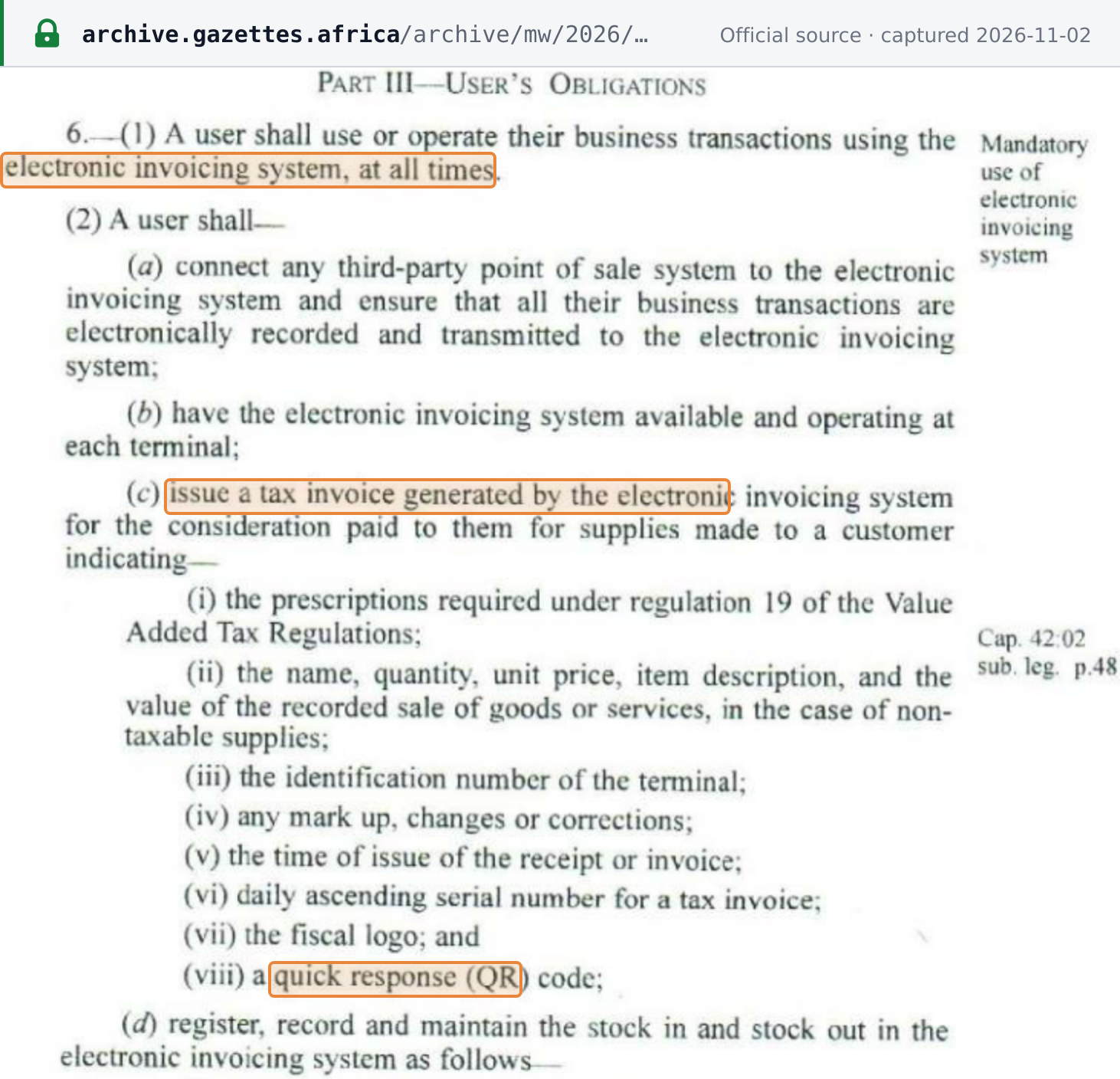
B2B, B2C and B2G. One rule for every supply. New s.25(1): "A person shall, on making a supply of goods or services, issue to the customer or the person supplied, a tax invoice." Reg. 6(1): "A user shall use or operate their business transactions using the electronic invoicing system, at all times." Neither the Act nor the Regulations creates a separate system for supplies to government or excludes sales to consumers. Buyers have duties too: a customer must demand and keep the tax invoice and report a supplier who refuses to issue one (reg. 13). [2] [3]
 Source snapshot captured 2026-11-02 — original
Non-established businesses. The Regulations apply to persons "carrying on business or trade in Malawi". Neither they nor MRA's guidance says whether a non-resident supplier of digital services, which must register for VAT whatever its turnover since the VAT (Amendment) Act, 2026 (Act No. 5 of 2026), has to issue through the EIS. MRA's VAT Guide lists "transactions in respect of digital services by a non-resident digital services supplier or an intermediary or an electronic market place operator" among the cases where the buyer cannot claim input tax. See the Malawi VAT guide and VAT on digital services from non-resident suppliers. [3] [12]
Exceptions. No category of supply is excluded. The Commissioner General may, on written application, allow "an invoice other than a tax invoice where, owing to the nature of the business or malfunctioning of the electronic tax invoicing system, as may be certified by a tax officer, it is impracticable for the person to issue a tax invoice" (s.25(4)). [2]
Simplified invoices. Not applicable: the Act and the Regulations set no value threshold below which a receipt outside the EIS is allowed.
Currency. MWK only. The EIS portal FAQ: "No, the current version does not support multi-currency. Use appropriate exchange rates to convert to MWK and then issue the invoice." [9]
Format & network
The model. Real-time submission and validation of every receipt through one government platform. MRA's API guide: "When making an online transaction, sales transactions are submitted to the Malawi Revenue Authority (MRA) in real-time. In response, the MRA returns a ValidationURL. The POS uses this ValidationURL to generate a QR code." MRA's June 2026 news: "Each invoice generated through EIS is electronically validated and assigned a unique reference number and QR code, creating a secure audit trail." There is no exchange network and no buyer acceptance step; the supplier hands the receipt to the buyer on paper or electronically. See CTC e-invoicing models. [15] [6]
What changed from EFDs. MRA's API guide compares the two systems:
| EFD | EIS | |
|---|---|---|
| Data transmission | Uses FTP | Will use Https |
| Data format | XML | Json / Rest Webservices |
| Data | Summary of sales | Detailed sales receipt |
| Transmission interval | Once a day | Realtime as sales as happening |
| Security | Security paper (receipt with MRA logo) | QR code on the receipt that can be validated |
| Receipt printing | Fiscal printers | Any printer capable of printing a QR code; PDF receipts may be sent by e-mail, WhatsApp etc. |
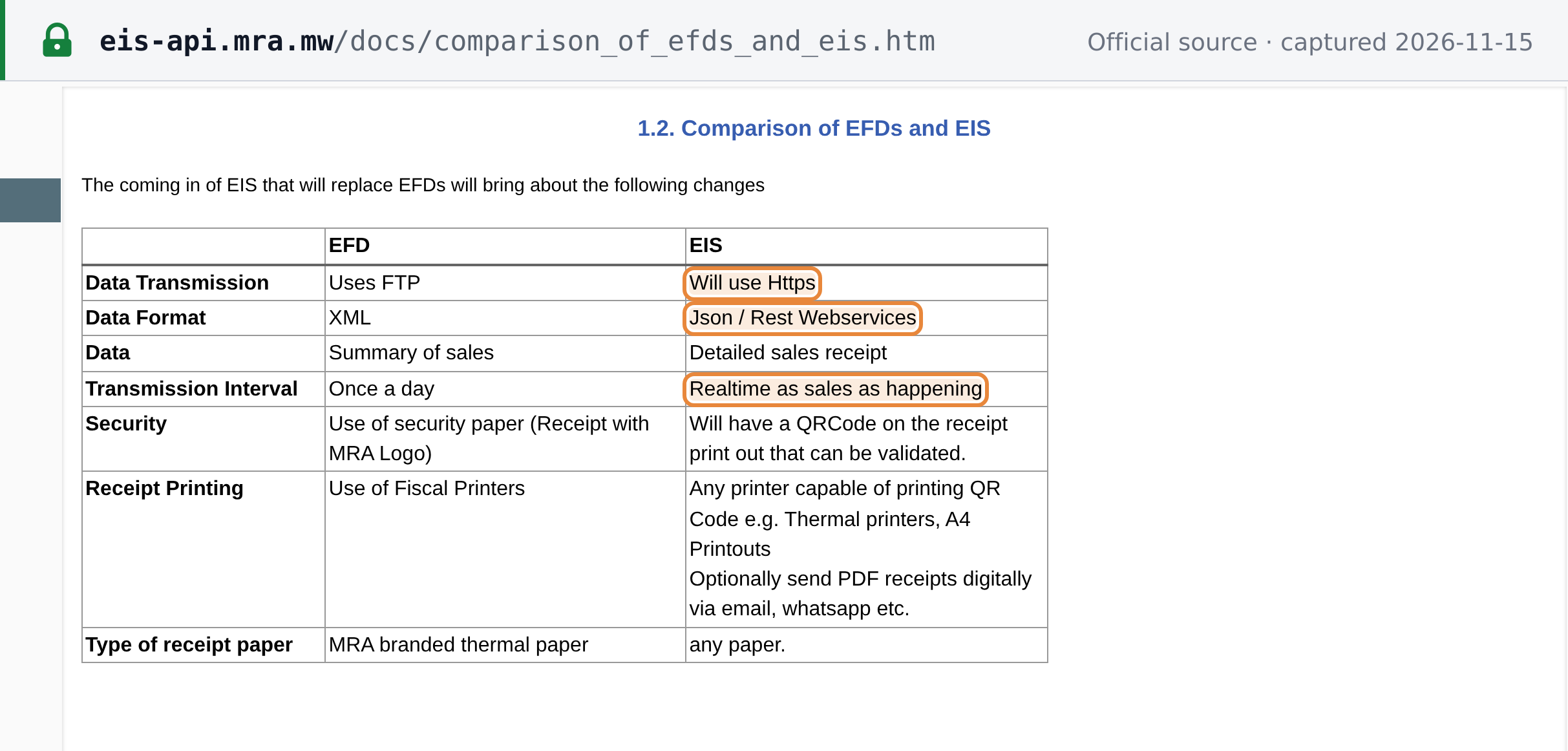 Source snapshot captured 2026-11-15 — original
Format and standard. JSON over MRA's REST API ("This API will be operational for POS devices around the clock, employing contemporary data transmission standards like REST APIs and JSON"). The API specification is published as an OpenAPI (Swagger) file, EISAPI v1.0; a sale is posted to /api/v1/sales/submit-sales-transaction, and credit and debit notes and cancellations have their own endpoints. Not Peppol-based, and no UBL, CII or EN 16931 profile: none appears in the Regulations or in MRA's API documentation. [8] [16]
Integrity. An EIS tax invoice must show, among other particulars, "(iii) the identification number of the terminal; … (vi) daily ascending serial number for a tax invoice; (vii) the fiscal logo; and (viii) a quick response (QR) code" (reg. 6(2)(c)). For offline sales, "the POS generates the ValidationURL offline. This is done by creating a HMAC (Hash-based Message Authentication Code) of the invoice request, which includes the invoice number, line items count, and transaction date. The HMAC is created using a secret key received during terminal activation." The EIS portal FAQ: "Receipts will have a unique number and QR code. When scanned, the QR shows exact receipt details which can be verified in the Backoffice." [3] [15] [9]
Offline limits. Each terminal receives offline limits at activation, by transaction amount and by hours since the last connection: "If either of the thresholds is exceeded, the POS will not be able to transact offline and will need to connect to the MRA server to continue processing transactions." The limits are set per site and terminal; MRA publishes no general figure. [17]
Stock records alongside invoicing. The EIS is also the stock ledger. Users must "register, record and maintain the stock in and stock out in the electronic invoicing system", including "all local purchases and imports", "disclose raw material conversion data", and use barcodes and invoice numbering "in a format approved by the Commissioner General" (reg. 6(2)(d)–(g)). [3]
Invoice content and MRA's sample. MRA's Tax Invoice Guide (reviewed September 2026) lists the particulars of an EIS tax invoice under regulation 19 of the VAT Regulations and the EIS Regulations, starting with the words "START OF LEGAL RECEIPT" at the top and "END OF LEGAL RECEIPT" at the bottom and ending with the fiscal logo and QR code, and includes a "Sample of a Tax Invoice". The guide is published as a Word document. For the field-by-field list, see Invoice requirements in the Malawi VAT guide. [11]
Onboarding / how to comply
Connection modes. MRA, June 2026: "Large taxpayers integrated their accounting and point-of-sale systems directly with MRA through Application Programming Interfaces (APIs), while medium-sized businesses were provided access through a secure web portal requiring no specialised hardware. Small and micro enterprises, including those operating in areas with intermittent internet connectivity, were supported through mobile-based solutions with offline functionality." The EIS portal FAQ refers to desktop and mobile POS apps "that work offline for invoicing" and to a browser-based Web POS. [6] [9]
| Channel | Suits | How |
|---|---|---|
| API integration | Businesses with their own accounting, ERP or POS software | Certified third-party POS calls the EIS API |
| Web portal (Web POS) | Businesses without their own software | Browser at the EIS Taxpayer Portal |
| Mobile / desktop POS apps | Small businesses, areas with poor connectivity | MRA's apps, which work offline and sync later |
Registration. A taxable person "must first create a user account for EIS using Msonkho Online credentials" and then create services and upload stock (MRA Tax Invoice Guide). Reg. 4(2) lists the account details: business or trading name, TIN, physical address, mobile number, mail address. MRA's pre-integration guide sets out the steps: register on the portal with the TIN, phone number and e-mail registered in Msonkho Online; for goods, upload opening stock for MRA approval into a "Virtual Warehouse" and transfer it to branches; for services, register the services; then apply for a terminal for each branch — "A Terminal Activation Code is automatically generated by the system. The code is also delivered to the taxpayer via email or SMS." [11] [3] [14]
Certification of third-party POS. "The Commissioner General shall certify a third-party point of sale system before that system is connected to the electronic invoicing system and used by a user" (reg. 5(1)). Certification criteria include "securely storing data for not less than six years" (reg. 5(3)(c)). MRA's API guide: "All POS systems developed by software vendors other than the MRA must be certified. We will certify both the software provider and the software itself. Each certified software will be assigned a product ID and a product version." and "Developers need to bring their software to the MRA for manual inspection and testing. … Certification can be revoked, and the POS system can be blocked if any non-compliance or malicious code is found in the software, even after it is in use." The API guide mentions a POS repository and a vendor repository, but MRA has not published a list of certified vendors or software on the EIS portal or in the API documentation. [3] [13] [18]
Hardware. None prescribed. EIS portal FAQ: "No. Taxpayers are responsible for acquiring POS hardware and printers. MRA has not appointed specific suppliers. Purchases are deductible business expenses." [9]
Testing. Developers register first on the sandbox portal, dev-eis-portal.mra.mw, and have their inventory uploaded and approved there before integrating. [14]
Day-to-day duties under the Regulations.
- System failure. Within six hours, report the incident to the Commissioner General in writing and record sales by the means the Commissioner General specifies; enter those sales into the EIS within 72 hours of issuing the invoice (reg. 6(2)(j)–(k)).
- Errors. Print the erroneous record and issue a correct tax invoice (reg. 9).
- Terminals. Not transferable (reg. 10) and kept in a conspicuous place (reg. 11).
- POS upkeep. Keep the POS system updated and keep an electronic maintenance ledger (reg. 7(1)); notify the Commissioner General in writing 30 days before discontinuing a POS system, or within seven days after an unplanned closure (reg. 7(2)–(3)).
- Records. Do not delete records without the Commissioner General's authorisation (reg. 6(2)(h)).
Penalties
Failure to use the EIS: Tax Administration Act s.95. "A person who fails to comply with the requirements of an electronic tax system as required under a tax law shall be liable to— (a) a penalty of five hundred currency points for an entity and one hundred currency points for an individual for the first month; and (b) a further penalty of fifty currency points for an entity and ten currency points for an individual for each month or part thereof during which the failure continues." One currency point is K1,000 (TAA Schedule). MRA's Tax Invoice Guide (September 2026) applies s.95 to the EIS. [10] [11]
| First month | Each further month or part | |
|---|---|---|
| Entity | 500 currency points = K500,000 | 50 currency points = K50,000 |
| Individual | 100 currency points = K100,000 | 10 currency points = K10,000 |
Offences: TAA s.107. "Impeding tax administration" includes "(r) failure to issue a tax invoice under a tax law for goods supplied or services rendered" and offences framed around electronic fiscal devices — failure to use one without approval, tampering with one — which regulation 14(2) of the EIS Regulations reads as references to the EIS. Outside cases of fraud or undue force, the penalty on conviction is "a fine of not less than one hundred currency points and not more than one thousand currency points or to imprisonment for one year" (s.107(1)(b)); with fraud or undue force, up to 10,000 currency points (natural person) or 20,000 currency points (body corporate), or ten or twenty times the tax sought to be evaded if greater (s.107(1)(a)). [10] [3]
Investigation under the Regulations. The Commissioner General may investigate a person who has, among other things, repeatedly submitted incorrect information, not uploaded stock, or tampered with the system (reg. 12(1)), and notify the person of the non-compliance and the penalty. Within seven days the person may correct it, deny it in writing, or ask to compound the offence under the Tax Administration Act (reg. 12(3)). If the person denies all the allegations, the Commissioner General may "(a) restrict the person's access to the electronic invoicing system; (b) impose a penalty for any contravention with these Regulations or any tax law; or (c) institute criminal proceedings against the person" (reg. 12(4)). [3]
Loss of input tax. On the buyer's side, an invoice not generated from the EIS does not support an input-tax claim (MRA VAT Guide, September 2026). [12]
Enforcement posture. MRA's January 2026 notice: "Failure to comply with the requirement to use EIS for issuing tax invoices and managing stock records will result in sanctions as prescribed under the tax laws." MRA has published no grace period or tolerance for the period after 1 May 2026. The VAT Act's own provisions on tax invoicing systems (ss.46A–46E and 57, amended by Act No. 14 of 2024) are not covered on this page. [1]
Frequently asked questions
Did Malawi's EIS start on 31 January 2026 or on 1 May 2026?
Both dates are official. The VAT (Electronic Invoicing System) Regulations, 2025, gazetted on 9 January 2026, let businesses issue invoices from Electronic Fiscal Devices only until 31 January 2026 (regulation 15(1)), and MRA's January 2026 notice repeated that cut-off. MRA later extended its rollout and gives 1 May 2026 as the date of the nationwide rollout for VAT-registered businesses. Any later change would be made by a Government Notice amending the Regulations. [3] [1] [6]
Can we still deduct input VAT on an invoice from our old EFD?
No. Regulation 15(2) provides that an EFD-issued tax invoice cannot be used for input tax deductions under section 30 of the VAT Act after 31 July 2026, and that date has passed. MRA's VAT Guide (September 2026) lists an invoice not generated from the EIS among the cases where input tax cannot be claimed. [3] [12]
We are not registered for VAT. Do we have to use the EIS?
The law says yes: the Regulations apply to any person carrying on business or trade in Malawi, and regulation 4(1)(b) requires any such person to create an EIS account. MRA's rollout so far has targeted VAT-registered businesses, and no MRA notice or guide says when, or whether, businesses that are not VAT-registered must onboard. [3] [5]
Can we keep our own POS or accounting software?
Yes, if MRA certifies it. Regulation 5(1) requires the Commissioner General to certify a third-party point of sale system before it is connected to the EIS, and MRA certifies both the software vendor and the software, which gets a product ID and version. MRA has not published a list of certified software. Without certified software, use MRA's own web portal or POS apps. [3] [13]
The EIS is down at the till. What do we do?
MRA's desktop and mobile POS apps can issue receipts offline, within limits set per terminal. If the system fails, the Regulations require you to report the incident in writing to the Commissioner General within six hours, record sales by the means the Commissioner General specifies, and enter them into the EIS within 72 hours (regulation 6(2)(j) and (k)). [9] [17] [3]
Can we issue an EIS invoice in US dollars?
No. MRA's EIS portal FAQ says the current version does not support multi-currency: convert to MWK at an appropriate exchange rate and issue the invoice in kwacha. [9]
Do we need MRA-supplied fiscal printers or paper?
No. MRA has not appointed suppliers and taxpayers buy their own hardware. Any printer that can print a QR code will do, including thermal and A4 printers, and receipts may also be sent as PDFs by e-mail or WhatsApp. [9] [7]
What is the fine for not using the EIS?
Under section 95 of the Tax Administration Act, an entity is liable to 500 currency points (K500,000) for the first month and 50 currency points (K50,000) for each further month or part of a month; an individual to 100 currency points (K100,000) and 10 currency points (K10,000). One currency point is K1,000. Failure to issue a tax invoice is also an offence under section 107. [10]
Recent changes
- 2026-06-23 — MRA reports more than 8,260 of about 9,000 targeted VAT-registered businesses migrated to the EIS, with the nationwide rollout effective from 1 May 2026. (MRA)
- 2026-04-28 — MRA: "The implementation of the EIS is 1st May 2026"; all VAT-registered taxpayers asked to onboard. (MRA)
- 2026-01-09 — VAT (Electronic Invoicing System) Regulations, 2025 gazetted (G.N. No. 6): EFD invoices may be issued until 31 January 2026 and cannot support input tax after 31 July 2026. (Malawi Gazette) — see event
Related resources
- Malawi VAT guide — rates, registration, invoice requirements, returns and penalties
- E-invoicing status and networks by country
- Fiscal devices and certified cash registers — how Malawi's move from devices to software compares
- CTC e-invoicing models explained
- Mauritius e-invoicing (MRA Invoice Fiscalisation)
- Malawi tax changes on Lookuptax
Important websites
- EIS Taxpayer Portal — registration, Web POS, stock; FAQ; developer resources
- EIS API v1 Developers Guide and OpenAPI specification
- EIS sandbox portal
- MRA domestic tax downloads — VAT Guide, Tax Invoice Guide
- MRA call centre: toll-free 672, callcentre@mra.mw
Reference links
- MRA public notice — Transition from Electronic Fiscal Devices to the Electronic Invoicing System (PDF)
- Value Added Tax (Amendment) Act, 2024 (Act No. 14 of 2024) (PDF)
- Malawi Gazette Supplement No. 2A of 9 January 2026 — G.N. No. 6, VAT (Electronic Invoicing System) Regulations, 2025 (PDF)
- MRA news — MRA extends transition period for Electronic Invoicing System (EIS)
- MRA news — MRA ready to rollout the EIS by 1st May 2026 (28 April 2026)
- MRA news — Malawi migrates from fiscal devices to real-time electronic invoicing (23 June 2026)
- MRA EIS API guide — 1.2 Comparison of EFDs and EIS
- MRA EIS API guide — 1. Introduction
- MRA EIS Taxpayer Portal — FAQ
- Tax Administration Act, 2021 (Act No. 13 of 2021), consolidated as at 14 April 2026 (PDF)
- MRA — Tax Invoice guide, reviewed September 2026 (Word)
- MRA — VAT Guide, reviewed 29 September 2026 (Word)
- MRA EIS API guide — 7. API Compliance Certification
- MRA EIS API guide — 2. Developer Pre-Integration Guide
- MRA EIS API guide — 6.2 Signing Offline Receipts
- MRA EIS API — OpenAPI specification (JSON)
- MRA EIS API guide — 6.3 Offline Thresholds
- MRA EIS API guide — 7.2 Certification Process
- MRA news — MRA stands firm on EIS rollout (6 May 2026)
- MRA news — EIS onboarding gains momentum (7 May 2026)