E-invoicing in Botswana: the electronic billing system
Overview
Botswana's e-invoicing system is called, in the statutes, the electronic billing system, and the document it produces an electronic invoice. No brand name or acronym appears in the 2026 Acts or regulations. It is run by the Botswana Unified Revenue Service (BURS): the Tax Administration Act, 2026 defines the system as "a billing system approved by the Revenue Service used for — (a) the issuance of an electronic invoice; and (b) recording and transmitting sales and related data". The Minister of Finance may make regulations for "the use of the electronic billing system" (s.127(1)(d)). [1] [1]
BURS's own planning documents call the project the "Electronic Vat Invoicing Solution" (Annual Business Plan 2025-2026), and its published adjudication decisions used "E-Billing solution". [5] [6]
Legal basis in one line. Value Added Tax Act, 2026 (Act No. 15 of 2026) ss.59(8) and 60(4); Tax Administration Act, 2026 (Act No. 14 of 2026) ss.2, 15, 48, 100 and 112; Tax Administration Regulations, 2026 (S.I. No. 90 of 2026) reg 34. [2] [1]
| Botswana | |
|---|---|
| System | Electronic billing system (statutory term); the document is an electronic invoice |
| Status | Enacted, not yet operative. The obligation is in Acts in force since 1 July 2026; the system commences nine months from that date (S.I. No. 90 of 2026, reg 34), which is about 1 April 2027 |
| B2B / B2G / B2C | No distinction in the law: every tax invoice, credit note and debit note of a VAT-registered person, from the same date |
| Non-residents | Within the words of s.59(8) if VAT-registered; BURS has not said how the system will apply to registered remote-services suppliers |
| Model | Not published. The Act defines the system as one approved by BURS that issues the invoice and records and transmits sales data |
| Format | No invoice technical specification, schema or API published by BURS |
| Network | None published; not Peppol-based on any official source |
| Authority | Botswana Unified Revenue Service (BURS) |
| Penalty | P10,000 for each month or part month of not using the system; up to P10,000 for failing to issue an electronic invoice (TAA s.100) |
For the VAT rate, registration and the general invoice rules, see the Botswana VAT guide.
Mandate status & timeline
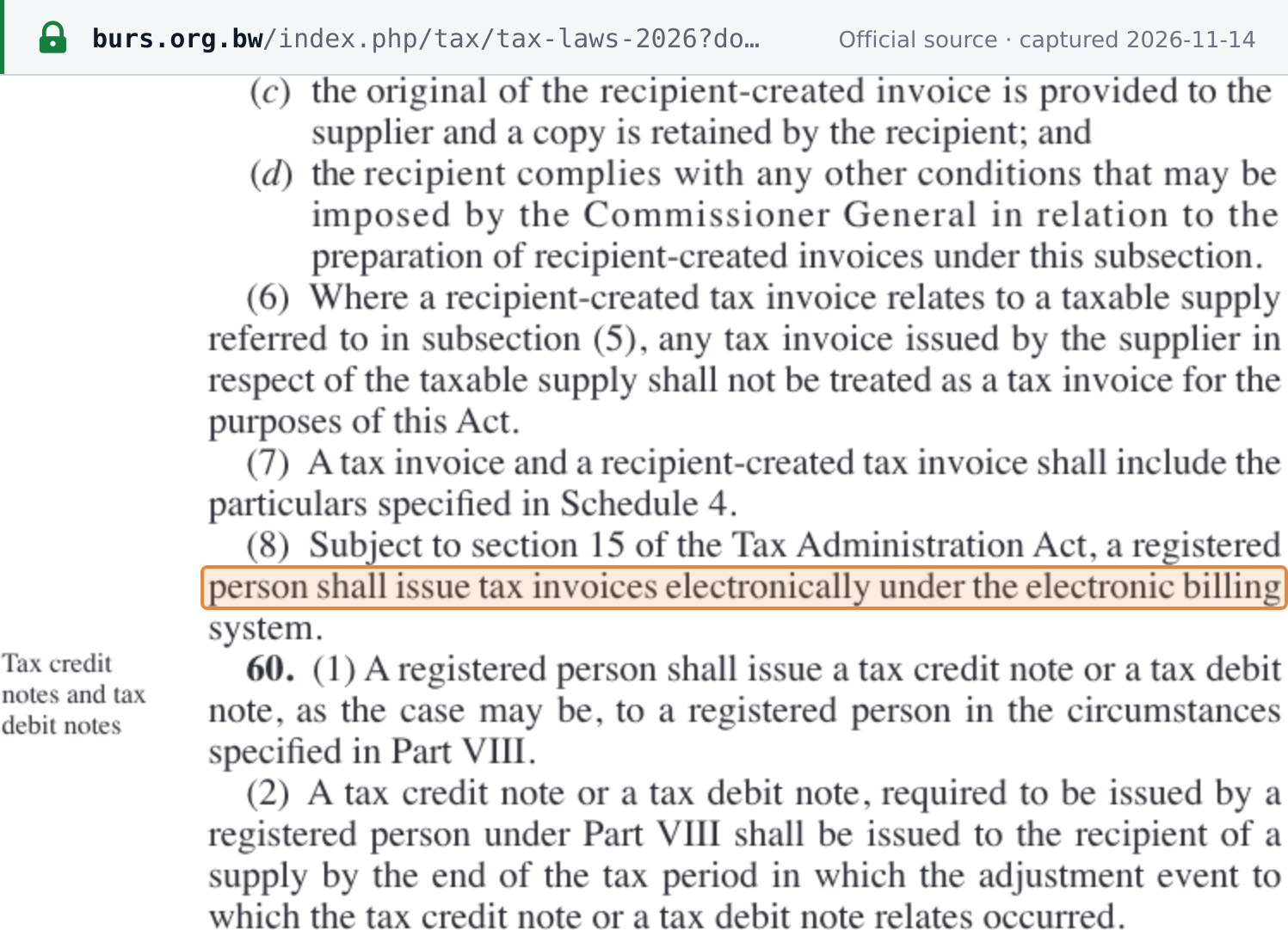
Status (as at 15 November 2026): enacted, not yet operative. Section 59(8) of the VAT Act, 2026: "Subject to section 15 of the Tax Administration Act, a registered person shall issue tax invoices electronically under the electronic billing system." Section 60(4) applies the same words to tax credit and debit notes. Both sections came into force on 1 July 2026, but the electronic billing system itself commences later. [2]
 Source snapshot captured 2026-11-14 — original
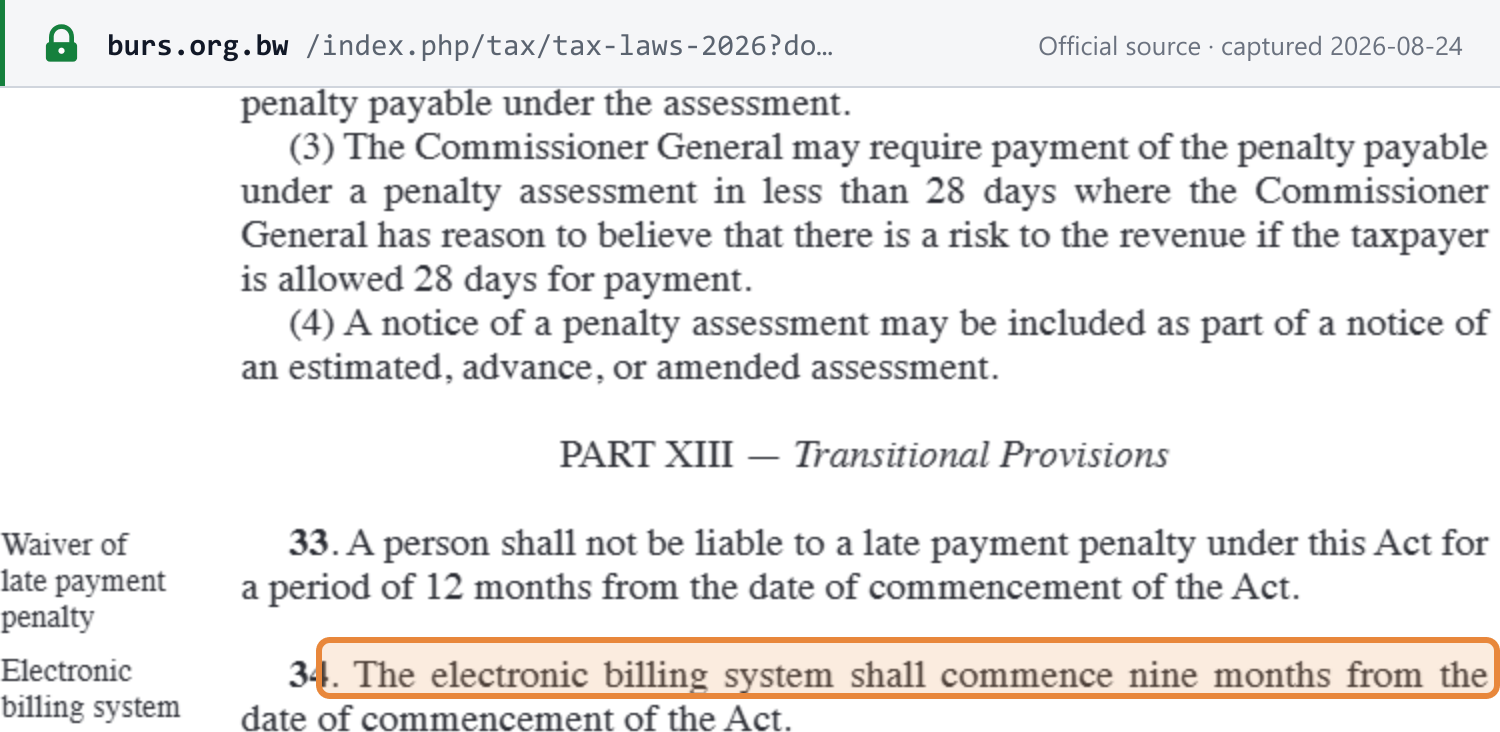
The start date is set by regulation 34. The Tax Administration Regulations, 2026 (S.I. No. 90 of 2026), reg 34: "The electronic billing system shall commence nine months from the date of commencement of the Act." The Tax Administration Act came into operation on 1 July 2026 (S.I. No. 91 of 2026, para 2), so nine months on is about 1 April 2027. That calendar date is computed from reg 34; BURS has published no notice confirming it. [1] [1]
 Source snapshot captured 2026-08-24 — original
| Step | Who | What happens | Date | Instrument | State |
|---|---|---|---|---|---|
| Acts in force | Every VAT-registered person (VAT Act); every taxpayer (TAA) | E-invoice obligation enacted; the system has not yet commenced | 1 July 2026 | S.I. No. 95 of 2026 (VAT Act); S.I. No. 91 of 2026 (TAA) | Passed |
| System commences | Same, with no phasing in the law | Tax invoices, credit notes and debit notes issued through the electronic billing system | About 1 April 2027 (nine months from 1 July 2026) | S.I. No. 90 of 2026, reg 34 | Upcoming |
| Approved systems and technical rules | — | BURS approves billing systems; any further regulations under TAA s.127(1)(d) | Not published | — | Not published |
No waves, pilot or turnover bands. No official instrument sets phases by turnover or sector, a voluntary or pilot window, or a postponement. The BURS homepage notices, the Tax Laws 2026 page and both 2026 legislation bundles carry nothing beyond reg 34 on timing. [3] [7]
The VAT Act provisions are already in force. The VAT Act (Part Commencement Date) Order, 2026 (S.I. No. 95 of 2026) brought the Act into operation on 1 July 2026 except for four tourism and gig-platform items; sections 59 and 60 are not among them. The obligation is therefore law today, but it cannot be met until the system commences and BURS has approved billing systems, because the Act defines the electronic billing system as one "approved by the Revenue Service". [2] [1]
Earlier dates that no longer apply.
- April 2026. In the 2026 Budget Speech of 9 February 2026 (para 114) the Minister of Finance said: "The rollout of electronic invoicing, which is anticipated in April 2026 will enable real time transaction monitoring, strengthen compliance, reduce leakages and significantly enhance revenue assurance". That was a policy forecast, not a legal instrument. The regulations made on 22 June 2026 set the start at nine months after 1 July 2026 instead. [4]
- 31 March 2026. BURS's Annual Business Plan 2025-2026 lists initiative 18, "Electronic Vat Invoicing Solution", with a start of 1 April 2022, a finish of 31 March 2026 and the status "C/F" (carried forward). [5]
Nothing built against those dates is lost: no technical rules were ever published, so there is nothing to undo.
Procurement. In the adjudication decisions published for the 11 September 2025 sitting, BURS's Accounting Officer approved a "Request to use Restricted International bidding method for the Provision of E-Billing solution". No award decision for that tender appears among the decisions BURS links from its homepage. [6]
Legal basis
| Instrument | Number / publication | Dates | What it does |
|---|---|---|---|
| Value Added Tax Act, 2026 | Act No. 15 of 2026; Supplement A, Botswana Government Extraordinary Gazette of 1 July 2026 | Passed by the National Assembly 13 April 2026; in force 1 July 2026 (S.I. No. 95 of 2026) | s.59(8) tax invoices and s.60(4) credit and debit notes issued electronically under the electronic billing system; s.59(1)-(7) and Schedule 4 invoice rules and particulars; s.86 lets the Minister amend Schedules 4 and 5 by Order; s.87 repeals the previous VAT Act (Cap. 50:03) |
| Tax Administration Act, 2026 | Act No. 14 of 2026 | Passed 13 April 2026; assent 29 June 2026; in force 1 July 2026 (S.I. No. 91 of 2026) | s.2 definitions of "electronic billing system" and "electronic invoice"; s.14(6) electronic-records notices; s.15 use of the electronic billing system; s.48 business closure; s.100 penalties; s.108(4)-(5) invoice penalties; s.112 offence; s.127(1)(d) regulations |
| Tax Administration Regulations, 2026 | S.I. No. 90 of 2026 | Made 22 June 2026; published 30 June 2026; in force 1 July 2026 | reg 2 defines "user of a system"; reg 34 commencement of the electronic billing system |
| Tax Administration Act (Commencement Date) Order, 2026 | S.I. No. 91 of 2026 | Made and published 30 June 2026 | TAA in force 1 July 2026 |
| VAT Act (Part Commencement Date) Order, 2026 | S.I. No. 95 of 2026 | Made and published 30 June 2026 | VAT Act in force 1 July 2026, with four exceptions that do not touch invoicing |
| Value Added Tax Regulations, 2026 | S.I. No. 94 of 2026 | Published 30 June 2026 | reg 16: invoice or receipt of a registered remote-services supplier |
Technical standards. None for invoices: neither the 2026 instruments nor burs.org.bw name an XML, UBL, JSON or other technical standard for electronic invoices. Regulation 26(1) of S.I. No. 90 of 2026 lets a taxpayer present evidence or information to the Commissioner General as CSV, XML, PDF or "The “JSON” or “XML” Real-Time Standard"; that rule concerns information submissions, not the electronic invoice. [1]
Scope
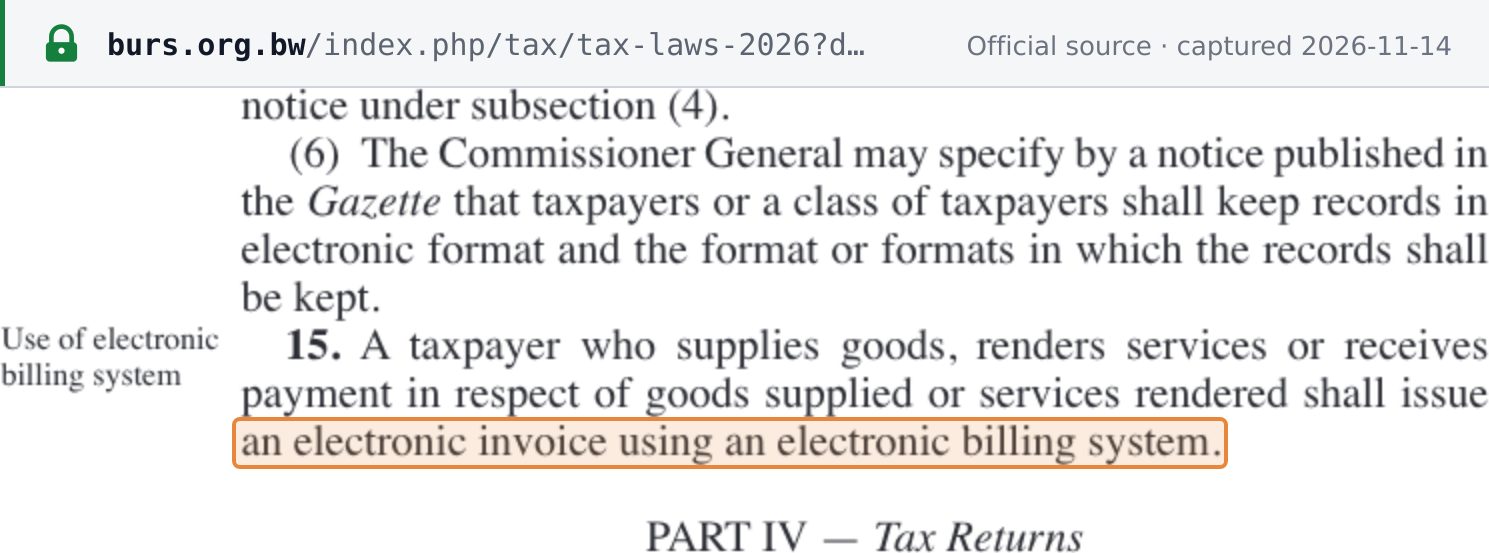
Who: VAT-registered persons, and on the face of the TAA every taxpayer. The VAT Act puts the duty on "a registered person", meaning a person registered for VAT (s.59(8), s.60(4)). Section 15 of the Tax Administration Act, 2026 is wider: "A taxpayer who supplies goods, renders services or receives payment in respect of goods supplied or services rendered shall issue an electronic invoice using an electronic billing system." The TAA defines a "taxpayer" as "a person registered under section 7 or a person required to apply for registration under section 6 but who has failed to do so", so section 15 reads as reaching people who hold a Taxpayer Identification Number but are not VAT-registered. BURS has published no guidance confirming or narrowing that reading. [1] [1]
 Source snapshot captured 2026-11-14 — original
B2B, B2G and B2C: one rule, one date. The law draws no line between flows. Section 59(1) requires a registered person making a taxable supply to give "the recipient" the original tax invoice, whether or not the recipient is registered (Schedule 4 para 2: "A tax invoice provided to a non-registered person may omit the details specified in paragraph 1 (c)"), and s.59(8) requires tax invoices to be issued electronically. Nothing in the VAT Act or S.I. No. 90 of 2026 carves out sales to government or to consumers, and BURS has published no guidance on flows. [2] [2]
Non-established businesses. Section 59(8) applies to any "registered person", so a VAT-registered non-resident falls within its words. The law treats registered suppliers of remote services separately for documents, though: reg 16 of the VAT Regulations, 2026 (S.I. No. 94 of 2026) has them issue "an invoice or receipt" showing Taxpayer Identification Numbers rather than VAT numbers, and s.62(5) of the VAT Act lets them keep VAT documentation outside Botswana. BURS has not said how the electronic billing system will apply to them. A remote-services supplier whose supplies are all reverse-charged need not register at all (S.I. No. 94 of 2026, reg 15(2)) and so is outside s.59(8). See VAT on digital services by non-resident suppliers. [2] [2]
Supplies that need no tax invoice.
- Cash supplies of P20 or less. "A registered person shall not be required to provide a tax invoice if the total consideration for the taxable supply is in cash and does not exceed the amount specified in paragraph 7 of Schedule 5" (s.59(2)); Schedule 5 para 7 sets that amount at P20. There is no separate simplified-invoice regime with lighter particulars. TAA s.15 has no P20 carve-out, and BURS has not said whether such sales must still pass through the system. [2]
- Reverse-charged supplies. The supplier "shall not provide a tax invoice" (s.59(3)); the registered recipient prepares a recipient-created tax invoice instead (s.59(4)). Section 59(8) speaks only of "tax invoices", and no official text says whether a reverse-charge recipient-created tax invoice must go through the electronic billing system. A self-billed invoice made with the Commissioner General's approval under s.59(5) is "treated, for the purposes of this Act, as a tax invoice issued by the supplier". See reverse charge explained. [2]
- Exempt supplies and imports. Section 59(1) applies to taxable supplies, so exempt supplies need no tax invoice under the VAT Act; TAA s.15 ("supplies goods, renders services") is not limited to taxable supplies, and BURS has not reconciled the two. Imports are documented through customs, not by a tax invoice: the input tax credit on a taxable import rests on "a customs import declaration document issued by a customs officer" (VAT Act s.31(4)(a)). [2]
Format & network
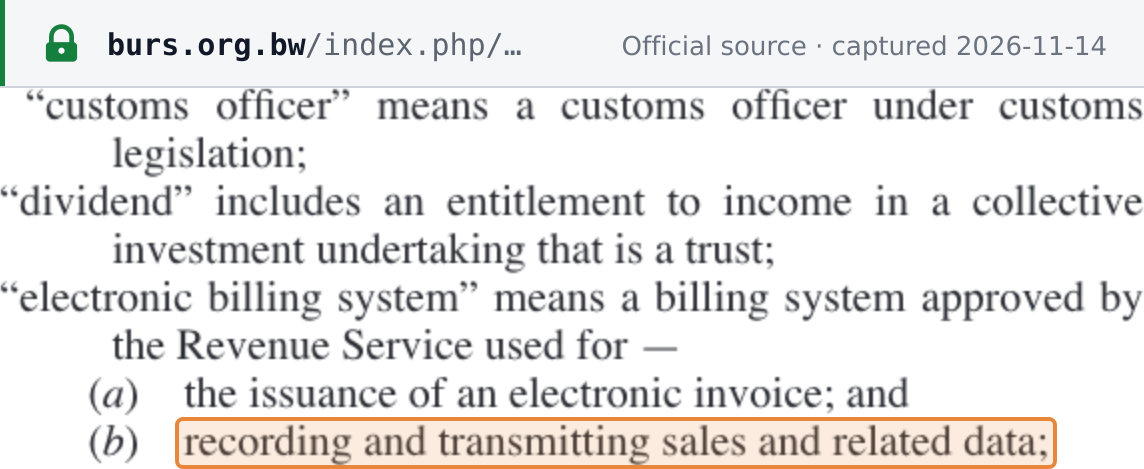
The model: not published. The only official description of the system is the TAA definition: a billing system approved by BURS, used for "(a) the issuance of an electronic invoice; and (b) recording and transmitting sales and related data". That establishes that invoices will be issued through a BURS-approved system and that sales data will be transmitted. It does not say whether BURS will clear (validate and stamp) each invoice before it reaches the buyer, receive it in real time after issue, or audit it later. The Minister's 2026 Budget Speech described the aim as enabling "real time transaction monitoring". See CTC e-invoicing models. [1] [4]
 Source snapshot captured 2026-11-14 — original
What BURS has not published (as at 2026-11-14). On burs.org.bw (homepage notices, the Tax Laws 2026 page) and in the 2026 Acts and regulations:
- no technical specification, XML, UBL or JSON schema, or API documentation for electronic invoices (reg 26 of S.I. No. 90 of 2026, on formats for information submitted to the Commissioner General, is not an invoice rule);
- no QR-code, digital-signature, hash or stamp requirement;
- no list of approved billing systems and no procedure for getting a system approved;
- nothing on Peppol: the system is not Peppol-based on any official source;
- no e-reporting obligation separate from the "recording and transmitting sales and related data" in the definition.
Not a fiscal-device regime by name. Some commentary describes Botswana's rule as an "electronic fiscal device" (EFD) requirement. The phrase "fiscal device" appears in neither the VAT Act, 2026 nor the Tax Administration Act, 2026 or their 2026 regulations; the statutes say "electronic billing system". For how device-based regimes work elsewhere, see fiscal devices and certified cash registers. [1] [2]
Electronic record formats. Separately, TAA s.14(6): "The Commissioner General may specify by a notice published in the Gazette that taxpayers or a class of taxpayers shall keep records in electronic format and the format or formats in which the records shall be kept." No such notice has been published. Failing to comply with one, once issued, carries a fixed penalty of P50,000 (s.99(7)). [1] [1]
What an electronic invoice must contain
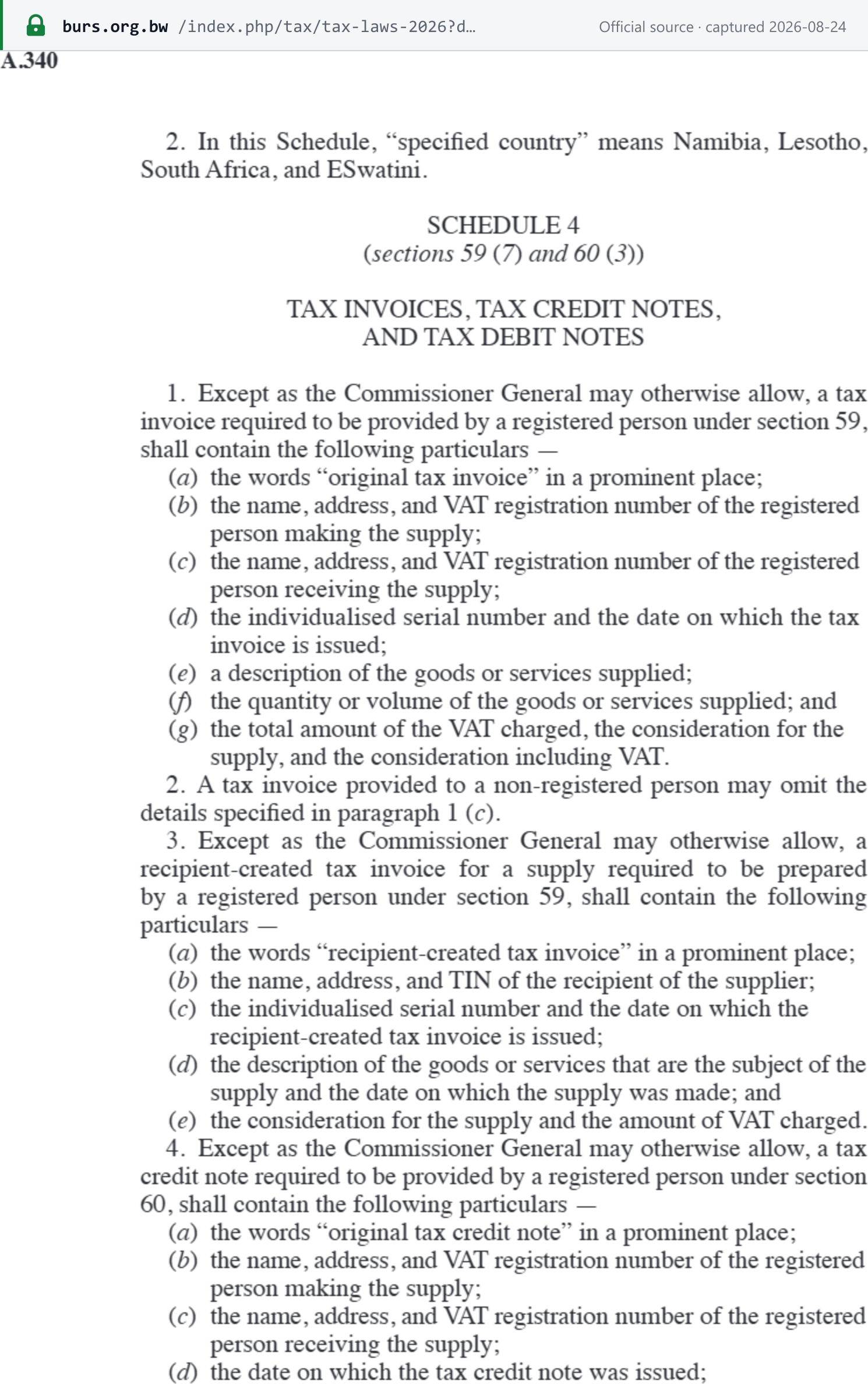
The particulars are statutory and do not depend on the system. Schedule 4 of the VAT Act, 2026, para 1, "Except as the Commissioner General may otherwise allow": a tax invoice must show
- (a) the words "original tax invoice" in a prominent place;
- (b) the supplier's name, address and VAT registration number;
- (c) the recipient's name, address and VAT registration number (may be omitted for a non-registered recipient, para 2);
- (d) the individualised serial number and the date of issue;
- (e) a description of the goods or services;
- (f) the quantity or volume supplied;
- (g) the total VAT charged, the consideration, and the consideration including VAT.
A recipient-created tax invoice carries the words "recipient-created tax invoice" and the recipient's TIN (para 3). Tax credit and debit notes carry the words "original tax credit note" or "original tax debit note", both parties' VAT numbers, the date of issue, the original and correct values with the difference and the VAT on it, a brief explanation of the adjustment event, and information identifying the original supply (paras 4-5). The Minister may amend Schedule 4 by Order in the Gazette (s.86). [2]
 Source snapshot captured 2026-08-24 — original
Timing and copies. A tax invoice is provided "at the time of the supply" (s.59(1)); a credit or debit note by the end of the tax period in which the adjustment event occurred (s.60(2)). A recipient who has not received a document may ask for it in writing within 60 days of the supply, and the supplier "shall comply with the request within 14 days after receiving the request" (s.61). Only one original may be issued, "but a copy clearly marked as such may be issued to a registered person who claims to have lost the original document" (s.62(1)). [2] [2]
BURS publishes no specimen tax invoice or e-invoice. The Botswana VAT guide shows a specimen built from Schedule 4.
Onboarding: how to comply
Not yet available (as at 2026-11-14). BURS has published no registration portal, credentials or device-registration step for the electronic billing system, no sandbox or test environment, no list of accredited providers and no connection modes (portal, API or other). S.I. No. 90 of 2026 defines a "user of a system" as "a person who is required to use an electronic billing system" (reg 2), but no regulation yet uses that term to set procedures. The BURS homepage links an "Application Form for eServices"; BURS does not present eServices as the electronic billing system. [1] [7]
What can be done before the system starts.
- Bring invoice, credit-note and debit-note templates into line with Schedule 4: the words "original tax invoice", "original tax credit note" and "original tax debit note", serial numbering and both parties' VAT numbers.
- List every place invoices are produced (ERP, point of sale, billing platforms, manual books), since s.59(8) and TAA s.15 attach to each tax invoice, not to a system or a turnover band.
- Watch the BURS homepage and the Tax Laws 2026 page for regulations under TAA s.127(1)(d), a Gazette notice under s.14(6), or a list of approved billing systems.
Penalties
All in the Tax Administration Act, 2026. They bite once a person is required to use the system, which cannot be before the system commences under reg 34.
| Failure | Consequence | Provision |
|---|---|---|
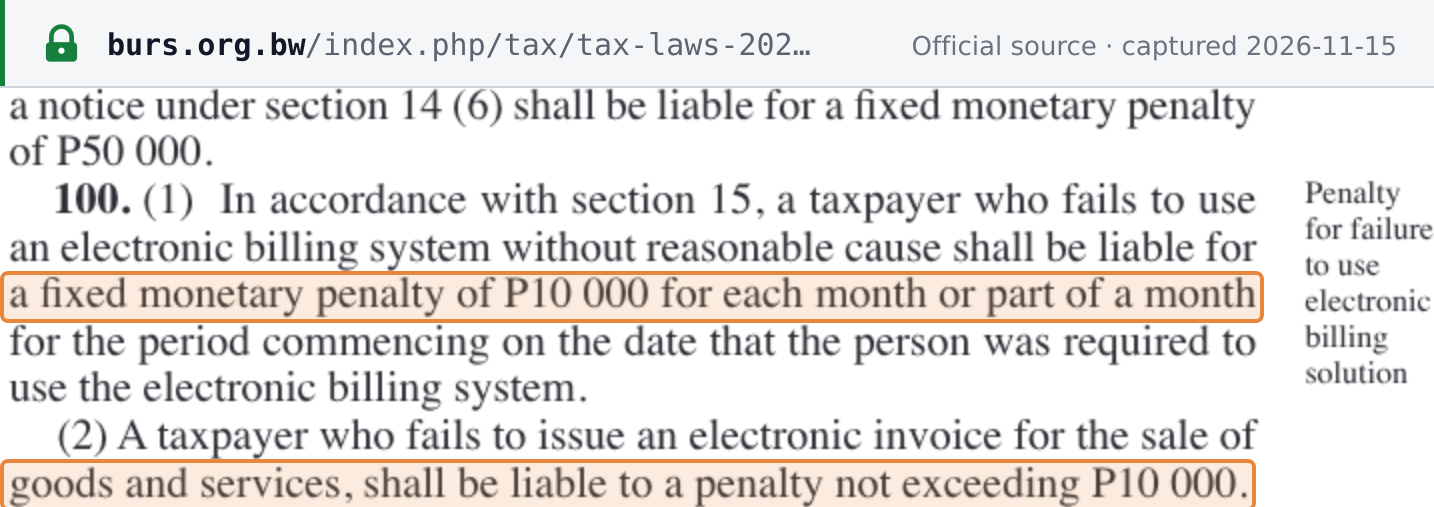
| Not using the electronic billing system without reasonable cause | P10,000 fixed penalty for each month or part of a month, from the date the person was required to use it | s.100(1) |
| Not issuing an electronic invoice for a sale | Penalty not exceeding P10,000 | s.100(2) |
| Not providing, or issuing otherwise than as provided, a tax invoice, tax credit note or tax debit note | P10,000 fixed penalty each | s.108(4)-(5) |
| Misleading use of the system, issuing a false or materially incorrect electronic invoice, or tampering with the system | Offence: fine up to P100,000, imprisonment up to two years, or both | s.112 |
| Not complying with the requirements of the electronic billing system | Notice of intended closure; if not remedied within seven days, closure of part or all of the business premises for up to 14 days | s.48 |
Section 100(1): "In accordance with section 15, a taxpayer who fails to use an electronic billing system without reasonable cause shall be liable for a fixed monetary penalty of P10 000 for each month or part of a month for the period commencing on the date that the person was required to use the electronic billing system." Section 112: "A person who — (a) uses an electronic billing system in any manner that misleads the Commissioner General; (b) issues an electronic invoice that is false or incorrect in any material particular; or (c) tampers with or causes the electronic billing system to work improperly, commits an offence and shall be liable to a fine not exceeding P100 000 or imprisonment for a term not exceeding two years, or to both."
Section 108(4) and (5) refer to tax invoices, credit notes and debit notes "as required under section 60 or 61 of the Value Added Tax Act"; the tax-invoice rule itself is in s.59. The text is quoted as enacted.
 Source snapshot captured 2026-11-15 — original
Enforcement posture. No grace period or tolerance for the electronic billing system has been announced. The 12-month waiver in reg 33 of S.I. No. 90 of 2026 covers late payment penalties only and is unrelated to e-invoicing. [1]
Frequently asked questions
The VAT Act commenced on 1 July 2026. Do we have to issue e-invoices already?
No. Sections 59(8) and 60(4) of the VAT Act, 2026 are in force, but regulation 34 of S.I. No. 90 of 2026 says the electronic billing system commences nine months after the Tax Administration Act's commencement on 1 July 2026, which is about 1 April 2027. The Act also defines the system as one approved by BURS, and as at 2026-11-14 BURS had approved none and published no confirming notice.
Is this an electronic fiscal device (EFD) regime?
The statutes do not use that term. The VAT Act, 2026 and the Tax Administration Act, 2026 speak of an "electronic billing system" approved by BURS, used to issue electronic invoices and to record and transmit sales data. The phrase "fiscal device" does not appear in either Act or their 2026 regulations.
Do businesses that are not VAT-registered have to issue e-invoices?
Possibly. The VAT Act duty is on VAT-registered persons, but section 15 of the Tax Administration Act, 2026 puts it on every "taxpayer" who supplies goods or services, and a taxpayer is anyone registered (or required to register) for a Taxpayer Identification Number. BURS has published no guidance on this.
Does the April 2026 date in the 2026 Budget Speech still apply?
No. The Minister anticipated the rollout in April 2026 in the Budget Speech of 9 February 2026, but the Tax Administration Regulations made on 22 June 2026 set the start at nine months after 1 July 2026, about 1 April 2027.
What should our invoices say?
Schedule 4 of the VAT Act, 2026 requires the words "original tax invoice" in a prominent place, and "original tax credit note" or "original tax debit note" on adjustment documents, together with the supplier's and recipient's names, addresses and VAT numbers, an individualised serial number and date, a description, the quantity, and the VAT and consideration totals.
What does not using the system cost?
Once a person is required to use it: P10,000 for each month or part of a month (Tax Administration Act s.100(1)) and up to P10,000 for failing to issue an electronic invoice (s.100(2)). Misleading use, false electronic invoices or tampering are an offence carrying a fine up to P100,000, up to two years' imprisonment, or both (s.112), and BURS may close business premises for up to 14 days (s.48).
Recent changes
- 2026-07-01 — VAT Act, 2026 ss.59(8) and 60(4) and Tax Administration Act, 2026 s.15 in force; S.I. No. 90 of 2026 reg 34 sets the start of the electronic billing system at nine months from 1 July 2026 (about 1 April 2027). (BURS) — see event
- 2026-07-01 — Schedule 4 invoice particulars of the VAT Act, 2026 in force: "original tax invoice", "original tax credit note", "original tax debit note". (BURS) — see event
- 2026-02-09 — 2026 Budget Speech: the Minister of Finance anticipated the e-invoicing rollout in April 2026, later replaced by the reg 34 start. (Government of Botswana)
Related resources
- Botswana VAT guide — rates, registration, invoice requirements, filing, penalties
- E-invoicing status and networks by country
- CTC e-invoicing models explained
- Fiscal devices and certified cash registers
- Reverse charge explained
- South Africa e-invoicing
- Botswana tax changes on Lookuptax
Important websites
- BURS — Tax Laws 2026 — the VAT Act, 2026 and Tax Administration Act, 2026 bundles with their regulations
- BURS homepage — public notices
- No electronic billing portal or sandbox has been published.
Reference links
- Tax Administration Act, 2026 (Act No. 14 of 2026), with S.I. No. 90 and S.I. No. 91 of 2026 (PDF, BURS)
- Value Added Tax Act, 2026 (Act No. 15 of 2026), with S.I. Nos. 94 to 96 of 2026 (PDF, BURS)
- BURS — Tax Laws 2026
- 2026 Budget Speech, 9 February 2026 (PDF, Government of Botswana)
- BURS Annual Business Plan 2025-2026 (PDF)
- BURS adjudication decisions, 11 September 2025 sitting (PDF)
- BURS homepage