E-invoicing in Georgia: the electronic tax invoice
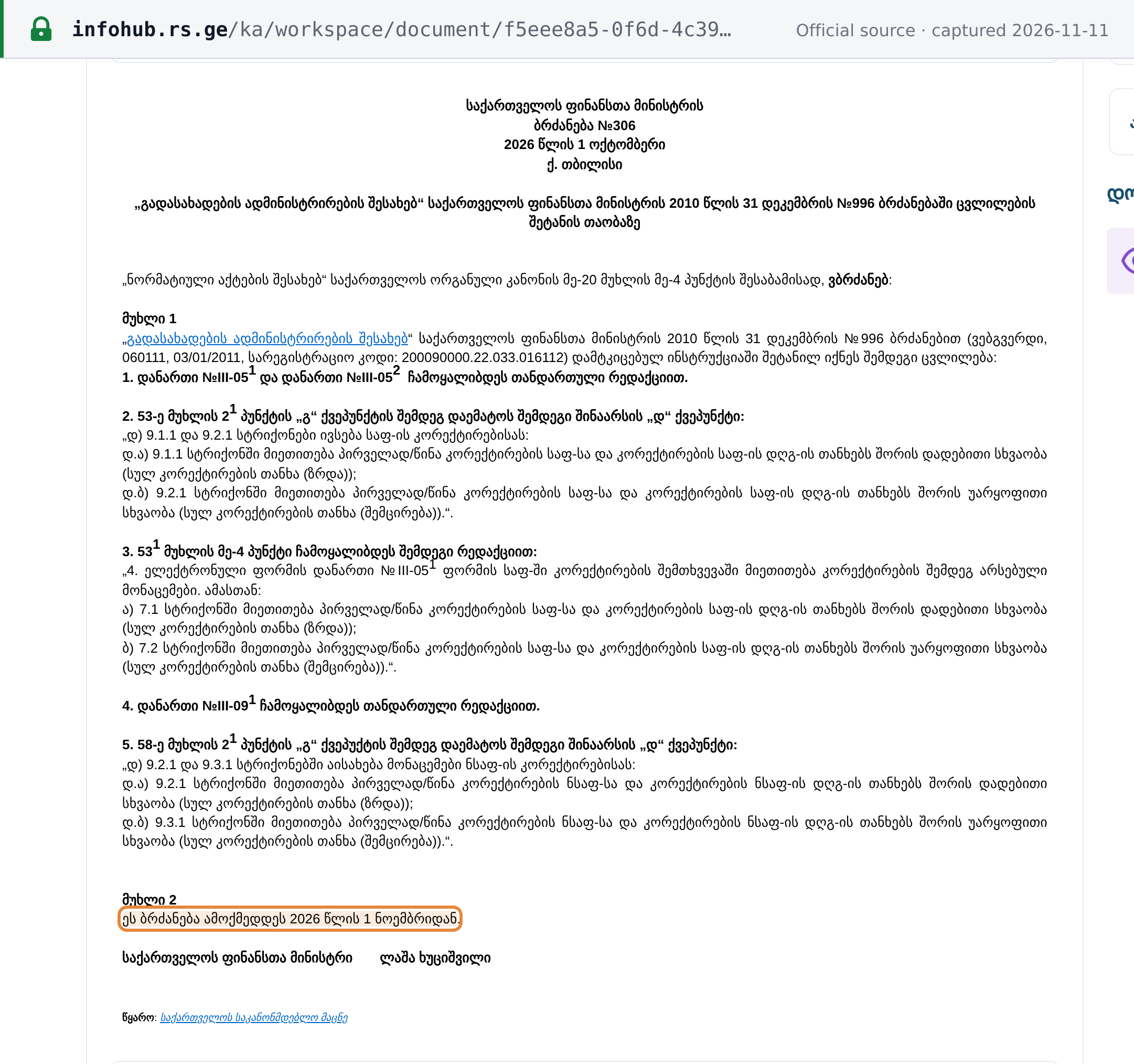
Under Minister of Finance Order No. 306 of 1 October 2026 (in force 1 November 2026, Art. 2), a corrective tax invoice must show the positive or negative difference between its VAT and the VAT on the original or previous corrective invoice: rows 9.1.1 (increase) / 9.2.1 (decrease) on the tax invoice III-05², rows 7.1 / 7.2 on the advance-payment invoice III-05¹, and rows 9.2.1 (increase) / 9.3.1 (decrease) on the special petroleum-products invoice III-09¹. Note that 9.2.1 means a decrease on one form and an increase on the other. See Mandate status & timeline. [2] [4]
Overview
This page is about Georgia the country (South Caucasus, currency lari, GEL), not the US state.
Georgia's e-invoice is the tax invoice (საგადასახადო ანგარიშ-ფაქტურა, abbreviated საფ), issued and confirmed on the authorised portal of the Revenue Service (შემოსავლების სამსახური) of the Ministry of Finance. The Revenue Service publishes no brand name for the system; its portal modules are called "Tax Invoice" and "Special Tax Invoice". [5]
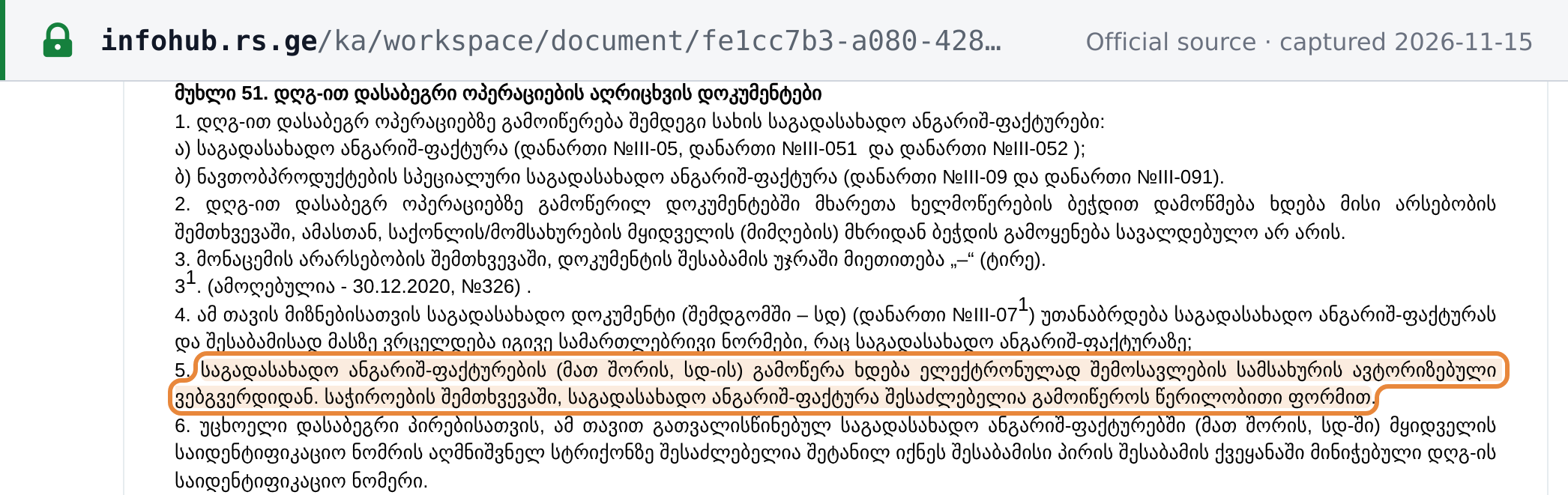
Electronic is the rule, but there is no clearance mandate. The instruction approved by Minister of Finance Order No. 996, Art. 51(5), reads: "საგადასახადო ანგარიშ-ფაქტურების (მათ შორის, სდ-ის) გამოწერა ხდება ელექტრონულად შემოსავლების სამსახურის ავტორიზებული ვებგვერდიდან. საჭიროების შემთხვევაში, საგადასახადო ანგარიშ-ფაქტურა შესაძლებელია გამოიწეროს წერილობითი ფორმით." (Tax invoices, including tax documents, are issued electronically from the authorised website of the Revenue Service. Where necessary, a tax invoice may be issued in written form.) Paper (form III-05) therefore remains lawful as the exception. Order No. 996 Arts. 51–56¹ and Order No. 306 provide for no clearance of each invoice before issue, a clearance stamp or ID, a QR code or a digital signature. [1]
Legal basis in one line. Tax Code of Georgia Arts. 180 and 72¹; Minister of Finance Order No. 996 of 31 December 2010 "On Tax Administration", Instruction Arts. 51–56¹ and 58; amending Orders No. 207 (2025) and No. 306 (2026); Order No. 3751 of the Head of the Revenue Service (2022). See Legal basis.
| Georgia | |
|---|---|
| System | Electronic tax invoice issued on the Revenue Service authorised portal (eservices.rs.ge); no brand name |
| Model | Invoice created on the tax authority's platform, addressed to the buyer's Revenue Service account and confirmed or rejected by the buyer there; data flow into the VAT return. Not a clearance-and-stamp model, not Peppol |
| B2B | Tax invoice required for supplies by a VAT payer to another taxable person (Tax Code Art. 180(1)); issued electronically as the rule, on paper "where necessary" (Order No. 996 Art. 51(5)) |
| B2C | Only if the consumer asks (Tax Code Art. 180(3)) |
| B2G | No separate rule: suppliers to public bodies issue the same tax invoice |
| Non-residents | A foreign buyer's own-country VAT number may go in the buyer-ID line (Order No. 996 Art. 51(6)) |
| Formats | National forms: III-05² (supply), III-05¹ (advance payment), III-09¹ (special petroleum-products invoice), III-07¹ (tax document). No UBL, CII or Peppol |
| Integration | Portal, or the Revenue Service SOAP web services (NtosService for invoices, WayBills for waybills) |
| Latest rule | Corrective invoices show the VAT increase/decrease, from 1 November 2026 (Order No. 306) |
| Authority | Revenue Service, Ministry of Finance of Georgia (rs.ge) |
| Penalties | 100% of the VAT for not issuing an invoice the buyer requested; 200% of the VAT shown for a fictitious or fake invoice (Tax Code Art. 282) |
For VAT rates, registration and the general invoice rules, see the Georgia VAT guide.
Mandate status & timeline
Status (as at 15 November 2026): electronic tax invoices on the Revenue Service portal are the rule; no clearance (CTC) mandate and no phased rollout. Georgia's timeline is therefore a list of rule changes, not of waves. [1]
| Date | What changed | Instrument | State |
|---|---|---|---|
| 1 December 2026 | Businesses buying goods from individuals may issue an electronic purchase document on eservices.rs.ge, confirmed by the seller; from that date it counts as documentary evidence of expenditure. This is an income-tax expense document, not a VAT tax invoice | Amendment of 30 October 2026 to Order N13017 of the Head of the Revenue Service; Minister of Finance Order N332 of 26 October 2026 (Order No. 996 Arts. 27¹ and 31) | Upcoming |
| 1 November 2026 | Corrective tax invoices must show the VAT increase or decrease against the original or previous corrective invoice (rows 9.1.1/9.2.1 on III-05², 7.1/7.2 on III-05¹, 9.2.1/9.3.1 on III-09¹); forms III-05¹, III-05² and III-09¹ restated | Minister of Finance Order No. 306 of 1 October 2026, published 2 October 2026, Art. 2 | In force |
| 1 October 2026 | A buyer with tax invoices still pending confirmation on the 5th of the month loses access to all Revenue Service e-services except the invoice modules until it confirms or rejects them | Revenue Service procedure announced 7 July 2026 | In force |
| 1 September 2025 | Electronic form III-05² for supplies, including corrections | Minister of Finance Order No. 207 of 4 August 2025 | In force |
| 1 March 2022 | Current rules on qualified / non-qualified VAT payer status take effect (Order No. 3751): a non-qualified payer's right to issue and confirm electronic tax invoices is suspended | Order No. 3751 of the Head of the Revenue Service, 16 February 2022 | In force |
| 1 January 2011 | Order No. 996 "On Tax Administration" in force: the instruction that sets the tax-invoice forms and procedure | Minister of Finance Order No. 996 of 31 December 2010 | In force |
The latest change: Order No. 306, in force 1 November 2026. The order was adopted on 1 October 2026 and published on 2 October 2026. Article 2: "ეს ბრძანება ამოქმედდეს 2026 წლის 1 ნოემბრიდან." (This order enters into force on 1 November 2026.) The Revenue Service announced it on 3 November 2026; its Georgian notice states that "მიმდინარე წლის 1 ნოემბრიდან ამოქმედდება ცვლილება" (the change takes effect from 1 November of this year) in the Order No. 996 instruction. [2] [3]
 Source snapshot captured 2026-11-11 — original
The Revenue Service's English notice spells out the rows: "When correcting a Tax Invoice: Field 9.1.1 shall indicate the increase in the VAT amount; Field 9.2.1 shall indicate the decrease in the VAT amount. When correcting an Advance Payment Tax Invoice: Field 7.1 shall indicate the increase in the VAT amount; Field 7.2 shall indicate the decrease in the VAT amount. When correcting a Special Petroleum Products Tax Invoice (PPTI): Field 9.2.1 shall indicate the increase in the VAT amount; Field 9.3.1 shall indicate the decrease in the VAT amount." [4]
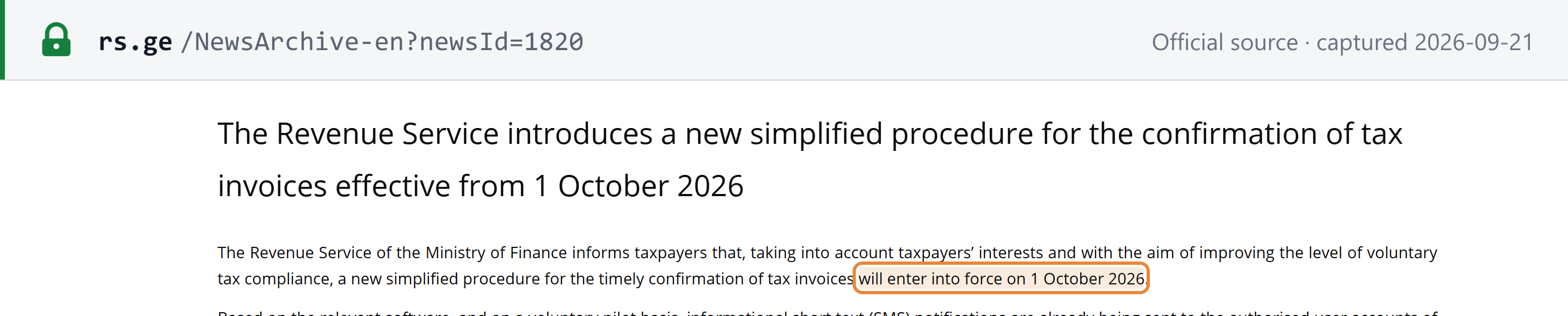
Buyer confirmation, from 1 October 2026. "If, as of the 5th day of the month following the month after the end of the reporting period (i.e. on the 5th day of each month), the recipient still has tax invoices and/or special tax invoices pending confirmation, both the primary user and any sub-users of the taxpayer’s authorised account will be restricted from using all electronic services, except for the Tax Invoice/Special Tax Invoice modules." Access returns once the invoices are confirmed or rejected. [5]
 Source snapshot captured 2026-09-21 — original
No further phase announced. The Revenue Service's legal-updates archive announces no clearance model, no Peppol plan and no structured-format (XML) requirement for tax invoices. The consolidated text of Order No. 996 does not state when Art. 51(5) took effect. [4] [1]
Legal basis
| Instrument | What it does for e-invoicing | Published / in force |
|---|---|---|
| Tax Code of Georgia, Art. 180 | Tax-invoice duty (B2B; B2C on request); "A tax invoice shall be issued in a writing or electronic form"; forms and procedure delegated to the Minister of Finance | Current wording: Law No 6817 of 14 July 2020 |
| Tax Code Art. 72¹ | Tax document (form III-07¹) replaces the consignment note and the tax invoice; "may be issued and submitted in an electronic form" | — |
| Tax Code Art. 282 | Invoice penalties | — |
| Minister of Finance Order No. 996 of 31 December 2010 "On Tax Administration", Instruction Arts. 51–56¹ and 58 | Forms, electronic issuance from the Revenue Service website (Art. 51(5)), requisites, corrections, cancellation, 30-day deadline | Published 3 January 2011; in force 1 January 2011; consolidated text on the Revenue Service infohub includes Order No. 306 |
| Minister of Finance Order No. 207 of 4 August 2025 | Electronic form III-05²; restated Arts. 51(1) and 52(1) | Published 5 August 2025; in force 1 September 2025 |
| Minister of Finance Order No. 306 of 1 October 2026 | Restated forms III-05¹, III-05², III-09¹; VAT increase/decrease rows on corrective invoices | Published 2 October 2026; in force 1 November 2026 |
| Order No. 3751 of the Head of the Revenue Service, 16 February 2022 | Qualified / non-qualified VAT payer status; suspension of the right to issue and confirm electronic tax invoices | Published 24 February 2022; in force 1 March 2022 |
| Minister of Finance Order N332 of 26 October 2026; Order N13017 of the Head of the Revenue Service (12 June 2023), amended 30 October 2026 | Electronic purchase document for goods bought from individuals | Applies from 1 December 2026 (Revenue Service notice) |
Technical standards. None. No XML schema, XSD, UBL or CII profile is published as a binding standard in Order No. 996 Arts. 51–56¹, Order No. 306 or the Revenue Service notices of 2026: the annexed forms are the standard. Matsne sells the consolidated text of Order No. 996 to subscribers; the Revenue Service's infohub publishes it free.
Scope
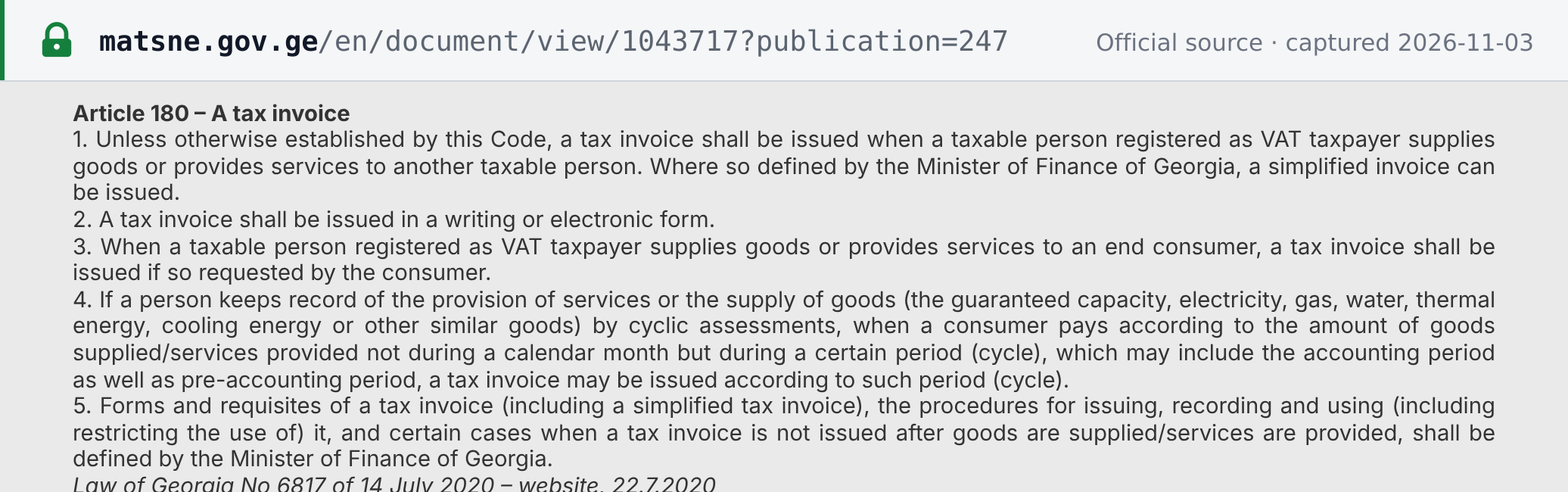
- B2B. "Unless otherwise established by this Code, a tax invoice shall be issued when a taxable person registered as VAT taxpayer supplies goods or provides services to another taxable person." (Tax Code Art. 180(1)). Under Order No. 996 Art. 51(5) it is issued electronically from the Revenue Service website, with paper "where necessary". [6] [1]
- B2C. A tax invoice is issued to an end consumer only "if so requested by the consumer" (Art. 180(3)). [6]
- B2G. Order No. 996 Arts. 51–56¹ contain no separate rule for public-sector buyers; a supplier to a public body issues the same tax invoice. We found no separate B2G e-invoicing system in the Revenue Service's rules. [1]
- Foreign buyers. For foreign taxable persons, the buyer-ID line of the invoice (including the tax document) may carry "შესაბამისი პირის შესაბამის ქვეყანაში მინიჭებული დღგ-ის საიდენტიფიკაციო ნომერი" (the VAT identification number assigned to that person in its country) (Order No. 996 Art. 51(6)). [1]
- Non-established suppliers. The invoice duty attaches to a "taxable person registered as VAT taxpayer" (Art. 180(1)). Foreign suppliers of digital services to consumers account for VAT under a separate simplified regime without registering as VAT payers (see the Georgia VAT guide); neither the Tax Code's invoice article (Art. 180) nor Order No. 996 Arts. 51–56¹ imposes the portal invoice on them.
- Exempt supplies. A tax invoice is not mandatory for VAT-exempt transactions unless the instruction provides otherwise (Order No. 996 Art. 52(5)). For a transaction exempt with the right of deduction, "0" is written in the VAT rows (Art. 53(8)). [1]
- Simplified invoice. The Tax Code allows one "where so defined by the Minister of Finance" (Art. 180(1)); Order No. 996 Arts. 51–56¹ define no simplified-invoice regime or value threshold.
- Summary invoices. At the buyer's request, one III-05 or III-05² invoice may cover a reporting period's deliveries or services (Order No. 996 Art. 53(7)–(7¹)). [1]
 Source snapshot captured 2026-11-03 — original
Format & network
Model: a centralised portal, not clearance-and-stamp. The seller creates the invoice on the Revenue Service's own platform (portal or web service), addressed to the buyer's account; the buyer confirms or rejects it there. Invoice data then feed the VAT return: "საფ-ის მონაცემები შეიტანება საგადასახადო ორგანოში წარსადგენ დღგ-ის დეკლარაციაში" (invoice data are entered in the VAT return filed with the tax authority, Art. 54(2)). Order No. 996 Arts. 51–56¹ describe no validation-then-stamp step, clearance ID, QR code, hash or digital signature. For the taxonomy, see CTC e-invoicing models. [1]
 Source snapshot captured 2026-11-15 — original
| Document | Paper form | Electronic form |
|---|---|---|
| Tax invoice (supply, including corrections) | III-05 | III-05² (since 1 September 2025) |
| Advance-payment tax invoice | — | III-05¹ |
| Special petroleum-products tax invoice | III-09 | III-09¹ |
| Tax document (combined waybill and invoice) | — | III-07¹, completed electronically |
- Format. The national forms above, annexed to Order No. 996 and in Georgian. No XML, UBL or CII schema is published as a binding standard.
- Peppol. Not Peppol-based. OpenPeppol's list of Peppol Authorities does not include Georgia, and the Revenue Service publishes no Peppol or UBL requirement. [12]
- Content rules. A paper invoice is issued in two copies; an electronic one is not ("საფ-ი (გარდა ელექტრონული ფორმის საფ-ისა) გამოიწერება 2 ეგზემპლარად", Art. 53(1)). An empty box gets a dash "–" (Art. 51(3)); a seal is used only where the party has one, and the buyer never needs one (Art. 51(2)). [1]
- Deadline to hand over. The first copy of a completed III-05 or III-05¹ invoice goes to the buyer "მოთხოვნიდან არა უგვიანეს 30 კალენდარული დღისა" (no later than 30 calendar days from the request, Order No. 996 Art. 54(1)). That article does not name the electronic supply form III-05². [1]
- Corrections. A corrective invoice is issued only if an invoice was issued for the original supply (Art. 55(1)). The electronic form shows the data as they stand after correction ("ელექტრონული ფორმის საფ-ში მიეთითება კორექტირების შემდეგ არსებული მონაცემები", Art. 55(2)(a)); paper corrections show "before" and "after" lines. Since 1 November 2026 the VAT difference goes in the rows set by Order No. 306 (see the box at the top). The comparison base is the original invoice or, in a chain of corrections, the previous corrective one. [1] [2]
- Cancellation. The seller sends the buyer a cancellation request for an electronic III-05¹ or III-05² invoice through the software. If either party has already included the invoice in its VAT return annexes, it must first be removed on application to the tax authority. "საფ გაუქმებულად ითვლება მყიდველის (მიმღების) მიერ გაუქმების მოთხოვნის დადასტურებისას." (The invoice is deemed cancelled when the buyer confirms the cancellation request, Art. 54(3¹).) [1]
- Tax document (III-07¹). Equated with a tax invoice for these rules (Art. 51(4)). It is completed electronically when goods are transported within the country, or supplied with transport, before transport starts, and also at the recipient's request within 30 calendar days (Art. 56¹(1)). Issuing it removes the duty to issue a consignment note or tax invoice (Tax Code Art. 72¹(2)). [1] [6]
- E-reporting alongside. No separate e-reporting obligation: invoice data flow into the monthly VAT return (Art. 54(2)), and goods movements use the electronic waybill or the tax document.
Onboarding: how to comply
- Registration. Taxpayers use the Revenue Service authorised portal (eservices.rs.ge), with a primary user and optional sub-users; the Tax Invoice and Special Tax Invoice modules are where invoices are issued, confirmed and rejected. [5] [9]
- Qualified status first. A newly registered VAT payer is given non-qualified status (Order No. 3751 Art. 2(1)(a)). While it lasts, the payer's right to use tax invoices and tax documents "(ელექტრონული ფორმით გამოწერის/დადასტურების ან/და ჩათვლის მიღების)" (to issue or confirm them electronically and/or obtain credit) is suspended, and it may not hand them out on paper either (Art. 1(2)). Other grounds (Art. 2(1)(b)–(d)): a qualified payer that, in any 12 consecutive calendar months, filed no tax return (other than a property-tax return) or filed returns showing tax of no more than GEL 1, where 6 calendar months have passed since qualified status was last granted; no active bank account on record with the Revenue Service; or a decision of the Head of the Revenue Service. [8]
- Connection modes. The portal suits low volumes. For ERP integration the Revenue Service runs SOAP web services: NtosService for tax invoices (operations include
save_invoice,get_buyer_invoices,acsept_invoice_statusandadd_inv_to_decl) and WayBills for electronic waybills. Their operations are listed on the service description pages linked here (with WSDL definitions). [10] [11] - Accredited providers. Not applicable: invoices are issued on the Revenue Service platform itself, and no instrument on this page sets up certified providers.
- Testing environment. The Order No. 996 instruction and the Revenue Service notices cited here describe no test or sandbox environment.
Penalties
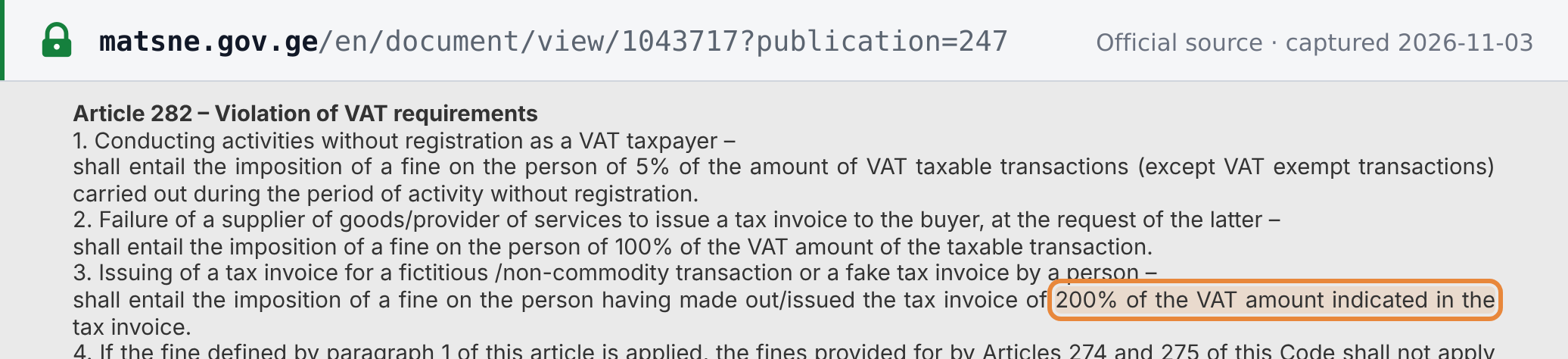
- Not issuing an invoice the buyer asked for: "a fine on the person of 100% of the VAT amount of the taxable transaction" (Tax Code Art. 282(2)). [6]
- Fictitious or fake invoice: a fine on the issuer "of 200% of the VAT amount indicated in the tax invoice" (Art. 282(3)). [6]
- Trading without VAT registration: 5% of the VAT-taxable transactions of the unregistered period (Art. 282(1)). [6]
- Unconfirmed invoices (from 1 October 2026): loss of access to the other Revenue Service e-services, not a fine (see timeline). [5]
The Tax Code sets no fine specific to the electronic channel or to the Order No. 306 correction rows.
 Source snapshot captured 2026-11-03 — original
Frequently asked questions
Since November our corrective invoices need extra rows. What changed?
From 1 November 2026 (Minister of Finance Order No. 306), a corrective tax invoice III-05² must show the VAT difference against the original or previous corrective invoice: an increase in row 9.1.1, a decrease in row 9.2.1. On an advance-payment invoice III-05¹ the rows are 7.1 and 7.2; on a special petroleum-products invoice III-09¹, row 9.2.1 is the increase and 9.3.1 the decrease. [2] [4]
We lost access to rs.ge services because a supplier's invoice was still pending. Why?
Since 1 October 2026, if a buyer still has tax invoices pending confirmation on the 5th of the month, its primary user and all sub-users lose every Revenue Service e-service except the Tax Invoice and Special Tax Invoice modules. Access returns once the invoices are confirmed or rejected. [5]
Can we still issue a paper tax invoice?
Yes, as the exception. Order No. 996 Art. 51(5) makes issuance from the Revenue Service's authorised website the rule and allows a written invoice "where necessary". A paper invoice is issued on form III-05 in two copies. [1]
How do we cancel an electronic invoice issued by mistake?
Send the buyer a cancellation request through the software. If either party has already included the invoice in its VAT return annexes, first apply to the tax authority to have it removed. The invoice is cancelled only when the buyer confirms the request (Order No. 996 Art. 54(3¹)). [1]
We have just registered for VAT and cannot issue invoices on the portal. Why?
A newly registered VAT payer starts with non-qualified status, which suspends the right to issue or confirm electronic tax invoices, and to hand them out on paper, until qualified status is granted (Order No. 3751 of the Head of the Revenue Service, Arts. 1–2). [8]
Our customer is a foreign company with no Georgian ID number. What goes in the buyer field?
The VAT identification number assigned to the customer in its own country may be entered (Order No. 996 Art. 51(6)). [1]
Recent changes
- 2026-11-01 — Corrective tax invoices must show the VAT increase or decrease against the original or previous corrective invoice (rows 9.1.1/9.2.1; advance invoices 7.1/7.2; petroleum invoices 9.2.1/9.3.1), under Minister of Finance Order No. 306 of 1 October 2026. (Revenue Service) — see event
- 2026-10-01 — Buyers with tax invoices still pending confirmation on the 5th of the month lose access to all Revenue Service e-services except the invoice modules. (Revenue Service) — see event
- 2025-09-01 — Electronic tax-invoice form III-05² for supplies, including corrections, under Minister of Finance Order No. 207 of 4 August 2025. (Matsne)
Related resources
- Georgia VAT guide — rates, registration, invoice requirements, filing
- Georgia tax identification numbers
- E-invoicing status and networks by country
- CTC e-invoicing models explained
- Georgia tax changes on Lookuptax
Important websites
- Revenue Service authorised portal (login)
- Revenue Service of Georgia (English)
- Revenue Service legal information hub (infohub) — consolidated Order No. 996 and amending orders, free
- NtosService web service (tax invoices) and WayBills web service
Reference links
- Minister of Finance Order No. 996 of 31 December 2010 "On Tax Administration", consolidated (Revenue Service infohub, Georgian)
- Minister of Finance Order No. 306 of 1 October 2026 (Revenue Service infohub, Georgian)
- Revenue Service — changes to the correction of tax invoices, 3 November 2026 (Georgian)
- Revenue Service — Changes Regarding the Correction of Tax Invoices, 3 November 2026 (English)
- Revenue Service — new procedure for the confirmation of tax invoices from 1 October 2026 (news, 7 July 2026)
- Tax Code of Georgia, English consolidated publication 247 (Matsne)
- Minister of Finance Order No. 207 of 4 August 2025 (Matsne, Georgian)
- Order No. 3751 of the Head of the Revenue Service, 16 February 2022 (Matsne, Georgian)
- Revenue Service — electronic purchase document for goods purchased from an individual, 5 November 2026
- Ministry of Finance — NtosService web service
- Revenue Service — WayBills web service
- OpenPeppol — Peppol Authorities