E-invoicing in Kenya: eTIMS
Overview
Kenya's e-invoicing system is eTIMS, which the Kenya Revenue Authority (KRA) describes as follows: "eTIMS (electronic Tax Invoice Management System) is a software solution that provides taxpayers with options for a simple, convenient and flexible approach to electronic invoicing." [1] Readers will also meet TIMS, the earlier device route: an upgraded Electronic Tax Register (a "TIMS ETR"). KRA's VAT page says "The electronic tax invoice refers to an invoice generated from a compliant/upgraded Electronic Tax Register (ETR) or from the eTIMS system." [29]
Who runs it. The Kenya Revenue Authority. Invoices from every eTIMS solution are visible on the taxpayer portal at etims.kra.go.ke; the eTIMS Lite web solution runs on eCitizen. [28]
Legal basis in one line. Tax Procedures Act (Cap. 469B) s.23A, which lets the Commissioner establish the system and requires "A person who carries on business" to issue electronic tax invoices through it, with the penalty in s.86 as recast by the Finance Act, 2026 s.48; VAT Act (Cap. 476) s.2, s.42 and s.43(4). [3] [17]
| Kenya | |
|---|---|
| System | eTIMS (electronic Tax Invoice Management System); legacy TIMS ETR devices still allowed for VAT-registered adopters |
| Authority | Kenya Revenue Authority (KRA) |
| Model | Invoices are issued through a KRA channel (Online Portal, eTIMS Client, eTIMS Lite, TIMS ETR device or a system-to-system integration) and transmitted to KRA "on real time or near real time basis"; for integrated systems, the OSCU or VSCU control unit must respond before the receipt can be printed |
| B2B | Mandatory. VAT-registered taxpayers: TIMS rollout from 1 August 2021; every person carrying on business, VAT-registered or not: from 1 September 2023 |
| B2G | Same duty, plus eTIMS–IFMIS matching for suppliers to government entities (KRA notice of 31 August 2026) |
| B2C | Covered: the s.23A(2) duty falls on the seller with no carve-out by buyer type (see Scope) |
| Non-residents | Permanent establishments of non-residents are in scope; registered non-resident suppliers of digital services are exempt from electronic tax invoices |
| Format | KRA's own eTIMS API: the OSCU and VSCU specifications give JSON as the interface data format; KRA's TIS specification also refers to XML messages. No UBL, CII or Peppol |
| Network | Direct to KRA (eTIMS API, eTIMS Client, portals, TIMS ETR devices); not Peppol |
| Integrity | SCU information block on every invoice: control-unit ID and invoice number, internal data, receipt signature and a QR code |
| Penalty | After a notice asking for reasons: the higher of 5% of the tax due, KES 100,000 (company) or KES 10,000 (individual) — TPA s.86, from 1 July 2026 |
| Legislation | TPA s.23A, s.86; VAT Act s.2, s.42, s.43(4); VAT (Electronic Tax Invoice) Regulations, 2020 (Legal Notice No. 189 of 2020); Tax Procedures (Electronic Tax Invoice) Regulations, 2024 (Legal Notice No. 64 of 2024) |
For the VAT rate, registration and the general invoice rules, see the Kenya VAT guide.
Mandate status & timeline
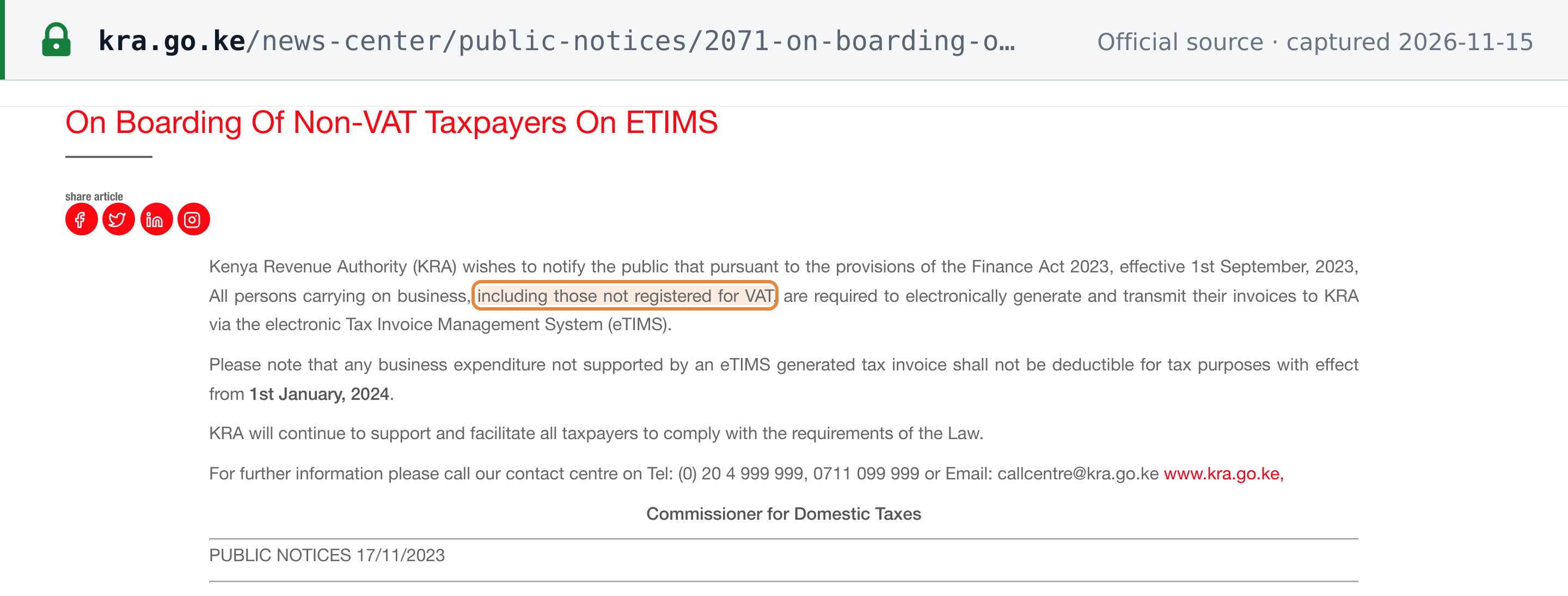
Status (as at 15 November 2026): mandatory and in force for every person carrying on business. KRA public notice 2071 of 17 November 2023: "pursuant to the provisions of the Finance Act 2023, effective 1st September, 2023, All persons carrying on business, including those not registered for VAT, are required to electronically generate and transmit their invoices to KRA via the electronic Tax Invoice Management System (eTIMS)." [2]
 Source snapshot captured 2026-11-15 — original
| Phase | Who | What becomes mandatory | Date | Source | State |
|---|---|---|---|---|---|
| Regulations | — | VAT (Electronic Tax Invoice) Regulations, 2020 gazetted (Legal Notice No. 189 of 2020) | 25 Sep 2020 | KRA notice 1307 | Passed |
| TIMS rollout | All VAT-registered taxpayers | Comply with the electronic tax invoice regulations within 12 months of rollout; extension of up to six months on application at least 30 days before the 12 months end | Rollout from 1 Aug 2021 | KRA notice 1307 (July 2021) | Passed |
| ETR transition | VAT-registered taxpayers on old ETRs | Move to upgraded (TIMS) ETRs; those already holding upgraded devices to finish activation and integration by 31 Aug 2022 | 31 Jul 2022 | KRA press release 1784 (28 Jul 2022) | Passed |
| Input tax | VAT-registered buyers | Accept only electronic tax invoices for input tax claims and refunds; no Tax Compliance Certificate for non-compliant taxpayers | 1 Jun 2023 | KRA notice 1944 (4 May 2023) | In force |
| All businesses | Every person carrying on business, including those not registered for VAT | Generate and transmit invoices through eTIMS | 1 Sep 2023 | KRA notice 2071 (17 Nov 2023); TPA s.23A | In force |
| Deduction rule | All taxpayers | Business expenditure not supported by an eTIMS invoice not deductible | 1 Jan 2024 | KRA notice 2071 | In force |
| Non-VAT grace | Non-VAT-registered taxpayers | Onboarding window with no penalties; manual invoices from 1 Jan 2024 to be captured once onboarded | Ended 31 Mar 2024 | KRA notice 2077 (27 Dec 2023) | Passed |
| Fuel stations | Fuel retailers | Integrate with eTIMS through the eTIMS Fuel Station System (rollout from June 2024 with a voluntary pilot) | 30 Jun 2025; enforcement after 31 Dec 2025 | KRA fuel station page; notice 2331 (25 Nov 2025) | In force |
| Government suppliers | Suppliers to government entities | Valid eTIMS invoice before submission for payment through IFMIS; details must match | Announced 31 Aug 2026 | KRA notice 2388 | In force |
| Stock records | All taxpayers in business | Keep accurate, up-to-date stock records while using TIMS/eTIMS | No go-live date published | KRA notice 2390 (7 Sep 2026) | Announced |
The VAT-registered phase. KRA notice 1307: "the roll out of the Electronic Tax Invoice pursuant to the provisions of the Value Added Tax (Electronic Tax Invoice) Regulations, 2020 shall commence on 1st August 2021. All VAT registered taxpayers shall thereafter be required to comply with the requirements of the regulations on implementation of the Electronic Tax Invoice within a period of twelve (12) months from the date of the roll out." KRA's press release of 28 July 2022 then set "the deadline of the transition from the old Electronic Tax Registers (ETRs) to the upgraded ETRs" at 31 July 2022. [4] [5]
Input tax from 1 June 2023. KRA notice 1944: "effective 1st June 2023, all VAT registered taxpayers are required to only accept electronic tax invoices from registered taxpayers in compliance with the VAT (Electronic Tax Invoice) Regulations 2020 for purposes of claiming input tax and processing of refunds." [6]
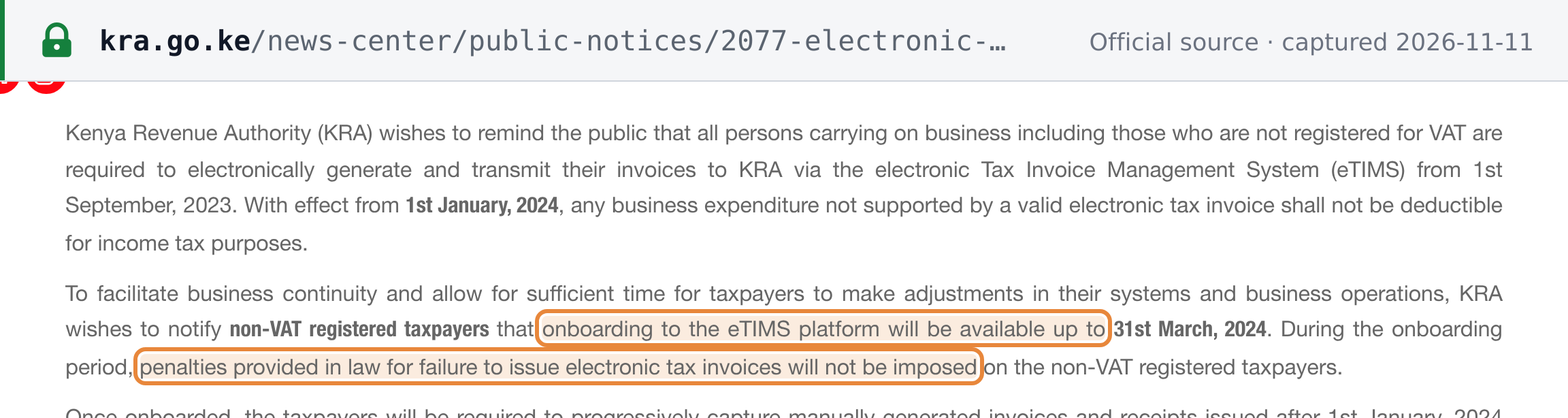
Non-VAT businesses: grace period to 31 March 2024. KRA notice 2077: "onboarding to the eTIMS platform will be available up to 31st March, 2024. During the onboarding period, penalties provided in law for failure to issue electronic tax invoices will not be imposed on the non-VAT registered taxpayers." [7]
 Source snapshot captured 2026-11-11 — original
Pre-filled VAT returns: one postponement on record. KRA notice 2074 (28 November 2023) announced VAT returns "pre-filled with tax information available to KRA with effect from the January 2024 tax period" and said "any input VAT claim that is not validated through TIMS/eTIMS or against existing customs import declarations for import VAT claims will not be allowed." Notice 2088 (12 February 2024) moved this to "the February 2024 tax period and not the January 2024 tax period as earlier communicated". Notice 2156 (3 December 2024) states pre-fill "starting from the November 2024 tax period". Notice 2156 does not refer back to notice 2088. [8] [9] [10]
Fuel stations: pilot, then a hard deadline. KRA: "Implementation began in June 2024 and follows a 12-month phased rollout, including a voluntary pilot", and "All fuel stations must integrate with eTIMS by 30th June 2025." Notice 2331 (25 November 2025) added: "Retailers who fail to comply by 31st December, 2025, will face enforcement measures as provided for under the law." [11] [12]
Latest phases. The latest dated eTIMS notice is notice 2406 of 28 October 2026: importer details on consolidated cargo have been required since 13 September 2026, and "KRA is working with cargo consolidators to facilitate the issuance of electronic tax invoices through the Electronic Tax Invoice Management System (eTIMS) to individual traders and importers whose goods are transported as consolidated cargo." [16] The latest structural change is the stock-management functionality (notice 2390, 7 September 2026): taxpayers "are required to maintain accurate and up to date stock records while using TIMS/eTIMS in accordance with the law", and "The forums are expected to commence in September 2026." KRA has published no go-live date for the stock-management module. Its FAQ page ties the duty to "Section 23A(2)(b) of the Tax Procedures Act, 2015". [14] [15]
Legal basis
| Instrument | Date / status | What it does |
|---|---|---|
| Tax Procedures Act (Cap. 469B) s.23A | Inserted by Act No. 4 of 2023 (Finance Act 2023) s.52; amended by Act No. 21 of 2024 s.3 and Act No. 9 of 2025 s.49 (Kenya Law consolidation as at 1 September 2026) | (1) the Commissioner may establish the electronic system; (2) a person who carries on business must issue electronic tax invoices and keep stock records in it; (2A) mandatory particulars; (3) resident persons and permanent establishments of non-residents; (3A) the buyer invoices for small suppliers; (4) exclusions; (5) Gazette exemptions |
| Tax Procedures Act s.86 | As recast by the Finance Act, 2026 (Act No. 19 of 2026) s.48, in force 1 July 2026 | Notice, then the higher of 5% of the tax due, KES 100,000 (company) or KES 10,000 (individual) |
| VAT Act (Cap. 476) s.2, s.42, s.43(4) | Kenya Law consolidation as at 1 July 2026 | "tax invoice" includes the s.23A electronic tax invoice; a registered person furnishes a tax invoice at the time of supply; the Commissioner may require an electronic tax register "in accordance with the regulations" |
| Finance Act, 2026 (Act No. 19 of 2026) | Kenya Gazette Supplement No. 157, 26 June 2026; s.48 and s.25 in force 1 July 2026 | Recasts TPA s.86; deletes the VAT Act's "tax computerized system" definition |
| VAT (Electronic Tax Invoice) Regulations, 2020 | Legal Notice No. 189 of 2020, gazetted 25 September 2020 | Per KRA, "introduced the implementation of the electronic tax invoice in Kenya"; basis of the 2021 TIMS rollout |
| Tax Procedures (Electronic Tax Invoice) Regulations, 2024 | Legal Notice No. 64 of 2024, made under TPA s.112 | Electronic tax invoice regulations made under the Tax Procedures Act |
| KRA technical specifications: OSCU, VSCU and TIS for OSCU/VSCU, v2.0 | April 2023 | Not gazetted. KRA links them as the documents "to commence the testing process" for certifying integrators and self-integrators, so they bind in practice through certification |
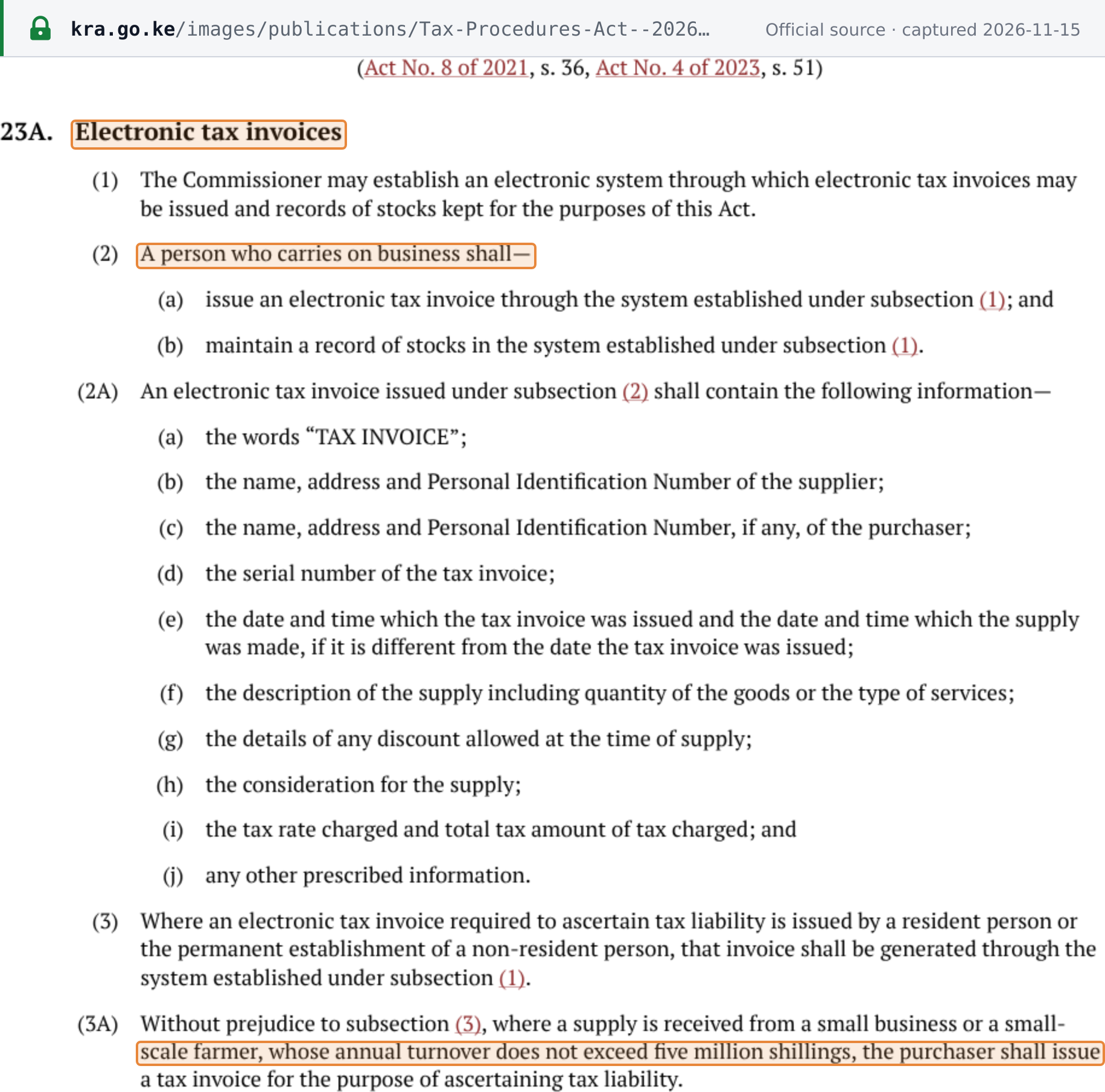
The statutory duty. TPA s.23A: "(1) The Commissioner may establish an electronic system through which electronic tax invoices may be issued and records of stocks kept for the purposes of this Act. (2) A person who carries on business shall— (a) issue an electronic tax invoice through the system established under subsection (1); and (b) maintain a record of stocks in the system established under subsection (1)." Subsection (2A) lists the particulars: the words "TAX INVOICE"; the supplier's name, address and PIN; the purchaser's name, address and PIN "if any"; the serial number; the date and time of issue (and of supply, if different); a description including quantity or type of service; any discount; the consideration; the tax rate and total tax; and any other prescribed information. [3]
 Source snapshot captured 2026-11-15 — original
Regulations. KRA: "The Value Added Tax (Electronic Tax Invoice) Regulations, 2020 were gazetted on 25th September 2020 vide Legal Notice No. 189 of 2020." [4] The Tax Procedures (Electronic Tax Invoice) Regulations, 2024 (Legal Notice No. 64 of 2024) were made under TPA s.112 and are listed on Kenya Law. KRA's eTIMS pages do not state how the 2024 regulations relate to the 2020 VAT regulations.
Technical standards. No gazetted technical standard. KRA's OSCU, VSCU and TIS specifications (v2.0, April 2023) define the eTIMS API and the invoice layout. They name no UBL, CII or Peppol profile. [20] [22]
Scope
Who. Every "person who carries on business" (TPA s.23A(2)). KRA: "All persons engaged in business are required to on-board eTIMS and issue electronic tax invoices." Its list of persons in business covers companies, partnerships, sole proprietorships, associations and trusts; persons with Monthly Rental Income, Turnover Tax or annual income tax obligations, "both resident and non-residents with a permanent establishment"; the informal sector; "Persons in business whether or not registered for VAT"; and businesses supplying VAT-exempt goods and services, such as hospitals, schools, tours and travel agents and NGOs in business. [3] [1]
B2B. Mandatory: VAT-registered taxpayers since the 2021 TIMS rollout, all businesses since 1 September 2023 (see the timeline).
B2G. No separate platform. Suppliers to government issue eTIMS invoices like anyone else, and the government's payment system, IFMIS, checks them against eTIMS. KRA notice 2388 (31 August 2026): "Suppliers must generate valid eTIMS invoices for all supplies before submission for payment processing through IFMIS", and "The details of invoices submitted to Government entities must correspond precisely with the invoices generated and recorded in eTIMS." [13]
B2C. Covered. KRA does not use the term "B2C", but s.23A(2) places the duty on the seller with no carve-out by buyer type, and KRA's TIS specification defines a "Normal Sale" as a receipt "produced and offered to the client". [3] [22]
Non-established businesses.
- Permanent establishments of non-residents: in scope. TPA s.23A(3) requires an electronic tax invoice issued "by a resident person or the permanent establishment of a non-resident person" to be generated through the system. [3]
- Registered non-resident suppliers of digital services: exempt. KRA notice 1797 (19 August 2022): the VAT (Digital Marketplace Supply) Regulations, 2020 "exempts registered non-resident suppliers of digital services from issuing electronic tax invoices", but they "are required to issue invoices or receipts showing the value of the supply and the tax charged." [24]
- Non-residents without a permanent establishment (buyer side): KRA's list of costs that need no eTIMS invoice includes "services provided by a non-resident person without a permanent establishment in Kenya", so a Kenyan buyer of such services needs no eTIMS invoice for them (see below). [1]
Costs that need no eTIMS invoice (buyer side). KRA lists: emoluments (salaries and wages), imports, air passenger ticketing, investment allowances, interest, fees charged by financial institutions, expenses subject to withholding tax that is a final tax, and services provided by a non-resident person without a permanent establishment in Kenya. TPA s.23A(4) is the statutory basis: the invoice "may exclude emoluments, imports, investment allowances, interest, airline passenger ticketing, payment of withholding tax and similar payments." [1] [3]
Small suppliers: the buyer issues the invoice. TPA s.23A(3A): "where a supply is received from a small business or a small-scale farmer, whose annual turnover does not exceed five million shillings, the purchaser shall issue a tax invoice for the purpose of ascertaining tax liability." KRA's Buyer Initiated Invoicing runs on eCitizen; eTIMS "blocks the issuance of invoices for VAT-registered sellers", and "Sellers have thirty (30) days during which they may accept or reject the generated invoice after which the invoice is automatically rejected". [3] [25]
Gazette exemptions. TPA s.23A(5): "The Commissioner may, by notice in the Gazette, exempt a person from the requirements of this section." [3]
Simplified invoices. Not applicable as a value threshold: VAT Act s.43(2)(a) mentions "simplified tax invoices" only as a record category, and neither TPA s.23A nor KRA's eTIMS pages publish a value threshold or a reduced field list. [17]
Format & network
The model: invoices go through a KRA channel; integrated systems wait for the control unit. Every invoice is issued through one of KRA's channels: the Online Portal, eTIMS Client, eTIMS Lite, a TIMS ETR device or a system-to-system integration (OSCU or VSCU); see Onboarding. KRA does not label its model as clearance or reporting. What its documents say:
- For system-to-system integrations, the trader's invoicing system cannot issue the invoice until the OSCU/VSCU control unit has answered: "Trader Invoicing System shall not be able to print receipt of any type before the aforementioned data flow has been finalized. This means that it shall be impossible to issue receipt if the TIS did not receive any response from the OSCU/VSCU." (TIS specification v2.0, item 10) [22]
- Electronic tax invoices "are transmitted to KRA on real time or near real time basis" (KRA notice 1944). The TIS specification separately says the data flow between the control unit and the invoicing system "should be schedule to a maximum of 15 min" (item 21.8). [6] [22]
- Offline working: "For other solutions (e.g., eTIMS Client and VSCU), invoicing can continue during internet downtime, with invoices transmitted once connectivity is restored." [23]
There is no buyer acceptance step (except for buyer-initiated invoices) and no exchange network. See CTC e-invoicing models and fiscal devices for how this compares.
Connection: KRA's own API, two integration modes. KRA: "System-to-system integration between KRA and the taxpayer's invoicing systems has been provisioned via an Application Programming Interface (API)." The Virtual Sales Control Unit (VSCU) "is suitable for taxpayers undertaking bulk invoicing and is not always online"; it runs as a KRA-supplied application on the taxpayer's own server. The Online Sales Control Unit (OSCU) "is suitable for taxpayers whose invoicing is always online." [19] [21]
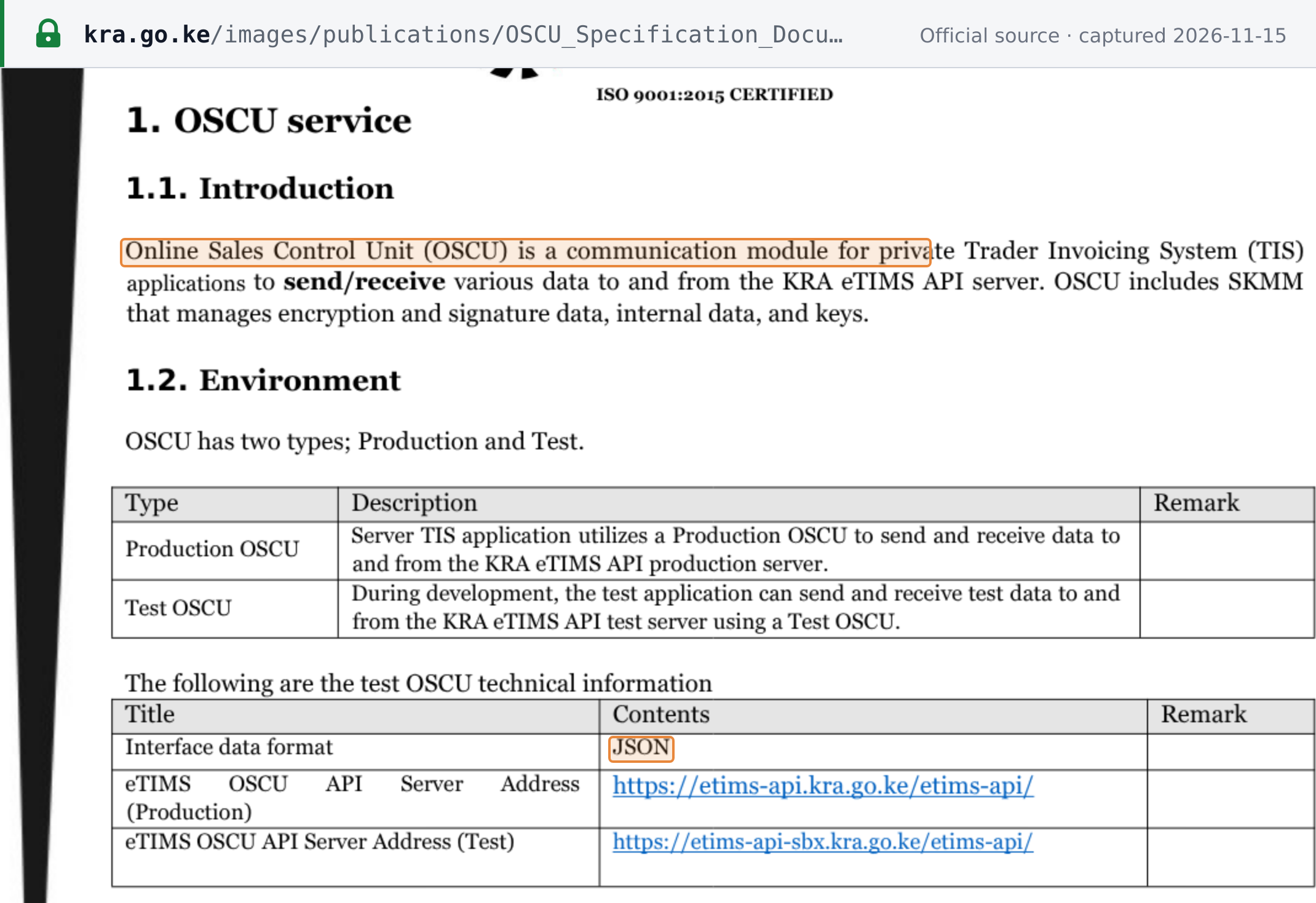
Data format: JSON, with an XML reference in the TIS specification. The OSCU specification v2.0 (April 2023): "Online Sales Control Unit (OSCU) is a communication module for private Trader Invoicing System (TIS) applications to send/receive various data to and from the KRA eTIMS API server. OSCU includes SKMM that manages encryption and signature data, internal data, and keys." Its environment table gives "Interface data format: JSON", a production server at https://etims-api.kra.go.ke/etims-api/ and a test server at https://etims-api-sbx.kra.go.ke/etims-api/. The VSCU specification also gives JSON. KRA's TIS specification, which covers the trader's invoicing system, says "TIS messages shall be sent in xml format" (21.2.2) and that the commands between the OSCU/VSCU and the invoicing system "are sent in XML format" (21.8). KRA does not reconcile the two. [20] [21] [22]
 Source snapshot captured 2026-11-15 — original
Not Peppol, UBL or CII. KRA's eTIMS pages, FAQ and the three v2.0 specifications name no UBL, CII, UN/CEFACT or Peppol profile.
Integrity mechanics. Every invoice carries an "SCU information" block: the OSCU/VSCU date and time, the control unit's serial number, the CU invoice number (control-unit ID plus receipt number), internal data and a receipt signature, and a QR code built from the invoice date, time, CU number, CU receipt number, internal data and receipt signature (TIS specification items 6.23.1–6.23.8). The official KRA logo is printed "on each receipt regardless the type" (item 6.28). KRA leaves the layout to the trader: "The format of the Invoice is at the discretion of the trader. It must, however, contain all the prescribed fields as indicated in the sample below." [22]
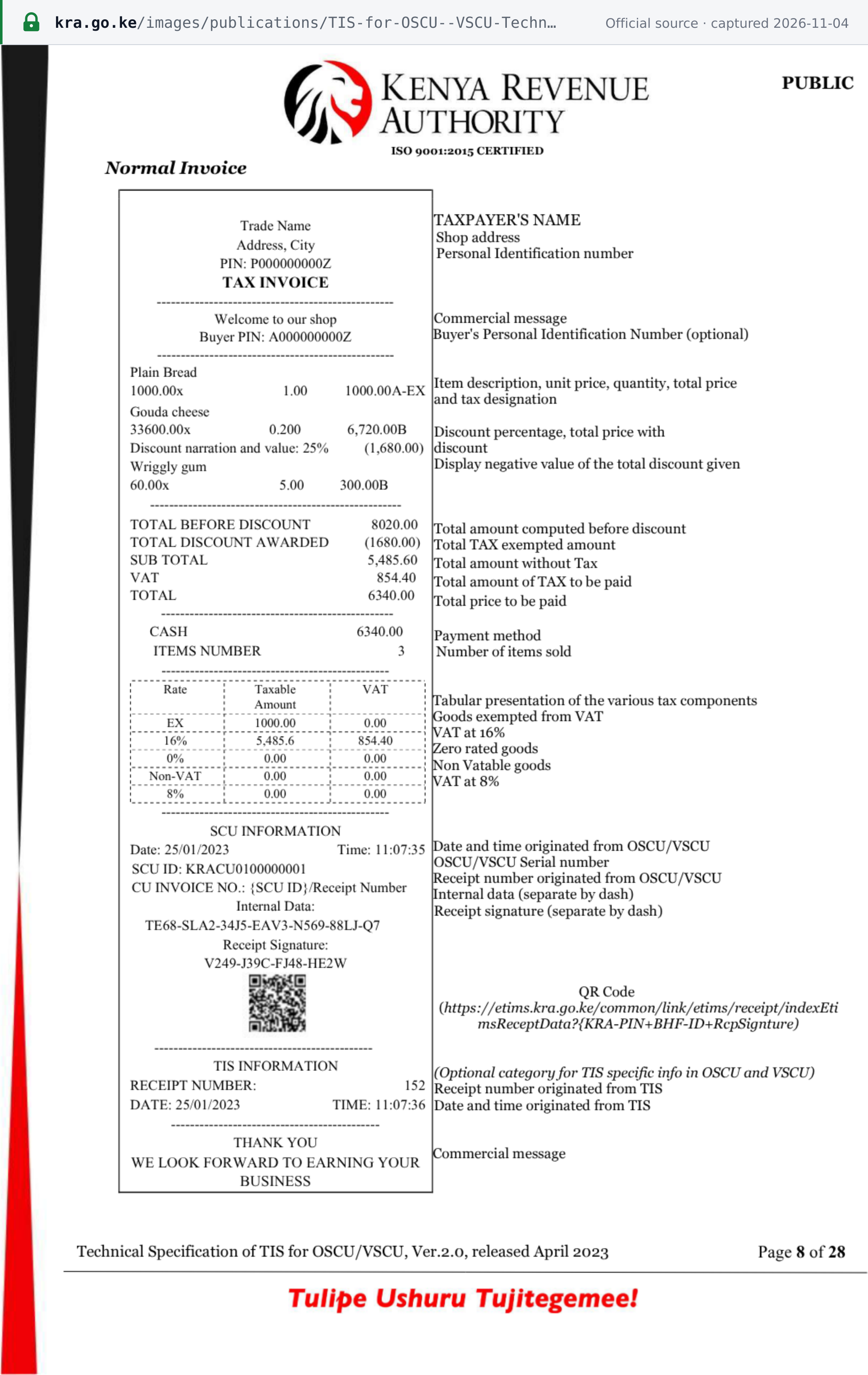 Source snapshot captured 2026-11-04 — original
Checking an invoice. KRA: "Scan the QR code on the invoice. Enter the invoice number in the "Invoice number checker" on the iTax portal." [23]
Reporting that rides alongside. eTIMS data pre-fills the VAT return, and input VAT not validated through TIMS/eTIMS, or against customs import declarations for import VAT, is not allowed (notices 2074, 2088 and 2156; see the timeline). [10]
Onboarding: how to comply
1. Register for eTIMS. "Taxpayers have been facilitated to self-on-board on eTIMS by eliminating the requirement for intervention from KRA in the approval of applications (service requests). Prior to installing any eTIMS Solution you are required to register for eTIMS by providing details regarding the nature of your business." Sign-up needs access to the mobile number registered on iTax: "If not, you will be required to update your mobile number through your iTax profile in order to complete the sign up process." KRA's VAT page still refers to "sending service request"; the dedicated onboarding page above is the current description. [27] [23] [29]
2. Pick a solution. From KRA's FAQ and solutions pages: [23] [27] [28]
| Solution | Suits (KRA's wording) | Connection |
|---|---|---|
| eTIMS Lite (web) | "businesses with minimal transactions" | Browser, through eCitizen |
| eTIMS Lite (USSD) | "individuals and sole proprietors" | Short code *222# |
| eTIMS Lite mobile app | Non-VAT taxpayers | "eTIMS Non VAT" app on Play Store and Apple Store |
| Online Portal | "taxpayers in the service sector exclusively, where no goods are supplied" | Browser |
| eTIMS Client | "taxpayers dealing in goods or both goods and services" | Downloadable software; works offline |
| VSCU | "taxpayers with extensive transactions or bulk invoicing" | API, KRA application on the taxpayer's server; works offline |
| OSCU | "taxpayers using an online invoicing system" | API, online |
| Reverse Invoicing / Buyer Initiated Invoicing | Buyers issuing invoices on behalf of sellers | Buyer's system (KYC approval) / eCitizen |
| TIMS ETR device | VAT-registered taxpayers who adopted one | Device; "may continue using the devices for invoicing and transmitting tax invoices to KRA" |
"Each solution will have its own unique invoice number sequence. However, credit notes can only be generated from the solution where the original invoice was raised." [28]
3. Integrate and test (OSCU/VSCU). Integration involves "the development, testing, vetting, and certification of either the interested taxpayer who has the capacity to self-integrate or for 3rd party software developers (integrators)". The sandbox portal is etims-sbx.kra.go.ke, and KRA publishes a step-by-step sandbox sign-up guide. [19]
Accreditation of integrators. Taxpayers can self-integrate or use a KRA-certified third-party integrator. KRA publishes a List of Approved eTIMS 3rd Party System to System Software Integrators as at 24th March 2025, linked from its system-to-system integration page; notice 2074 also says "A list of approved eTIMS third party system-to-system integrators is available on the KRA website". KRA publishes no validity period for certification and no rule on losing it. [31] [19] [8]
Cost. "The eTIMS software is offered free of charge by KRA, including the online portal and eTIMS client software. However, businesses that integrate their invoicing system directly to eTIMS may incur costs if they opt to partner with one of the approved third-party integrators." [23]
Reverse invoicing (self-billing). "Buyers are required to be approved by KRA for Reverse Invoicing through the Know Your Customer (KYC) process before implementation." The buyer keeps the invoices "for a minimum of five (5) years", "Transmission of invoices shall be in Kenya Shillings", and the cost of the functionality "is to be borne by the buyer and not transferred to the seller." [26]
Penalties
Failing to issue an electronic tax invoice: TPA s.86, from 1 July 2026. "(1) Where the Commissioner determines that a taxpayer has failed to comply with the requirement under a tax law to issue an electronic tax invoice, submit a tax return in electronic form, or pay tax electronically pursuant to section 75, the Commissioner shall issue a notice in writing to the taxpayer requiring the taxpayer to provide reasons for the non-compliance." The Commissioner then considers whether the failure arose from circumstances beyond the taxpayer's reasonable control, was not due to wilful neglect or deliberate default, and whether the taxpayer took reasonable steps to comply. "(3) Where the Commissioner is not satisfied by the reasons given under subsection (2), the taxpayer shall be liable to pay the higher of the following penalties— (a) five percent of the tax due; (b) one hundred thousand shillings, in the case of a company; or (c) in the case of an individual, ten thousand shillings." The section carries the annotation "(Act No. 4 of 2023, s. 64, Act No. 19 of 2026, s. 48)". [3]
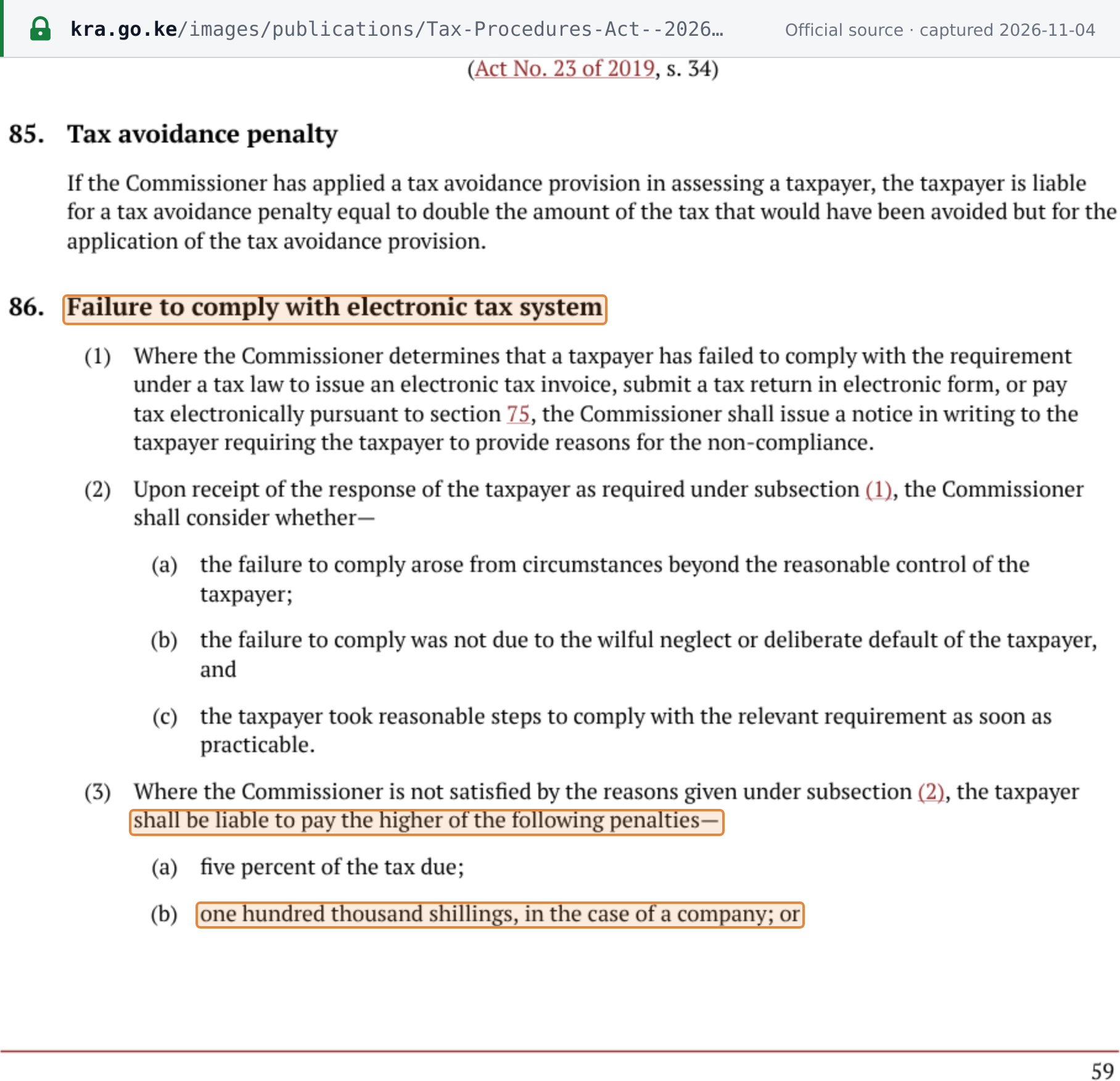 Source snapshot captured 2026-11-04 — original
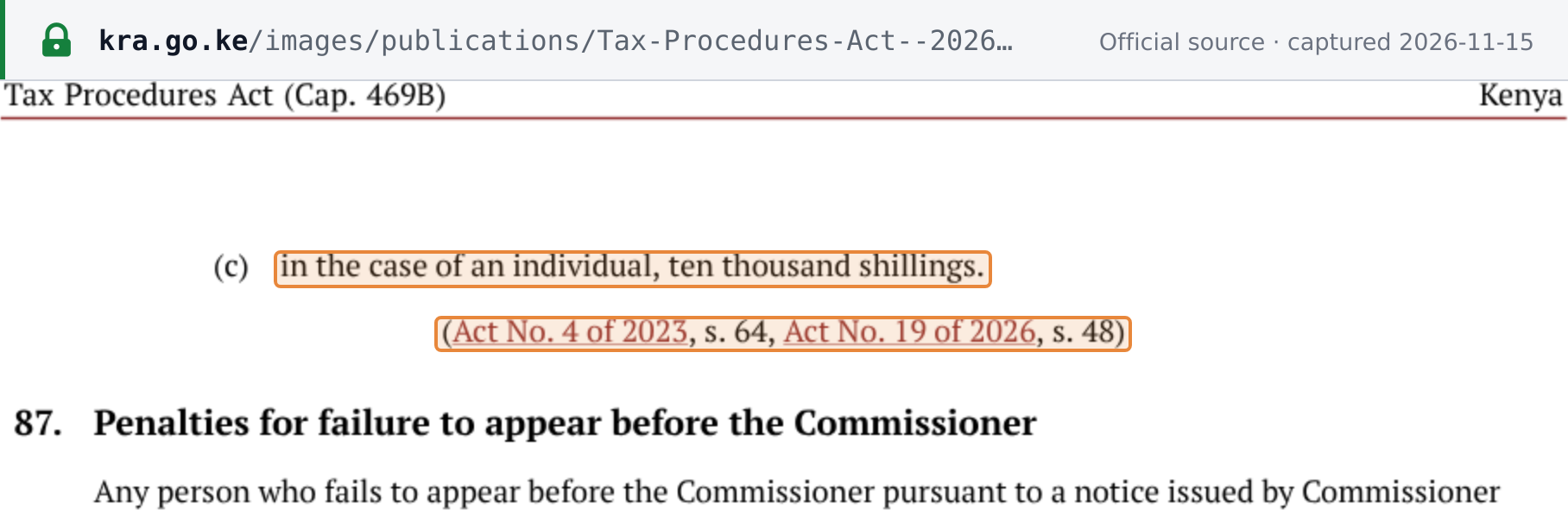 Source snapshot captured 2026-11-15 — original
Other consequences KRA states.
- No deduction for business expenditure not supported by an eTIMS invoice, from 1 January 2024 (notice 2071). [2]
- No input VAT for claims not validated through TIMS/eTIMS (notices 2074 and 2156). [8] [10]
- No Tax Compliance Certificate for VAT-registered taxpayers not complying with the 2020 regulations "unless they comply" (notice 1944). [6]
- Government suppliers: invoices must be generated in eTIMS "before submission for payment processing through IFMIS" (notice 2388). [13]
Enforcement posture (dated). Non-VAT taxpayers were spared penalties until 31 March 2024 (notice 2077); fuel retailers not compliant by 31 December 2025 face enforcement (notice 2331). [7] [12]
Frequently asked questions
We are not registered for VAT. Do we still need eTIMS?
Yes. Tax Procedures Act s.23A(2) applies to every person who carries on business, and KRA notice 2071 made eTIMS mandatory for all persons carrying on business, including those not registered for VAT, effective 1 September 2023. KRA offers eTIMS Lite (web through eCitizen, USSD *222# and a mobile app) for small and micro taxpayers not registered for VAT. [3] [2] [27]
Our supplier is a small trader or farmer who does not issue eTIMS invoices. Can we still deduct the cost?
Under TPA s.23A(3A), where the supplier is a small business or small-scale farmer with annual turnover up to KES 5 million, the buyer issues the tax invoice. KRA's Buyer Initiated Invoicing on eCitizen does this; it is blocked for VAT-registered sellers, and the seller has 30 days to accept or reject the invoice, after which it is automatically rejected. [3] [25]
Which business costs do not need an eTIMS invoice?
KRA lists eight: emoluments (salaries and wages), imports, air passenger ticketing, investment allowances, interest, fees charged by financial institutions, expenses subject to withholding tax that is a final tax, and services from a non-resident person without a permanent establishment in Kenya. TPA s.23A(4) is the statutory basis. [1] [3]
We supply a government entity. Why is our payment held up?
Since KRA notice 2388 of 31 August 2026, suppliers must generate a valid eTIMS invoice before submitting it for payment through IFMIS, and the invoice details submitted to the government entity must correspond precisely with the invoice recorded in eTIMS. A mismatch between the two is the first thing to check. [13]
We use two eTIMS solutions. Why are there two invoice number sequences, and where do we raise a credit note?
KRA: each eTIMS solution has its own unique invoice number sequence, and a credit note can only be generated from the solution where the original invoice was raised. [28]
Is the eTIMS stock-management module live?
KRA has published no go-live date. Notice 2390 of 7 September 2026 says taxpayers must keep accurate, up-to-date stock records while using TIMS/eTIMS and that consultative forums were expected to start in September 2026. The duty to keep stock records in the system is already in TPA s.23A(2)(b). [14] [15] [3]
We are a foreign digital-services supplier registered for Kenyan VAT. Do we need eTIMS?
No. KRA notice 1797 says the VAT (Digital Marketplace Supply) Regulations, 2020 exempt registered non-resident suppliers of digital services from issuing electronic tax invoices, but they must still issue invoices or receipts showing the value of the supply and the tax charged. A non-resident with a permanent establishment in Kenya is in scope under TPA s.23A(3). [24] [3]
Is the eTIMS API JSON or XML?
KRA's OSCU and VSCU specifications (v2.0, April 2023) give JSON as the interface data format for the eTIMS API. KRA's TIS specification, which covers the trader's invoicing system, also says TIS messages are sent in XML. KRA does not reconcile the two. eTIMS is not based on UBL, CII or Peppol. [20] [22]
Can we keep our TIMS ETR device?
Yes. KRA says VAT-registered taxpayers who adopted the TIMS ETR may continue using the devices for invoicing and transmitting tax invoices to KRA, and encourages those with technical problems to migrate to eTIMS. [23]
What is the penalty for not issuing an eTIMS invoice?
Under TPA s.86 as recast by the Finance Act, 2026 (from 1 July 2026), the Commissioner first issues a written notice asking for reasons. If not satisfied, the penalty is the higher of 5% of the tax due, KES 100,000 for a company or KES 10,000 for an individual. Business expenditure without an eTIMS invoice is also not deductible. [3] [2]
Recent changes
- 2026-10-28 — KRA public notice 2406: importer details required on consolidated cargo since 13 September 2026; KRA working with consolidators so that importers receive eTIMS invoices. (Kenya Revenue Authority)
- 2026-09-07 — KRA public notice 2390: stock-management functionality for electronic invoicing announced; forums from September 2026; no go-live date. (Kenya Revenue Authority) — see event
- 2026-08-31 — KRA public notice 2388: eTIMS–IFMIS integration; government suppliers need a valid eTIMS invoice matching the invoice submitted for payment. (Kenya Revenue Authority) — see event
- 2026-07-01 — Finance Act, 2026 s.48 recasts the TPA s.86 e-invoice penalty: notice first, then the higher of 5% of the tax due, KES 100,000 (company) or KES 10,000 (individual). (Finance Act, 2026, hosted by KRA)
- 2025-11-25 — KRA public notice 2331: fuel retailers not on the eTIMS Fuel Station System by 31 December 2025 face enforcement; the compliance deadline was 30 June 2025. (Kenya Revenue Authority) — see event
- 2024-12-03 — KRA public notice 2156: VAT returns pre-filled from the November 2024 tax period; input VAT not validated through TIMS/eTIMS not allowed. (Kenya Revenue Authority) — see event
Related resources
- Kenya VAT guide — rates, registration, invoice requirements, filing
- Kenya KRA PIN guide — the PIN that appears on every eTIMS invoice
- E-invoicing status and networks by country
- CTC e-invoicing models explained
- Fiscal devices and certified cash registers
- Nigeria e-invoicing (Merchant-Buyer Solution)
- Kenya tax changes on Lookuptax
Important websites
- eTIMS taxpayer portal — sign-up and all invoices from every eTIMS solution
- eCitizen — eTIMS Lite (web) and Buyer Initiated Invoicing
- eTIMS sandbox and the OSCU/VSCU sandbox sign-up guide (PDF)
- KRA eTIMS hub and eTIMS FAQ
- Approved eTIMS integrators as at 24 March 2025 (PDF)
- KRA specifications v2.0: OSCU (PDF), VSCU (PDF), TIS for OSCU/VSCU (PDF)
- Reverse Invoicing KYC questionnaire (PDF)
Reference links
- KRA — What is eTIMS
- KRA public notice 2071 — On Boarding of Non-VAT Taxpayers on eTIMS (17 Nov 2023)
- Tax Procedures Act (Cap. 469B), Kenya Law consolidation as at 1 September 2026, hosted by KRA (PDF)
- KRA public notice 1307 — Extension of time to comply with the VAT (Electronic Tax Invoice) Regulations, 2020
- KRA press release — Compliance with the VAT Electronic Tax Invoice Regulations, 2020 (28 Jul 2022)
- KRA public notice 1944 — Enforcement of the Electronic Tax Invoice (4 May 2023)
- KRA public notice 2077 — Electronic tax invoicing for non-VAT registered persons (27 Dec 2023)
- KRA public notice 2074 — Simplification of the VAT return filing process (28 Nov 2023)
- KRA public notice 2088 — Update on simplification of the VAT return filing (12 Feb 2024)
- KRA public notice 2156 — Update on simplification of VAT return filing (3 Dec 2024)
- KRA — eTIMS Fuel Station System
- KRA public notice 2331 — Reminder on electronic tax invoicing for fuel stations (25 Nov 2025)
- KRA public notice 2388 — Implementation of the eTIMS–IFMIS integration (31 Aug 2026)
- KRA public notice 2390 — Stock management functionality for electronic invoicing (7 Sep 2026)
- KRA — Stock Management Functionality for Electronic Invoicing (FAQ)
- KRA public notice 2406 — Importer details for consolidated cargo and eTIMS invoices (28 Oct 2026)
- VAT Act (Cap. 476), Kenya Law consolidation as at 1 July 2026, hosted by KRA (PDF)
- Finance Act, 2026 (Act No. 19 of 2026), hosted by KRA (PDF)
- KRA — eTIMS System to System Integration
- KRA — OSCU Requirements & Communication Protocols v2.0 (PDF)
- KRA — VSCU specification v2.0 (PDF)
- KRA — Technical Specification of TIS for OSCU/VSCU v2.0 (PDF)
- KRA — eTIMS FAQ
- KRA public notice 1797 — Exemption of non-resident suppliers of digital services (19 Aug 2022)
- KRA — Buyer Initiated Invoicing
- KRA — Reverse Invoicing
- KRA — How to onboard on eTIMS
- KRA — Types of eTIMS solutions
- KRA — Value Added Tax page
- Kenya Law — Tax Procedures (Electronic Tax Invoice) Regulations, 2024 (LN 64 of 2024)
- KRA — List of approved eTIMS third-party system-to-system integrators as at 24 March 2025 (PDF)