E-invoicing in the DR Congo: the facture normalisée
Overview
The Democratic Republic of the Congo (DRC, Congo-Kinshasa) requires every VAT taxpayer to issue a facture normalisée ("normalised invoice") for each transaction. The invoice is produced by a dispositif électronique fiscal (DEF), a fiscal device approved by the tax administration and connected to it. The system is run by the Direction Générale des Impôts (DGI) of the Ministry of Finance (dgi.gouv.cd). [1]
The DGI defines it this way: "La Facture Normalisée est un document commercial électronique, doté des éléments de sécurité qui garantissent l'authenticité et la traçabilité des opérations qui y figurent, émis à l'occasion de toute transaction commerciale. Elle est émise à l'aide d'un Dispositif Électronique Fiscal qui est directement relié à l'Administration des Impôts." (The normalised invoice is an electronic commercial document with security features that guarantee the authenticity and traceability of the operations on it, issued at every commercial transaction, through a fiscal device linked directly to the tax administration.) [1]
This page is about the DRC. The Republic of the Congo (Congo-Brazzaville) runs a different system, the SFEC; see E-invoicing in the Republic of the Congo.
Legal basis in one line. VAT Ordonnance-loi n° 10/001 of 20 August 2010, articles 58, 59 ter, 59 quater and 74 quater to 74 decies (as created and amended by Finance Laws n° 17/005 of 2017, n° 18/025 of 2018 and n° 22/071 of 2022); Décret n° 23/10 of 3 March 2023; Arrêtés ministériels n° 033 and 034 of 2023 and n° 016 of 2025; Circulaires ministérielles n° 004 and 005 of 2024. Details in Legal basis. [2]
| DR Congo | |
|---|---|
| System | Facture normalisée issued through a fiscal device (DEF): physical UF or MCF, or the online e-UF and e-MCF on the DGI's e-DEF platform |
| Model | Device-based real-time reporting: the device secures each invoice and transmits its data to the DGI's server. No pre-issue approval by the DGI and no exchange network |
| B2B and B2C | Mandatory since 1 December 2025 for all VAT taxpayers, at every transaction |
| B2G | Public spending bodies, public enterprises and other public bodies may accept only normalised invoices (Décret 23/10 art. 27). The State and public bodies are themselves dispensed from using a device (Circulaire 005/2024) |
| Non-residents | The DGI's texts do not address non-resident suppliers specifically |
| Format | Invoice secured by the device: DEF identification number, transaction authentication code and QR code. The DGI publishes no XML, UBL or other schema |
| Network | DGI servers, reached by the device (over GSM for physical devices) or the e-DEF platform. Not Peppol |
| Software | Enterprise billing systems (SFE) must be homologated by the DGI and connected to an MCF or e-MCF |
| Authority | Direction Générale des Impôts (DGI), Ministry of Finance |
| Penalty | Five times the VAT not invoiced, minimum CDF 10,000,000 per invoice not issued (art. 74 sexies) |
For the VAT rates, registration and the full list of invoice particulars, see the DR Congo VAT guide.
Mandate status & timeline
Status (as at 15 November 2026): mandatory for all VAT taxpayers since 1 December 2025, with no phasing by size or turnover. The DGI fixed the date in Communiqué officiel N° 01/050/DGI/DG/FACNO-TVA/2025 of 2 October 2025: "la date de l'effectivité de l'obligation d'émission et d'exigence d'une facture normalisée émise à l'aide d'un dispositif électronique fiscal (DEF) est fixée au 1er décembre 2025" (the obligation to issue and to demand a normalised invoice issued through a fiscal device takes effect on 1 December 2025). [3]
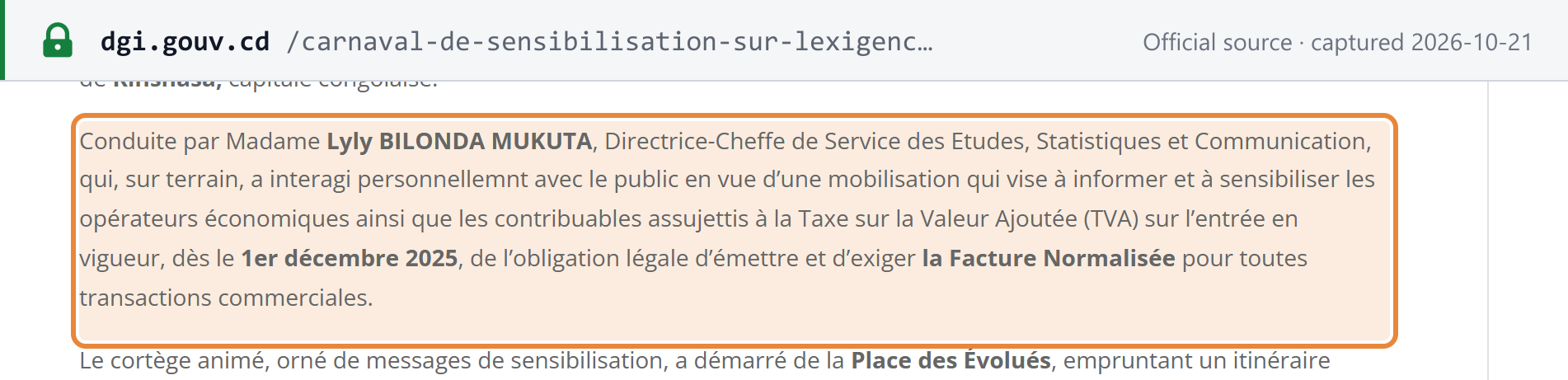 Source snapshot captured 2026-10-21 — original
Latest announcement: 5 October 2026, the moratoria are over. DGI Communiqué officiel N° 01/043/DGI/DG/DESCOM/DIV.COM/NB/TMI/2026 of 5 October 2026 states that the obligation "est pleinement effective" (is fully effective). It says that, "à la suite de l'annonce, par Son Excellence Monsieur le Ministre des Finances, de la fin des moratoires accordés dans le cadre de la mise en œuvre de cette réforme" (following the Minister of Finance's announcement of the end of the moratoria granted for the reform), every taxpayer concerned must now comply strictly. Its operational services are carrying out compliance checks across the country, covering the actual issue of normalised invoices and the requirements for DEFs and SFEs. [4]
The communiqué gives no date for the Minister's announcement and does not say what the moratoria covered. No ministerial communiqué or arrêté ending them is published on the DGI's website. What can be said is that the moratoria had ended by 5 October 2026. The DGI announced no further phase in that communiqué; it says rewards for members of the public who report non-compliance will follow "suivant les modalités qui seront arrêtées" (on terms still to be set). [4]
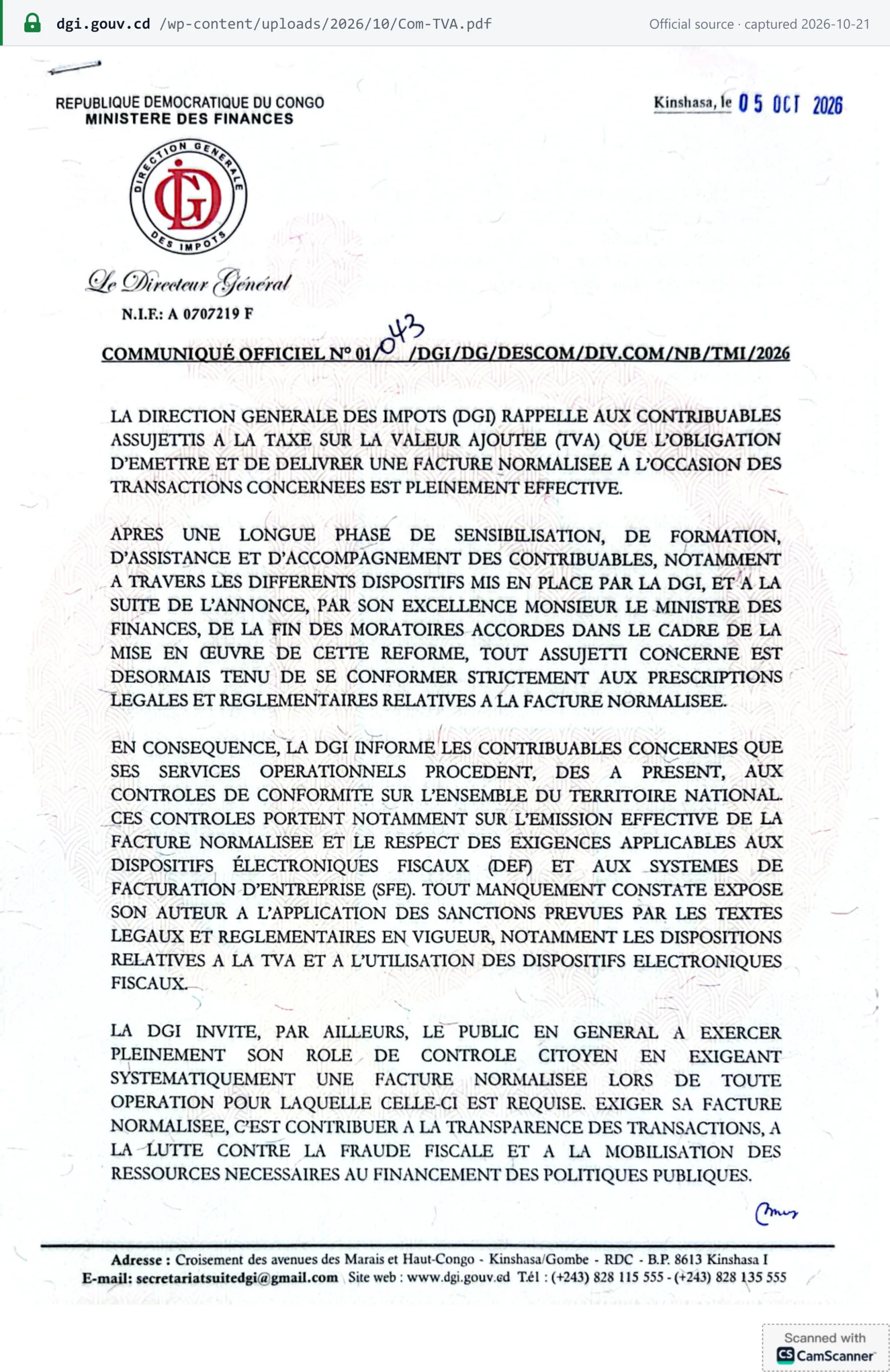 Source snapshot captured 2026-10-21 — original
| Date | Step | Instrument | State |
|---|---|---|---|
| 23 June 2017 | Fiscal-device obligation created (VAT arts. 59 ter and 59 quater) | Finance Law n° 17/005 | Background |
| 28 December 2022 | Facture normalisée, SFE homologation and penalties (arts. 74 sexies to 74 decies) introduced | Finance Law n° 22/071 | Background |
| 3 March 2023 | Rules for the facture normalisée and the fiscal devices; in force on signature (art. 29) | Décret n° 23/10 | In force |
| 23 October 2023 | Conditions of use of DEFs (AM 033) and of sale of devices and billing systems (AM 034) | Arrêtés ministériels n° 033 and 034 | In force |
| 30 December 2024 | Credit notes (Circ. 004); scope, obligation to demand and dispensations (Circ. 005); documents standing in for a normalised invoice (AM 044) | Circulaires n° 004 and 005; Arrêté n° 044 | In force |
| 27 February 2025 | Supplier approval and homologation rules amended | Arrêté ministériel n° 016 | In force |
| 16 June 2025 | Homologation of enterprise billing systems (SFE) opens; generalisation announced for 1 July 2025, with a first list of homologated SFE from 30 June 2025 | Communiqué 01/034 | Passed (superseded) |
| 1 August 2025 | Generalisation to all VAT taxpayers begins (instead of 1 July 2025); compliance deadline "sera fixée ultérieurement" (to be fixed later) | Communiqué 01/039 | Passed (preparatory window) |
| 2 October 2025 | Start date fixed at 1 December 2025 | Communiqué 01/050 | Passed |
| 10 November 2025 | Free registration on e-DEF opens to VAT taxpayers; webinars until 19 December 2025 | Communiqué 01/057 | Passed |
| 1 December 2025 | Obligation to issue and to demand a normalised invoice in force for all VAT taxpayers | Communiqué 01/050 | In force |
| 4 December 2025 | December 2025 VAT deductions without a normalised invoice to be reassessed, with an exceptional 20-day regularisation window from notification | Communiqué 01/059 | Passed |
| 25 February 2026 | Invoicing taxation groups updated for Finance Law n° 25/060 (5% and 1% groups, "hors champ") | Communiqué 01/010/2026 | In force |
| April 2026 | Official list of approved DEF suppliers and homologated SFE and DEF published (April 2026 edition) | DGI list | Updated since |
| 5 October 2026 | Moratoria ended, per the Minister of Finance; obligation "pleinement effective"; nationwide compliance checks | Communiqué 01/043/2026 | In force |
Pilot. None was announced. Between 1 August and 30 November 2025 businesses could prepare (homologate their software, register on e-DEF), but the DGI did not call this a pilot.
Postponements. The calendar slipped twice before the obligation took effect. Communiqué 01/034 of 16 June 2025 announced "la généralisation de la réforme de la facture normalisée à dater du 1er juillet 2025", with a first list of homologated SFE from 30 June 2025. Communiqué 01/039 then started generalisation on 1 August 2025 and said the compliance deadline "sera fixée ultérieurement" (will be fixed later). Communiqué 01/050 of 2 October 2025 fixed it at 1 December 2025, and that date has not moved since. What followed were enforcement tolerances. The communiqué N° 01/059/DGI/DG/FACNO-TVA/FMM/2025 of 4 December 2025 said that VAT deductions for December 2025, declared in January 2026, that are not backed by a normalised invoice "feront l'objet de rappel de droits avec une tolérance, à titre exceptionnel, pour leur régularisation dans les 20 jours de la notification" (will be reassessed, with an exceptional 20-day window to regularise after notification). The moratoria were then ended by the Minister before 5 October 2026. Arrêté 033 of 2023 had separately given SFE users three months from its signature to update their software, extendable by up to two months (art. 15); no official document describes the 2025 start as a postponement of that window. [5] [6] [3] [8] [11]
Legal basis
| Instrument | Date | What it does |
|---|---|---|
| Ordonnance-loi n° 10/001 (VAT), arts. 58, 59 ter, 59 quater, 42 point 3, 74 quater to 74 decies | 20 August 2010; arts. 59 ter, 59 quater and 74 quater created by Finance Law n° 17/005 (23 June 2017), art. 74 quinquies by Finance Law n° 18/025 (13 December 2018), arts. 74 sexies to 74 decies by Finance Law n° 22/071 (28 December 2022), which also amended arts. 58, 59 ter and 59 quater | Duty to deliver a facture normalisée produced by a fiscal device (art. 58); registration as a DEF user (art. 59 ter); use of devices connected to the DGI and SFE homologation (art. 59 quater); non-deduction of VAT on invoices issued outside a device (art. 42); penalties |
| Décret n° 23/10 "portant réglementation de la facture normalisée et fixation des modalités de mise en œuvre des dispositifs électroniques fiscaux" | 3 March 2023; in force on signature (art. 29) | Definitions; the four device types; acquisition of devices and SFE; mandatory particulars (art. 26); buyers bound to accept only normalised invoices (art. 27) |
| Arrêté ministériel n° 033/CAB/MIN/FINANCES/2023 | 23 October 2023 | Conditions of use of DEFs and of delivery of the facture normalisée: user obligations, backup devices, connectivity, 50% refund of device cost |
| Arrêté ministériel n° 034/CAB/MIN/FINANCES/2023 | 23 October 2023 | Conditions of sale of physical DEFs and SFE |
| Arrêté ministériel n° 016/CAB/MIN/FINANCES/2025, amending AM 034 | 27 February 2025 | Supplier approval, homologation by a commission within 30 working days, NID and ISF identifiers, re-homologation on change, distribution zones |
| Circulaire ministérielle n° 004/CAB/MIN/FINANCES/2024 | 30 December 2024 | Conditions for the normalised credit note (facture d'avoir normalisée) |
| Circulaire ministérielle n° 005/CAB/MIN/FINANCES/2024 | 30 December 2024 | Obligation to deliver and to demand the facture normalisée; permanent dispensations and temporary derogations; invoice verification |
| Arrêté ministériel n° 044/CAB/MIN/FINANCES/2024 | 30 December 2024 | Documents that may stand in for a facture normalisée. Named in DGI communiqué 01/059 of 4 December 2025; the text is not published on the DGI's website |
| DGI communiqués 01/034, 01/039, 01/040, 01/050, 01/057 and 01/059 (2025), 01/010 and 01/043 (2026) | 2025–2026 | Operational calendar, registration, taxation groups and enforcement (see the timeline) |
Article 58, as amended in 2022, reads: "Tout redevable de la taxe sur la valeur ajoutée qui livre des biens ou rend des services à un autre redevable ou réclame à ce dernier des acomptes donnant lieu à l'exigibilité de la taxe doit lui délivrer une facture normalisée produite par les dispositifs électroniques fiscaux ou un document en tenant lieu." (A VAT debtor that supplies goods or services to another, or claims a taxable advance, must deliver a normalised invoice produced by fiscal devices, or a document standing in for one.) The consolidated Code des Impôts published by the DGI is updated to 10 July 2023; later finance laws are not consolidated in it. [14]
Technical standards. The DGI publishes no technical standard openly. Arrêté 016 art. 10 says the homologation procedures for devices are detailed in a service note of the Director General, and Communiqué 01/040 says the technical documentation is made available in the candidate's personal space on e-DEF once the account is validated. [12] [15]
Scope
Who. Every VAT taxpayer. Article 59 quater 1) of the VAT Ordonnance-loi: "Les personnes physiques ou morales assujetties à la taxe sur la valeur ajoutée sont tenues d'utiliser les dispositifs électroniques fiscaux connectés au système informatique de l'Administration des Impôts pour la collecte et la gestion des données de la taxe sur la valeur ajoutée sur les opérations réalisées, de délivrer une facture produite automatiquement au travers desdits dispositifs lors de chaque transaction." (VAT-liable persons must use fiscal devices connected to the tax administration's IT system and deliver an invoice produced automatically by them at each transaction.) Décret 23/10 applies to "toute personne physique ou morale opérant en République Démocratique du Congo, éligible à l'obligation d'utiliser les dispositifs électroniques fiscaux" (art. 2). [2] [16]
B2B and B2C. Both in scope from 1 December 2025. Arrêté 033 art. 3 requires every VAT taxpayer that supplies a good or a service to deliver a normalised invoice "lors de chaque transaction" (at each transaction), and the DGI describes the obligation as covering "toutes transactions commerciales". [11] [23]
B2G. No separate government platform. Décret 23/10 art. 27 binds buyers: private enterprises, NGOs, public spending bodies at central, provincial and decentralised-entity level, public enterprises, public establishments and other public bodies "sont tenus de n'accepter que les factures normalisées" (may accept only normalised invoices) issued by persons eligible to use fiscal devices. Circulaire 005 adds the alternative of a document standing in for one, within the limits of Arrêté 044/2024. As sellers, the State, provinces, decentralised entities, public establishments and other public bodies are dispensed from using a device. [17] [13]
Dispensed from using a device (Circulaire 005/2024), "en raison du statut spécial leur accordé par la Loi ou en raison de la nature de leurs activités":
- the State, provinces, decentralised territorial entities, public establishments and other public bodies;
- diplomatic and consular missions, and international organisations;
- persons not liable to VAT under the small-enterprise regime;
- farmers, breeders and gardeners selling their own unprocessed produce (intermediaries excluded);
- individuals letting unfurnished property to individuals;
- public water and electricity utilities;
- banks and microfinance institutions approved by the Banque Centrale du Congo;
- foreign airlines operating in the DRC that sell only their own companies' products.
Others could ask the Director General for a temporary derogation, with reasons: an existing business had to apply before the compliance deadline (1 December 2025, now passed); a new business may apply within three months of its registration. An ad hoc commission decides within eight days, and "aucune dérogation ne peut excéder une période de deux (02) mois" (no derogation may exceed two months). [13]
Non-established businesses. The DGI's texts do not address non-resident suppliers specifically: Décret 23/10, Arrêté 033, Circulaire 005, the 2025–2026 communiqués on the reform and the DGI reform page say nothing on how a non-resident issues a normalised invoice. A non-resident liable to DRC VAT must appoint an approved resident representative (VAT art. 23; see the country guide), and access to e-DEF is reserved to VAT taxpayers "ayant un numéro impôt valide avec un statut actif" (Communiqué 01/057). Separately, DGI Communiqué officiel N° 01/047 of 5 November 2026 requires non-resident providers of digital services to register online on the DGI's e-impôts platform and to file and pay VAT; it says nothing about the facture normalisée. [7] [24]
Imports, self-supplies and exempt sales. For imports, deductible VAT is evidenced by the customs "déclaration de mise à la consommation", not a normalised invoice; for self-supplies, by a "facture normalisée à soi-même" (Décret 23/10 art. 25). Exempt and out-of-scope sales are still invoiced through the device, under taxation group A "EXONERE ET HORS CHAMP" (Communiqué 01/010/2026). [17] [9]
Simplified invoices. Not provided for. The Code des Impôts, Décret 23/10, Arrêté 033 and Circulaires 004 and 005 set no value threshold below which a lighter document is allowed. The only alternative is the "document tenant lieu de facture normalisée", which carries every particular of art. 26 except the device number, the authentication code and the QR code; the list of qualifying documents is in Arrêté 044/2024, which the DGI has not published online. [17]
Format & network
The model: device-based real-time reporting. Each invoice is produced by a homologated fiscal device, physical or hosted by the DGI. The device adds the security elements and transmits the invoice data to the DGI's server. The DGI does not approve an invoice before it is issued, so this is not a clearance model, and there is no exchange network between businesses. See CTC e-invoicing models and fiscal devices. [2] [16]
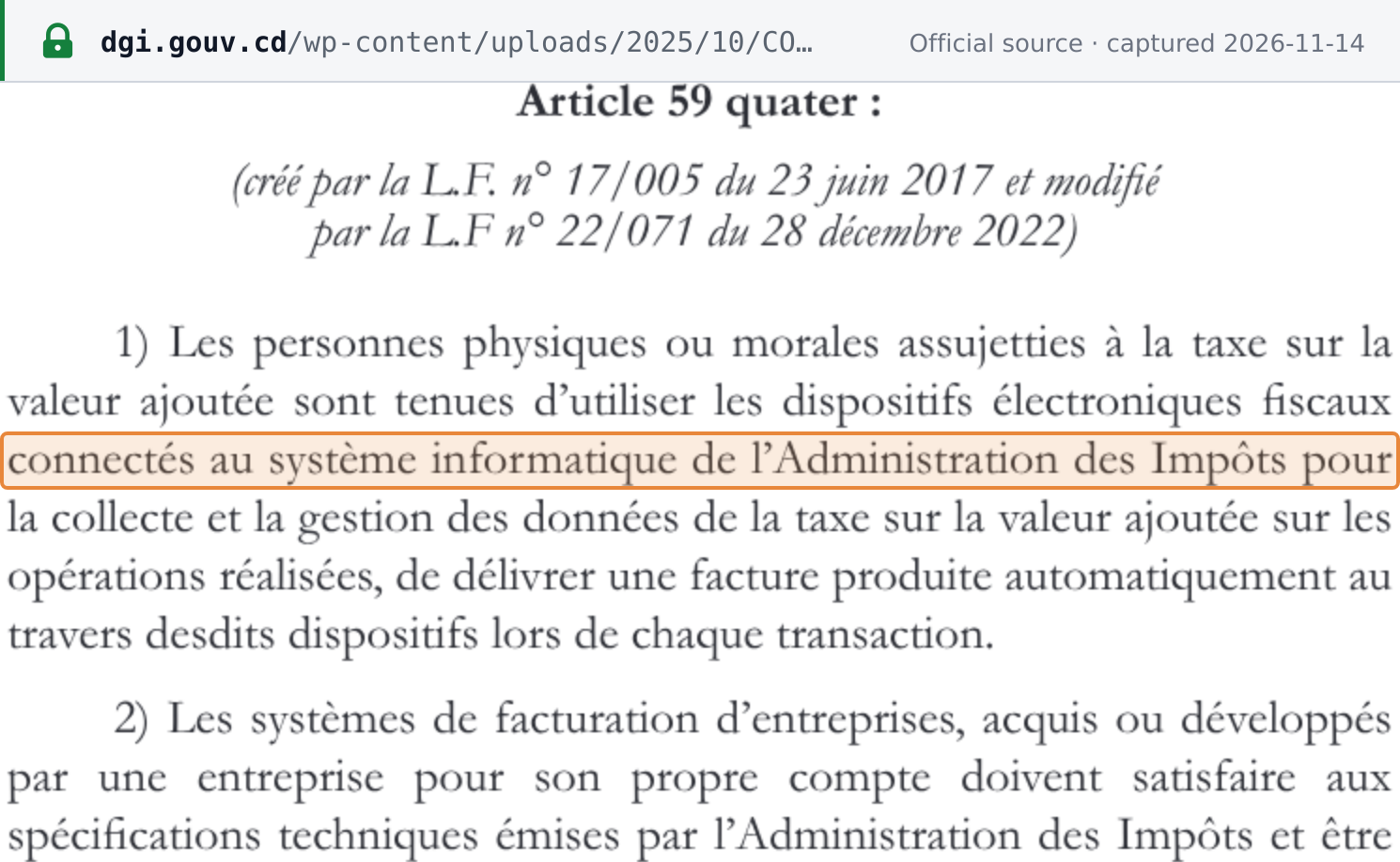 Source snapshot captured 2026-11-14 — original
The four device types (Décret 23/10 arts. 5 to 10):
| Device | What it is | For whom |
|---|---|---|
| UF (unité de facturation) | Physical billing device: records, authenticates, prints and transmits invoices | Businesses that buy a standalone device |
| MCF (module de contrôle de facturation) | Physical module connected to a homologated enterprise billing system (SFE): it collects the invoice data, adds the security elements and transmits the data to the DGI's server | Businesses with their own billing software |
| e-UF | DGI online invoicing application | "destiné aux entreprises qui ne disposent pas de système de facturation" (businesses without a billing system); free of charge (Communiqué 01/057) |
| e-MCF | DGI online control module receiving data from an SFE | "destiné aux entreprises qui disposent déjà d'un système de facturation d'entreprise homologué" (businesses that already have a homologated SFE) |
The online devices form "le système de facturation normalisée en ligne" (art. 19), which the DGI runs as the e-DEF platform at edef.dgirdc.cd. An SFE can issue a normalised invoice only if it is homologated and "relié soit à un MCF physique, soit à un MCF dématérialisé" (art. 3, 7°). Physical devices must be placed where they can reach the GSM mobile network "afin de transmettre les données au serveur de l'Administration fiscale" (Arrêté 033 art. 8 d). [16] [7] [11]
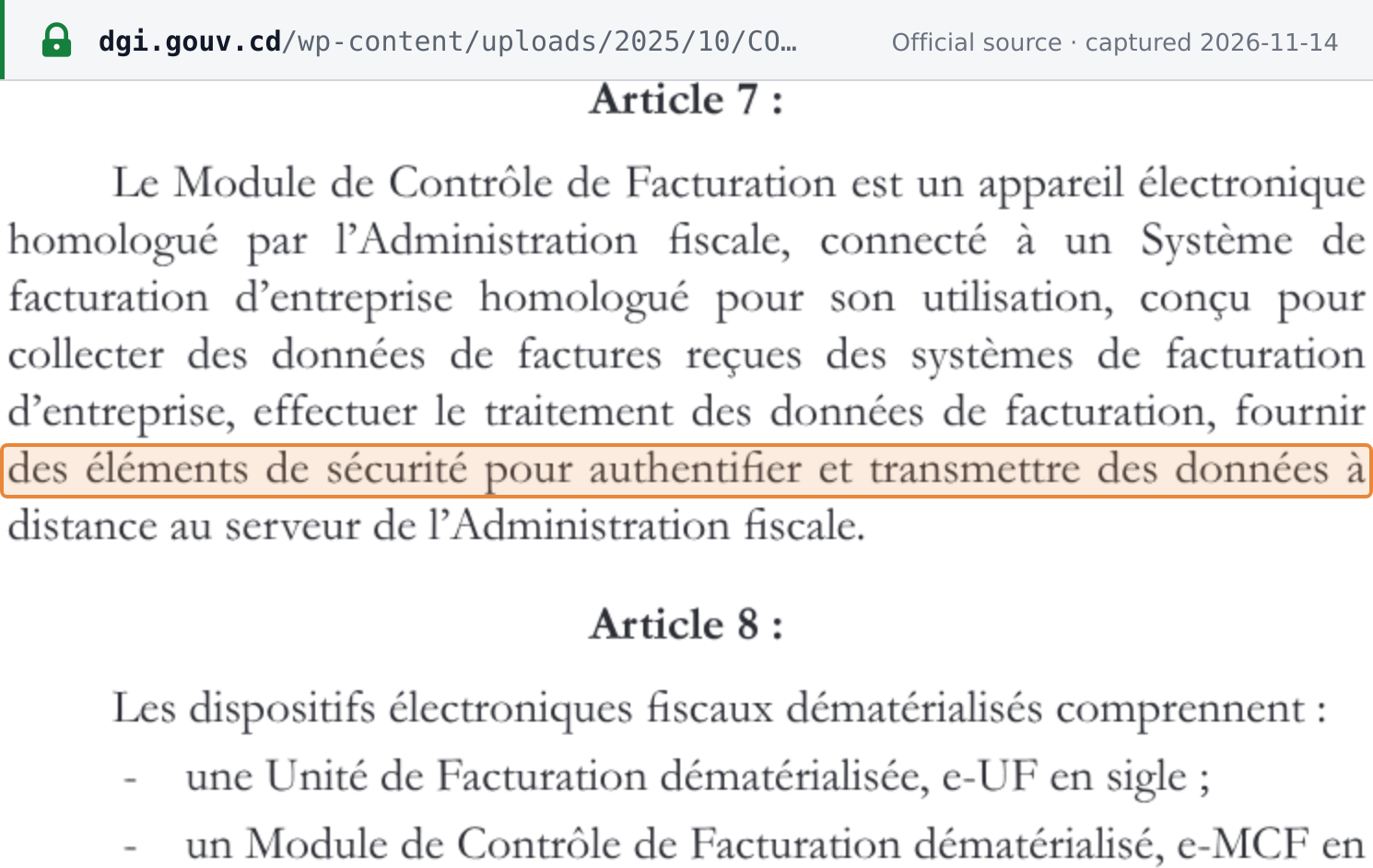 Source snapshot captured 2026-11-14 — original
Format. Décret 23/10 defines the facture normalisée as an invoice "émise sous différents formats, transmise par un des dispositifs électroniques fiscaux", carrying the ordinary invoice particulars plus "des éléments de sécurité qui garantissent l'authenticité et l'intégrité des données sur la facture" (art. 3, 3°). The DGI publishes no XML, UBL, CII or JSON schema, no API specification and no QR-code payload definition on dgi.gouv.cd, on e-DEF or on the test environment's landing page; the technical documentation is released to homologation candidates inside their e-DEF account (Communiqué 01/040). The system is not based on Peppol: no DGI text refers to it. [16] [15]
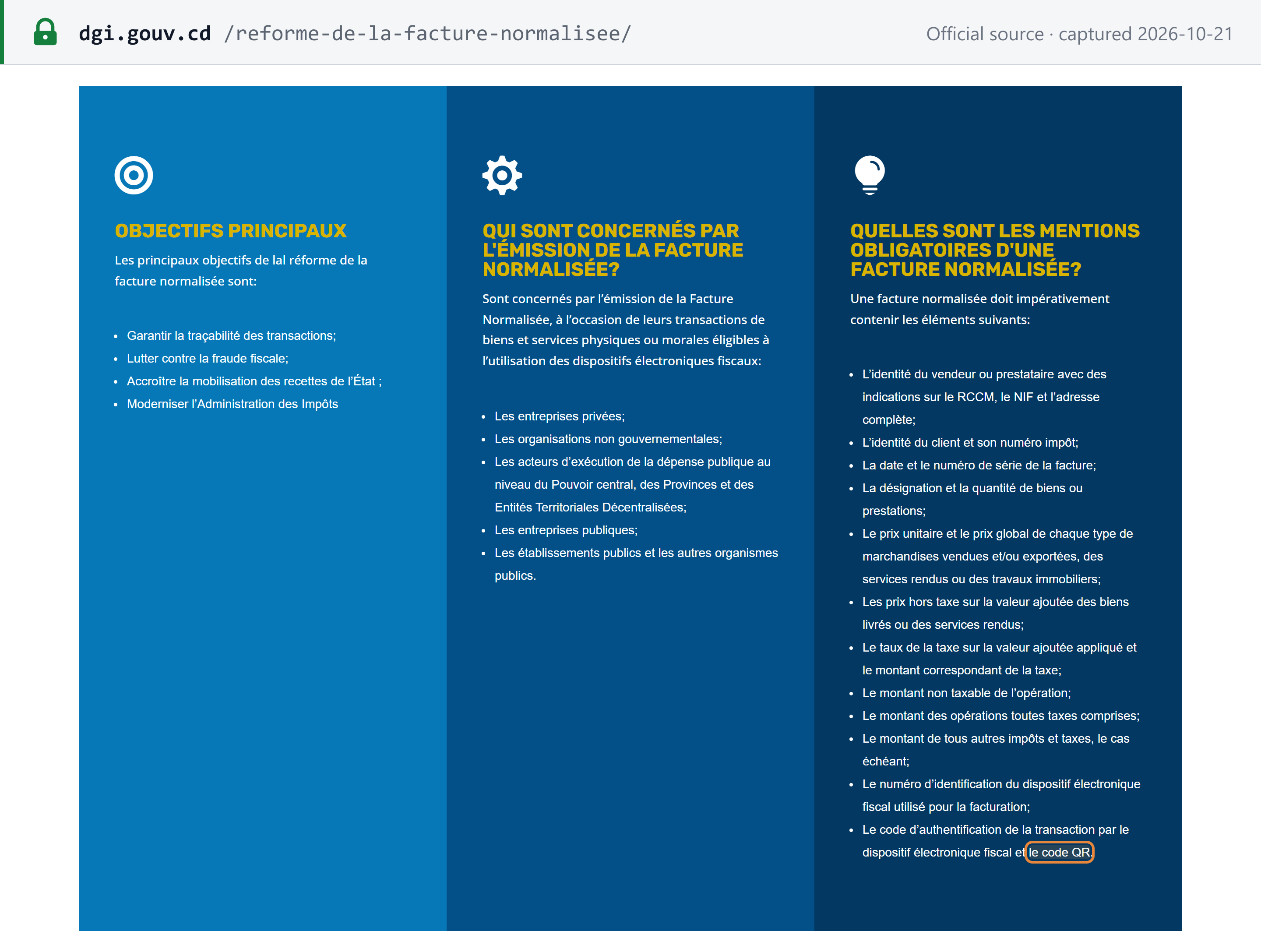
Integrity elements. Every normalised invoice must show "le numéro d'identification du dispositif électronique fiscal utilisé pour la facturation" and "le code d'authentification de la transaction par le dispositif électronique fiscal et le code QR" (Décret 23/10 art. 26 k and l), in addition to ten ordinary particulars (seller's and client's identity, address and Numéro Impôt, date and serial number, description and quantity, prices, VAT rate and amount, non-taxable amount, total, other taxes). The full list and a labelled specimen are in the country guide's invoice requirements. [17]
 Source snapshot captured 2026-10-21 — original
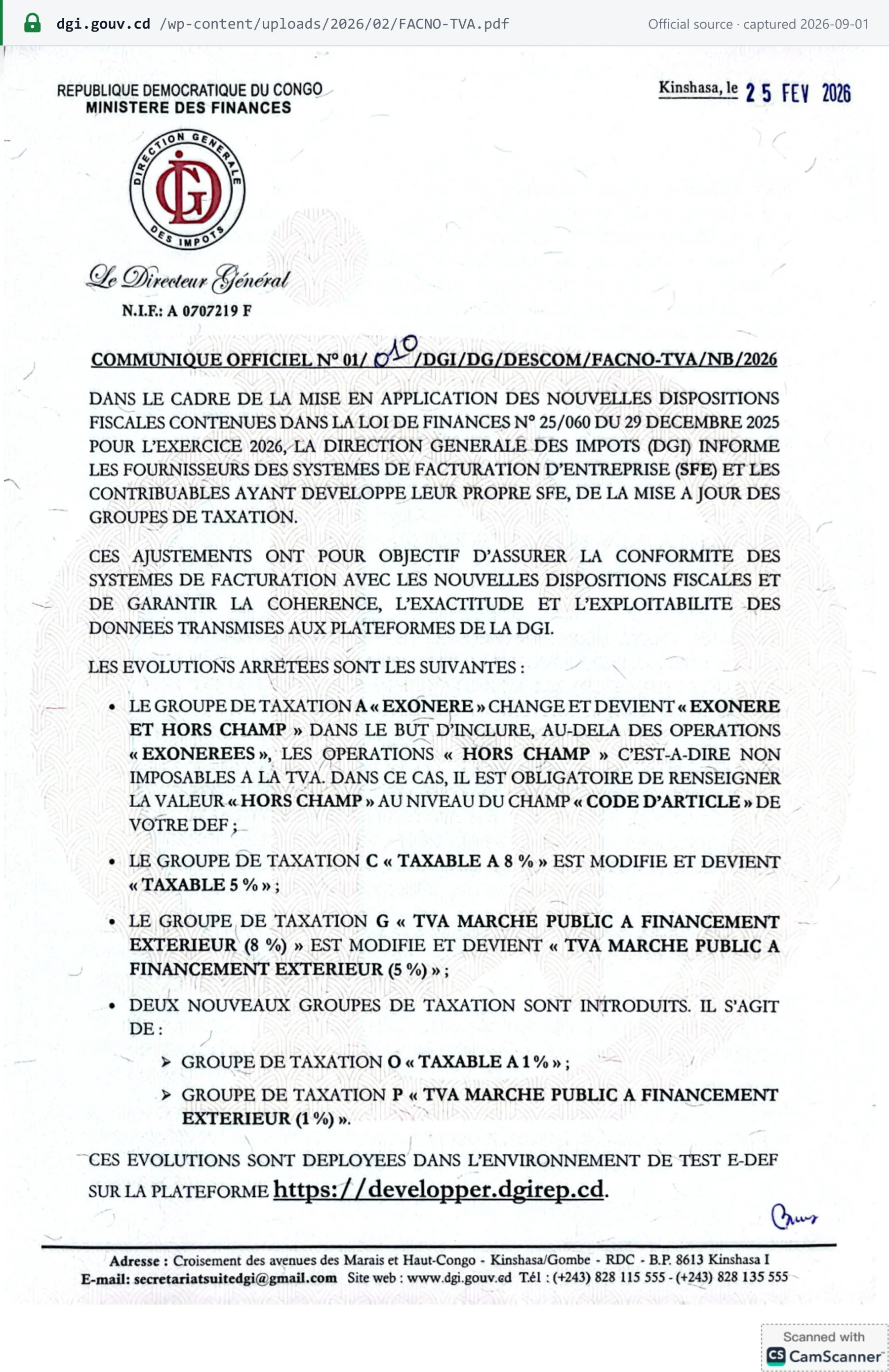
Taxation groups. Each invoice line carries a taxation group that the SFE must implement. On 25 February 2026 (Communiqué 01/010/2026, for Finance Law n° 25/060) group A became "EXONERE ET HORS CHAMP", group C "TAXABLE 5 %", group G (public contracts with external financing) moved from 8% to 5%, and two groups were added: O "TAXABLE A 1 %" and P "TVA MARCHE PUBLIC A FINANCEMENT EXTERIEUR (1 %)". The changes were deployed in the e-DEF test environment. The DGI's public documents do not give the full A-to-P table. [9]
 Source snapshot captured 2026-09-01 — original
Credit notes. A normalised credit note (facture d'avoir normalisée) follows Circulaire 004/2024, and every fiscal-device user, physical or online, keeps a special register of credit notes (Arrêté 033 art. 7 j). [20] [11]
Buyer-side verification. Anyone can check a normalised invoice with the DGI's official FACNO RDC mobile app by scanning its QR code (Communiqué 01/043/2026). Circulaire 005 also names the site sygdef.dgirdc.cd, which now leads to an account login. [4] [13]
E-reporting. No separate e-reporting obligation is attached to the facture normalisée: the device's transmission to the DGI is the reporting. The annual customer and supplier lists are a distinct filing, covered in the country guide.
Onboarding: how to comply
Choose a channel.
| Channel | Suits | What you need |
|---|---|---|
| e-UF on e-DEF | Businesses without billing software | A free e-DEF account; a computer, tablet or phone with a browser; an internet connection |
| SFE + e-MCF | Businesses with their own billing software, online | A homologated SFE connected to the DGI's online control module |
| SFE + physical MCF | Businesses with their own billing software | A homologated SFE and an MCF bought from an approved distributor |
| Physical UF | Shops and businesses wanting a standalone device | A UF bought from an approved distributor, activated by the DGI |
The protocol between an SFE and the e-MCF or MCF is not public; it is part of the technical documentation given to homologation candidates. [11] [15]
Register on e-DEF (e-UF and e-MCF). Communiqué 01/057 of 10 November 2025 invites every VAT taxpayer to register free of charge. "L'accès à la plateforme e-DEF est réservé aux assujettis à la TVA ayant un numéro impôt valide avec un statut actif." The steps:
- request an account at edef.dgirdc.cd;
- receive an access-request form by e-mail;
- have it signed by the legal representative and stamped;
- e-mail it back to activation-edef@dgirdc.cd.
Arrêté 033 art. 10 lists what an online-device user needs: an e-UF account with a valid e-mail address, a computer, tablet or phone with a browser, an active internet connection and, for e-MCF users, an SFE homologated by the DGI. [7] [11]
Obligations of every fiscal-device user, physical or online (Arrêté 033 art. 7, and arts. 9 and 11 on backups):
- display "EXIGEZ LA FACTURE NORMALISEE" at every till;
- keep a backup: a physical-device user needs an online backup device, and an online-device user a physical one;
- issue regularising invoices within 48 hours for sales not invoiced because of a temporary loss of connectivity, and within seven days of notification for unbilled sales found in a check;
- keep a special register of credit notes;
- deactivate the device through the supplier within seven working days of closing or ceasing the business.
Additional obligations for physical devices (Arrêté 033 arts. 6 and 8):
- buy a UF, or an MCF with a homologated SFE, only from a distributor of an approved supplier; the DGI activates the device before use;
- annual maintenance at the user's cost; do not break the seals; use thermal paper legible for at least four years;
- place the device where it can reach the GSM mobile network to transmit data to the DGI.
The cost of a physical device can be partly refunded: "Le remboursement forfaitaire visé à l'alinéa précédent correspond à 50 % des frais d'acquisition" (50% of the purchase cost), as a credit against the following year's profits tax (Arrêté 033 art. 12, under VAT art. 59 quater 3). [11]
Homologation of billing software and devices (Arrêté 016/2025, amending Arrêté 034/2023):
- A homologation commission designated by the Director General examines DEFs and SFEs within 30 working days of a complete file (art. 9); the supplier must demonstrate the product.
- A conforming model receives an attestation from the Director General with a NID (numéro d'identification de dispositif) for a device or an ISF (identifiant de système de facturation) for an SFE. "Seuls les DEF et les SFE homologués sont autorisés à générer la facture normalisée." (art. 14)
- The attestation is valid "tant qu'aucune modification matérielle ou logicielle n'a été apportée au DEF ou au SFE présenté à l'homologation" (art. 15), and any software change made to an SFE after homologation needs a new homologation procedure (art. 16).
- A business that develops its own SFE for internal use must also have it homologated (art. 17).
- Only persons under Congolese law registered in the trade register may distribute devices and sell SFEs.
The SFE homologation file (Communiqué 01/040 of 1 August 2025), all in French: application form; trade-register (RCCM) extract; valid tax-clearance certificate; CNSS certificate; national identity document; technical catalogue; specification sheets with user and control manuals, brochure, conformity table and test cases; installation files; and an undertaking to demonstrate the product. Test accounts are requested on the developer environment at developper.dgirdc.cd, with the signed form returned to homologationfe@dgirdc.cd; a physical MCF is lent free of charge for six weeks for homologation. Communiqué 01/010/2026 gives the test environment's address as developper.dgirep.cd. [15] [9]
The official list. The DGI's homologation commission publishes the list of homologated SFE and DEF and of approved device suppliers. The latest edition is dated 22 October 2026, published on the DGI website in November 2026. It has four parts: SFE homologated for sale (34 as at 22 October 2026), SFE homologated for internal use (23), DEF models homologated for sale (six) and approved DEF suppliers (six). Each SFE row gives its ISF, the homologation type ("Transitoire" or "Complète") and whether it works with an MCF or e-MCF. No public DGI text defines the two homologation types. Buy only from the list: an SFE or device not on it cannot produce a valid normalised invoice. [19] [12]
Penalties
Fines under the VAT Ordonnance-loi n° 10/001, as consolidated in the DGI's Code des Impôts (updated to 10 July 2023):
| Breach | Penalty | Article |
|---|---|---|
| Not using the fiscal device in transactions | CDF 10,000,000 | 74 quater |
| Deliberately corrupting the fiscal device | CDF 5,000,000; tripled on a repeat | 74 quinquies |
| A transaction without delivering a normalised invoice (art. 59 quater) | Five times the VAT not invoiced, minimum CDF 10,000,000 per invoice not issued. On a repeat: ten times the amount not invoiced, minimum CDF 50,000,000 per invoice, which may be combined with a three-month administrative closure by decision of the Director General; foreign managers may also be banned from residing in the DRC | 74 sexies |
| A normalised invoice understating value or quantity; causing a device or homologated software to malfunction | Same as 74 quater (CDF 10,000,000) | 74 septies |
| Modifying the SFE, or using another's identity, to issue fraudulent or falsified normalised invoices | CDF 10,000,000 per invoice, without prejudice to criminal penalties | 74 octies |
| SFE suppliers and billing-software publishers without homologation, and businesses using an in-house system without homologation | CDF 50,000,000; CDF 100,000,000 on a repeat | 74 nonies |
| Any other breach of the e-invoicing device rules | CDF 10,000,000; the VAT evaded and its penalties remain due and criminal proceedings remain possible | 74 decies |
| Each mandatory particular missing from an invoice | CDF 750,000 (legal persons) or CDF 250,000 (individuals) per omission | Tax procedures law art. 97 bis |
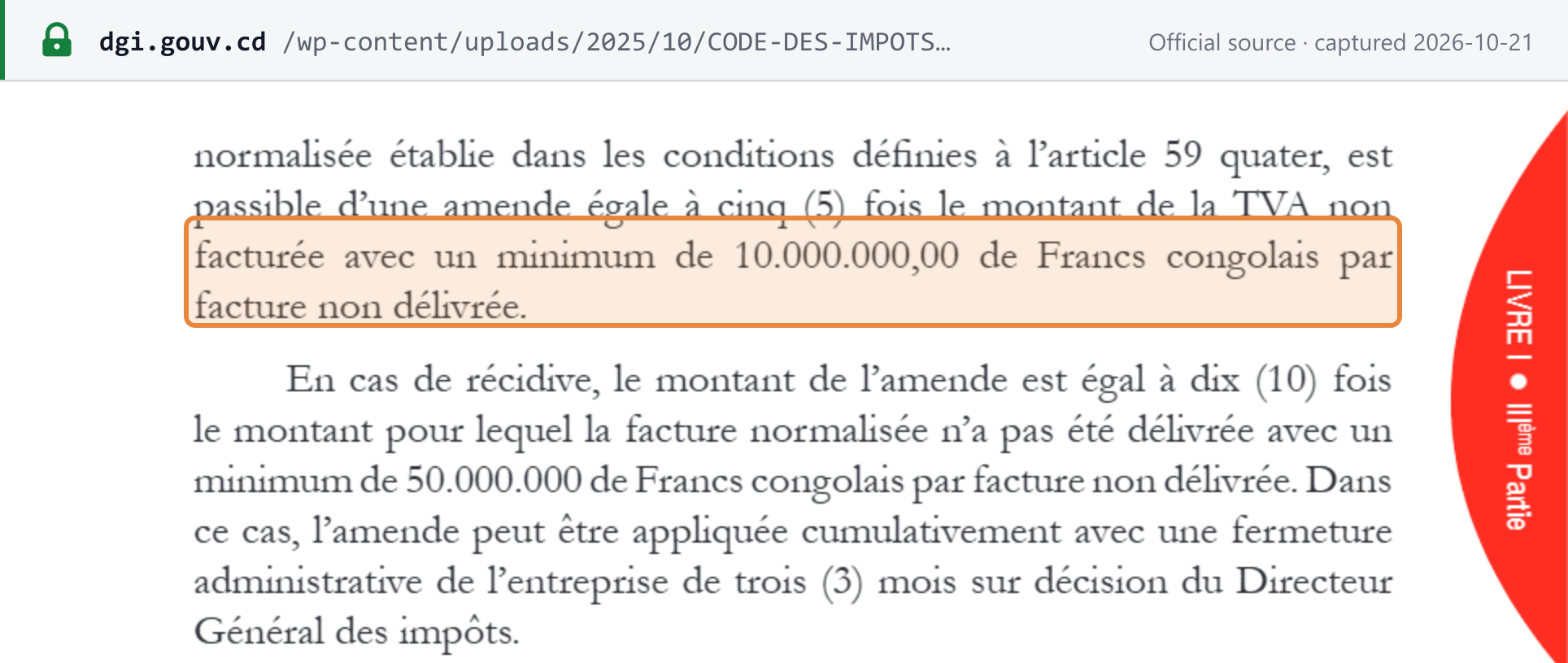
Article 74 sexies: "Toute personne soumise à l'obligation d'utiliser les dispositifs électroniques fiscaux qui effectue une transaction sans délivrer une facture normalisée établie dans les conditions définies à l'article 59 quater, est passible d'une amende égale à cinq (5) fois le montant de la TVA non facturée avec un minimum de 10.000.000,00 de Francs congolais par facture non délivrée." [18]
 Source snapshot captured 2026-10-21 — original
Loss of VAT deduction. Article 42 point 3 bars the deduction of "la taxe sur la valeur ajoutée reprise sur une facture émise en dehors des dispositifs électroniques fiscaux par les personnes soumises à l'obligation d'utiliser lesdits dispositifs". The consolidated code notes that this point applies from a date to be fixed by ministerial arrêté; no such arrêté is published on the DGI's website. In practice the DGI applies the rule: its communiqué 01/059 of 4 December 2025 warns of the "rejet des déductions de TVA ne figurant pas sur des factures normalisées ou des documents en tenant lieu" (rejection of VAT deductions not shown on normalised invoices or substitute documents). [22] [8]
Enforcement posture. 4 December 2025: the DGI announced that December 2025 deductions without a normalised invoice were to be reassessed, with an exceptional 20-day regularisation window. 5 October 2026: moratoria ended, compliance checks under way nationwide, and the public invited to report refusals and non-compliant invoices. Finance laws for 2024 to 2026 are not consolidated in the DGI's code; check with the DGI whether any of them changed these amounts. [8] [4]
Frequently asked questions
A supplier gave us an ordinary invoice, not a facture normalisée. Can we still deduct the VAT on it?
Not safely. The DGI's communiqué 01/059 of 4 December 2025 warns that VAT deductions not shown on normalised invoices or substitute documents are rejected, and December 2025 deductions without a normalised invoice were to be reassessed. VAT law article 42 point 3 bars deducting VAT on an invoice issued outside a fiscal device by a person required to use one. Ask the supplier for a normalised invoice carrying the device number, authentication code and QR code. [8] [22]
We read that the moratorium ended on 15 May 2026. What is the official date?
No official document gives one. DGI Communiqué officiel N° 01/043 of 5 October 2026 says the Minister of Finance announced the end of the moratoria, without dating the announcement, and that the obligation is fully effective with compliance checks under way nationwide. The obligation itself has applied since 1 December 2025. [4]
We have our own ERP. Can we keep using it to issue invoices?
Only if it is homologated by the DGI as an enterprise billing system (SFE) and connected to a physical MCF or to the online e-MCF. Homologation applies to in-house systems too (Arrêté 016/2025 art. 17), and any software change after homologation requires a new homologation (art. 16). Using an in-house system without homologation carries a fine of CDF 50,000,000, or CDF 100,000,000 on a repeat (VAT art. 74 nonies). [12] [18]
Our billing software is not homologated yet. What can we issue in the meantime?
The free e-UF on the DGI's e-DEF platform issues normalised invoices without any software; access requires a valid, active Numéro Impôt. A temporary derogation from the Director General under Circulaire 005/2024 is no longer open to existing businesses, which had to apply before the 1 December 2025 compliance deadline; a new business can still apply, with reasons, within three months of its registration, for at most two months. [7] [13]
Homologation asks us to hand over our software's installation files. Is that really required?
Yes. DGI Communiqué 01/040 of 1 August 2025 lists the installation files among the documents in the SFE homologation file, with the technical catalogue, manuals, test cases and an undertaking to demonstrate the product. The commission must decide within 30 working days of a complete file (Arrêté 016/2025 art. 9). [15] [12]
What happens if the internet or the mobile network goes down?
Keep invoicing on your backup device: a physical-device user must have an online backup and an online-device user a physical one, and unavailability of the device does not excuse failing to issue normalised invoices (Arrêté 033). Sales not invoiced because of a temporary loss of connectivity must be regularised with normalised invoices within 48 hours (art. 7 g). [11]
How can a customer check that a normalised invoice is genuine?
Scan its QR code with the DGI's official FACNO RDC mobile app, which the DGI's communiqué of 5 October 2026 says can verify a normalised invoice. The DGI also invites the public to report refusals to issue a normalised invoice and non-compliant invoices. [4]
We are a foreign company selling to DRC businesses. Do we issue normalised invoices?
The DGI's texts do not address non-resident suppliers specifically. A non-resident liable to DRC VAT must appoint an approved resident representative, and access to the e-DEF platform is reserved to VAT taxpayers with a valid, active Numéro Impôt. Confirm your position with the DGI before invoicing. [7]
Recent changes
- 2026-10-22 — The DGI's homologation commission updated the list of homologated SFE and DEF and approved device suppliers. (DGI)
- 2026-10-05 — Following the Minister of Finance's announcement of the end of the moratoria, the DGI said the obligation to issue and deliver a facture normalisée is fully effective and began nationwide compliance checks. (DGI) — see event
- 2026-02-25 — Invoicing taxation groups updated for Finance Law n° 25/060: the 8% groups become 5%, 1% groups are added, and group A covers out-of-scope operations. (DGI) — see event
- 2025-12-04 — DGI: December 2025 VAT deductions not backed by a normalised invoice will be reassessed, with an exceptional 20-day regularisation window. (DGI)
- 2025-12-01 — The facture normalisée, issued through a fiscal device, became mandatory for all VAT taxpayers. (DGI) — see event
Related resources
- DR Congo VAT guide — rates, registration, invoice requirements with a labelled specimen, filing
- E-invoicing status and networks by country
- CTC e-invoicing models explained
- Fiscal devices and certified cash registers
- DR Congo tax changes on Lookuptax
- Not to be confused with the Republic of the Congo's SFEC: E-invoicing in the Republic of the Congo
Important websites
- DGI — Réforme de la facture normalisée — the reform page, with the decree, arrêtés and circulars
- e-DEF — online invoicing (e-UF, e-MCF); account activation activation-edef@dgirdc.cd
- e-DEF test environment — for homologation candidates; homologationfe@dgirdc.cd
- List of homologated SFE and DEF, 22 October 2026 (PDF)
- DGI official communiqués
- FACNO RDC — the DGI's invoice-verification app, on Google Play
Reference links
- DGI — Réforme de la facture normalisée
- Code des Impôts (DGI, updated to 10 July 2023), p. 240 — VAT arts. 59 ter and 59 quater (PDF)
- DGI Communiqué officiel N° 01/050/DGI/DG/FACNO-TVA/2025 of 2 October 2025 (PDF)
- DGI Communiqué officiel N° 01/043/DGI/DG/DESCOM/DIV.COM/NB/TMI/2026 of 5 October 2026 (PDF)
- DGI Communiqué officiel N° 01/034/DGI/DG/FACNO-TVA/2025 of 16 June 2025 (PDF)
- DGI Communiqué officiel N° 01/039/DGI/DG/FACNO-TVA/TTO/2025 of 1 August 2025 (PDF)
- DGI Communiqué officiel N° 01/057/DGI/DG/FACNO-TVA/FMK/2025 of 10 November 2025 (PDF)
- DGI Communiqué officiel N° 01/059/DGI/DG/FACNO-TVA/FMM/2025 of 4 December 2025 — practical rules on the obligation to demand and issue the facture normalisée (PDF)
- DGI Communiqué officiel N° 01/010/DGI/DG/DESCOM/FACNO-TVA/NB/2026 of 25 February 2026 (PDF)
- DGI — list of homologated SFE and DEF, April 2026 edition (PDF)
- Arrêté ministériel n° 033/CAB/MIN/FINANCES/2023 of 23 October 2023 (PDF)
- Arrêté ministériel n° 016/CAB/MIN/FINANCES/2025 of 27 February 2025 (PDF)
- Circulaire ministérielle n° 005/CAB/MIN/FINANCES/2024 of 30 December 2024 (PDF)
- Code des Impôts, p. 238 — VAT art. 58 (PDF)
- DGI Communiqué officiel N° 01/040 of 1 August 2025 — SFE homologation file (PDF)
- Code des Impôts, pp. 355–358 — Décret n° 23/10 arts. 1 to 10 (PDF)
- Code des Impôts, pp. 361–362 — Décret n° 23/10 arts. 25 to 29 (PDF)
- Code des Impôts, pp. 246–248 — VAT arts. 74 quater to 74 decies (PDF)
- DGI — list of homologated SFE and DEF and approved suppliers, 22 October 2026 (PDF)
- Circulaire ministérielle n° 004/CAB/MIN/FINANCES/2024 of 30 December 2024 (PDF)
- Code des Impôts, p. 469 — tax procedures law art. 97 bis (PDF)
- Code des Impôts, p. 232 — VAT art. 42 (PDF)
- DGI news — awareness carnival on the facture normalisée from 1 December 2025
- DGI Communiqué officiel N° 01/047 of 5 November 2026 — non-resident providers of digital services (PDF)