E-invoicing in Côte d'Ivoire: the facture normalisée électronique (FNE)
Status as at 3 November 2026.
Overview
In Côte d'Ivoire every standardised invoice is now certified by the tax authority's own platform before it reaches the customer. The facture normalisée électronique (FNE) replaced the paper facture normalisée that had been in use since 2005. Since December 2025 (February 2026 for some small taxpayers), only an FNE supports an expense deduction or an input-VAT (TVA) deduction.
What the system is. The facturation normalisée électronique covers two documents:
- the facture normalisée électronique (FNE), the electronic standardised invoice;
- the reçu normalisé électronique (RNE), the electronic standardised receipt used for retail sales and by flat-rate taxpayers.
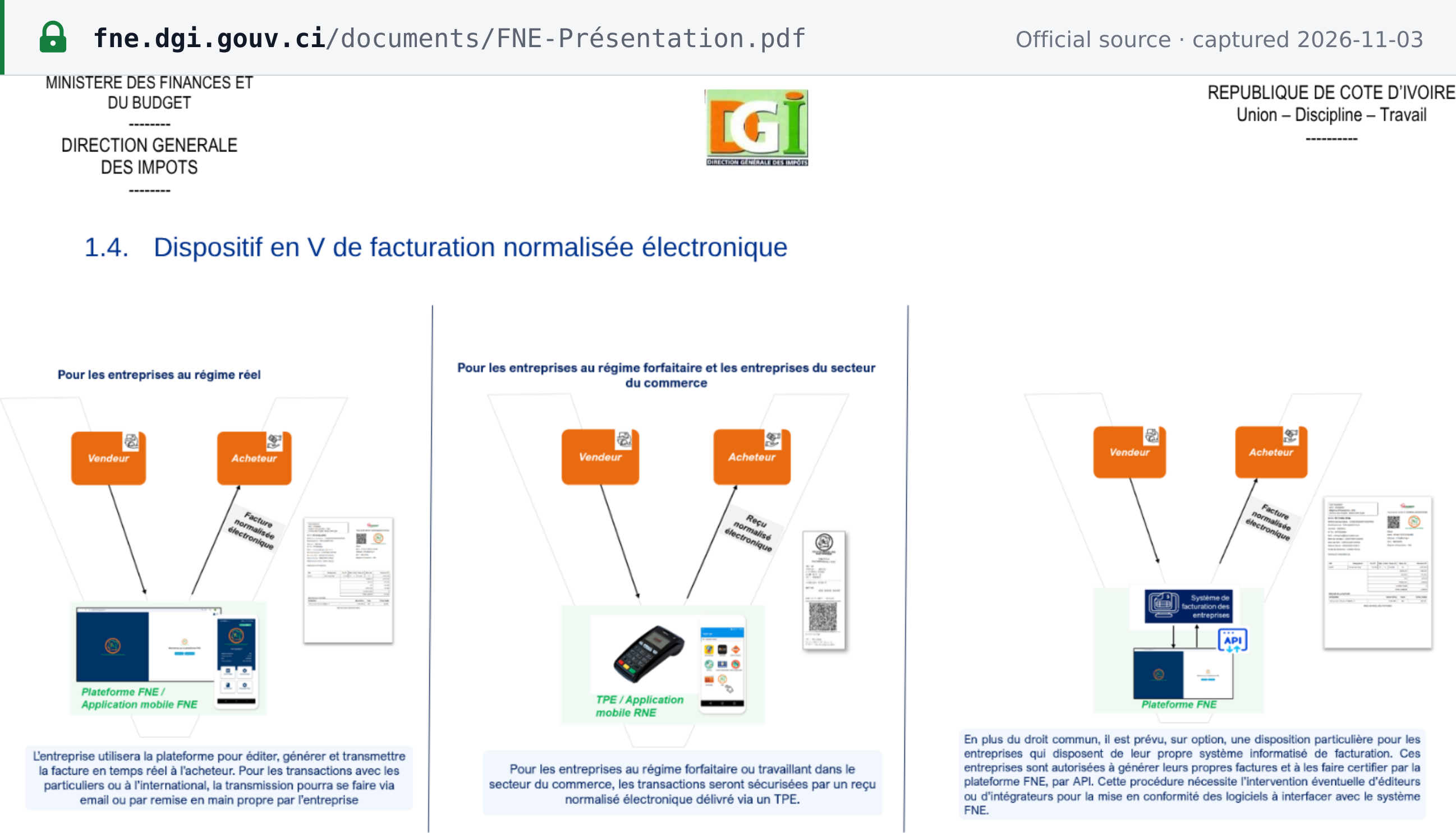
Both can be issued from the DGI's FNE platform (web or mobile app), from approved invoicing terminals, or from a business's own invoicing system connected to the platform through an API. (DGI — Présentation de la FNE, March 2025, p.3)
Who runs it. The Direction générale des Impôts (DGI) of the Ministry of Finance and Budget, through its FNE portal at fne.dgi.gouv.ci.
Legal basis in one line. Article 6 of the 2025 annexe fiscale (Loi de finances n° 2024-1109 of 18 December 2024) extended the FNE to all taxpayers, and Arrêté n° 0337 of 9 May 2025 sets the implementing rules. The instrument list is under Legal basis.
| Côte d'Ivoire | |
|---|---|
| Status | In force. FNE mandatory by tax regime from 1 June 2025 (RNI) to 1 September 2025 (entreprenant regimes); paper standardised invoices ended 1 December 2025 (RNI, RSI) and 11 December 2025 (RME), and could be used by TEE taxpayers for B2B and B2G until 13 February 2026 |
| B2B / B2G / B2C | All three, plus B2F (foreign customers), on the same platform and from the same dates. Start dates depend on the supplier's tax regime, not on the type of customer |
| Non-residents | Businesses with no professional installation in Côte d'Ivoire are dispensed (LPF art. 145) |
| Format | Data sent as JSON to the DGI platform (API route) or keyed on the platform; the certified FNE is rendered as a PDF. No XML standard is published |
| Network | DGI FNE platform, real-time certification. Not Peppol-based |
| Integrity | Electronic sticker: FNE visual + QR code + regulated numbering format (Arrêté 0337 art. 4) |
| Latest deadline | API integrators had to conform their payloads by 29 October 2026 (DGI communiqué of 14 September 2026); deadline passed |
| Authority | Direction générale des Impôts (DGI) · FNE portal |
| Legislation | CGI arts. 384–385; LPF arts. 144, 145, 145 bis, 168, 171 bis; Arrêté n° 0337/MFB/DGI/DLCD/SDL/bke of 9 May 2025 |
Mandate status & timeline
Legal start dates by tax regime
Article 8 of Arrêté n° 0337 phased the FNE in by the supplier's tax regime. Each date is a "no later than" date ("au plus tard"), not a window:
- 1 June 2025 — businesses under the régime du réel normal d'imposition (RNI);
- 1 July 2025 — the régime du réel simplifié d'imposition (RSI);
- 1 August 2025 — the régime des microentreprises (RME);
- 1 September 2025 — the régime de l'entreprenant (taxe communale de l'entreprenant, TCE, and taxe d'État de l'entreprenant, TEE).
(DGI — Arrêté n° 0337 of 9 May 2025, art. 8; restated in the DGI communiqué of 13 June 2025)
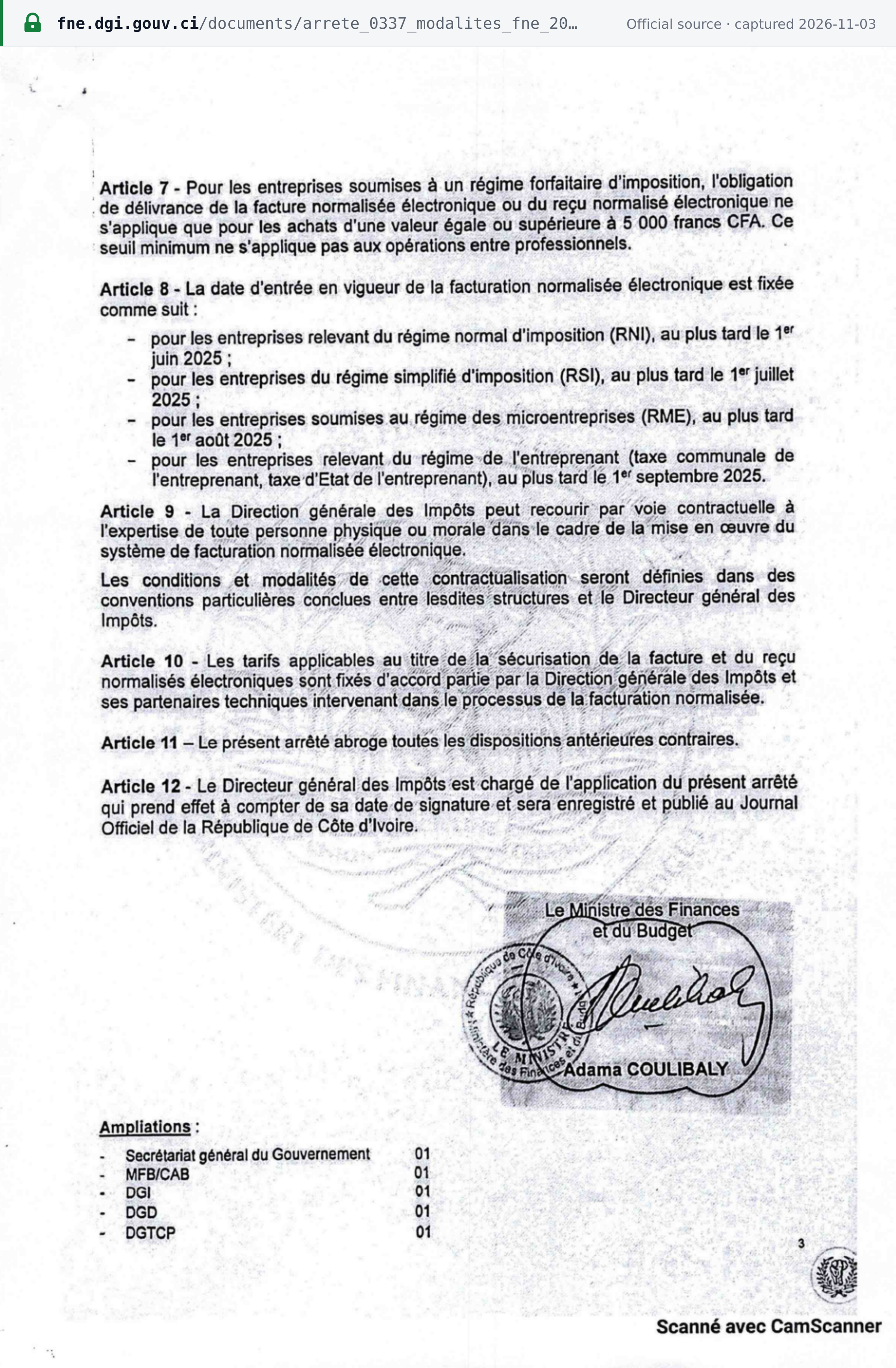 Source snapshot captured 2026-11-03 — original (scanned document, page 3)
The end of paper standardised invoices
The FNE start dates did not end paper. The DGI let businesses keep using the paper facture normalisée alongside the FNE, then extended that tolerance twice:
- The communiqué of 13 June 2025 kept paper "exceptionnellement" until 2 September 2025. Holders of paper stocks had to declare them to the Chamber of Commerce and Industry and to the DGI by 30 June 2025. (DGI communiqué, 13 June 2025)
- The communiqué dated 5 September 2025 extended it to 1 December 2025 (RNI and RSI), 11 December 2025 (RME) and 22 December 2025 (entreprenant regimes). The extension did not cover multi-department stores (magasins à rayons multiples) under RNI or RSI, which must issue RNEs. (DGI communiqué, 5 September 2025)
- The communiqué of 27 January 2026 confirmed that paper ended on 1 and 11 December 2025 for the real regimes and the RME. For TEE taxpayers it set the last day for paper standardised invoices at Friday 13 February 2026, for operations between businesses or with the State. From then on, only FNEs are accepted to justify expenses and to deduct the TVA charged on purchases. (DGI communiqué, 27 January 2026)
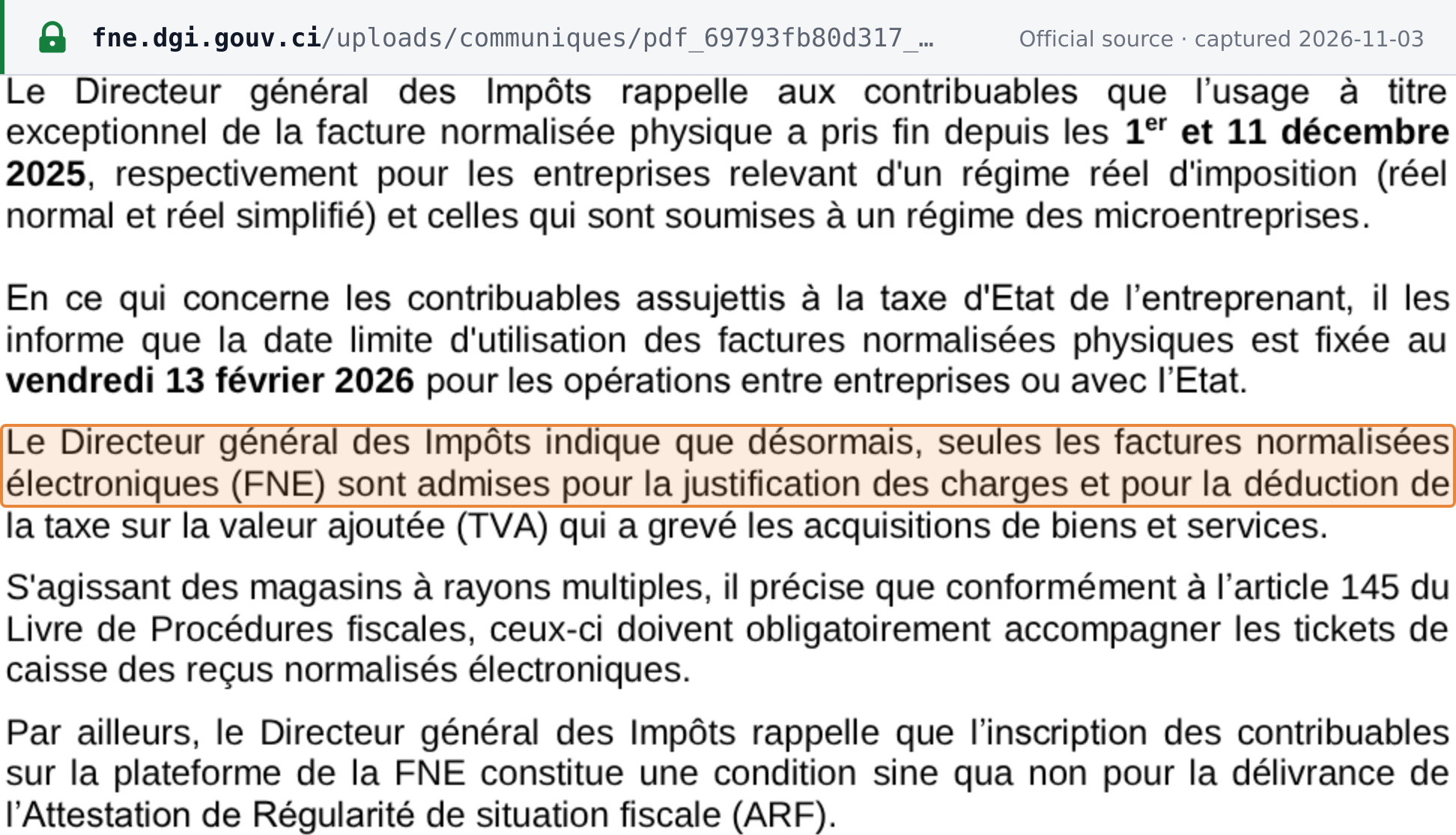 Source snapshot captured 2026-11-03 — original
TEE taxpayers. The 5 September 2025 communiqué set 22 December 2025 for the entreprenant regimes; the 27 January 2026 communiqué sets 13 February 2026 for TEE operations with businesses and the State. The 18 December 2025 communiqué covers only the real regimes and the RME; no communiqué between 5 September 2025 and 27 January 2026 addresses TEE taxpayers, and none says what applied to TEE sales to consumers after 22 December 2025.
TCE taxpayers. Article 8 of the arrêté names the taxe communale de l'entreprenant, but the DGI's FAQ says TCE payers "ne sont pas encore pris en charge" on the platform: only businesses attached to a DGI tax office can enrol. (DGI — FNE FAQ)
Timeline
| Date | Who | What | Instrument | Status at 2026-11-03 |
|---|---|---|---|---|
| 19 May 2025 | All | FNE enrolment opens | DGI communiqué [1] | Passed |
| 1 Jun 2025 (no later than) | RNI | FNE in force | Arrêté 0337 art. 8 | Passed |
| 1 Jul 2025 (no later than) | RSI | FNE in force | Arrêté 0337 art. 8 | Passed |
| 1 Aug 2025 (no later than) | RME | FNE in force | Arrêté 0337 art. 8 | Passed |
| 1 Sep 2025 (no later than) | Entreprenant (TCE, TEE) | FNE in force | Arrêté 0337 art. 8 | Passed; TCE payers not yet on the platform |
| 2 Sep 2025 | All | First end date for paper | Communiqué of 13 Jun 2025 | Postponed |
| 1 Dec 2025 | RNI, RSI | Paper standardised invoices end | Communiqués of 5 Sep 2025 and 18 Dec 2025 [2] | Passed |
| 11 Dec 2025 | RME | Paper standardised invoices end | Same | Passed |
| 22 Dec 2025 | Entreprenant | Paper end date set by the 5 Sep 2025 communiqué | Communiqué of 5 Sep 2025 | Replaced for TEE B2B/B2G by 13 Feb 2026 |
| 31 Jan 2026 | All | FNE enrolment closes ("délai de rigueur") | Communiqué of 27 Jan 2026 | Passed |
| 13 Feb 2026 | TEE (B2B, B2G) | Last day paper standardised invoices may be used | Communiqué of 27 Jan 2026 | Passed |
| 1 Sep 2026 | All regimes | Nationwide FNE/RNE control operation begins | Communiqué of 21 Aug 2026 [3] | Under way |
| 29 Oct 2026 | API users and integrators | Payload conformity deadline; API keys can be suspended after it | Communiqué of 14 Sep 2026 | Passed |
Latest phase: API conformity by 29 October 2026
In a communiqué signed in Abidjan on 14 September 2026, the Director-General gave every business using the API route 45 days from signature (to 29 October 2026) to bring its solution into line with the FNE technical specifications. The rules it lists:
- the customer's taxpayer account number (NCC) is 8 alphanumeric characters with no spaces: 7 digits and an upper-case key letter;
- phone numbers use the Ivorian format, 10 digits starting 01, 05, 07, 21, 25 or 27, without +225 or 00225, for B2B, B2C and B2G; for B2F only the destination country's prefix is required;
- email and phone are mandatory for B2B;
- B2F invoices show the destination currency and the exchange rate, including for customers in the CFA-franc zones (UEMOA, CEMAC);
- only RNI and RSI taxpayers may invoice TVA;
- quantities must be positive, and no negative values are allowed except for kerosene (pétrole lampant) sales.
After the deadline, businesses and software editors or integrators whose data flows are non-compliant face a temporary suspension of their API key to the FNE platform, on top of any tax penalties. As at 2026-11-03 the FNE portal shows no extension or follow-up communiqué. (DGI communiqué, 14 September 2026)
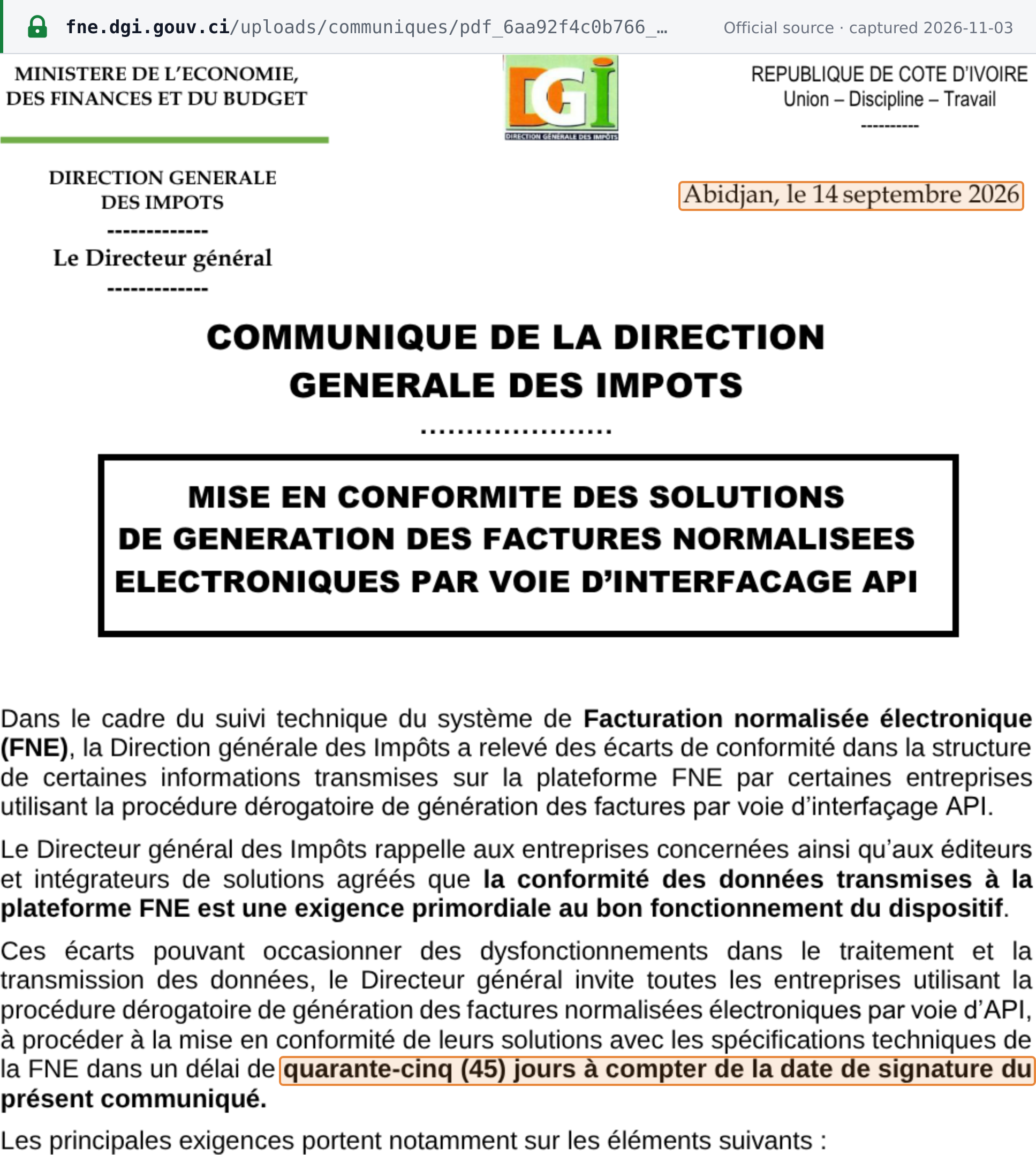 Source snapshot captured 2026-11-03 — original
The DGI has not announced further phases. Its FNE presentation lists pre-filled TVA returns as a capability planned "à terme" (eventually), with no date. (DGI — Présentation de la FNE, p.12)
Legal basis
| Instrument | What it does | Date / in force |
|---|---|---|
| Annexe fiscale 2019, art. 15 (Loi n° 2018-984 of 28 December 2018) | Authorised the tax administration to set up an electronic invoicing system; created LPF art. 145 bis (FNE for goods and services supplied electronically) | 2019 Finance Law |
| Annexe fiscale 2025, art. 6 (Loi de finances n° 2024-1109 of 18 December 2024) | Extended the FNE to all taxpayers. Amended CGI art. 384 (adds the "hologramme ou sticker électronique sécurisé"), LPF arts. 13 bis, 13 ter, 13 quater, 13 sexies, 144 and 145, and created LPF art. 171 bis. Left the detailed rules to an arrêté of the Budget Minister, with paper continuing in the meantime | 2025 Finance Law |
| Arrêté n° 0337/MFB/DGI/DLCD/SDL/bke of 9 May 2025 [4] | Implementing rules: scope (art. 2), the three issuance procedures (art. 3), the electronic sticker (art. 4), numbering (art. 5), mandatory particulars (art. 6), the FCFA 5,000 floor for flat-rate regimes (art. 7), start dates (art. 8) | In effect from signature (art. 12) |
| Annexe fiscale 2026, art. 18-7 (Loi de finances n° 2025-987 of 19 December 2025) | Widened the LPF art. 145 dispensation to all transport companies that are not public-service concessionaires | In force 5 January 2026 [5] |
| CGI arts. 384–385; LPF arts. 144, 145, 145 bis, 168, 171 bis [6] | The current statutory text: who must issue, invoice mentions, exemptions, penalties | Consolidated 2026 edition |
Article 384 of the CGI requires every invoice to show, besides the LPF art. 144 mentions, the price excluding tax, the TVA rate and amount, and "un hologramme ou un sticker électronique sécurisé selon un modèle déterminé par l'Administration fiscale". For multi-department retailers, till tickets accompanied by receipts secured by the FNE platform count as invoices. (CGI art. 384, consolidated 2026)
Article 12 of the arrêté provides for publication in the Journal Officiel; the DGI publishes the signed text on its FNE legal texts page. The 2025 annexe's explanatory text is on the FNE portal (DGI — annexe fiscale 2025 extract).
Scope
All businesses, all regimes. The FNE applies to all businesses, natural or legal persons, whatever their tax regime, except where the law limits it (Arrêté 0337 art. 2). LPF art. 144 requires every trader, manufacturer, craftsman or service provider supplying another professional or a consumer to issue an FNE once the sale is final, and the buyer must ask for it.
B2B, B2G, B2C and B2F. All four run on the same platform from the same dates; the start date depends on the supplier's regime, not the customer. The DGI's invoice templates are:
| Template | Customer |
|---|---|
| B2B | A business or professional with an NCC (customer NCC mandatory) |
| B2G | A government institution. The DGI's FNE documents describe no separate public-procurement invoicing channel; B2G invoices use the same template and platform |
| B2C | An individual |
| B2F | A customer abroad. The customer's tax ID is not required; currency and exchange rate are |
The RNE (receipt) covers sales to consumers and B2B sales between flat-rate and real-regime businesses. (DGI — Procédure d'interfaçage par API, Annexe 1; Présentation de la FNE, p.7)
Non-established businesses. Out of scope. LPF art. 145 dispenses "les entreprises n'ayant pas d'installations professionnelles en Côte d'Ivoire". Enrolment also requires an NCC and a numéro de télédéclarant (NTD), and the DGI's FAQ says only businesses attached to a DGI tax office can currently enrol.
Who is dispensed (LPF art. 145, as at 2026-11-03). Businesses dispensed from standardised invoices:
- water, electricity and telephone public-service concessionaires, for their concession activities;
- multi-department retailers, for retail sales giving rise to till tickets accompanied by receipts secured by the FNE platform;
- pharmacies; airlines; banks; insurance companies; La Poste de Côte d'Ivoire;
- the public-service concessionaire for identification of persons;
- petroleum companies under production-sharing contracts;
- fuel stations, for fuel sales only;
- transport concessionaires, for operations covered by the concession;
- all transport companies that are not public-service concessionaires (since 5 January 2026);
- businesses with no professional installation in Côte d'Ivoire;
- public gaming concessionaires, for sales to final customers but not to resellers;
- licensed telephony operators;
- road-works concessionaires, for the tolls they collect but not subscriptions.
Before 5 January 2026, the transport dispensation applied only to non-concession transport companies that had not opted to be liable for TVA. Annexe fiscale 2026 art. 18-7 deleted that condition. The DGI's own March 2025 presentation and its FAQ still show the older list. (LPF art. 145, consolidated 2026; Annexe fiscale 2026, art. 18)
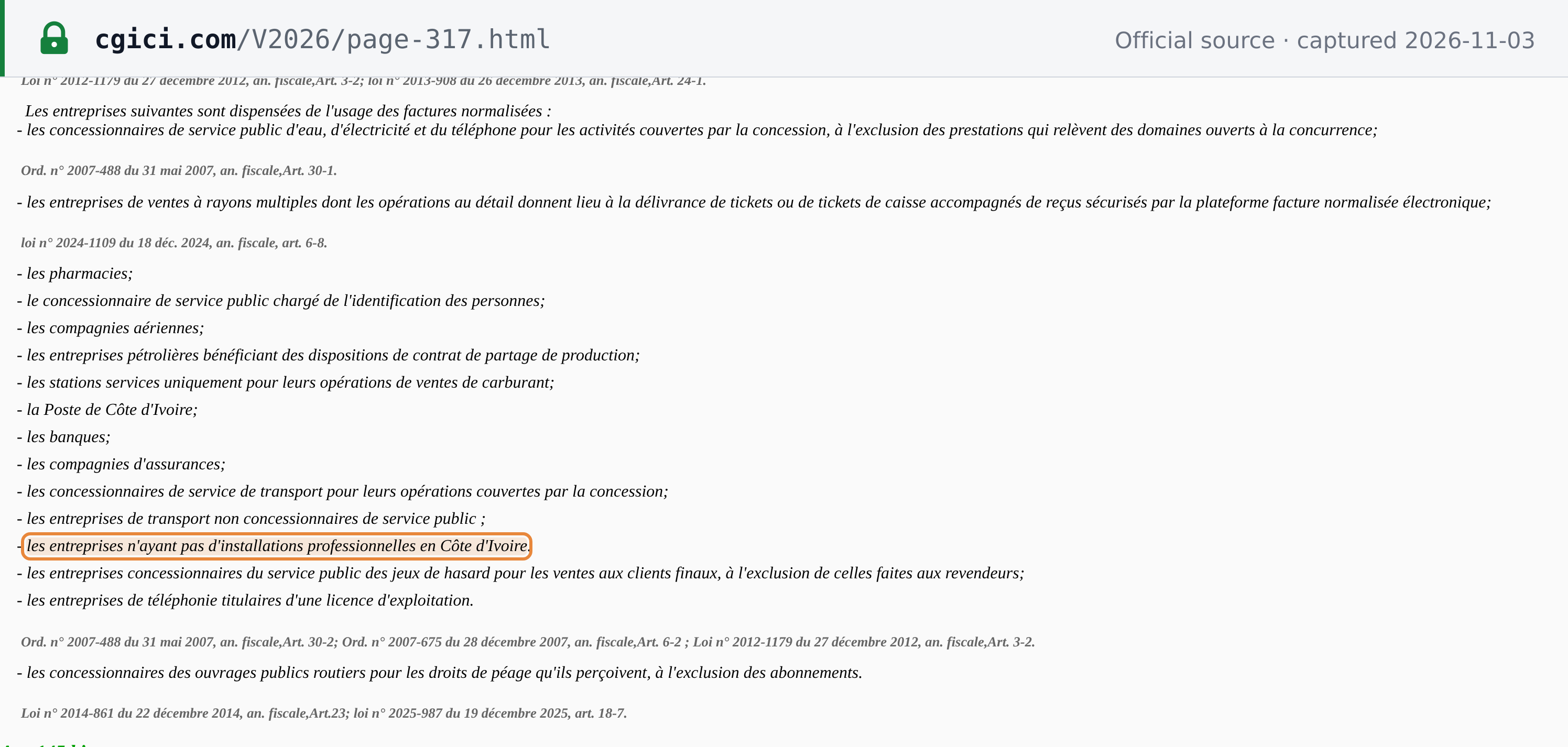 Source snapshot captured 2026-11-03 — original
The DGI's FAQ adds practice points: travel agencies' air-ticket sales and the related agency fees fall under the airline dispensation, but their other services need an FNE or RNE. Rent on bare buildings is documented by a rent receipt, not an FNE, unless the owner opted into TVA; furnished lettings and estate-agency commissions need an FNE or RNE. (DGI — FNE FAQ)
Flat-rate regimes and small sales. For businesses on a flat-rate regime (RME, TEE), the FNE or RNE obligation applies only to purchases of FCFA 5,000 or more. The floor does not apply to operations between professionals (Arrêté 0337 art. 7). Separately, retailers, craftsmen, farmers, livestock farmers and fishermen not on a real regime issue an invoice to a consumer only on request (LPF art. 144). The DGI's FAQ words this differently, saying the RNE is mandatory for all RME and TEE taxpayers "quel que soit le montant", with a free sticker for transactions of FCFA 1 to 5,000.
TVA on the FNE. Only RNI and RSI taxpayers may invoice TVA. The platform's tax codes are TVA
(18%), TVAB (reduced, 9%), TVAC (0%, conventional exemption) and TVAD (0%, statutory
exemption for TEE and RME).
(DGI — Procédure d'interfaçage par API, Annexe 1; communiqué of 14 September 2026, p.2)
Agricultural purchases. Buyers of agricultural and fishery produce from small producers without an NCC issue an electronic bordereau (detailed; it serves as the purchase invoice) or an electronic receipt of produce. (Présentation de la FNE, p.11)
Imports and services bought from abroad. The DGI's FNE texts (arrêté, communiqués, guides and FAQ) set no FNE rule for imports or for services bought from foreign suppliers.
Format & network
CTC model: real-time certification by the DGI. The invoice data goes to the DGI's FNE platform, which checks that the issuer is authorised and the data is valid, certifies the invoice, and returns the security elements: invoice number, a QR-code verification token and the sticker balance. The platform also makes the invoice available in the professional customer's FNE space. Article 3 of Arrêté 0337 sets three procedures:
- Common procedure (droit commun): direct use of the DGI platform (web, file import or the FNE mobile app).
- Exception procedure: direct API connection between the business's invoicing system and the platform. It applies on the business's option and after prior approval of the Director-General of Taxes.
- RNE via electronic payment terminals (TPE): for flat-rate businesses and multi-department retailers whose retail sales produce till tickets.
(Arrêté 0337 art. 3; DGI — Procédure d'interfaçage par API, May 2025)
 Source snapshot captured 2026-11-03 — original (page 6)
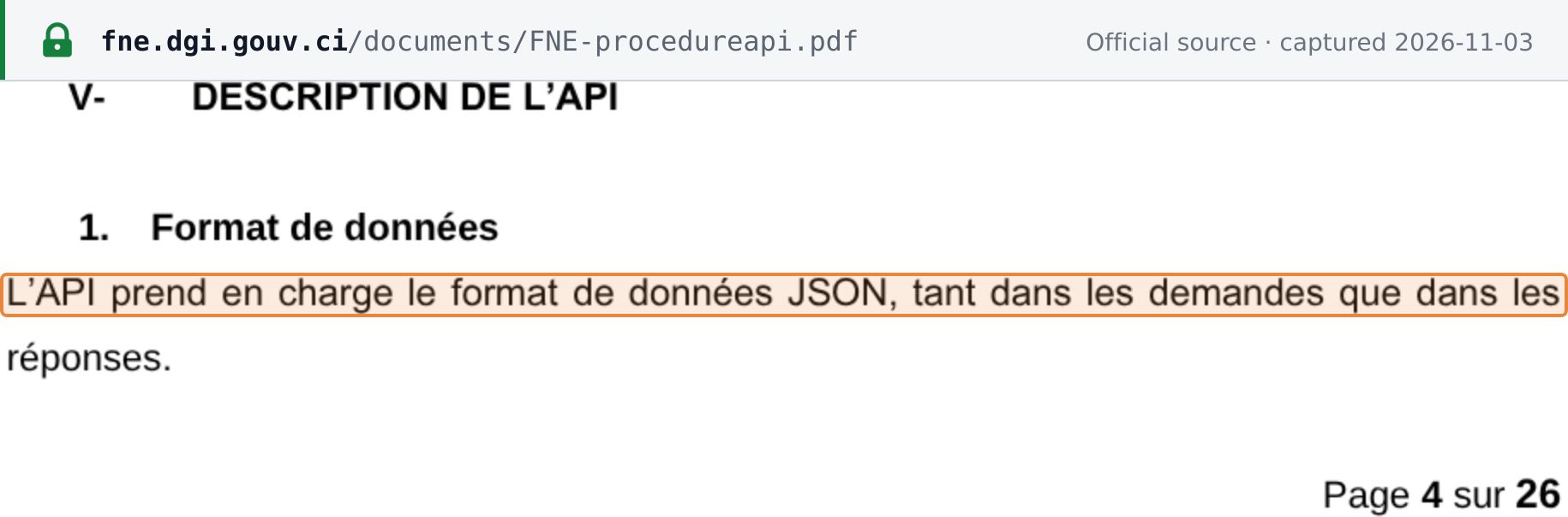
Data format: JSON, PDF output, no XML standard. The API is RESTful, uses POST only, exchanges
JSON in both directions, and authenticates with a JWT in an Authorization: Bearer header. Sale
invoices (and agricultural purchase slips) are certified at POST /external/invoices/sign; credit
notes at POST /external/invoices/{id}/refund. The FAQ says FNEs "sont générées au format PDF".
None of the DGI's FNE documents (arrêté, presentation, API guide, user guide, communiqués, FAQ)
publishes an XML schema such as UBL or CII, or mentions Peppol; the data format they set is JSON.
 Source snapshot captured 2026-11-03 — original (page 4)
Main payload fields in the API guide: invoiceType (sale or purchase), paymentMethod (cash, card,
check, mobile-money, transfer, deferred), template (B2B, B2C, B2G, B2F), clientNcc (mandatory
for B2B), client name, phone and email, pointOfSale, establishment, foreignCurrency and
foreignCurrencyRate (mandatory for B2F in another currency), and items[] with tax code, unit
price excluding tax, quantity and discount. Currencies accepted: XOF, USD, EUR, JPY, CAD, GBP, AUD,
CNH, CHF, HKD and NZD.
(DGI — Procédure d'interfaçage par API)
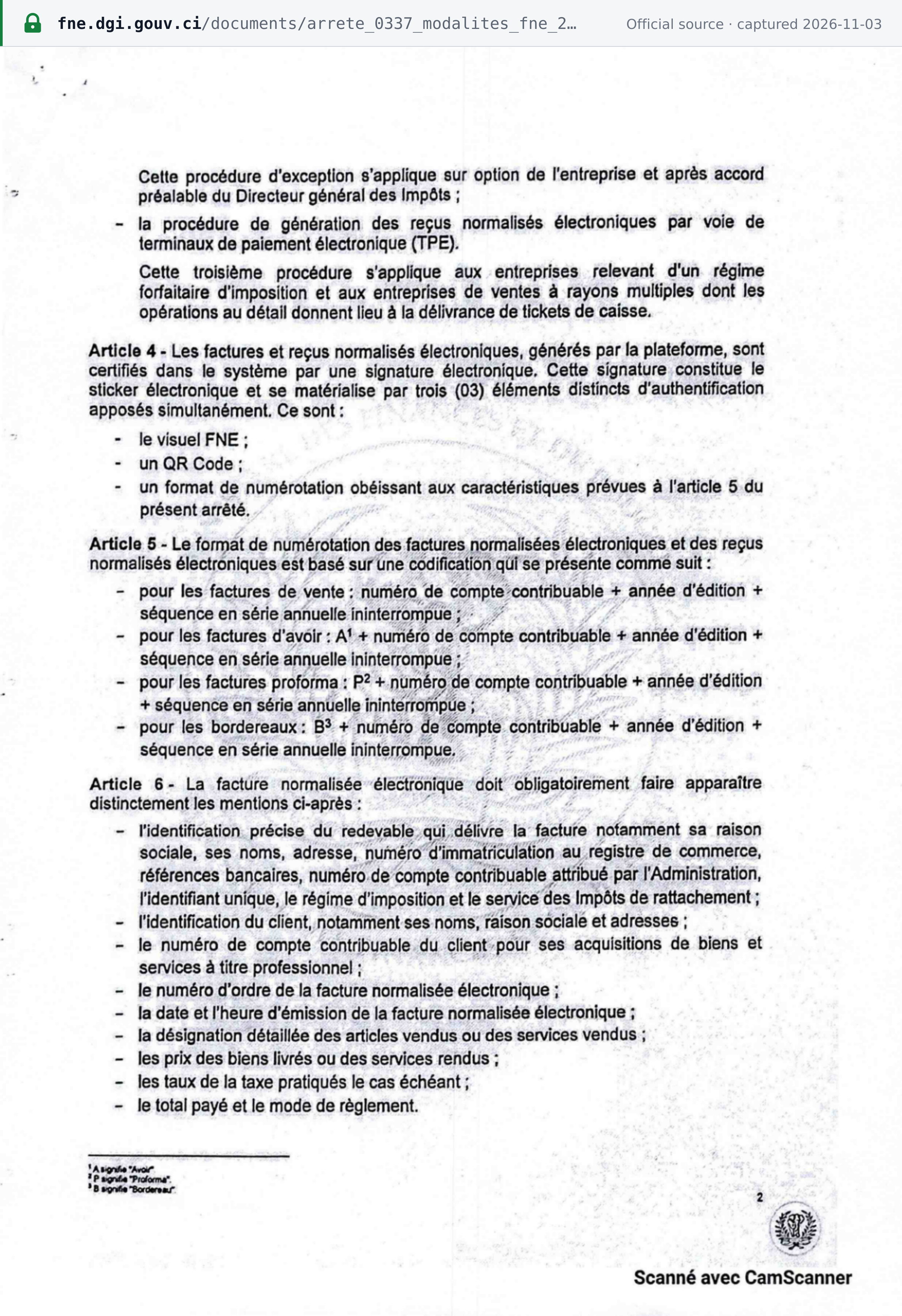
Integrity: the electronic sticker. Every FNE and RNE generated by the platform is certified by an electronic signature, the sticker électronique, made of three elements applied together: the FNE visual, a QR code, and a numbering format set by article 5:
| Document | Number |
|---|---|
| Sale invoice | NCC + year of issue + uninterrupted annual sequence |
| Credit note (facture d'avoir) | A + NCC + year + sequence |
| Pro-forma | P + NCC + year + sequence |
| Agricultural purchase slip (bordereau) | B + NCC + year + sequence |
The QR code appears on sale invoices, receipts and purchase slips, but not on pro-formas; scanning it displays the invoice. Article 6 lists the mandatory particulars, including the supplier's NCC, tax regime and tax office, the customer's NCC for professional purchases, and the date and time of issue. (Arrêté 0337 arts. 4–6; DGI — Guide d'utilisation de la plateforme FNE, p.40)
 Source snapshot captured 2026-11-03 — original (scanned document, page 2)
Sticker cost. Stickers are bought as prepaid credit on the platform. Prices set by the DGI communiqué of 15 September 2025:
| Document | Cost per document |
|---|---|
| FNE | FCFA 20 |
| RNE, transaction of FCFA 5,000 or less | FCFA 0 |
| RNE, transaction above FCFA 5,000 | FCFA 15 |
| RNE, transaction above FCFA 100,000 paid in cash | FCFA 25 |
If the balance runs out, the business can keep generating FNEs and RNEs for 48 hours; after that, generation is blocked. The electronic sticker does not replace the receipt stamp (timbre de quittance). (DGI communiqué, 15 September 2025; FNE FAQ)
Credit notes and corrections. The platform issues credit notes for all or part of an invoice, and "avoirs hors facture" for rebates, discounts and refunds through the Facture 3R type. API flows may not carry negative values (except kerosene sales), so corrections go by credit note. No debit-note document type appears in the DGI's FNE documents.
Delivery and storage. A certified FNE appears in real time in the customer's FNE space; it can also be downloaded and sent by email or any other channel. The DGI presents centralised storage as a benefit. The FNE texts set no retention period of their own.
E-reporting. The DGI's FNE texts set no separate e-reporting obligation alongside the FNE. For VAT-credit refunds on exports, customs Circulaire n° 2423 of 15 September 2026 requires the FNE in the export file. (Direction générale des Douanes — Circulaire n° 2423)
Onboarding / how to comply
Enrolling on the FNE platform
The DGI's user guide (May 2025) sets out the steps:
- Go to the FNE portal and choose to sign up.
- Fill in the identification form with your taxpayer account number (NCC) and your numéro de télédéclarant (NTD).
- Complete the company form (head-office location by section and parcel, lot and block, or GPS) and the technical invoicing information, accept the terms of use and submit.
- The principal manager receives a username and password by email. The principal manager's username is the company's NCC.
- A one-time password (OTP) is emailed at every login. Change the password on first login (at least 12 characters with a digit, upper and lower case and a special character).
- Configure the company logo, the sticker alert threshold, the receipt-stamp option, agricultural purchase slips and the invoice footer.
(DGI — Guide d'utilisation de la plateforme FNE, pp.7–14)
The 27 January 2026 communiqué closed enrolment on Saturday 31 January 2026, "délai de rigueur", with LPF sanctions for missing it. The 21 August 2026 communiqué tells taxpayers who are still not enrolled to "régulariser leur situation sans délai". FNE enrolment is also a condition for the Attestation de régularité de situation fiscale (ARF), the tax-compliance certificate. (DGI communiqué, 27 January 2026; DGI communiqué, 21 August 2026)
Connecting your own system by API
The API route is the exception procedure. The prerequisites in the DGI's API guide are software that supports RESTful HTTP and JSON, OAuth 2.0 or certificate authentication, and a stable secure connection. The steps:
- Enrol the business on the FNE test platform and configure the test environment.
- Develop the integration and generate test documents (sale invoice, credit note, purchase slip).
- Email the specimens (the FNE-generated documents and the matching invoices from your own system) to support.fne@dgi.gouv.ci.
- The DGI checks substance and form. On success it sends the production URL and displays the API key in the company's FNE space under "Paramétrage", visible to the principal manager only.
The guide publishes the test environment as a bare HTTP address; the production URL is issued by the DGI after validation. Completing the steps "vaut acceptation" of FNE generation by API. (DGI — Procédure d'interfaçage par API, pp.3–4; DGI communiqué, 13 June 2025)
Accredited integrators and terminal suppliers
Since 12 August 2025 the DGI accredits (agrément) two kinds of partner: editors and integrators of API solutions, and suppliers of TERNE receipt terminals. Both must be tax-resident in Côte d'Ivoire, hold an attestation de régularité fiscale, be enrolled on the FNE platform and apply by letter to the Director-General. Integrators also pass validation tests, including an on-site technical check by the DGI.
The official list n° 0008/MFB/DGI-CAB/CT/KY of 28 November 2025 names the accredited companies "au titre de l'année 2025 et 2026". It is "non exhaustive" and will be completed as the accreditation committee rules. The DGI has published no rule on renewal or withdrawal of an accreditation. TERNE terminals are supplied free of charge by the DGI through its accredited partners, who configure and maintain them. (DGI — list of accredited companies; FNE FAQ)
Support. Centre des Téléservices Fiscaux: 25 21 01 86 60 (option 4); support.fne@dgi.gouv.ci; infos.fne@dgi.gouv.ci; accreditation: agrement.fne@dgi.gouv.ci.
Penalties
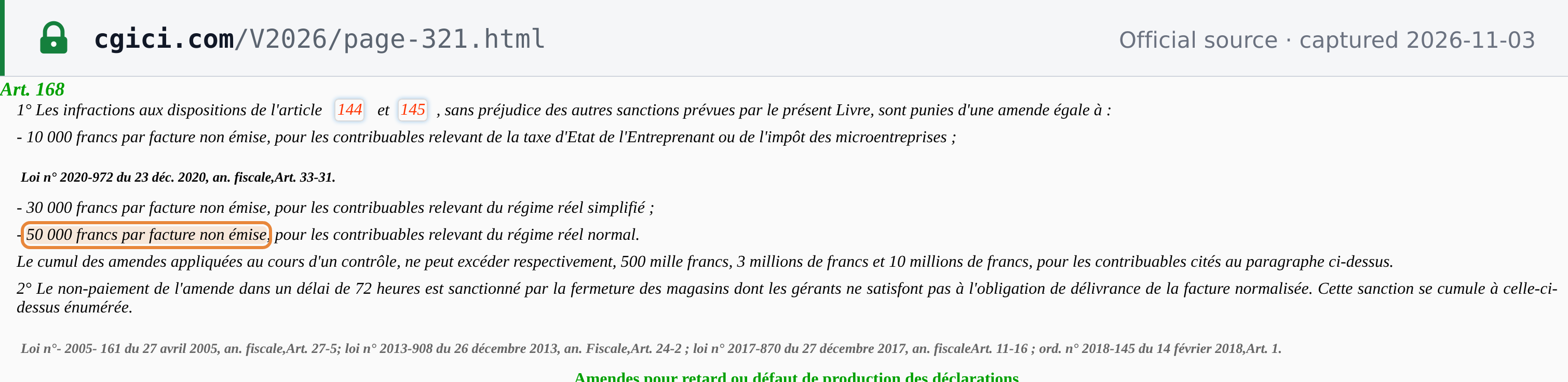
Failure to issue an FNE (LPF art. 168). Breaches of LPF arts. 144 and 145 are fined per invoice not issued, with a cap per tax audit:
| Taxpayer | Fine per invoice not issued | Cap per audit |
|---|---|---|
| TEE or RME | FCFA 10,000 | FCFA 500,000 |
| RSI | FCFA 30,000 | FCFA 3,000,000 |
| RNI | FCFA 50,000 | FCFA 10,000,000 |
If the fine is not paid within 72 hours, the shop is closed, on top of the fine. (LPF art. 168, consolidated 2026)
 Source snapshot captured 2026-11-03 — original
Loss of TVA deduction (CGI art. 385). Invoices without the CGI art. 384 mentions, including the electronic sticker, give no right to deduct the TVA they show. Putting irregularly worded invoices into circulation is fined within the LPF art. 168 limits. Since 1 and 11 December 2025 only FNEs support expense and TVA deductions; TEE taxpayers could use paper for B2B/B2G until 13 February 2026. (CGI art. 385)
Disconnecting FNE installations (LPF art. 171 bis). Any fraudulent manoeuvre to disconnect, or organise the disconnection of, FNE installations is treated as resistance to tax and carries criminal liability under LPF art. 171: a fine of FCFA 500,000 to 30,000,000 and/or one month to two years' imprisonment. Where the conduct involves sales or purchases without invoices or fictitious invoices, the range is FCFA 500,000 to 60,000,000 and/or six months to three years; a repeat offence within five years carries FCFA 1,500,000 to 100,000,000 and/or one to five years. (LPF arts. 171 and 171 bis, consolidated 2026)
Enforcement posture (dated).
- 27 January 2026: missing the 31 January 2026 enrolment deadline exposes taxpayers to LPF sanctions.
- 21 August 2026: a nationwide operation to control the use and issue of FNEs and RNEs runs from Tuesday 1 September 2026. Taxpayers not enrolled, or not issuing FNEs or RNEs, face LPF sanctions, "notamment l'application d'amendes".
- 14 September 2026: after 29 October 2026, non-compliant API flows risk temporary suspension of the API key, without prejudice to tax penalties.
Frequently asked questions
Our supplier still gives us a paper facture normalisée. Can we deduct the TVA on it?
No. Paper standardised invoices ended on 1 December 2025 for the RNI and RSI regimes and on 11 December 2025 for the RME. TEE taxpayers could use them for operations with businesses or the State until 13 February 2026. Only FNEs are now accepted to justify expenses and to deduct input TVA, and CGI article 385 denies deduction on invoices without the required mentions, including the electronic sticker. (DGI communiqués of 18 December 2025 and 27 January 2026)
We are a foreign company with no establishment in Côte d'Ivoire. Must we issue FNEs?
No. LPF article 145 dispenses businesses with no professional installation in Côte d'Ivoire from standardised invoices. Enrolment asks for an NCC and a numéro de télédéclarant (NTD), and the DGI's FAQ says only businesses attached to a DGI tax office can currently enrol. (LPF art. 145, consolidated 2026)
How do we invoice a foreign customer, and do we need their tax ID?
Use the B2F template. The customer's tax ID is not required, and phone and email are optional (if you give a phone number, it carries the destination country's prefix). Since the 14 September 2026 communiqué, B2F invoices must show the destination currency and the exchange rate, including for customers in the UEMOA and CEMAC CFA-franc zones. (DGI FNE FAQ; communiqué of 14 September 2026)
Our sticker balance ran out. Are we blocked from invoicing?
Not at once. You can keep generating FNEs and RNEs for 48 hours after the balance runs out; after that, generation is blocked until you top up. Stickers cost FCFA 20 per FNE; RNEs cost FCFA 0 up to FCFA 5,000, FCFA 15 above FCFA 5,000 and FCFA 25 above FCFA 100,000 paid in cash. (DGI FNE FAQ; communiqué of 15 September 2025)
Does the electronic sticker replace the timbre de quittance?
No. The DGI's FAQ states that the electronic sticker does not dispense from the receipt stamp (timbre de quittance). (DGI FNE FAQ)
How do we correct an FNE that is already certified?
Issue a credit note (facture d'avoir) for all or part of the original invoice; its number starts with A. Rebates, discounts and refunds not tied to one invoice go through the Facture 3R type. API flows may not carry negative values, except kerosene sales, so a correction cannot be made with negative lines. (Arrêté 0337 art. 5; DGI FNE FAQ; communiqué of 14 September 2026)
Can our ERP issue FNEs directly?
Only through the API route, which Arrêté 0337 treats as an exception procedure, on your option and with the Director-General's prior approval. You enrol on the test platform, send specimen invoices to support.fne@dgi.gouv.ci, and once the DGI validates them it issues the production URL and shows the API key in your FNE space. Businesses without in-house IT can use a DGI-accredited integrator. (Arrêté 0337 art. 3; DGI API guide)
What did the 29 October 2026 API deadline require?
Payloads must follow the FNE specifications set out in the 14 September 2026 communiqué: an 8-character customer NCC (7 digits and an upper-case key letter), 10-digit Ivorian phone numbers without +225, email and phone for B2B, currency and exchange rate for B2F, TVA invoiced only by RNI and RSI taxpayers, and positive quantities. Non-compliant flows risk temporary suspension of the API key, on top of tax penalties. (DGI communiqué of 14 September 2026)
Do air-ticket sales and rent need an FNE?
Air-ticket sales by travel agencies, and the related agency fees, fall under the airline dispensation; the agencies' other services need an FNE or RNE. Rent on bare buildings is documented by a rent receipt, not an FNE, unless the owner opted into TVA. Furnished lettings and estate-agency commissions need an FNE or RNE. (DGI FNE FAQ)
Recent changes
- 2026-10-29 — Deadline for businesses on the API route to bring their FNE payloads into line with the DGI's technical specifications; non-compliant flows risk temporary suspension of the API key. (DGI) — see event
- 2026-09-01 — Nationwide operation to control the use and issue of FNEs and RNEs begins, under the DGI communiqué of 21 August 2026. (DGI)
- 2026-02-13 — Last day TEE taxpayers could use paper standardised invoices for operations with businesses or the State. (DGI)
- 2026-01-31 — FNE enrolment closes, "délai de rigueur". (DGI)
- 2026-01-05 — Annexe fiscale 2026 in force; LPF art. 145 now dispenses all transport companies that are not public-service concessionaires. (DGI)
- 2025-12-11 — Paper standardised invoices end for RME taxpayers, after ending for RNI and RSI taxpayers on 1 December 2025. (DGI)
Related resources
- E-invoicing status and networks worldwide — Côte d'Ivoire in global context
- Worldwide VAT and GST rates — Côte d'Ivoire's 18% standard and 9% reduced TVA rates alongside other countries
- E-invoicing in Burkina Faso · Congo-Brazzaville — other West and Central African certified-invoice systems, built on fiscal devices rather than a central platform
- Côte d'Ivoire tax-change chronology — every tracked Ivorian change, dated and sourced
- Validate an Ivorian NCC — the taxpayer account number every B2B FNE carries
Important websites
- FNE portal — information, communiqués, legal texts and FAQ
- FNE enrolment · FNE login — where invoices are issued and API keys are shown
- API integration guide (PDF) · Platform user guide (PDF)
- Accredited integrators and TERNE suppliers (PDF) — the DGI's official list, updated as accreditations are granted
- Direction générale des Impôts · e-impots — the DGI's online tax services
- Consolidated CGI and LPF — current text of the tax code and procedure book