E-invoicing in Poland: KSeF
Overview
Poland runs a centralised clearance system for invoices: the Krajowy System e-Faktur (KSeF), the National e-Invoicing System. An invoice issued through KSeF in the Ministry's XML format is a faktura ustrukturyzowana (structured invoice). KSeF validates it, assigns it a unique KSeF number, stores it and makes it available to the buyer. The current version, KSeF 2.0, went live on 1 February 2026, when KSeF 1.0 was permanently switched off. [1]
KSeF is run by the Head of the National Revenue Administration (Szef Krajowej Administracji Skarbowej), who is also the controller of the data in it (art. 106nd(1) VAT Act). The Ministry of Finance publishes guidance, schemas and the free tools on ksef.podatki.gov.pl. [2]
The legal basis is the VAT Act of 11 March 2004, consolidated text Dz.U. 2026 poz. 1263, arts 106ga–106ni. The full list of instruments is under Legal basis.
| Poland (position at 4 November 2026) | |
|---|---|
| System | Krajowy System e-Faktur (KSeF 2.0) |
| Authority | Szef Krajowej Administracji Skarbowej; guidance from the Ministry of Finance (ksef.podatki.gov.pl) |
| CTC model | Clearance on a central state platform. Not Peppol-based for B2B. |
| B2B | Mandatory. Receiving through KSeF for everyone from 1 Feb 2026. Issuing from 1 Feb 2026 (2024 gross sales above PLN 200m), from 1 Apr 2026 (all others), and from 1 Jan 2027 once the PLN 10,000-a-month and cash-register opt-outs end |
| B2G | Mandatory through KSeF on the same dates (public buyers are taxpayers). PEF, the B2G Peppol platform, remains a channel: PEF invoices count as structured invoices once they are sent to KSeF |
| B2C | Excluded, but issuing through KSeF voluntarily is allowed |
| Non-residents | Excluded unless a Polish fixed establishment takes part in the supply. Voluntary use allowed |
| Format | National XML logical structure FA(3), binding since 1 Feb 2026 (replaced FA(2)). Peppol BIS / EN 16931 only through PEF for B2G |
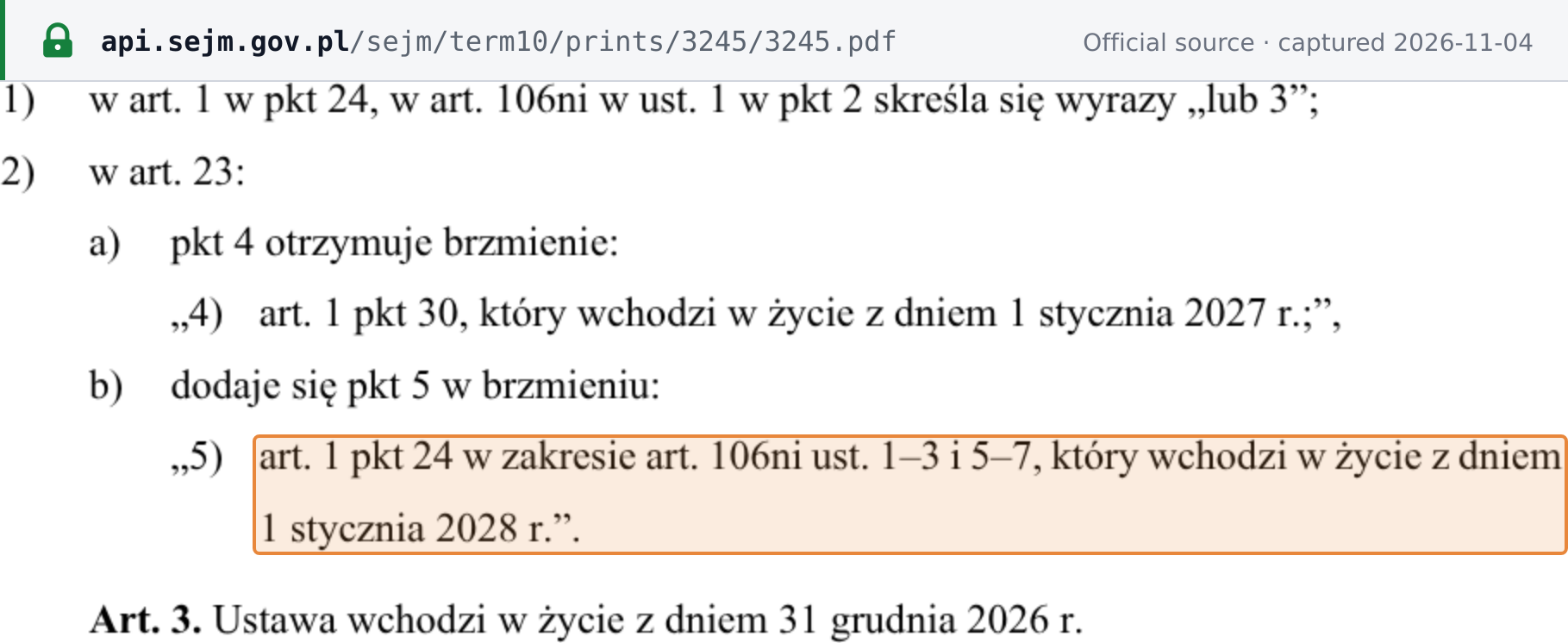
| Penalties | Art. 106ni: up to 100% of the VAT shown, or 18.7% of the gross amount. In force from 1 Jan 2027 under current law; a government bill (Sejm print 3245) would defer them to 1 Jan 2028 |
| Legislation | VAT Act (Dz.U. 2026 poz. 1263); Acts Dz.U. 2023 poz. 1598, 2024 poz. 852, 2025 poz. 1203; Regulations Dz.U. 2025 poz. 1815 and 1740 |
Mandate status and timeline
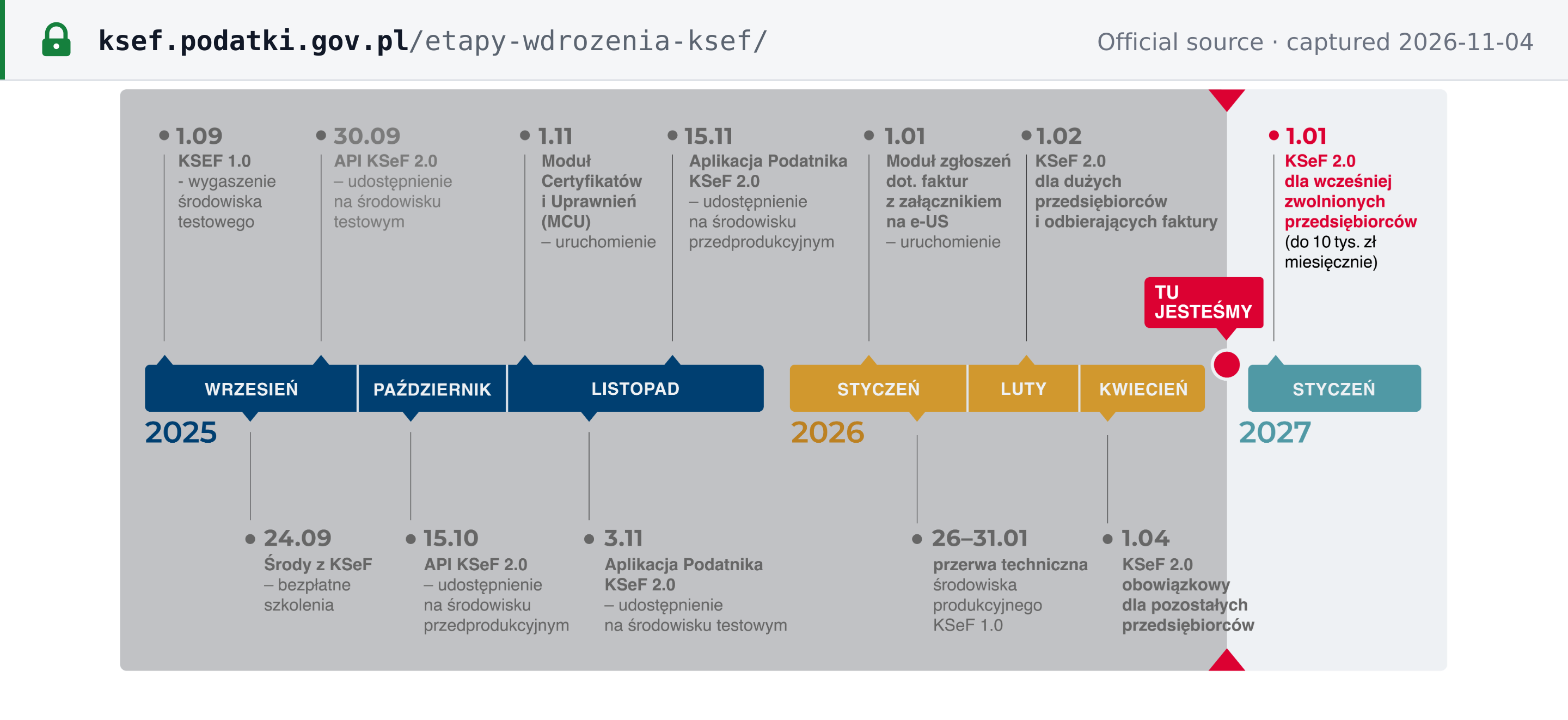
The mandate has applied since 1 February 2026. It was phased in by the Act of 5 August 2025 (Dz.U. 2025 poz. 1203), and the last phase starts on 1 January 2027. These dates are law; only the start of penalties is subject to a pending bill (see Penalties).
| Phase | Who | What becomes mandatory | Date | Legal basis | Status |
|---|---|---|---|---|---|
| Voluntary | Any taxpayer | Optional issuing through KSeF 1.0 | 1 Jan 2022 – 31 Jan 2026 | Act of 29 Oct 2021, Dz.U. 2021 poz. 2076 | Ended |
| 1 | Taxpayers whose 2024 sales including VAT exceeded PLN 200,000,000 | Issuing through KSeF 2.0 in FA(3) | 1 Feb 2026 | art. 106ga(1); art. 145l | Passed |
| 1 | All buyers | Receiving structured invoices through KSeF | 1 Feb 2026 | art. 106ga(1); MF guidance | Passed |
| 2 | All other taxpayers | Issuing through KSeF | 1 Apr 2026 | art. 145l (end of the transitional period) | Passed |
| 2a | Taxpayers whose invoices issued in a month total ≤ PLN 10,000 including VAT | May keep issuing paper or ordinary e-invoices to 31 Dec 2026. The right is lost from the invoice that takes the month over the limit | 1 Apr – 31 Dec 2026 | art. 145m | In force; ends 31 Dec 2026 |
| 2b | Invoices from cash registers, and till receipts with the buyer's NIP that count as simplified invoices | May be issued outside KSeF | 1 Feb – 31 Dec 2026 | art. 145n | In force; ends 31 Dec 2026 |
| 3 | Everyone still using 2a or 2b | Issuing through KSeF | 1 Jan 2027 | expiry of arts 145m–145n | Upcoming |
 Source snapshot captured 2026-11-04 — original
Art. 145l lets taxpayers whose total sales including VAT "nie przekroczyła w 2024 r. kwoty 200 000 000 zł" (did not exceed PLN 200,000,000 in 2024) keep issuing paper or ordinary electronic invoices until 31 March 2026. That is how the PLN 200 million test is built: it uses calendar 2024 and gross sales. [2] [3]
Receiving is not phased. The Ministry of Finance states that "Otrzymywanie faktur przy użyciu KSeF będzie obowiązkowe już od 1 lutego 2026 r." (receiving invoices through KSeF is mandatory from 1 February 2026), whatever the buyer's own issuing date. [4]
How the PLN 10,000 opt-out works, according to the Ministry's FAQ: only invoices that would otherwise have to go through KSeF count towards the limit. Cash-register invoices, receipts up to PLN 450 and consumer invoices do not count. The test runs by date of issue. Once the limit is exceeded, every later invoice goes through KSeF, even in a later month that stays under PLN 10,000. [5]
Postponements: what changed and what still applies
- 1 July 2024 → 1 February 2026. The original mandate date in the Act of 16 June 2023 (Dz.U. 2023 poz. 1598) was moved by the Act of 9 May 2024 (Dz.U. 2024 poz. 852, published 10 June 2024). [6]
- A single date → phases. The Act of 5 August 2025 (Dz.U. 2025 poz. 1203, published 1 September 2025) introduced the 1 February / 1 April 2026 split, used 2024 sales for the PLN 200 million test, added the PLN 10,000-a-month and cash-register opt-outs to 31 December 2026, the permanent offline24 mode and invoices with attachments, and set the start of penalties for 1 January 2027. The Ministry's June 2024 notice still previews a 2025 base year; that preview was superseded. [3]
- Format. Work done against the old FA(2) schema does not carry over. FA(3) is the only binding structure for invoices issued from 1 February 2026 (see Format and network).
Latest announced change: penalties deferred to 2028 (bill, not yet law)
On 20 October 2026 the Council of Ministers adopted a bill extending the deferral of KSeF penalties to 31 December 2027. It was filed in the Sejm the same day as print 3245, with the shortened procedure requested. It had its first reading on 21 October 2026 and was referred to the Public Finance Committee. It is on the agenda of the Public Finance Committee for 4 November 2026, and the committee's report is on the agenda of the Sejm sitting of 5–6 November 2026. The bill would make the money penalties in art. 106ni apply from 1 January 2028. Until it is enacted, the statutory date remains 1 January 2027. [7] [25] [26] [8]
The Ministry has said that the deferral does not suspend the obligation: "Odroczenie kar nie oznacza braku obowiązku stosowania KSeF" (deferring penalties does not mean there is no obligation to use KSeF). [9]
Legal basis
| Instrument | Number | Published | In force | What it does |
|---|---|---|---|---|
| VAT Act of 11 March 2004 (consolidated text) | Dz.U. 2026 poz. 1263, as amended | 28 Sep 2026 | current text | KSeF rules: art. 2 pt 32a, arts 106ga–106gba, 106na–106ni, 112aa, 145l–145n |
| Act of 29 October 2021 | Dz.U. 2021 poz. 2076 | 18 Nov 2021 | 1 Jan 2022 | Voluntary KSeF |
| Act of 16 June 2023 (the KSeF Act) | Dz.U. 2023 poz. 1598 | 11 Aug 2023 | 1 Feb 2026 (as amended) | Mandatory KSeF, penalties |
| Act of 9 May 2024 | Dz.U. 2024 poz. 852 | 10 Jun 2024 | — | Moved the mandate from 1 Jul 2024 to 1 Feb 2026 |
| Act of 5 August 2025 | Dz.U. 2025 poz. 1203 | 1 Sep 2025 | in stages | Phasing, offline24, attachments, arts 145l–145n, penalties from 1 Jan 2027 |
| Regulation of 12 December 2025 on the use of KSeF | Dz.U. 2025 poz. 1815, amended by Dz.U. 2026 poz. 169 | 18 Dec 2025; 13 Feb 2026 | 1 Feb 2026 | Permissions, authentication, access to invoices, QR codes |
| Regulation of 7 December 2025 on cases with no structured-invoice obligation | Dz.U. 2025 poz. 1740 | 9 Dec 2025 | 1 Feb 2026 | Exempt transactions |
| Act of 9 November 2018 on electronic invoicing in public procurement (consolidated) | Dz.U. 2026 poz. 276 | 5 Mar 2026 | — | B2G platform (PEF) |
| Council Implementing Decision (EU) 2022/1003 | OJ text | 27 Jun 2022 (OJ L 168) | 1 Jan 2024 – 31 Dec 2026 | EU derogation for mandatory e-invoicing |
| Council Directive (EU) 2025/516 (ViDA) | OJ text | 25 Mar 2025 | art. 1 pts 2–3 may apply from 14 Apr 2025 | Lets Member States mandate domestic e-invoicing without a derogation |
| FA(3) logical structure | crd.gov.pl/wzor/2025/06/25/13775 | 25 Jun 2025 | 1 Feb 2026 | Binding XML template (art. 106gb(1), (8)) |
The EU derogation expires on 31 December 2026; the mandate does not depend on it. Decision 2022/1003 applies "from 1 January 2024 until 31 December 2026". ViDA's new second paragraph of art. 218 allows any Member State to require established taxable persons to issue e-invoices for domestic supplies, and Member States may apply it from 14 April 2025. Member States that held a pre-2024 authorisation, such as Poland, must align their domestic system with the post-2030 EU rules by 1 January 2035. ViDA itself therefore permits a domestic mandate after the derogation ends. See the ViDA explainer. [10] [11]
Scope
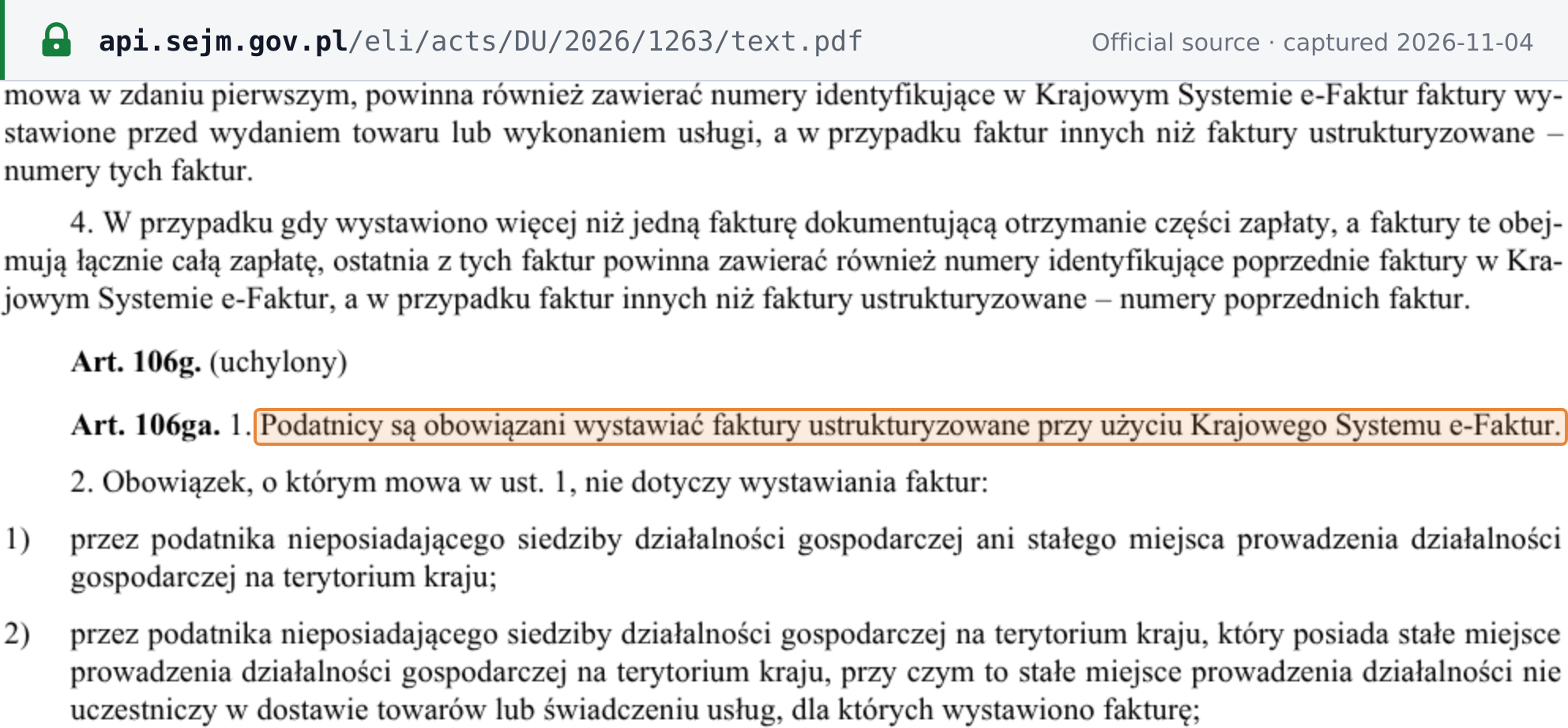
Art. 106ga(1) sets a general rule: "Podatnicy są obowiązani wystawiać faktury ustrukturyzowane przy użyciu Krajowego Systemu e-Faktur" (taxpayers must issue structured invoices using KSeF). Paragraph 2 lists the exclusions, and paragraph 4 allows voluntary use in some of them. [2]
 Source snapshot captured 2026-11-04 — original
- B2B. In scope, on the dates in the timeline above.
- B2G. In scope. Public contracting authorities are taxpayers or NIP holders, so invoices to them fall under the general obligation. Under the 2018 B2G Act, public buyers must accept structured invoices sent through the PEF platform (efaktura.gov.pl), and suppliers may use it (art. 4). PEF invoices must meet the European standard EN 16931 (art. 9). The VAT Act treats a PEF or Peppol invoice that meets EN 16931 as a structured invoice once it has been sent to KSeF and given a KSeF number (art. 106gb(7)). [12] [4]
- B2C. Invoices to individuals not in business are excluded (art. 106ga(2)(4)), but sellers may issue them through KSeF voluntarily (art. 106ga(4)). They are delivered to the consumer in an agreed manner and carry a QR code.
- Non-established businesses. Excluded where the seller has no Polish seat and no Polish fixed establishment, or where its Polish fixed establishment does not take part in the supply (art. 106ga(2)(1)–(2)). A Polish VAT number alone does not bring a foreign business into scope. Such sellers may opt in voluntarily (art. 106ga(4)). The Ministry of Finance published tax explanations of 28 January 2026 on how to decide whether a fixed establishment exists for KSeF purposes. [4]
- Special procedures with no voluntary option. Excluded are invoices under the non-Union OSS scheme, the IOSS import scheme and the scheme for occasional international road passenger transport (Division XII, chapters 7, 7a and 9). Also excluded are invoices from taxpayers using the EU cross-border SME exemption (art. 113a(1)). The Ministry states that voluntary issuance through KSeF is not possible in these cases. The Union OSS scheme (chapter 6a, B2C) is not on the list. [4]
- Exempt transactions (Regulation Dz.U. 2025 poz. 1740, §2). Toll-motorway services documented by reduced-data invoices; passenger transport documented by single-journey tickets; EUROCONTROL route-charge invoices; financial and insurance services exempt under art. 43(1)(7) and (37)–(41) and documented by reduced-data invoices; self-billing where the buyer has no Polish NIP for the transaction; and self-billing where the seller has no Polish NIP. §3 allows voluntary KSeF for buyer-side self-billing in an intra-EU supply. [13]
- Documents that never go to KSeF. Pro-forma invoices, internal invoices and documents, and credit or debit notes (noty uznaniowe / obciążeniowe). Correction notes (noty korygujące) were abolished on 1 February 2026: "nie są one wystawiane ani w KSeF ani poza KSeF" (they are issued neither in nor outside KSeF), and art. 106k is now repealed. [4]
- Simplified invoices. Till receipts showing the buyer's NIP for up to PLN 450 (or EUR 100) count as invoices. They may be issued outside KSeF only until 31 December 2026 (art. 145n). From 1 January 2027 cash registers issue receipts only; see fiscal devices.
Format and network
Clearance model
KSeF is a clearance platform (see CTC models). A structured invoice is treated as issued on the day it is sent to KSeF, and as received on the day KSeF assigns its number (art. 106na(1), (3)). KSeF rejects a file that does not match the published template (art. 106nd(2)(10)(b)). For buyers outside KSeF (foreign buyers without a participating Polish establishment, buyers without a NIP, consumers), the invoice is made available in an agreed manner and marked with a QR code, and the date of receipt is the date of actual receipt (art. 106gb(4)–(5), 106na(4)). KSeF is not Peppol-based for B2B. Peppol BIS and EN 16931 apply only to the B2G PEF channel (see Peppol). [2]
FA(3) logical structure
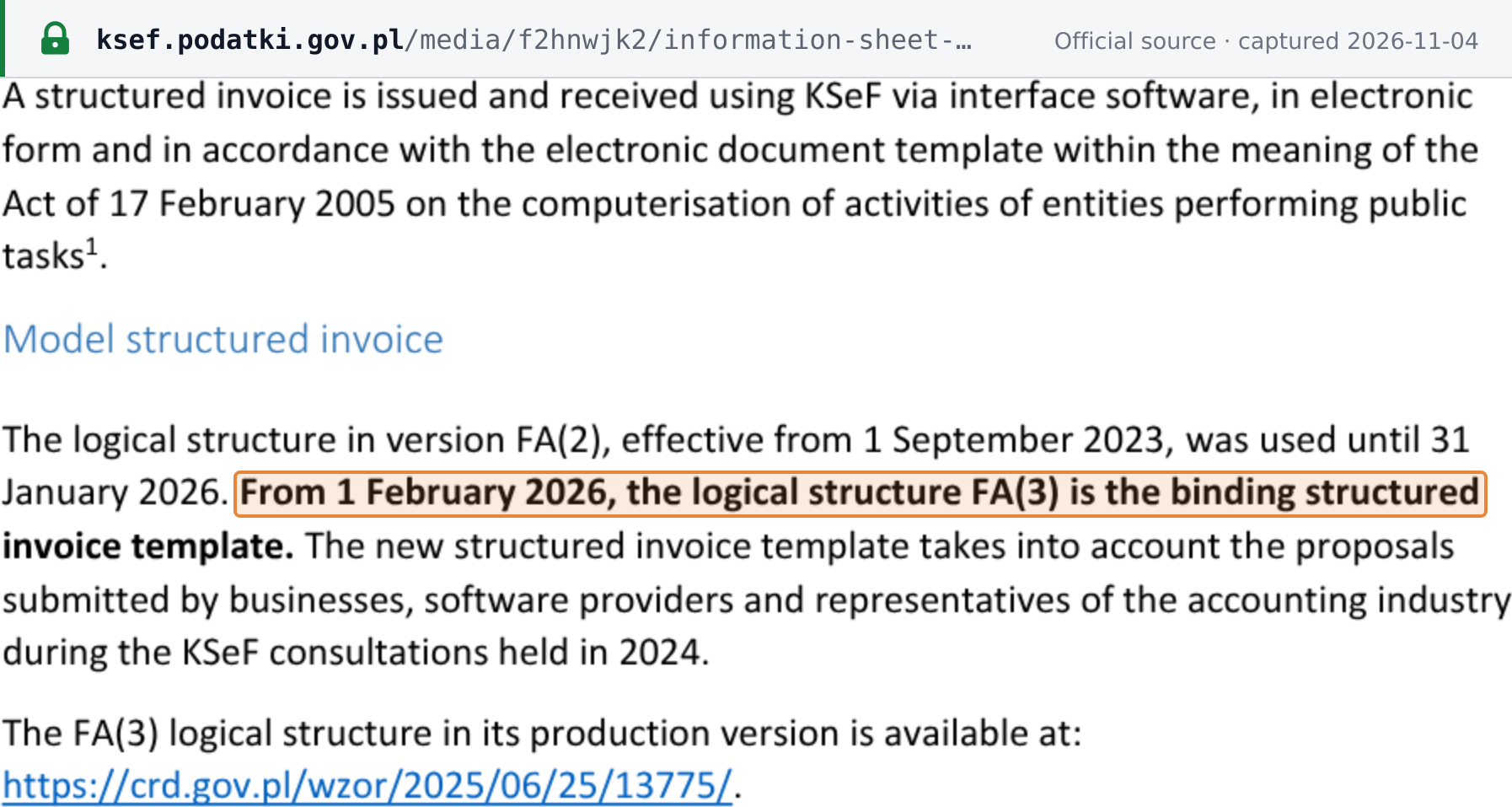
The only binding format is the national XML logical structure FA(3). It was published on 25 June 2025 in the Central Repository of Electronic Document Templates, under the namespace http://crd.gov.pl/wzor/2025/06/25/13775/. FA(2), in use from 1 September 2023, was used until 31 January 2026. FA(3) applies to every structured invoice issued from 1 February 2026, including corrections of invoices that were originally issued in FA(2) or FA(1). A separate structure, FA_RR(1), covers VAT RR invoices for flat-rate farmers. [14] [15]
 Source snapshot captured 2026-11-04 — original
The header of the Ministry's own sample file (FA_3_Przykład_1.xml, from the official sample set):
<Faktura xmlns="http://crd.gov.pl/wzor/2025/06/25/13775/">
  <Naglowek>
    <KodFormularza kodSystemowy="FA (3)" wersjaSchemy="1-0E">FA</KodFormularza>
    <WariantFormularza>3</WariantFormularza>
Invoices with attachments (since 1 February 2026)
Art. 106gba allows an optional invoice with an attachment for transactions with a complex set of data on units, quantities or unit prices, such as utilities, telecoms and fuel. The attachment is an integral part of the invoice and may contain only invoice data under art. 106e(1), or data closely related to it. It may not contain marketing content. A taxpayer must first notify the Head of KAS, only through e-Urząd Skarbowy; notifications could be filed from 1 January 2026. Other documents, such as contracts or delivery notes, still cannot be attached. [3] [4]
KSeF number
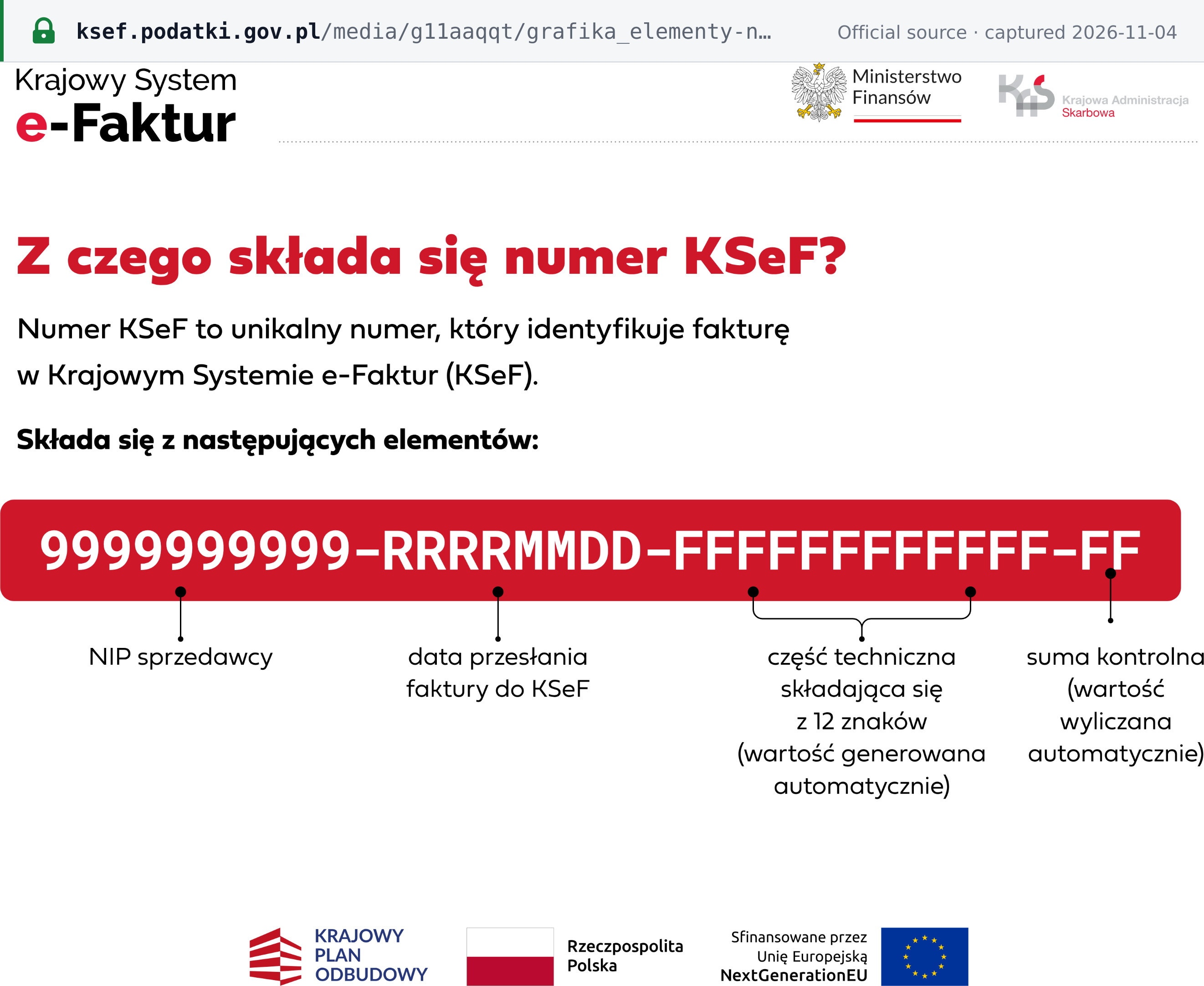
Every invoice accepted by KSeF receives a 35-character number in the form 9999999999-RRRRMMDD-FFFFFFFFFFFF-FF. It is made up of the seller's NIP, the date the invoice was sent to KSeF, a 12-character technical part, and a 2-character CRC-8 checksum. [16] [17]
 Source snapshot captured 2026-11-04 — original
QR codes and access without logging in
A structured invoice used outside KSeF must carry a QR code that gives access to it and lets its data be checked (art. 106gb(5)). An invoice issued in an offline mode and handed over before it is uploaded carries two QR codes: one marked "OFFLINE" for access and verification, and one marked "CERTYFIKAT" that confirms the issuer's identity. The second code requires a type-2 KSeF certificate. Anyone can also open an invoice in KSeF by entering five items: the KSeF number, the invoice number, the buyer's NIP or other identifier, the buyer's name, and the total amount due (Regulation Dz.U. 2025 poz. 1815, §8). [18] [19]
Corrections
A correction that reduces the taxable amount and is issued as a structured invoice is recognised in the period in which the correction invoice is issued, meaning sent to KSeF. The buyer's confirmation is not needed (art. 29a(13)). The older rule, under which the correction counts in the period when the buyer's confirmation is received, now applies only to corrections issued outside KSeF (art. 29a(13a)). A correction to an offline-mode or outage-mode invoice can be issued only after the original has a KSeF number (art. 106nda(12) and 106nf(11)). Errors that were once fixed with a buyer's nota korygująca now require a correction invoice from the seller, because correction notes were abolished. [2]
Offline and outage modes
Besides normal online issuing, there are four fallback modes. The Ministry sets them out side by side in its table of invoicing modes (24 February 2026):
| Mode | Basis | When it can be used | How the invoice is issued | Deadline to send to KSeF |
|---|---|---|---|---|
| offline24 | art. 106nda | Any time; the Act sets no conditions | Electronically, in FA(3) | Next business day after issue |
| Unavailability (niedostępność) | art. 106nh | Scheduled unavailability announced in the Ministry's BIP | Electronically, in FA(3) | Next business day after the unavailability ends |
| Outage (awaria) | art. 106nf | Outage announced in the BIP and in the interface software | Electronically, in FA(3) | 7 business days from the end of the outage; the period restarts if a new outage is announced |
| Total outage (awaria całkowita) | art. 106ng | Announced in the mass media | On paper or in any electronic form | Never sent to KSeF |
Invoices may be issued "in any format" only in a total outage. In an ordinary outage the FA(3) schema still applies. [2] [20]
 Source snapshot captured 2026-08-22 — original
Storage and reporting
KSeF stores structured invoices for 10 years from the end of the year of issue. If the limitation period runs longer, the taxpayer keeps them outside KSeF until it expires (art. 112aa). KSeF does not replace the JPK_V7 VAT return. The JPK markers for KSeF invoices are covered in the Poland country guide. [2]
Onboarding and how to comply
Connection modes. There are four ways to connect:
- The KSeF 2.0 API (production
https://api.ksef.mf.gov.pl, OpenAPI 3.0.4 contract, interactive and batch sessions), for ERP and invoicing software. - The free web Aplikacja Podatnika KSeF 2.0 (
https://ap.ksef.mf.gov.pl). - The free Aplikacja Mobilna KSeF, available from 1 February 2026.
- Commercial software that is integrated with the API.
The Ministry states that buying software is not required, because it provides free tools. [21] [5]
Authentication. Regulation Dz.U. 2025 poz. 1815 §6(1) allows four methods:
- eID means issued in a system connected to the national node, such as the trusted profile or mObywatel (from 14 February 2026)
- a qualified electronic signature
- a qualified electronic seal
- a KSeF certificate, generated after authenticating by one of the first three methods.
A KSeF certificate is valid for no more than 2 years. Type 1 is used for authentication; type 2 is used for the offline issuer-identity QR code. The old trusted-profile route ended on 13 February 2026 (Dz.U. 2026 poz. 169). KSeF tokens remain valid until 31 December 2026 under §13(1)(1) of the Regulation. The Ministry's certificates page says that tokens "zostaną utrzymane bezterminowo" (will be kept indefinitely) and that the Regulation will be amended. As at 4 November 2026 no amending regulation has been published, so the 31 December 2026 date is still the law. [19] [22] [23]
Permissions. KSeF has four kinds of permission: to grant and revoke permissions; to issue or access invoices; to issue invoices as the buyer (self-billing); and to issue VAT RR invoices. They are granted and revoked electronically, through the interface software (Regulation §3–§4). The paper ZAW-FA notification to the tax office is only for taxpayers that are not natural persons and cannot authenticate with a qualified seal (§5(1)). It is typically used to appoint the first person, who then grants further permissions electronically. [19]
Test environments. There are two non-production environments:
- Integration (test):
https://api-test.ksef.mf.gov.pl. Use anonymised data; invoices have no legal effect and are deleted after a time. - Pre-production (Demo):
https://api-demo.ksef.mf.gov.pl. Uses real authentication data; invoices have no legal effect.
Official documentation and client libraries are published in the Ministry's CIRFMF GitHub repositories. [21]
Accreditation of providers. Not applicable. KSeF is a single state platform that any software can reach through the public API, and the Ministry of Finance publishes no provider accreditation scheme or list. [21]
Penalties
Art. 106ni of the VAT Act sets a money penalty for three breaches:
- Not issuing a structured invoice through KSeF where required.
- Issuing an invoice in an offline, unavailability or outage mode that does not follow the published schema.
- Not sending an offline24, unavailability or outage invoice to KSeF on time.
The tax office head (naczelnik urzędu skarbowego) imposes the penalty by decision. It is up to 100% of the VAT shown on the invoice issued outside KSeF, or, where the invoice shows no VAT, up to 18.7% of the gross amount due. It must be paid within 14 days. The Administrative Procedure Code's rules on administrative money penalties apply, and the "warning first" rule of art. 21a of the Entrepreneurs' Law does not. Paragraph 4, already in force, bars fiscal-penal proceedings for failing to issue through KSeF or to upload offline and outage invoices on time. [2]
When penalties start. Under the law in force at 4 November 2026, art. 106ni(1)–(3) and (5)–(7) apply from 1 January 2027 (Dz.U. 2025 poz. 1203). Government bill Sejm print 3245 would move that date to 1 January 2028. It would also remove the penalty for the format of invoices issued in a total outage. The bill had its first reading on 21 October 2026 and is on the agenda of the Public Finance Committee for 4 November 2026; it is not yet law. [3] [24]
 Source snapshot captured 2026-11-04 — original
Enforcement posture. The Ministry announced on 16 September 2026 that penalties would be deferred to the end of 2027. It says that during the deferral the tax authorities will respond to invoices issued outside KSeF. The bill's justification says they will first remind taxpayers of the obligation, and then check under art. 272 of the Tax Ordinance whether not using KSeF leads to unreliable VAT settlement. [9] [24]
 Source snapshot captured 2026-10-12 — original
Frequently asked questions
When did KSeF become mandatory for my business, and what changes on 1 January 2027?
Receiving invoices through KSeF has been mandatory for every buyer since 1 February 2026. Issuing became mandatory on 1 February 2026 for taxpayers whose 2024 sales including VAT exceeded PLN 200,000,000, and on 1 April 2026 for everyone else. Until 31 December 2026, a taxpayer whose invoices issued in a month total PLN 10,000 or less including VAT may still issue paper or ordinary electronic invoices, and invoices from cash registers (including receipts with the buyer's NIP up to PLN 450) may be issued outside KSeF. Both opt-outs end on 31 December 2026, so from 1 January 2027 every in-scope taxpayer issues through KSeF. The PLN 10,000 test applies to any taxpayer, month by month; it is not a size category.
I exceeded the PLN 10,000 monthly limit once in 2026. Can I go back to paper invoices in a quieter month?
No. Under art. 145m(2) of the VAT Act the right to issue outside KSeF is lost from the invoice that takes the month over PLN 10,000, and the Ministry of Finance confirms that staying under the limit in a later month makes no difference. Only invoices that would otherwise have to go through KSeF count: consumer invoices, cash-register invoices and receipts up to PLN 450 do not. The limit is counted by date of issue.
Sources: [1]
I am a foreign company registered for Polish VAT but have no fixed establishment in Poland. Do I need to use KSeF?
No. Art. 106ga(2) of the VAT Act excludes invoices issued by a taxpayer with no Polish seat and no Polish fixed establishment, and by one whose Polish fixed establishment does not take part in the supply. A Polish VAT number alone does not bring you into scope, although you may issue through KSeF voluntarily. The Ministry of Finance published tax explanations on 28 January 2026 on how to decide whether a fixed establishment exists for KSeF purposes. If your Polish customer self-bills on your behalf and you have no Polish NIP, that self-billed invoice is also outside KSeF under the Regulation of 7 December 2025 (Dz.U. 2025 poz. 1740).
What happens when KSeF is unavailable — can I still invoice my customers, and what are the upload deadlines?
Yes. In offline24 mode, which any taxpayer may use at any time, you issue the invoice electronically in the FA(3) schema and send it to KSeF by the next business day after issue. During scheduled unavailability announced by the Ministry of Finance, the deadline is the next business day after the unavailability ends. During an announced outage (awaria), invoices are still issued electronically in the FA(3) schema and must reach KSeF within 7 business days of the end of the outage; a newly announced outage restarts the period. Only in a total outage announced in the mass media may invoices be issued on paper or in any electronic form, and those are never sent to KSeF. Offline24 is permanent; it does not expire with the 2026 transitional rules.
How does self-billing work under KSeF?
The seller grants the buyer a KSeF permission to issue invoices on its behalf, which is one of the four permission types in the Regulation on the use of KSeF (Dz.U. 2025 poz. 1815). Permissions are granted electronically through the interface software; the paper ZAW-FA notification is only for taxpayers that are not natural persons and cannot authenticate with a qualified electronic seal. Self-billed invoices are outside KSeF where the buyer, or the seller, is not identified by a Polish NIP for the transaction. A buyer self-billing an intra-EU supply under another Member State's VAT number may still use KSeF voluntarily.
When does a value-reducing correction count, and can my buyer still issue a correction note (nota korygująca)?
A correction invoice issued as a structured invoice reduces the taxable amount in the period in which it is issued, meaning sent to KSeF, with no buyer confirmation needed (art. 29a(13) of the VAT Act). Corrections of invoices issued before 1 February 2026 are also issued in KSeF in the FA(3) format. Correction notes are no longer available: the Ministry of Finance states that from 1 February 2026 the provisions on correction notes were repealed and they are issued neither in nor outside KSeF. The seller must issue a correction invoice instead.
Will KSeF tokens stop working on 1 January 2027?
The Regulation on the use of KSeF (Dz.U. 2025 poz. 1815, §13) still allows tokens only until 31 December 2026. The Ministry of Finance has said that tokens will be kept indefinitely and that the Regulation will be amended, but as at 4 November 2026 no amending regulation had been published. The permanent methods are the national eID node (trusted profile, mObywatel), a qualified electronic signature or seal, and a KSeF certificate, which is valid for up to two years.
What are the penalties for issuing invoices outside KSeF, and when do they start?
Under art. 106ni of the VAT Act, the head of the tax office may impose, by decision, a money penalty of up to 100% of the VAT shown on an invoice issued outside KSeF, or up to 18.7% of the gross amount where no VAT is shown. It also covers offline or outage invoices issued outside the published schema or uploaded late, and it is payable within 14 days. Under the law in force at 4 November 2026 these penalties apply from 1 January 2027. A government bill, Sejm print 3245 (on the agenda of the Public Finance Committee for 4 November 2026), would defer them to 1 January 2028; it is not yet law. The deferral does not suspend the obligation to use KSeF, and no fiscal-penal proceedings are brought for failing to issue through KSeF or to upload on time.
Recent changes
- 2026-10-21 — Government bill deferring KSeF money penalties (art. 106ni) to 1 January 2028 had its first reading in the Sejm (print 3245) and was referred to the Public Finance Committee. Not yet law. (Sejm Rzeczypospolitej Polskiej) — see event
- 2026-10-20 — Council of Ministers adopted the draft law extending the KSeF penalty deferral to 31 December 2027. (Ministerstwo Finansów) — see event
- 2026-04-01 — KSeF issuing mandatory for all remaining in-scope taxpayers, with the PLN 10,000-a-month opt-out running to 31 December 2026. (Ministerstwo Finansów — KSeF)
- 2026-02-13 — Regulation Dz.U. 2026 poz. 169 ended the old trusted-profile login route on 13 February 2026 and applied national eID-node authentication from 14 February 2026. (Dziennik Ustaw)
- 2026-02-01 — KSeF 2.0 live: issuing mandatory for taxpayers with 2024 gross sales above PLN 200 million; receiving through KSeF mandatory for all; FA(3) replaced FA(2); correction notes abolished; invoices with attachments allowed. (Ministerstwo Finansów — KSeF) — see event
Related resources
- Poland VAT guide: rates, registration, invoicing rules and JPK reporting
- Poland tax identification number (NIP): the seller NIP is the first part of every KSeF number
- Verify EU VAT numbers (VIES): for Polish VAT-EU numbers and foreign buyers
- E-invoicing status and networks worldwide
- Peppol, used for the B2G PEF channel
- Poland tax changes chronology