E-invoicing in Sri Lanka: the National e-Invoicing System
Overview
Sri Lanka's Inland Revenue Department (IRD) is rolling out what it calls the National e-Invoicing System: VAT-registered persons connect their ERP systems to the IRD's Revenue Administration Management Information System (RAMIS) through a Web API, and invoice data flows to RAMIS as invoices are issued. The IRD's notice SEC/PN/VAT/2026-03 of 4 May 2026 says: "The Government of Sri Lanka has announced the implementation of a National e-Invoicing System under the National Budget 2026." [1]
The notice describes the system as one that "enables digital transmission of invoice data directly from taxpayers’ Enterprise Resource Planning (ERP) to Revenue Administration Management Information System (RAMIS) of the Inland Revenue Department, ensuring that all invoices are transmitted in real time." [1]
It is not yet a legal mandate. As at 20 November 2026 the IRD's gazette page lists no order requiring any taxpayer to connect to the Web API, and neither the IRD notice nor the IRD's quick guide sets a penalty for not doing so. Three separate things are in play, and they are easy to confuse:
- The Web API rollout (administrative, phased, no gazetted obligation) — this page's main subject.
- The tax invoice format in Gazette Extraordinary No. 2481/22, binding on every VAT-registered person since 1 October 2026 whether or not it uses the Web API (date moved by Gazette Extraordinary No. 2500/106).
- A Budget 2027 proposal to recognise electronic invoices as legally valid, with their format to be set by Gazette order — a proposal, not law.
Legal basis in one line. No statute or Gazette order mandates Web API transmission. The invoice format rests on VAT Act No. 14 of 2002, section 20(2A) (inserted by Act No. 4 of 2025), under which the Commissioner General of Inland Revenue (CGIR) issued Gazettes 2481/22 and 2500/106. [8]
| Sri Lanka | |
|---|---|
| System | National e-Invoicing System: VAT invoice data integration between taxpayers' ERP systems and RAMIS through a Web API |
| Authority | Inland Revenue Department (IRD); enquiries ramis.webapi@ird.gov.lk |
| Status (20 Nov 2026) | No mandating order on the IRD's gazette page. Pilot under way since before 4 May 2026; Phase 1 export-oriented VAT-registered enterprises; Phase 2 all VAT-registered persons; "full integration of the WEB API is expected to be completed by the end of 2026" |
| Model | Real-time reporting of invoice, credit-note and debit-note records to RAMIS, which posts them to the supplier's and purchaser's VAT schedules; the purchaser approves. No clearance step published (our classification; the IRD's circular calls it "API-based reporting" and never uses "clearance") |
| B2B | The data flow is built around supplier-to-purchaser schedule matching |
| B2G / B2C | No separate rule published |
| Non-residents | Not addressed by the IRD notice or quick guide |
| Format | No payload schema (JSON, XML, UBL) published; not Peppol-based |
| Invoice content | Gazette 2481/22 format, binding on all VAT-registered persons from 1 October 2026 |
| Penalty for not joining the Web API | None published |
| Pending | Budget 2027 Technical Note item 2.6: legal validity for electronic invoices, default effective date 1 April 2027 (proposal) |
For VAT rates, registration and the full invoice field list, see the Sri Lanka VAT guide.
Mandate status & timeline
Status as at 20 November 2026: phased rollout; no mandating order on the IRD's gazette page. The IRD notice of 4 May 2026 says the project "has already commenced with a pilot phase involving a selected group of VAT registered persons" and that "The full integration of the WEB API is expected to be completed by the end of 2026." That is an expectation, not a statutory deadline. The IRD's gazette page lists, for 2026, only Gazettes 2481/22 and 2500/106 (both on the tax invoice format); neither orders anyone to use the Web API. [1] [10]
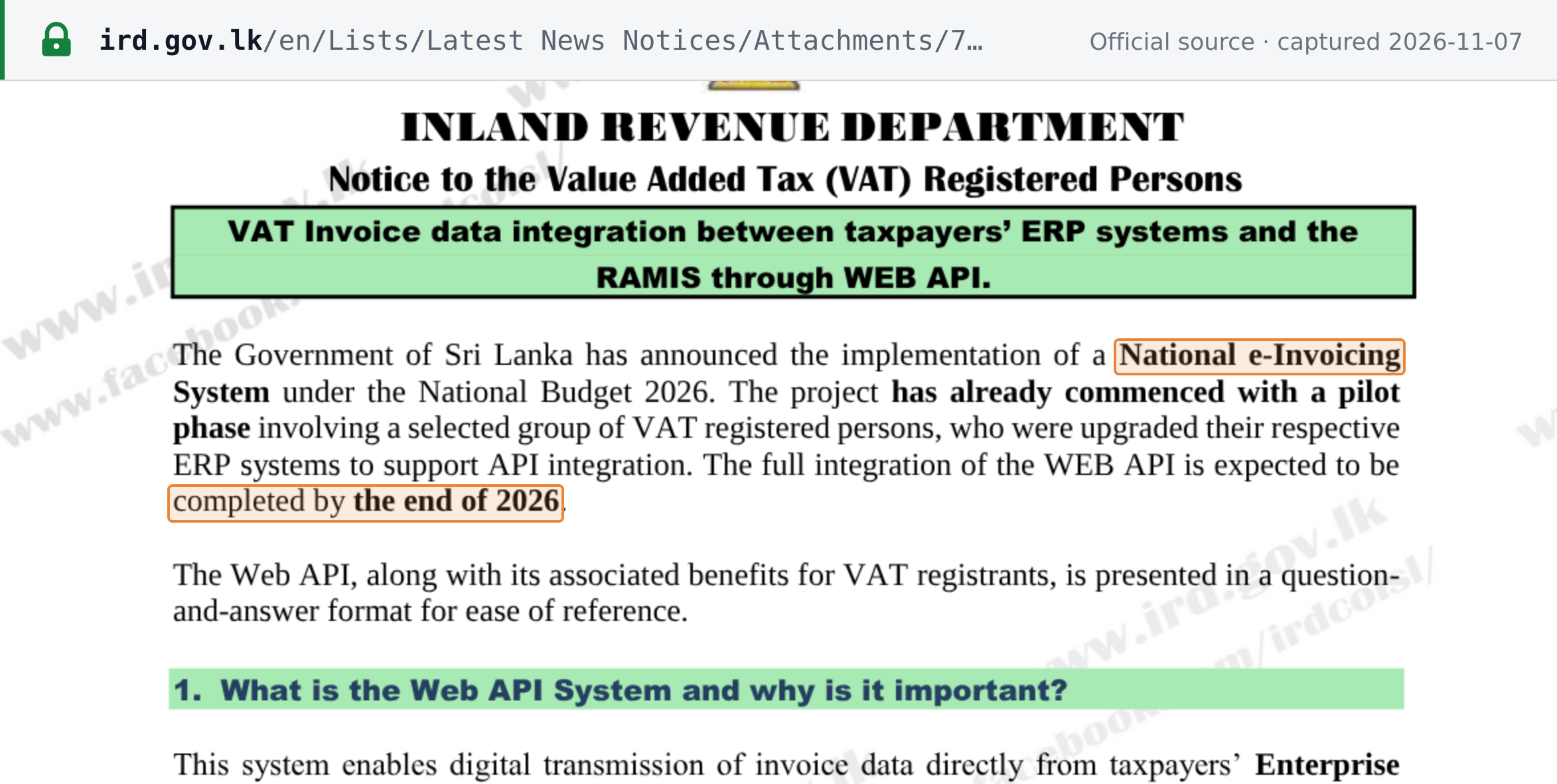 Source snapshot captured 2026-11-07 — original
| Stage | Who | What | Date | Source | State |
|---|---|---|---|---|---|
| Pilot and already integrated | Pilot: "a selected group of VAT registered persons" (p. 1). The notice lists selected companies in these sectors as "already integrated with WEB API" (Q5): garment export entities, tea export entities, and tea manufacturing entities through tea brokers' systems | ERP integrated with the Web API | Pilot start date not published; Q5 sectors integrated at 4 May 2026 | IRD notice, p. 1 and Q5 | Running |
| Tea brokers | Tea brokers, for supplies through the Colombo Tea Auction | Invoice, credit-note and debit-note records transmitted to RAMIS | From 1 May 2026 | IRD notice, Q6 | Live |
| Phase 1 | "Expansion to VAT-registered export-oriented enterprises" | Web API integration | No date or turnover threshold published | IRD notice, Q3 | Announced |
| Phase 2 | "Expansion to all VAT-registered persons" | Web API integration | No date or turnover threshold published | IRD notice, Q3 | Announced |
| Overall | — | "full integration of the WEB API" | "expected to be completed by the end of 2026" | IRD notice, p. 1 | Expectation |
The notice does not say whether joining a phase is compulsory, and it attaches no consequence to not joining. Tea producers' supplies outside the Colombo Tea Auction are still reported the old way: "Uploading Excel (CSV) files, or" "Using the Schedule Record Submission interface in RAMIS e-Service". [1]
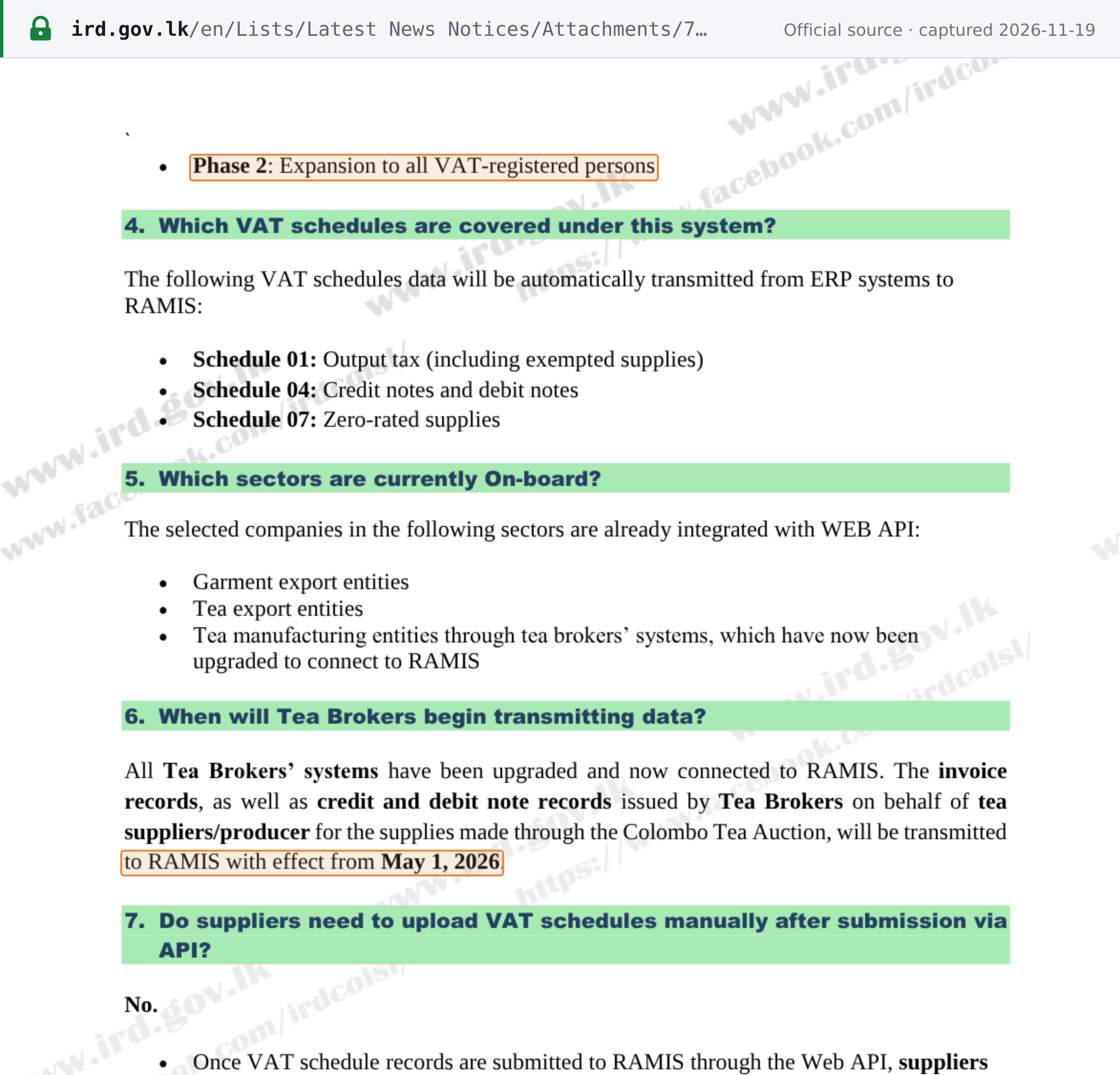 Source snapshot captured 2026-11-19 — original
The one hard Web API date: 31 December 2026, for approved early adopters only. IRD Circular SEC/2026/E/03 (20 May 2026) lets a registered person treat the "YYMMM_QQQQ_" part of the invoice number as optional if, "prior to 1 July 2026", it obtained the CGIR's approval "upon expressing interest in integrating their Enterprise Resource Planning (ERP) system with the Revenue Administration Management Information System (RAMIS) through a Web API for the real-time transmission of tax invoices or invoice details, provided that such integration is completed on or before 31 December 2026." Gazette 2500/106 later moved the format's start date to 1 October 2026 but changed nothing else; the IRD's circulars page shows no revised version of SEC/2026/E/03, so the circular's 1 July 2026 approval cut-off and 31 December 2026 integration date stand as published. This is a condition of a numbering relaxation, not a deadline for everyone. [5] [4] [11]
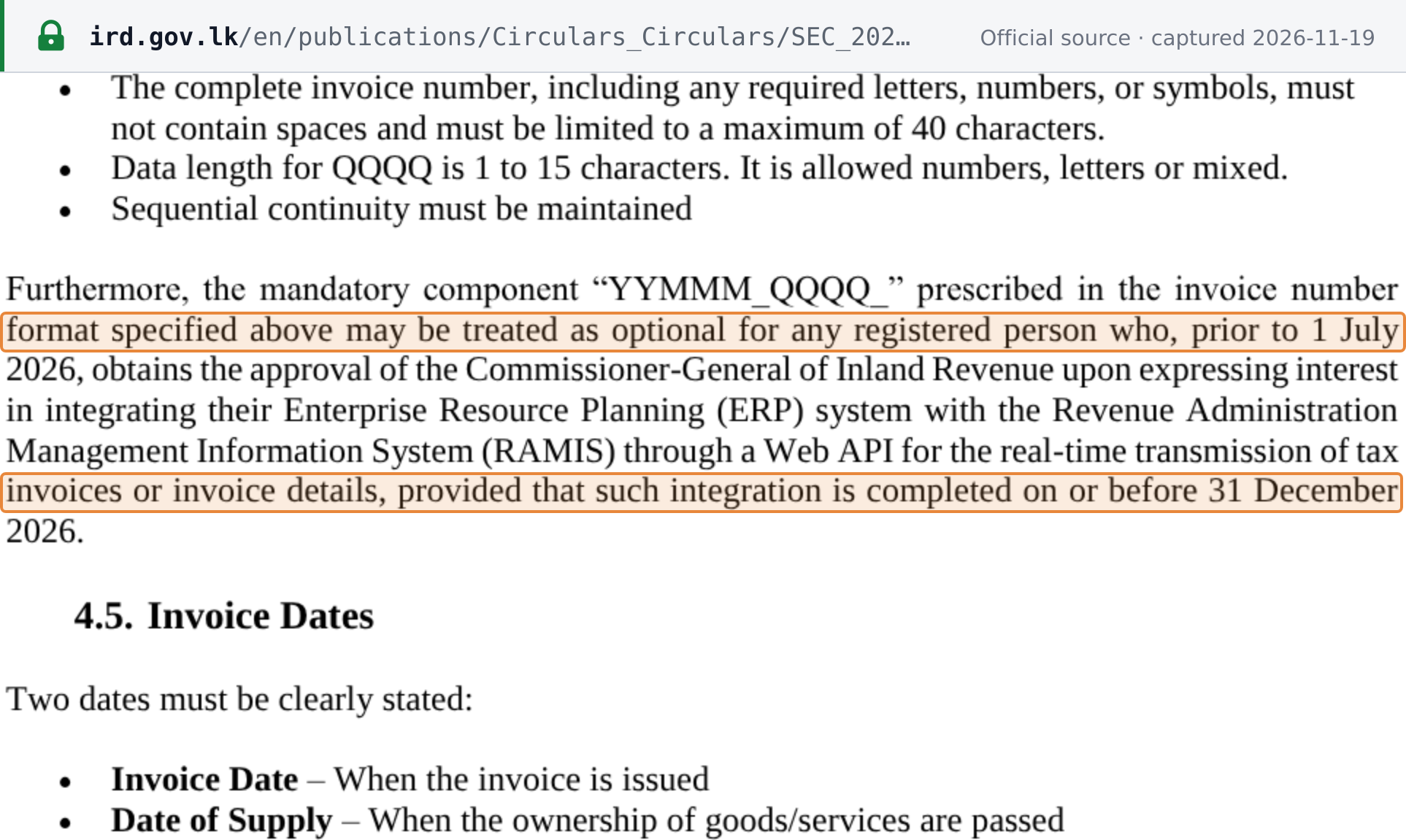 Source snapshot captured 2026-11-19 — original
The tax invoice format: binding since 1 October 2026, after one postponement.
| Instrument | Date | Effect |
|---|---|---|
| Gazette Extraordinary No. 2463/05 | 17 November 2025 | First CGIR format order, "effective from January 01, 2026" |
| Gazette Extraordinary No. 2481/22 | 27 March 2026 | New format "effective from July 01, 2026"; the 2463/05 format "shall remain optional and are hereby rescinded with effect from July 01, 2026" |
| Circular SEC/2026/E/03 | 20 May 2026 | Explains the format: "the revised Tax Invoice format shall be deemed legally binding and must be duly adopted and implemented by all VAT-registered persons" |
| Gazette Extraordinary No. 2500/106 | 6 August 2026 | "The effective date of “July 01, 2026”, is hereby amended as “October 01, 2026”;" and "All other matters shall remain unchanged." |
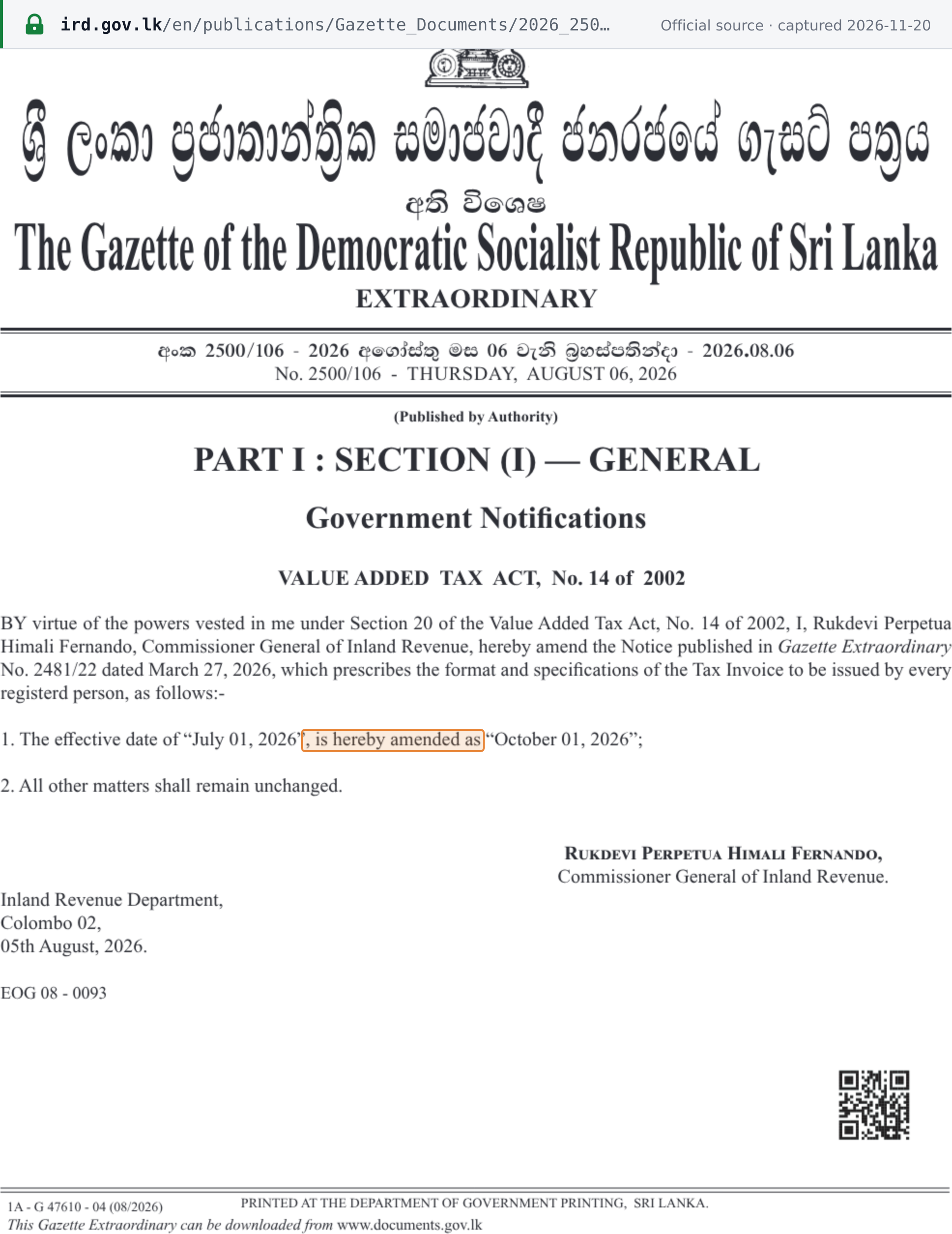 Source snapshot captured 2026-11-20 — original
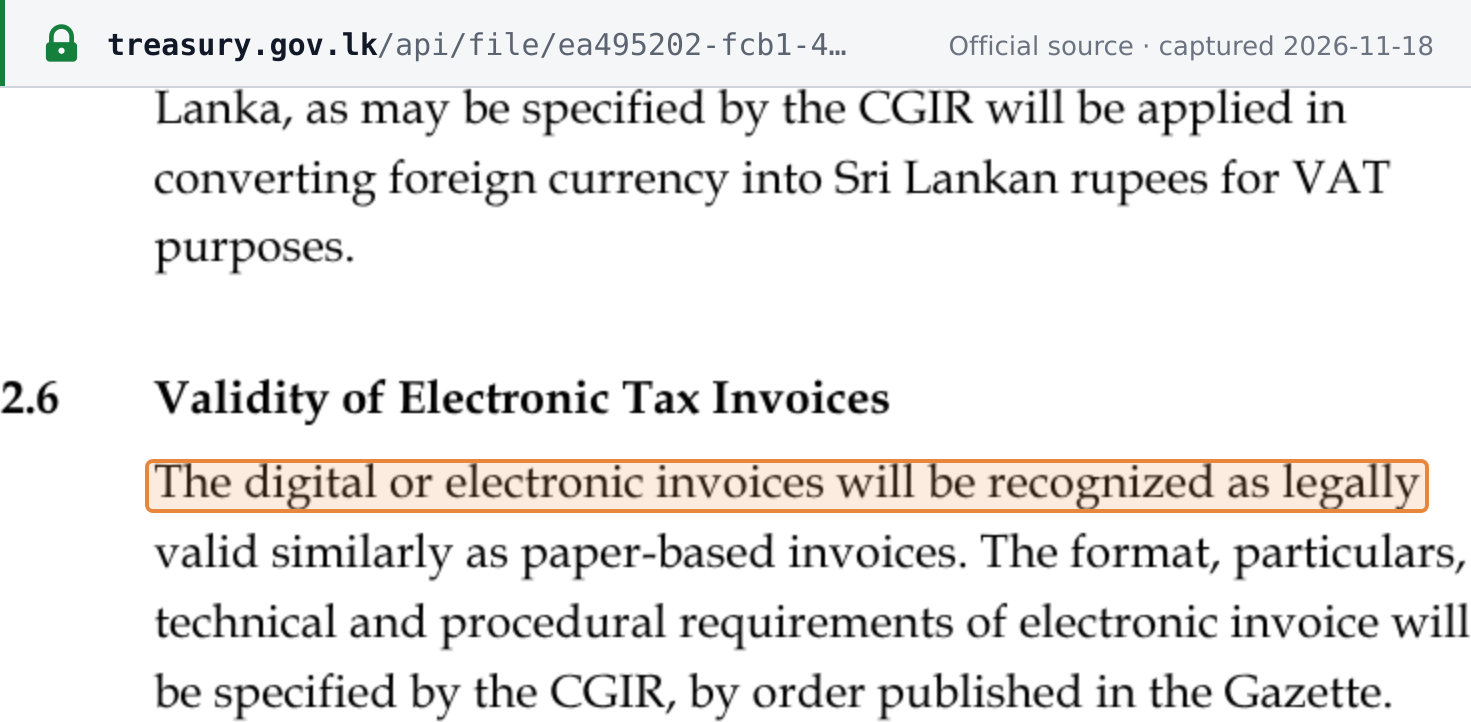
What is coming: legal validity for electronic invoices (proposal). The Budget 2027 Technical Note, item 2.6 "Validity of Electronic Tax Invoices", says: "The digital or electronic invoices will be recognized as legally valid similarly as paper-based invoices. The format, particulars, technical and procedural requirements of electronic invoice will be specified by the CGIR, by order published in the Gazette." Item 9 adds: "Unless specifically mentioned otherwise in this Technical Note or the relevant Tax Legislation, amendments proposed herein before will be effective from April 1, 2027." Item 2.6 gives no date of its own. This needs amending legislation; as at 20 November 2026 the IRD's gazette page lists no such order. [7]
 Source snapshot captured 2026-11-18 — original
Legal basis
| Instrument | Date | In force | What it does |
|---|---|---|---|
| VAT Act No. 14 of 2002, section 20 (s.20(2A) inserted by Act No. 4 of 2025, s.6) | — | In force | Tax invoice particulars; "the format of the tax invoice shall be as specified by the Commissioner-General by Order published in the Gazette" |
| VAT (Amendment) Act No. 14 of 2026 | Certified 30 June 2026 | In force; s.64B awaits a prescribed date | New s.64B: secured point-of-sale machines; new s.67(p) offence and higher fines |
| Gazette Extraordinary No. 2463/05 | 17 November 2025 | 1 January 2026 (optional); rescinded "with effect from July 01, 2026" as gazetted in 2481/22 | First format order |
| Gazette Extraordinary No. 2481/22 | 27 March 2026 | 1 October 2026 (as amended) | Tax invoice format and specification, Annexure I and specimen |
| Gazette Extraordinary No. 2500/106 | 6 August 2026 | — | Moves the 2481/22 date to 1 October 2026 |
| IRD Circular SEC/2026/E/03 | 20 May 2026 | Guidance | Explains the format; Web API early-adopter numbering relaxation |
| IRD notice SEC/PN/VAT/2026-03 | 4 May 2026 | Administrative notice; cites no legal basis | National e-Invoicing System, phases, schedules, purchaser approvals |
| IRD "How to submit Invoice via WEB API" quick guide v0.1 | Undated | Guidance | Authentication, submission pipeline, schedule posting, approval screens |
| Budget 2027 Technical Note, item 2.6 | 12 November 2026 | Proposal; default effective date 1 April 2027 | Legal validity of electronic invoices; format by CGIR Gazette order |
The VAT Act does not expressly recognise electronic tax invoices or require real-time transmission. Section 25K lets the Minister, on the CGIR's recommendation, "make regulations for the purpose of authorizing or facilitating the use of electronic communications or electronic records in respect of matters specified in section 8 of the Electronic Transactions Act, No.19 of 2006"; the IRD's gazette page lists no such regulations. [8] [10]
The only electronic-device duty in the VAT Act is new section 64B, inserted by Act No. 14 of 2026: "Every registered person shall use secured point of sale machines for all the transactions, issuance of invoices and to manage and maintain records in respect of the taxable activities carried out by him in the manner as may be prescribed, within three months from the date so prescribed." A "secured point of sale machine" is "an electronic device or system, approved by the Commissioner-General in the manner prescribed, which is used by a registered person for the purpose of recording the supplies of goods or services, generating invoices or receipts, and capturing transaction data in real time". The duty starts only once a date is prescribed; as at 20 November 2026 the IRD's gazette page lists no order prescribing one. [9] [10]
Technical standards. None. The IRD has published no API specification, payload schema or reference to UBL, CII, EN 16931 or Peppol in the notice, the quick guide, the Gazettes or the circular. [1] [2]
Scope
B2B. The Web API carries VAT schedule data, and the design is built around registered supplier to registered purchaser matching. The notice lists the schedules: "Schedule 01: Output tax (including exempted supplies)", "Schedule 04: Credit notes and debit notes" and "Schedule 07: Zero-rated supplies". A supplier's Schedule 01 and 04 records are "automatically populated in the respective purchaser’s Schedule 02 and Schedule 04". [1]
B2G and B2C. The IRD notice and quick guide set no B2G-specific or B2C-specific rule and name no separate public-sector platform. [1] [2]
Non-established businesses. The IRD notice and quick guide do not address non-resident suppliers, and place no category of them in either phase. For VAT on digital services supplied by non-residents, see the Sri Lanka VAT guide. [1]
Imports and exports. Not transmitted by taxpayers. The IRD "intends to further enhance this system by enabling the pre-population of import data (VAT Schedule 03) and export data (VAT Schedule 06) within the RAMIS e-Service", using "Data obtained from Sri Lanka Customs". No date is given. [1]
Tax invoices themselves. The Gazette 2481/22 format applies to every tax invoice a VAT-registered person issues from 1 October 2026, whether or not that person uses the Web API. "The tax invoice shall exclusively include goods or services only that are subject to VAT." The Gazette does not distinguish paper from electronic invoices. [3] [4]
Simplified invoices. Not applicable: the VAT Act sets no simplified tax-invoice category or value threshold, and the Web API notice says nothing on the point. [8]
Format & network
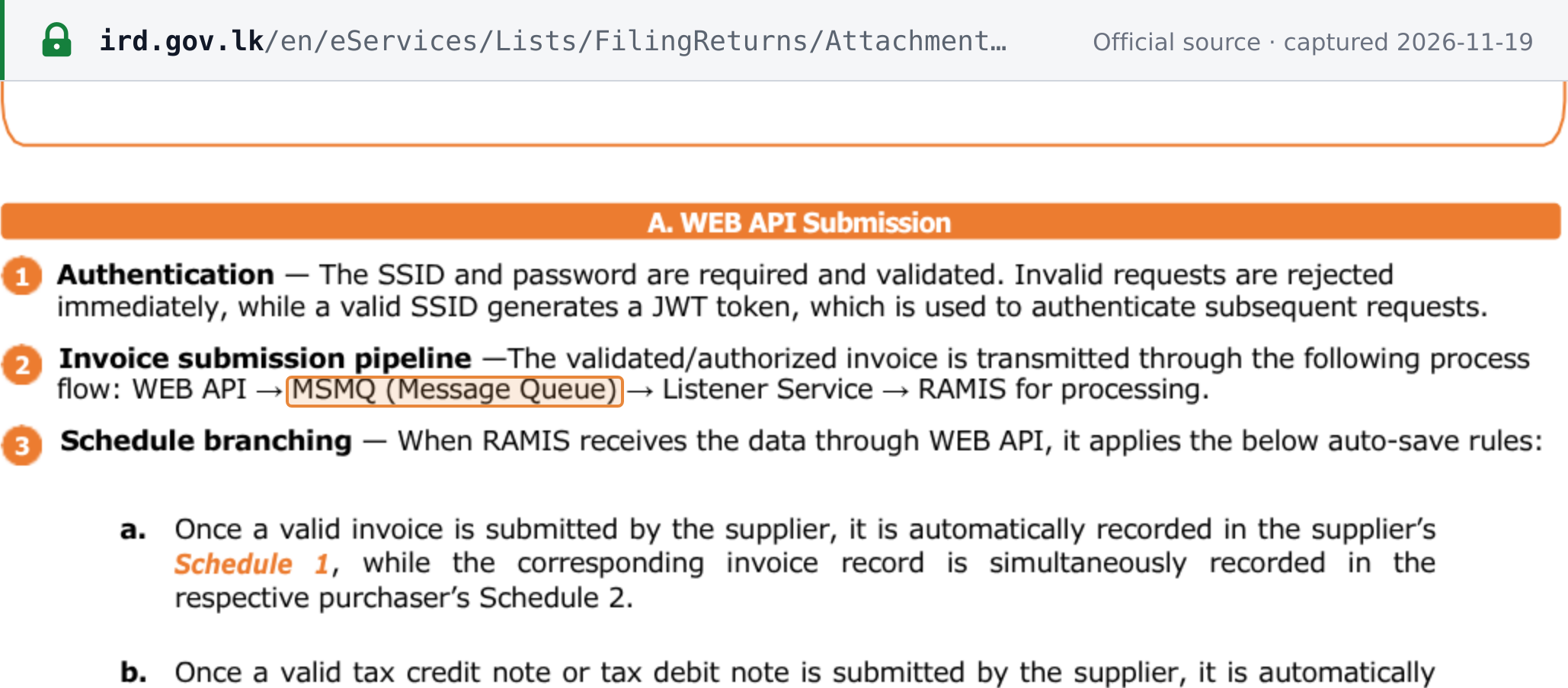
Model: real-time reporting of invoice data to RAMIS, with buyer-side matching. The IRD's quick guide sets out the flow:
- Authentication. "The SSID and password are required and validated. Invalid requests are rejected immediately, while a valid SSID generates a JWT token, which is used to authenticate subsequent requests."
- Pipeline. "The validated/authorized invoice is transmitted through the following process flow: WEB API → MSMQ (Message Queue) → Listener Service → RAMIS for processing."
- Posting to schedules. "Once a valid invoice is submitted by the supplier, it is automatically recorded in the supplier’s Schedule 1, while the corresponding invoice record is simultaneously recorded in the respective purchaser’s Schedule 2." Credit and debit notes go to both parties' Schedule 4; an invoice for a zero-rated service goes to the supplier's Schedule 7.
 Source snapshot captured 2026-11-19 — original
On LookupTax's reading this is a reporting model, not clearance: the IRD publishes no step in which RAMIS validates and returns the invoice with an IRD number, stamp, QR code or signature before it is valid. The IRD never uses the word "clearance"; its circular describes the system as "API-based reporting" (SEC/2026/E/03 §3). [5] For how the models differ, see CTC e-invoicing models.
| Item | Position as published by the IRD |
|---|---|
| Payload format | Not published (no JSON or XML schema, no field mapping) |
| Standard | No UBL, CII or EN 16931 reference |
| Network | Direct taxpayer-to-RAMIS Web API; not Peppol-based; no service-provider network |
| QR code, hash, signature | None in Gazette 2481/22, Circular SEC/2026/E/03, the notice or the quick guide. The circular's stated integrity aim for the serial number is that it "Prevents duplication or omission of invoices" |
| Corrections | "Any schedule record submitted by a supplier or an agent (tea broker) through the Web API cannot be amended or deleted." Adjustments "must be made only through the issuance of a tax credit note or tax debit note." |
| Failed submissions | Records that fail "may be submitted via Excel files or through the Schedule Record Submission interface in RAMIS e-Service"; records sent through the Web API need not be uploaded again |
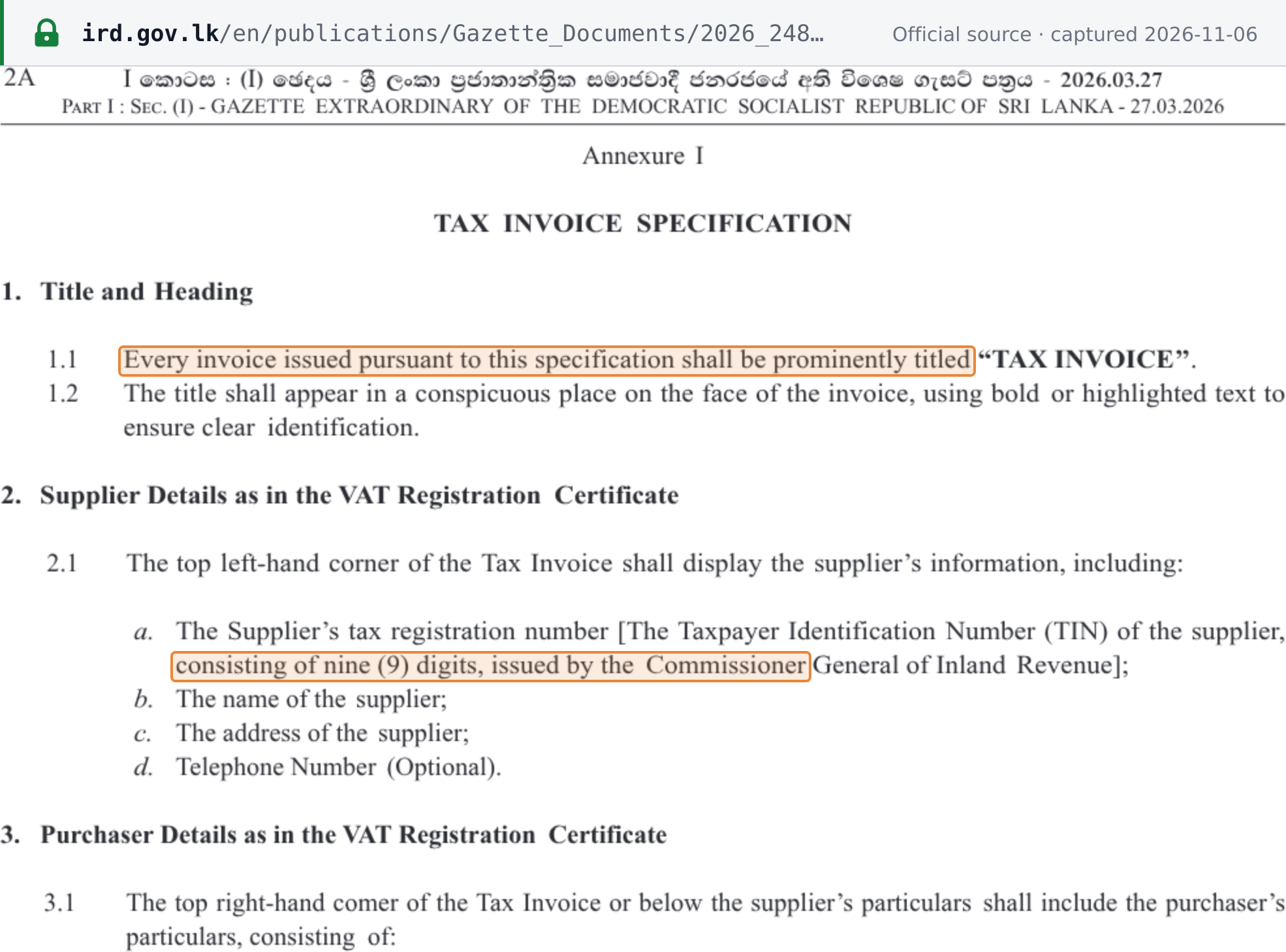
The invoice document (all VAT-registered persons, from 1 October 2026). Gazette 2481/22 Annexure I prescribes the content of every tax invoice: the title "TAX INVOICE"; the supplier's and purchaser's nine-digit TIN, name and address; an invoice serial number in the form YYMMM_QQQQ_XXXXX, which "shall not have any spaces but limited to forty (40) characters in length"; the invoice date and date of supply "expressed in MM/DD/YYYY format"; description and quantity; and values in Sri Lankan rupees. This is a rule about what the document shows, not a data schema; the IRD has not published how these fields map to Web API data. The full field list and the IRD's specimen are in the Sri Lanka VAT guide's invoice section. [3]
 Source snapshot captured 2026-11-06 — original
E-reporting alongside. The VAT return schedules are the reporting layer: Web API records replace the CSV upload or Schedule Record Submission entry for the schedules transmitted. No separate e-reporting obligation is published. [1]
Onboarding: how to comply
Joining the Web API. The IRD has published no application form, technical specification, sandbox or provider list. What is published:
- Express interest and obtain CGIR approval. The only published reference to an approval step is the early-adopter relaxation in Circular SEC/2026/E/03, whose approval window closed on 1 July 2026: it refers to approval by the CGIR "upon expressing interest". [5]
- Contact the Web API team. "Furthermore, inquiries may be submitted via email to ramis.webapi@ird.gov.lk". [1]
- Authenticate with the SSID and password; the IRD does not publish how an SSID is issued. [2]
- Check submitted records in RAMIS e-Service: Return/Schedule Management → Value Added Tax (VAT) → Schedule Records. "Records submitted through the WEB API cannot be updated or deleted via the e-Service UI." [2]
Accreditation of providers. Not applicable: the IRD publishes no certified-provider or accreditation scheme. Testing environment: none published.
Connection modes.
| Mode | Who it suits |
|---|---|
| Web API (ERP to RAMIS) | Approved and onboarded VAT-registered persons |
| Tea brokers' systems | Tea producers selling through the Colombo Tea Auction |
| Excel (CSV) upload or Schedule Record Submission interface in RAMIS e-Service | Everyone else, records that failed via the API, and tea supplies outside the auction |
Purchasers: approve before you claim. Even a business that has not integrated will see its integrated suppliers' invoices arrive in its RAMIS Schedule 02 and 04. Purchasers must "Review and approve invoice records and tax credit/debit note records where applicable"; "Approval can be done as an individual record or as bulk records (5,000 records at once)"; "After approving the record status will be updated as “Matched”"; and they must "Ensure accuracy before claiming input tax and the necessary adjustments for tax credit/debit note." Purchases from suppliers who have not integrated are still submitted by CSV upload or the Schedule Record Submission interface. [1]
The quick guide adds that a purchaser may change a Schedule 2 record's period code to claim input tax in a later period ("Such change can only be made after the VAT return for the relevant taxable period has been issued"), may enter a disallowed VAT amount, and sees records as "Pending Approval" until approved. [2]
Penalties
For not joining the Web API: none published. The IRD notice, the quick guide and the IRD's 2026 Gazettes set no penalty for not integrating. [1] [10]
For invoices that do not meet the rules:
- Invalid invoice. Under VAT Act s.20, "Any tax invoice not issued within the period specified in subsection (1) and which does not conform to the provisions of subsection (2) shall not be a valid tax invoice." [8]
- Format non-compliance. Circular SEC/2026/E/03 §7: failure to comply with the prescribed format "may result in" "Rejection of invoices for VAT input credit purposes", "Inconsistencies in VAT returns", "Increased audit scrutiny" and "Possible penalties under the VAT Act". [5]
- Offence. Act No. 14 of 2026 adds to s.67 an offence where a person "(p) fails to furnish valid tax invoices or customs good declarations or other authenticated documents as required under section 21." For any period on or after 1 October 2025, a s.67 offence carries, on conviction, "a fine not exceeding one million rupees, or to imprisonment of either description for a term not exceeding six months or both such fine and imprisonment" (LKR 25,000 for earlier periods). [9]
- Secured POS machines (s.64B). No penalty can bite until a start date is prescribed.
Frequently asked questions
Do we have to connect our ERP to RAMIS now?
No obligation appears in the IRD's published gazettes as at 20 November 2026. The IRD's notice of 4 May 2026 announces Phase 1 for VAT-registered export-oriented enterprises and Phase 2 for all VAT-registered persons, with no dates or turnover thresholds, and expects full Web API integration by the end of 2026. It sets no penalty for not joining. [1] [10]
We were approved for the Web API before 1 July 2026. What must we finish, and by when?
Complete the integration on or before 31 December 2026. Circular SEC/2026/E/03 lets a registered person that obtained CGIR approval before 1 July 2026 treat the YYMMM_QQQQ_ part of the invoice number as optional, provided integration is completed by that date. Gazette 2500/106 moved only the format's start date to 1 October 2026 and did not change the circular. [5] [4]
A wrong invoice went to RAMIS through the API. Can we fix it?
Not by editing it. Records submitted through the Web API cannot be amended or deleted, in the API or in the e-Service screens. Correct an overstated or understated amount by issuing a tax credit note or tax debit note. [1] [2]
Supplier invoices show as Pending Approval in RAMIS. What do we do before claiming input tax?
Review and approve them, one by one or in bulk up to 5,000 records at once; approved records show as Matched. Check them before claiming input tax. To claim in a later period you may change the record's period code once the VAT return for the original period has been issued. Purchases from suppliers who are not on the Web API are still submitted by CSV upload or the Schedule Record Submission interface. [1] [2]
Some records failed to go through the API. Do we re-upload everything?
No. Only the failed records are submitted, by Excel (CSV) upload or through the Schedule Record Submission interface in RAMIS e-Service. Records already received through the Web API need not be uploaded again. [1]
Is an emailed or PDF tax invoice legally valid in Sri Lanka?
The VAT Act does not expressly recognise electronic tax invoices. Section 25K lets the Minister make regulations for electronic records under the Electronic Transactions Act No. 19 of 2006; the IRD's gazette page lists none. The Budget 2027 Technical Note proposes that electronic invoices be recognised as legally valid like paper invoices, with their format set by a CGIR Gazette order, by default from 1 April 2027; this is a proposal that needs amending legislation. Whatever the medium, the Gazette 2481/22 content rules apply to tax invoices from 1 October 2026; the Gazette does not distinguish paper from electronic invoices. [8] [10] [7] [3]
Recent changes
- 2026-11-12 (proposed — Budget 2027) — Budget 2027 Technical Note item 2.6 proposes legal validity for electronic tax invoices, with format set by CGIR Gazette order; needs amending legislation; default effective date 1 April 2027. (Ministry of Finance) — see event
- 2026-08-06 — Gazette Extraordinary No. 2500/106 moves the mandatory tax invoice format (Gazette 2481/22) from 1 July to 1 October 2026. (IRD) — see event
- 2026-05-20 — Circular SEC/2026/E/03 explains the format and relaxes the invoice-number prefix for Web API adopters approved before 1 July 2026 that integrate by 31 December 2026. (IRD)
- 2026-05-04 — IRD notice SEC/PN/VAT/2026-03 describes the National e-Invoicing System: ERP to RAMIS via Web API, pilot under way, Phase 1 export-oriented enterprises, Phase 2 all VAT-registered persons, full integration expected by the end of 2026. (IRD) — see event
Related resources
- Sri Lanka VAT guide — rates, registration, invoice requirements, filing
- E-invoicing status and networks by country
- CTC e-invoicing models explained
- Fiscal devices and certified cash registers
- Sri Lanka tax changes on Lookuptax
Important websites
- IRD — "How to submit Invoice via WEB API" quick guide (PDF); Web API enquiries: ramis.webapi@ird.gov.lk
- IRD — Access to e-Services (RAMIS)
- IRD — Gazette notifications and circulars
- IRD — News and notices
Reference links
- IRD — Notice SEC/PN/VAT/2026-03 of 4 May 2026: VAT invoice data integration between taxpayers' ERP systems and RAMIS through Web API (PDF)
- IRD — How to submit Invoice via WEB API, quick guide v0.1 (PDF)
- Gazette Extraordinary No. 2481/22 of 27 March 2026 — tax invoice format and specification (PDF)
- Gazette Extraordinary No. 2500/106 of 6 August 2026 — effective date amended to 1 October 2026 (PDF)
- IRD Circular SEC/2026/E/03 of 20 May 2026 — Implementation of Revised Tax Invoice Format (PDF)
- Gazette Extraordinary No. 2463/05 of 17 November 2025 — first tax invoice format order (PDF)
- Ministry of Finance — Budget Speech 2027 and Technical Note (PDF)
- IRD — VAT Act No. 14 of 2002, consolidated to 2025 (PDF)
- IRD — Value Added Tax (Amendment) Act No. 14 of 2026 (PDF)
- IRD — Gazette notifications page
- IRD — Circulars page