E-invoicing in New Zealand: Peppol and Procurement Rule 44
Overview
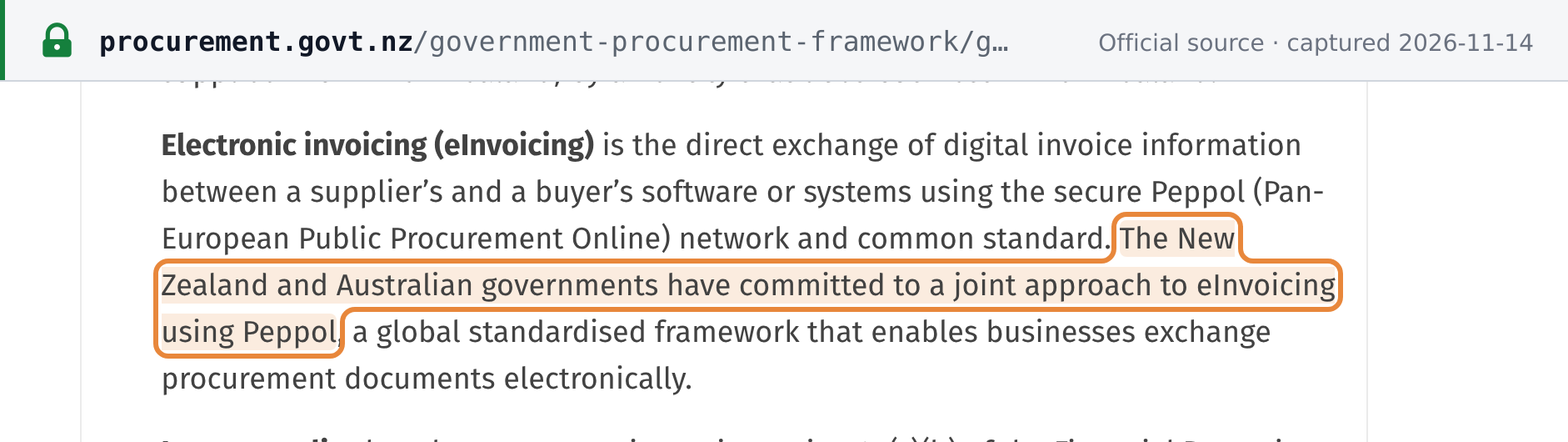
New Zealand e-invoicing runs on Peppol. The Government Procurement Rules define it as "the direct exchange of digital invoice information between a supplier’s and a buyer’s software or systems using the secure Peppol (Pan-European Public Procurement Online) network and common standard", and add: "The New Zealand and Australian governments have committed to a joint approach to eInvoicing using Peppol". [1]
There is no clearance or real-time reporting system. Inland Revenue says: "Information is exchanged through the Peppol network using the software business specifications for eInvoicing. Inland Revenue does not receive this information." [9]
The one obligation is in public procurement. Government Procurement Rule 44 (eInvoicing capability), run by New Zealand Government Procurement in the Ministry of Business, Innovation and Employment (MBIE), requires larger government agencies to be able to send and receive eInvoices by 1 January 2026, and to require large suppliers to submit eInvoices from 1 January 2027. [1]
Legal basis in one line. Government Procurement Rules, 5th edition (in effect 1 December 2025), Rule 44 (eInvoicing capability) and Rule 36 (prompt payment); on the tax side, the GST Act 1985 rules on taxable supply information (sections 19E to 19N, from 1 April 2023), which let a Peppol e-invoice serve as the GST record. [5] [13]
| New Zealand | |
|---|---|
| System | Peppol eInvoicing (no national platform) |
| Model | Interchange: Peppol 4-corner exchange between the parties' Service Providers; no clearance, no reporting to Inland Revenue |
| B2G | Agencies receiving or sending more than 2,000 domestic trade invoices a year: e-invoice capable by 1 January 2026 (Rule 44.1, passed); agencies receiving more than 2,000 domestic trade invoices a year must require large suppliers to submit eInvoices from 1 January 2027 (Rule 44.2, upcoming) |
| Large supplier | Total revenue of the entity and its subsidiaries over NZD 33 million in each of the two preceding accounting periods (Financial Reporting Act 2013 s 45(1)(b)) |
| B2B and B2C | No mandate; Peppol exchange is voluntary |
| Non-residents | Rule 44 covers only "domestic" invoices: payment in NZD, for goods or services supplied within New Zealand, by an entity that does business in New Zealand |
| Format | PINT A-NZ Billing v1.1.3 (UBL), shared with Australia; optional PINT A-NZ Self-billing |
| Network | Peppol, through Service Providers accredited by the New Zealand Peppol Authority; NZBN as the legal registration number |
| Authorities | New Zealand Government Procurement (MBIE) for Rules 44 and 36; Inland Revenue for GST taxable supply information |
| Penalty | No supplier penalty in the Procurement Rules; agencies face accountability measures |
For GST rates, registration and the full taxable-supply-information table, see the New Zealand GST guide. New Zealand shares its Peppol specification with Australia; see the Australia Peppol e-invoicing guide.
Mandate status & timeline
Status (as at 15 November 2026): no B2B or B2C mandate; B2G obligation on government agencies, with agencies e-invoice capable since 1 January 2026 and large suppliers required to submit eInvoices from 1 January 2027. Rule 44 states: "Agencies must meet the requirements of Rule 44.1 to be eInvoice capable by 1 January 2026." and "Agencies must meet the requirements of Rule 44.2 to require large suppliers to submit eInvoices from 1 January 2027." [1]
| Phase | Who | Obligation | Date | Instrument | State |
|---|---|---|---|---|---|
| 5th-edition Rules | Agencies required to apply the Rules | Government Procurement Rules, 5th edition (published October 2025), in effect; Rule 44 replaces 4th-edition Rule 51 (eInvoicing capability) | 1 December 2025 | Government Procurement Rules, 5th edition | In force |
| Rule 44.1 | Agencies receiving more than 2,000 domestic trade invoices a year (receive), or sending more than 2,000 (send) | Be capable of receiving eInvoices through the primary accounts payable system(s), or of sending them through the primary accounts receivable system(s) | By 1 January 2026 | Rule 44.1 | Passed |
| Rule 36 | Agencies required to apply the Rules | Pay 95% of domestic trade eInvoices within 5 business days, other domestic trade invoices within 10 | January 2026 | Rule 36 | In force |
| Rule 44.2 | Agencies receiving more than 2,000 domestic trade invoices a year | Require large suppliers to submit eInvoices | From 1 January 2027 | Rule 44.2 | Upcoming |
 Source snapshot captured 2026-11-15 — original
The latest step: large suppliers from 1 January 2027. Rule 44.2 is written as a duty on the agency ("Agencies must require large suppliers to submit eInvoices"), so it reaches a supplier through the agencies it sells to. It applies only where the agency is over the threshold: "The requirement in Rule 44.2 only applies if an agency meets the threshold of receiving more than 2,000 domestic trade invoices annually, set out in 44.1.a." MBIE publishes guidance for agencies and suppliers on how the requirement is applied to contracts on einvoicing.govt.nz. [1]
Rules 36 and 44 in force, January 2026. New Zealand Government Procurement announced on 29 January 2026: "Mandated agencies must send and receive eInvoices and pay 95% of them within 5 business days and other domestic trade invoices within 10 days." The 5th edition had set the payment target at 90% when published in October 2025; it rose to 95% from 1 January 2026. [6]
Before the 5th edition. The 5th-edition Rules "came into effect on 1 December 2025". The official mapping table pairs 5th-edition "Rule 44: eInvoicing capability" with 4th-edition "Rule 51: eInvoicing capability", so an eInvoicing-capability rule existed before. [5] [7]
Further phases. Neither the Rules nor Inland Revenue announce a B2B or B2C mandate or any phase after 1 January 2027.
Legal basis
| Instrument | Date | What it does |
|---|---|---|
| Government Procurement Rules, 5th edition | Published October 2025; in effect 1 December 2025 | Binds the agencies required to apply the Rules; "must" makes a Rule compulsory |
| Rule 44 — eInvoicing capability | 44.1 by 1 January 2026; 44.2 from 1 January 2027 | Agency send/receive capability above 2,000 domestic trade invoices a year; large suppliers to submit eInvoices; definitions of domestic, eInvoicing, large supplier, trade credit |
| Rule 36 — prompt payment | In force January 2026 | 95% of domestic trade eInvoices paid within 5 business days; quarterly reporting to MBIE |
| Financial Reporting Act 2013, s 45(1)(b) | — | The "large" test Rule 44 borrows: total revenue over NZD 33 million in each of the two preceding accounting periods |
| GST Act 1985, ss 19E–19N, inserted by the Taxation (Annual Rates for 2021–22, GST, and Remedial Matters) Act 2022 | Royal assent 30 March 2022; taxable periods starting on or after 1 April 2023 | Replaced tax invoices with taxable supply information (TSI): defined in s 19E; held by supplier and recipient (s 19F); supply correction information (s 19N) |
| Taxation (Annual Rates for 2022–23, Platform Economy, and Remedial Matters) Act 2023 | Royal assent 31 March 2023 | Amended s 19K(1): TSI is due within 28 days of a request |
| PINT A-NZ Billing v1.1.3 | Released 2026-06-08 (final) | The joint Australia & New Zealand Peppol invoice and credit note specification |
| NZ Peppol Authority Specific Requirements | Published 2022 | NZBN as legal registration number; mandatory A-NZ documents; accreditation of Service Providers |
Why the GST rules changed. Inland Revenue's commentary on the 2022 Act gives two purposes: "to reduce compliance costs for businesses, and • to facilitate the introduction of e-invoicing." The main technical change "is that an invoice no longer needs to have the words “tax invoice” in a prominent place on the invoice." [13]
Technical standards. PINT A-NZ is an OpenPeppol specification maintained by the Australian and New Zealand Peppol Authorities. It binds through the Peppol network: Service Providers accredited in New Zealand "must support mandatory business documents", the A-NZ invoice and credit note. No Act or Procurement Rule names the specification. [17] [18]
Scope
B2G (agencies as buyers). Rule 44 covers invoices "related to domestic trade credit that are received or sent by an agency in the ordinary course of its business". Out of scope: "reimbursement of employee expenses rents and leases credit card statements, finance payments, and insurance premiums payments made regularly as part of an ongoing contract, which don’t require an invoice, such as progress payments on a roading contract." Invoices so significant that "extraordinary checks and approvals are required (for example, payments for significant infrastructure)" are not in the ordinary course of business. [1]
Which agencies. Required to apply the Rules: all Public Service departments, New Zealand Police, New Zealand Defence Force, Crown agents, Autonomous Crown Entities, Independent Crown Entities, Crown Entity Companies (other companies) and Public Finance Act 1989 Schedule 4A companies. "Crown Research Institutes must have regard to the Rules". School boards, Public Finance Act Schedule 4 organisations and the Reserve Bank "are expected to have regard to the Rules as good practice guidance", and the wider state and public sector is encouraged to. Local councils are not on the required list. [3]
Which suppliers. Rule 44.2 reaches large suppliers: "A supplier entity is defined as large if in each of the two preceding accounting periods the total revenue of the entity and its subsidiaries (if any) exceeds $33 million." The test is the supplier group's total revenue, not the amount it invoices government. Smaller suppliers are not required to e-invoice by Rule 44.2, although agencies receiving more than 2,000 domestic trade invoices a year must be "capable of receiving eInvoices through their primary accounts payable system(s)". [1]
Supplier benefit — Rule 36. "Agencies must pay 95% of: domestic trade eInvoices within 5 business days other domestic trade invoices within 10 business days." The clock starts "from the day an invoice is entered into an accounts payable system", and it does not run if the goods or services are unsatisfactory or incomplete, the amount is disputed, or the invoice is incomplete or incorrectly rendered. Agencies report payment times to MBIE quarterly. [2]
B2B and B2C. Neither Inland Revenue's GST guidance nor the Government Procurement Rules impose e-invoicing on business-to-business or consumer sales. The GST law makes Peppol exchange an option: "you can provide taxable supply information using an automated direct exchange through your software, such as eInvoicing." [10]
Non-residents. The Rules do not mention non-resident suppliers by name. Rule 44 covers only domestic invoices: "Domestic means that the requested payment is in $NZD, for goods or services supplied within New Zealand, by an entity that does business in New Zealand." An invoice in another currency, or for a supply outside New Zealand, is outside Rule 44. [1]
Low-value supplies (GST). For a sale of NZD 200 or less including GST, the seller does not need to provide taxable supply information to the buyer, though both must keep records. [12]
Format & network
The model: interchange, not clearance. New Zealand uses the Peppol 4-corner model: the supplier's Service Provider (Access Point) delivers the invoice to the buyer's. No government platform validates, stamps or returns the invoice, and "Inland Revenue does not receive this information." Inland Revenue itself is a Peppol buyer: "We prefer our suppliers to send us eInvoices instead of sending PDFs via email." See CTC e-invoicing models. [9]
 Source snapshot captured 2026-11-14 — original
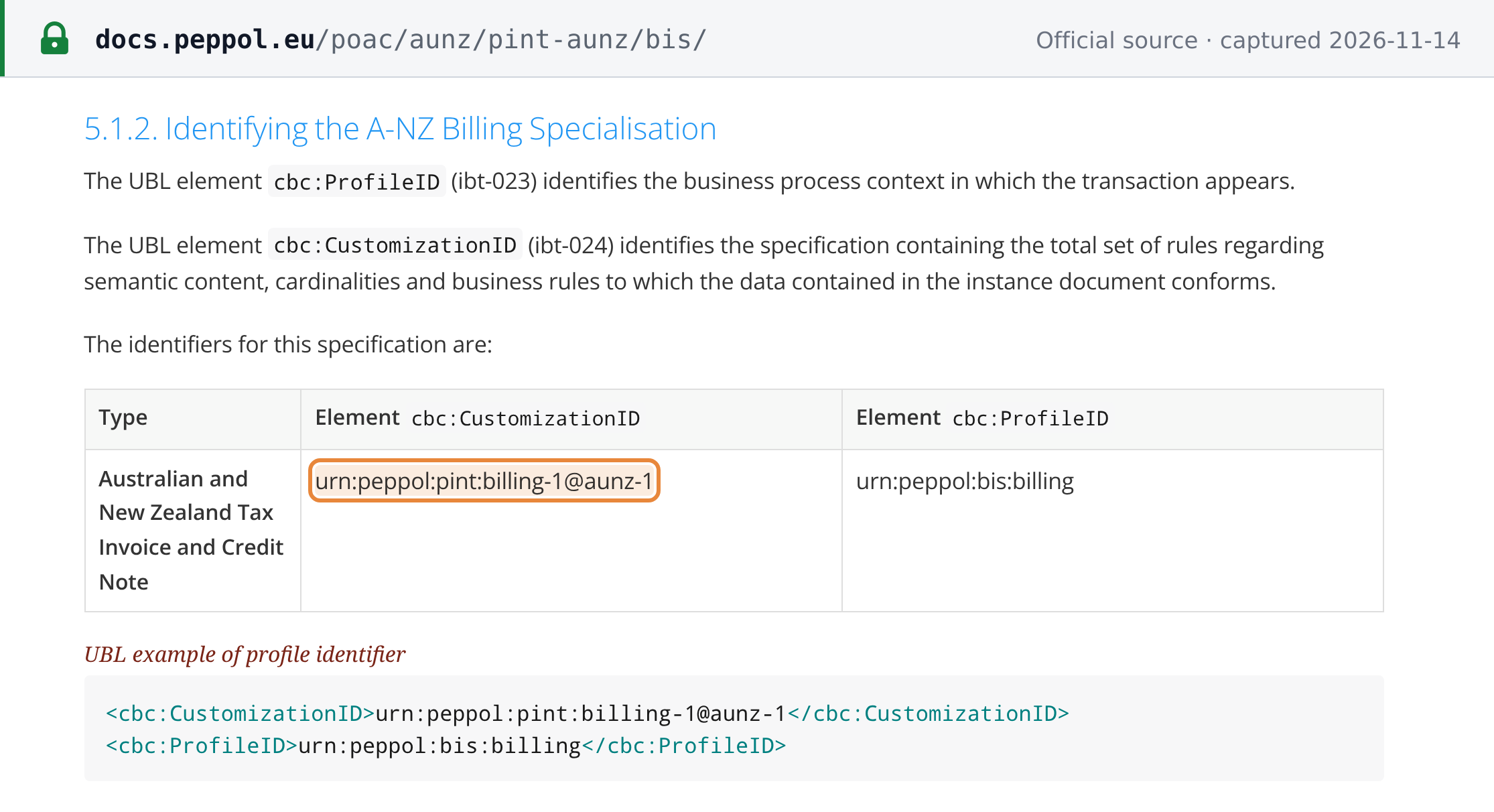
Format: PINT A-NZ. The joint specification is PINT A-NZ Billing, "the specification for the Australia & New Zealand specialisation of the Peppol International (PINT) Billing process incorporating Invoice and Credit Note transactions". It "is based on the Peppol International Invoice (PINT) framework, and includes localisations to support Australian and New Zealand business and legal requirements." The syntax is UBL. The current version is v1.1.3, status Final, release date 2026-06-08, "Maintained by Australian & New Zealand Peppol Authorities"; v1.1.2 was released on 2025-12-08. An optional PINT A-NZ Self-billing specification also exists: "It is optional for Service Providers operating in Australia & New Zealand to support this specification." [15] [16] [17]
| Identifier | Value |
|---|---|
cbc:CustomizationID (ibt-024) | urn:peppol:pint:billing-1@aunz-1 |
cbc:ProfileID (ibt-023) | urn:peppol:bis:billing |
| Tax scheme | GST |
 Source snapshot captured 2026-11-14 — original
New Zealand rules inside the specification. [16]
- GST number. "In New Zealand, when a GST registered organisation makes a taxable sale and issues “taxable supply information”, the New Zealand GST number must be included". "The NZ GST number is 9 digits long, in the cases of an 8-digit number, format with a leading zero e.g. 049027089." The buyer's field carries the buyer's New Zealand GST number.
- Not GST-registered. "If a business is not registered for GST, the business cannot issue tax invoices. In this case, the GST category code should be O (Outside scope of tax)".
- Credit notes. "Credit Notes and negative invoices may also be known as adjustment notes in Australia or supply corrections in NZ."
- Bank details. "In New Zealand, it is common business practice to provide the combined bank account details shown as a 16-digit number", with credit transfer as payment means code 30.
- Tax law prevails. The specification points to Inland Revenue's taxable supply information page and says: "In the event of any conflict or ambiguity regarding tax information, the relevant tax authority website takes precedence."
What a Peppol invoice must carry for GST. Since 1 April 2023 there is no "tax invoice" document requirement; the invoice must carry the taxable supply information for its value band. Inland Revenue: "Sellers can provide taxable supply information to a customer using an automated direct exchange between the buyer's and seller's software, for example PEPPOL eInvoicing". Taxable supply information "must be provided to GST registered buyers within 28 days of a request (or by an alternative date agreed to by the parties) for supplies over $200", and "Amounts of money must be expressed in New Zealand currency." The value bands (NZD 200 or less, over NZD 200 to NZD 1,000, over NZD 1,000) are tabled in the GST guide's mandatory content. [11] [12]
 Source snapshot captured 2026-10-13 — original
Identifiers on the network. The New Zealand Peppol Authority's published requirements: "New Zealand Business numbers (NZBN)s must be used as the legal registration number for New Zealand buyers and sellers." The GST number goes in the tax fields (above). Check an NZBN with the NZBN verification guide; the GST number is covered in the New Zealand tax ID guide. [18]
Integrity mechanics. Not applicable: neither the PINT A-NZ specification nor Inland Revenue's GST guidance sets a QR code, hash, cryptographic stamp or government signature on the invoice. Security sits in the Peppol network and the accreditation of Service Providers.
E-reporting. Not applicable: Inland Revenue receives no invoice data, and GST returns are filed as before.
Onboarding: how to comply
1. Choose an accredited Service Provider. "Service Providers must be accredited by the NZPA. The accreditation process has been implemented to help protect all New Zealand participants." Accreditation covers "Due diligence checks (including insurance), • Security requirements (including a security questionnaire), and • Interoperability testing to demonstrate the ability to support the A-NZ specifications", with an "annual review of the accreditation status". Service Providers must support the mandatory documents (A-NZ invoice and A-NZ credit note; self-billing optional), complete End User identification, and report statistics to the NZPA. These requirements were published in 2022. [18]
2. Who runs the network. MBIE leads New Zealand's eInvoicing programme: it is the lead agency of the government's Peppol services panel, and Rule 44 points agencies to "the MBIE eInvoicing page". The PINT A-NZ release notes give the New Zealand Peppol Authority's support address as support@nzpeppol.govt.nz. [8] [1] [17]
3. Agencies: the syndicated panel. "If you use a finance platform that requires an Access Point Provider to enable eInvoicing, there is an open government syndicated panel." The agreement "PEPPOL capabilities and associated services (including eInvoicing)" (lead agency MBIE) covers sending and receiving eInvoices, connectors, translation and validation, and Peppol SMP look-up "to confirm and clarify the ability to query/lookup and determine whether an organisation can send/receive an eInvoice". Its current term ends on 14 June 2027 with no renewals left. [1] [8]
4. Platform registration and testing. Not applicable in the government sense: there is no government portal to register with and no government sandbox. A business joins Peppol through its Service Provider. The government eInvoicing site, einvoicing.govt.nz, carries MBIE's guidance for businesses and agencies.
5. Keep records. "You must keep records of all cash and electronic sales and purchases for 7 years." This applies to e-invoices as to any record. [20]
Penalties
Procurement Rules: no supplier penalty. Rule 44, Rule 36, the application page and the "What happens if the Rules are not followed" page set no financial penalty on a supplier that does not e-invoice. The Rules bind agencies: "Agencies that do not apply the Rules appropriately are subject to a range of accountability measures that are the basis of New Zealand’s public sector accountability framework. Aside from potential legal action by an aggrieved supplier, procurement practices can also be reviewed/audited by the Office of the Auditor General and Comptroller, resulting in a report tabled in Parliament or by an Ombudsman." For a large supplier, the practical consequence after 1 January 2027 is what the agency's requirement and contract say. [4] [1]
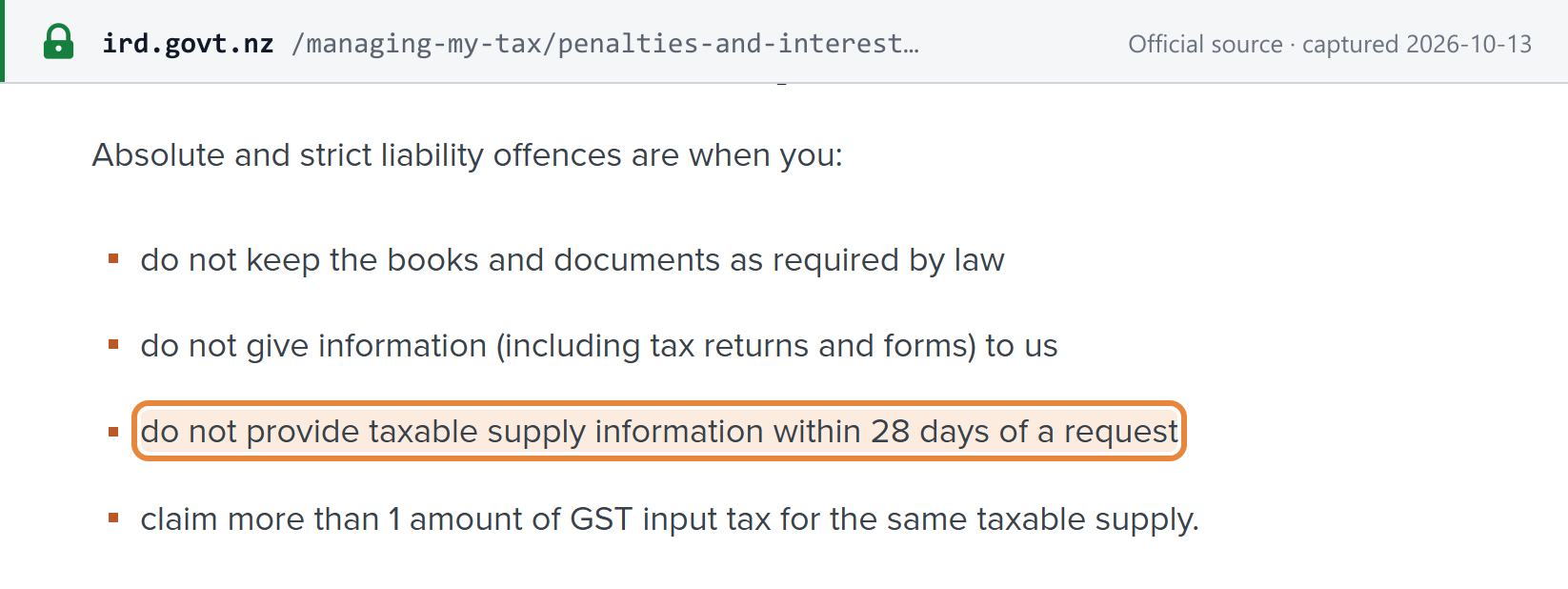
GST: taxable supply information on request. Whatever the channel (paper, PDF or Peppol), Inland Revenue lists among absolute and strict liability offences: "do not provide taxable supply information within 28 days of a request". [19]
 Source snapshot captured 2026-10-13 — original
Frequently asked questions
We are a large supplier to a government department. Do we have to send eInvoices from 1 January 2027?
Rule 44.2 obliges agencies that receive more than 2,000 domestic trade invoices a year to require large suppliers to submit eInvoices from 1 January 2027. A supplier is large if its total revenue, with subsidiaries, exceeded NZD 33 million in each of the two preceding accounting periods. The duty reaches you through the agency, so check what each agency you invoice requires. MBIE publishes guidance on how agencies apply the requirement to contracts on einvoicing.govt.nz. [1]
Does Inland Revenue see our e-invoices?
No. Inland Revenue says invoice information is exchanged through the Peppol network and that Inland Revenue does not receive it. There is no clearance or real-time reporting in New Zealand. [9]
Does our Peppol invoice still need the words "tax invoice"?
No. Since 1 April 2023 the GST Act requires taxable supply information instead of a tax invoice, and that information can be provided by an automated exchange such as Peppol eInvoicing. Old-style tax invoices still comply. [10] [11]
Which identifiers go on a New Zealand Peppol invoice?
The NZBN is the legal registration number for New Zealand buyers and sellers under the New Zealand Peppol Authority's requirements. A GST-registered seller puts its 9-digit New Zealand GST number in the seller tax identifier, with a leading zero for an 8-digit number. [18] [16]
Is the New Zealand format the same as Australia's?
Yes. Both countries use PINT A-NZ, maintained by the Australian and New Zealand Peppol Authorities, with the CustomizationID urn:peppol:pint:billing-1@aunz-1. It contains country-specific rules, such as the New Zealand GST number format. [17] [16]
Are invoices to a local council covered by Rule 44?
Local councils are not on the list of agencies required to apply the Government Procurement Rules; the wider public sector is encouraged to use them as good practice guidance. [3]
Does Rule 44 cover invoices in Australian or US dollars?
No. Rule 44 covers domestic invoices only: payment requested in NZD, for goods or services supplied within New Zealand, by an entity that does business in New Zealand. [1]
Do we get paid faster if we send eInvoices to government?
Rule 36 requires agencies to pay 95% of domestic trade eInvoices within 5 business days, against 10 business days for other domestic trade invoices. The clock starts when the invoice is entered into the agency's accounts payable system and does not run for disputed, incomplete or incorrectly rendered invoices. [2]
Recent changes
- 2026-10-26 — Under Government Procurement Rule 44.2, agencies receiving more than 2,000 domestic trade invoices a year must require large suppliers (revenue over NZD 33 million in each of the two preceding accounting periods) to submit Peppol eInvoices from 1 January 2027. (NZ Government Procurement) — see event
- 2026-06-08 — PINT A-NZ Billing v1.1.3 released (final), maintained by the Australian and New Zealand Peppol Authorities. (OpenPeppol)
- 2026-01-29 — Rules 36 and 44 in force: mandated agencies must send and receive eInvoices and pay 95% of them within 5 business days. (NZ Government Procurement)
- 2025-12-01 — Government Procurement Rules 5th edition in effect, with Rule 44 (eInvoicing capability) replacing 4th-edition Rule 51. (NZ Government Procurement)
Related resources
- New Zealand GST guide — rates, registration, taxable supply information, filing
- New Zealand tax ID guide — IRD and GST numbers
- NZBN verification and the NZBN validator
- Australia Peppol e-invoicing guide — the other half of PINT A-NZ
- What is Peppol? and Peppol requirements by country
- E-invoicing status and networks by country
- CTC e-invoicing models explained
- New Zealand tax changes on Lookuptax
Important websites
- Government Procurement Rules — Rule 44 and Rule 36
- einvoicing.govt.nz — MBIE's government eInvoicing site
- PINT A-NZ specifications — billing and self-billing, release notes
- Inland Revenue — taxable supply information
- Inland Revenue — eInvoicing
Reference links
- NZ Government Procurement — Rule 44: eInvoicing capability
- NZ Government Procurement — Rule 36: prompt payment times
- NZ Government Procurement — Application of the Rules
- NZ Government Procurement — What happens if the Rules are not followed
- NZ Government Procurement — Shifting to the new Government Procurement Rules
- NZ Government Procurement — eInvoicing and prompt payment rules take effect (29 January 2026)
- Table of Rules changes, 5th edition mapped against 4th edition (PDF)
- NZ Government Procurement — PEPPOL capabilities and associated services (including eInvoicing)
- Inland Revenue — eInvoicing
- Inland Revenue — Taxable supply information for GST
- Inland Revenue — How taxable supply information works
- Inland Revenue — IR375 GST guide (PDF)
- Tax Information Bulletin Vol 34 No 5, June 2022 (PDF)
- Tax Information Bulletin Vol 35 No 6, July 2023 (PDF)
- OpenPeppol — PINT A-NZ specifications
- PINT A-NZ Billing — business interoperability specification
- PINT A-NZ — release notes
- New Zealand Peppol Authority Specific Requirements (PDF)
- Inland Revenue — Criminal penalties
- Inland Revenue — Records of income and expenses