E-invoicing in Zambia: Smart Invoice
Overview
Zambia's e-invoicing system is Smart Invoice, run by the Zambia Revenue Authority (ZRA). The statute calls it the "electronic invoicing system" (EIS), and the VAT (Electronic Invoicing System) Regulations, 2023 provide that "The Commissioner General shall operate an electronic invoicing system" (reg. 3). [2]
ZRA describes it as "a software-based electronic invoicing solution that taxpayers use to manage invoices and stock data transmitted to ZRA". It replaced the hardware Electronic Fiscal Devices (EFDs), which covered only VAT and Insurance Premium Levy. Smart Invoice covers "VAT, Turnover Tax (TOT), Income Tax, Rental Income tax and Local Excise Duty on Coal and Electricity", the Insurance Premium Levy and the Tourism Levy, and includes stock management. [1]
Legal basis in one line. Value Added Tax Act (Cap. 331) section 7A, as amended by the VAT (Amendment) Acts No. 44 of 2021, No. 27 of 2023 and No. 23 of 2024; the VAT (Electronic Invoicing System) Regulations, 2023 (Statutory Instrument No. 58 of 2023) as amended by SI No. 94 of 2024; and, for income tax, the Income Tax (Electronic Invoicing System) Regulations, 2025 (SI No. 84 of 2025). [15] [2] [3] [4]
| Zambia | |
|---|---|
| System | Smart Invoice (statutory name: electronic invoicing system, EIS) |
| Authority | Zambia Revenue Authority (ZRA), Commissioner-General |
| Model | Real-time reporting: each invoice is transmitted to ZRA as it is issued and returned with a fiscal signature, a ZRA receipt number and a QR code |
| B2B, B2G and B2C | All in scope together. In law since 1 January 2024; ZRA rollout to all VAT-registered taxpayers from 1 July 2024; register-and-use deadline 30 September 2024, "standard penalties" from 1 October 2024 |
| Input VAT | Since 1 January 2025, only on invoices issued from Smart Invoice (or by a supplier the Commissioner-General has exempted) |
| Beyond VAT | Income Tax (EIS) Regulations, in force 19 December 2025: every business invoices through the EIS to record sales for income tax |
| Thresholds | None: "There is no monetary threshold or turnover required to register for Smart Invoice" |
| Non-residents | Not addressed in ZRA's Smart Invoice guidance (see Scope) |
| Format | JSON over the ZRA VSDC (Virtual Sales Data Controller) REST API, defined in ZRA's own specification; no UBL, CII or Peppol |
| Channels | ZRA desktop/tablet app, mobile app (not for VAT-registered taxpayers), online portal, or a Certified Invoicing System integrated through the VSDC |
| Penalty for non-use | Up to K40,000 (1st offence), K80,000 (2nd), K120,000 (300,000 penalty units) or up to 3 years' imprisonment (3rd or subsequent): VAT Act s.7A(3) |
For the VAT rate, registration, invoice content and filing, see the Zambia VAT guide.
Mandate status & timeline
Status (as at 20 November 2026): mandatory and in force for every sale; one cohort, no turnover phases. The legal start was 1 January 2024. ZRA set 1 July 2024 as the date from which all VAT-registered taxpayers had to issue through Smart Invoice, then gave a grace period to 30 September 2024. ZRA has announced no further phase; its news page and Smart Invoice section carry no new obligation date as at 20 November 2026.
| # | Date | What changes | Who | Instrument | State |
|---|---|---|---|---|---|
| 0 | 2020 to 31 Dec 2023 | Electronic Fiscal Devices regime (hardware EFDs) | VAT and IPL suppliers on EFDs | VAT (Electronic Fiscal Devices) Regulations, 2020, revoked by SI 58 of 2023 | Ended |
| 1 | 1 Jan 2024 | Section 7A switches from "electronic fiscal device" to "electronic invoicing system"; the EIS Regulations take effect | Every taxable supplier | VAT (Amendment) Act No. 27 of 2023; SI 58 of 2023 reg. 1 | In force |
| 2 | 1 Jul 2024 | ZRA operational start: issue electronic invoices using Smart Invoice | All VAT-registered taxpayers | ZRA notice of 24 January 2024 | Passed |
| 3 | 30 Sep 2024 (deadline); 1 Oct 2024 (penalties) | End of the grace period: register and use Smart Invoice, integrations "completed and fully operational"; "standard penalties" from 1 October 2024 | All VAT taxpayers | ZRA notice of 25 September 2024 | Passed |
| 4 | 1 Jan 2025 | Input tax claimable only on invoices issued from the EIS, or issued as prescribed by a supplier exempted under s.7A(2) | Every VAT claimant | VAT (Amendment) Act No. 23 of 2024; SI 94 of 2024 | In force |
| 5 | 19 Dec 2025 | Invoices issued through the EIS "to record sales for income tax purposes" | Every person or partnership carrying on a business | Income Tax (EIS) Regulations, 2025 (SI 84 of 2025) | In force |
1 January 2024: the law. ZRA's Practice Note No. 2/2024 reproduces both commencement provisions: the Amendment Act "comes into operation on 1st January, 2024", and the EIS Regulations "come into operation on 1st January, 2024". [2]
1 July 2024: ZRA's rollout date. ZRA's notice of 24 January 2024: "Following the enactment of the Value Added Tax (Amendment) Act No. 27 of 2023 and the gazetting of The Value Added Tax (Electronic Invoicing System) Regulations, Statutory Instrument No. 58 of 2023, the Zambia Revenue Authority hereby informs the public that all Value Added Tax (VAT) registered taxpayers will be required to issue electronic invoices using the Smart Invoice with effect from 1st July, 2024." [5]
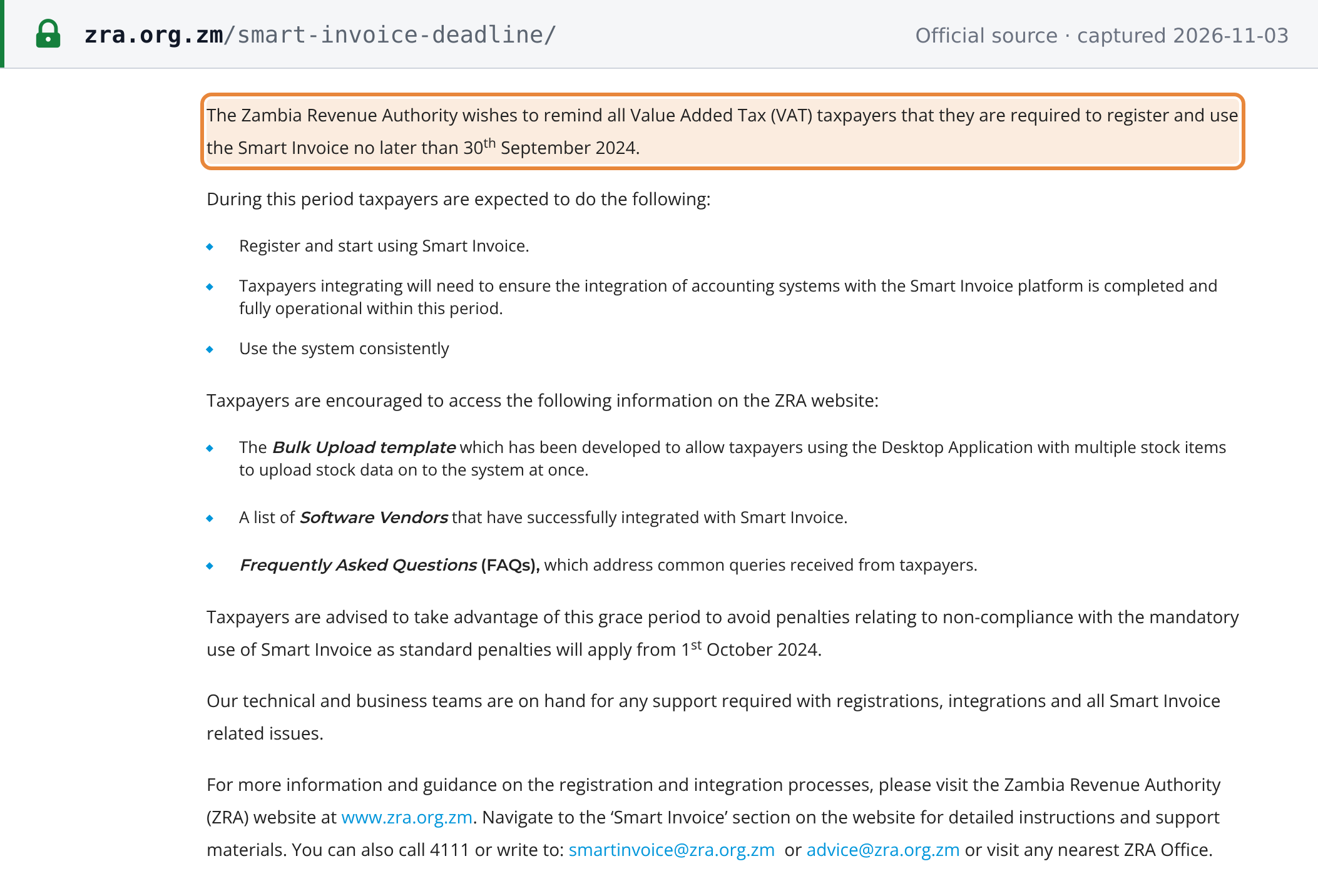
30 September 2024: the hard deadline. ZRA's notice of 25 September 2024 reminded "all Value Added Tax (VAT) taxpayers that they are required to register and use the Smart Invoice no later than 30th September 2024". Taxpayers integrating their accounting systems had to ensure the integration "is completed and fully operational within this period". ZRA called the period a "grace period" and warned that "standard penalties will apply from 1st October 2024". [6]
 Source snapshot captured 2026-11-03 — original
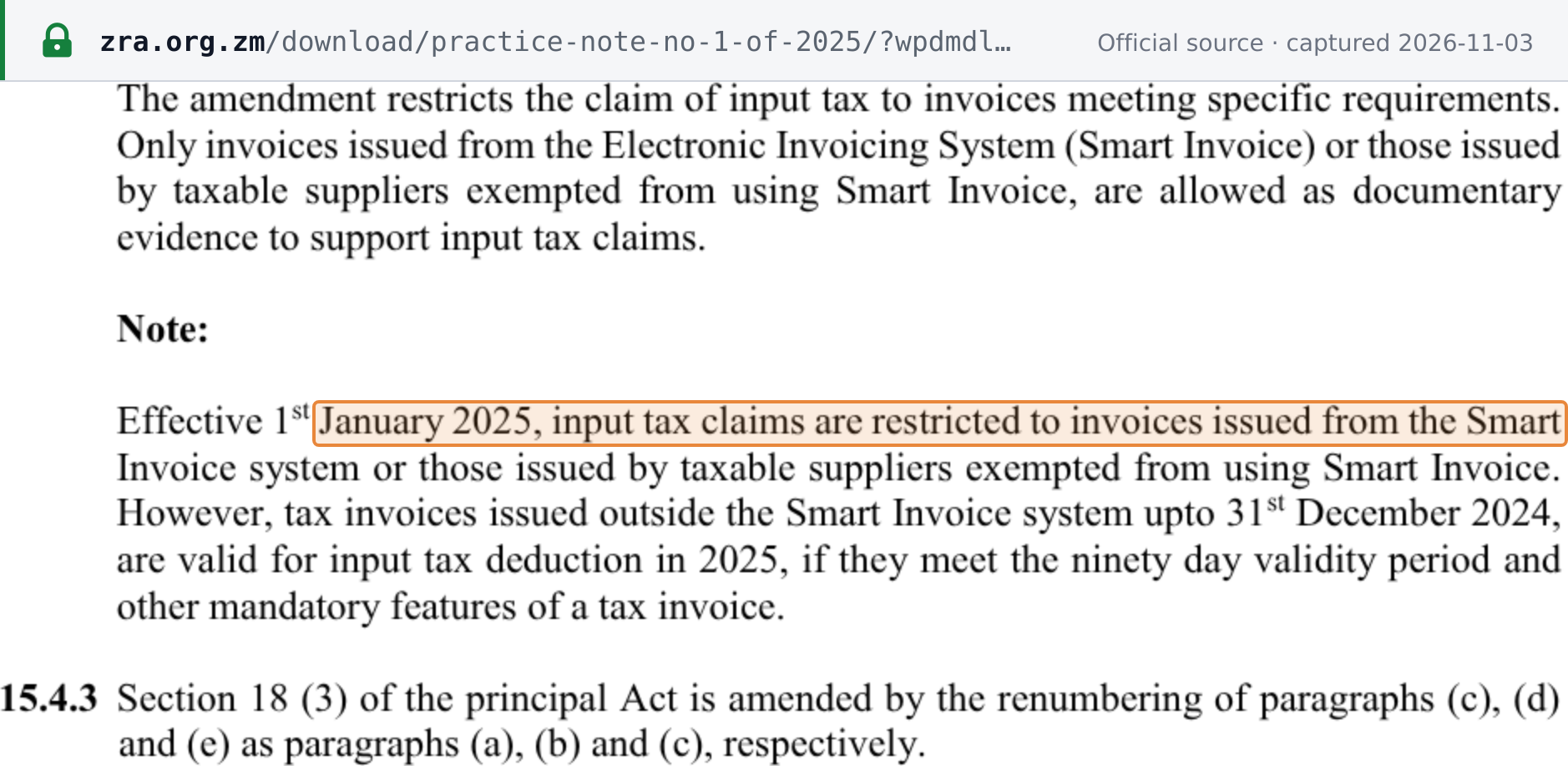
1 January 2025: input tax only on Smart Invoice invoices. The VAT (Amendment) Act No. 23 of 2024 rewrote section 18(3)(c) so that input tax rests on "an invoice issued from the electronic invoicing system or an invoice issued, as prescribed, by a taxable supplier who is exempt from the use of the electronic invoicing system under section 7A(2)". ZRA's Practice Note No. 1/2025: "Effective 1st January 2025, input tax claims are restricted to invoices issued from the Smart Invoice system or those issued by taxable suppliers exempted from using Smart Invoice. However, tax invoices issued outside the Smart Invoice system upto 31st December 2024, are valid for input tax deduction in 2025, if they meet the ninety day validity period and other mandatory features of a tax invoice." [3]
 Source snapshot captured 2026-11-03 — original
19 December 2025: income tax. The Income Tax (Electronic Invoicing System) Regulations, 2025 (SI No. 84 of 2025) "come into operation on 19th December 2025". Regulation 4(1): "A person or partnership carrying on a business shall issue an invoice using an electronic invoicing system to a customer for an amount paid or payable by that customer for every transaction,to record sales for income tax purposes." This reaches businesses that are not registered for VAT. [4]
Specification updates are not new phases. ZRA revised its VSDC API Specification on 2 September 2026 and again on 2 October 2026 (see Format & network). Those revisions change the integration contract for software, not who must use Smart Invoice or from when.
Legal basis
| Instrument | In force | What it does for e-invoicing | Text |
|---|---|---|---|
| Value Added Tax Act, Cap. 331, section 7A | — | s.7A(1): "A taxable supplier shall use an electronic invoicing system to record each sale or transaction"; s.7A(2): the Commissioner-General's power to approve another document, device or equipment; s.7A(3): penalties for contravening the section | As amended by the Acts below; s.7A(1) quoted in ZRA Practice Note 2/2024 |
| VAT (Amendment) Act, 2021 (Act No. 44 of 2021) | 1 Jan 2022 | s.7A(1) now requires recording of "each sale or transaction" (was "daily sales"); substitutes s.7A(3), the penalty for contravening s.7A | Government Printer PDF |
| VAT (Amendment) Act, 2023 (Act No. 27 of 2023) | 1 Jan 2024 | Defines "electronic invoicing system"; replaces the electronic fiscal device in s.7A; adds invoices issued from the approved invoicing system to the input-tax evidence (s.18(3)(c)) | Government Printer PDF; reproduced in PN 2/2024 §4 |
| VAT (Electronic Invoicing System) Regulations, 2023 (SI No. 58 of 2023) | 1 Jan 2024 | Regs 3 to 13: the Commissioner-General operates the EIS; every tax invoice through the EIS; buyer name, address and TPIN on B2B and B2G invoices; disruption and manual fallback; display of a notice; faults; deactivation; no transfer of a system; offences. Revokes the EFD Regulations, 2020 | Reproduced in PN 2/2024 §5 |
| VAT (Amendment) Act, 2024 (Act No. 23 of 2024) | 1 Jan 2025 | New s.7A(2): approval of an alternative "on prescribed conditions"; new s.18(3)(c): "an invoice issued from the electronic invoicing system" or an exempted supplier's invoice | Government Printer PDF; summarised in PN 1/2025 §4 and §15 |
| VAT (EIS) (Amendment) Regulations, 2024 (SI No. 94 of 2024) | 1 Jan 2025 | Manual transactions uploaded within 72 hours of the system being restored; input tax on exempted suppliers' invoices; deactivation within 30 days of discontinuing a system | Reproduced in PN 1/2025 §17 |
| Income Tax (EIS) Regulations, 2025 (SI No. 84 of 2025) | 19 Dec 2025 | EIS invoicing for every business to record sales for income tax; exemption by the Commissioner-General; integration of accounting software; offences | Reproduced in PN 1/2026 §24 |
| ZRA VSDC API Specification | Edition "updated 02-10-2026" | The integration contract for certified invoicing systems: endpoints, fields, codes | ZRA PDF |
How to read the Practice Notes. ZRA's Practice Notes reproduce the text of the regulations they explain, and that text is the law. ZRA's own commentary around it is not: "The commentary in this Practice Note is for general guidance only and is not to be taken as a legal authority in any proceedings" (PN 2/2024). [2]
The statutory design is real-time. The definition inserted by Act No. 27 of 2023: "“electronic invoicing system” means the core system and any other system which has a fiscal memory capable of generating and storing fiscal information and transmitting production, invoicing and stock data in real time to the Authority, and has the capacity to generate and record data and other reports and includes software applications and web based applications". [2]
Scope
Who. VAT side: every "taxable supplier" (VAT Act s.7A(1)). Income tax side, since 19 December 2025: every "person or partnership carrying on a business" (SI 84 of 2025 reg. 4). ZRA's FAQs: "There is no monetary threshold or turnover required to register for Smart Invoice. To be eligible, a business must be registered for any of the following; Value Added Tax (VAT), Turnover Tax (TOT), Insurance Premium Levy (IPL), Tourism Levy (TL), Excise (coal and electricity), Rental Tax or Income Tax." [2] [4] [1]
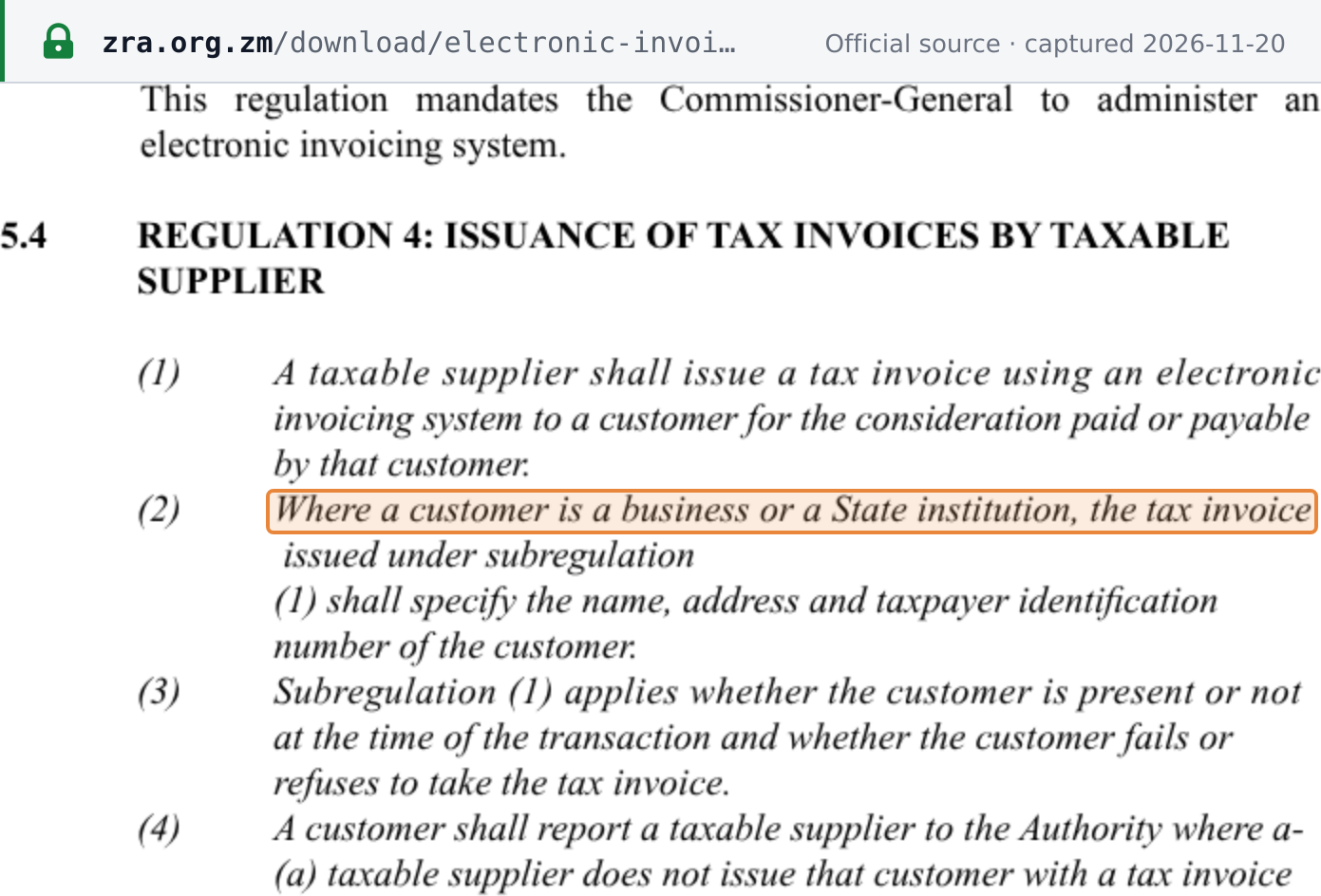
B2B, B2G and B2C together. There is no separate B2G system and no B2C carve-out. EIS Regulations reg. 4: "(1) A taxable supplier shall issue a tax invoice using an electronic invoicing system to a customer for the consideration paid or payable by that customer. (2) Where a customer is a business or a State institution, the tax invoice issued under subregulation (1) shall specify the name, address and taxpayer identification number of the customer. (3) Subregulation (1) applies whether the customer is present or not at the time of the transaction and whether the customer fails or refuses to take the tax invoice." The invoice may be delivered electronically or printed; ZRA's FAQs say "Printing of an invoice is optional." [2] [1]
 Source snapshot captured 2026-11-20 — original
Exemptions. The only route out is an approval by the Commissioner-General. Since 1 January 2025, VAT Act s.7A(2) (substituted by Act No. 23 of 2024) reads: "Despite subsection (1), the Commissioner-General may, on prescribed conditions, approve the use of a document, device or equipment, other than an electronic invoicing system, by a taxable supplier." [16] An exempted supplier invoices "manually or using a computer generated invoice", and its invoices still support the buyer's input tax (SI 94 of 2024). On the income tax side, the Commissioner-General may exempt a business and "shall issue a notice" to it (SI 84 of 2025 reg. 7). ZRA's Smart Invoice FAQs and Practice Notes 2/2024, 1/2025 and 1/2026 publish neither the "prescribed conditions" nor a list of exempted categories (as at 20 November 2026). [3] [4]
Non-established businesses. Not addressed. The VAT duty attaches to a "taxable supplier", and non-resident suppliers of cross-border electronic services register under a separate simplified regime (see the Zambia VAT guide). ZRA's Smart Invoice FAQs, Practice Notes 2/2024, 1/2025 and 1/2026 and the VSDC API Specification do not say whether those suppliers must issue through Smart Invoice (as at 20 November 2026).
Imported services. Reverse VAT on imported services is accounted for by the Zambian recipient. The VSDC API Specification's tax-category table carries a code for it: "RVAT Reverse VAT Applies to transactions involving imported services. (For both Appointed Tax Agent and Self-invoicing)." [7]
Exports. Export sales go through Smart Invoice: it "has a feature that supports export sales transactions for purposes of zerorating Value Added Tax (VAT) for VAT registered suppliers" (FAQs). The specification adds a commercial invoice, "Required for mining sector": "For all export of goods and incidental services (e.g. Transport and Insurance), suppliers will be required to issue a commercial invoice using Smart Invoice." [1] [7]
Simplified invoices. Not applicable as a value threshold: neither the EIS Regulations nor ZRA's Smart Invoice FAQs set an amount below which an invoice may be issued outside Smart Invoice. A B2C invoice simply omits the buyer's TPIN, which reg. 4(2) requires only for business and State customers. [2]
Format & network
The model: real-time reporting with a fiscal signature. ZRA: "the Zambia Revenue Authority (ZRA) has implemented Smart Invoice, which transmits invoice data to ZRA in real-time. Each invoice transaction has a special mark called a fiscal signature to authenticate the invoice." And: "Each invoice generated by the Smart Invoice has a Quick Response (QR) code enabling Taxpayers to verify the authenticity of the invoice using a mobile application." When a sale is posted, the VSDC returns the ZRA receipt number (rcptNo), internal data (intrlData), the receipt signature (rcptSign), the SDC ID, the MRC number and a qrCodeUrl. "All sales receipts must be printed with the ‘rcptNo’ which is returned in success response when sale is posted to VSDC. This is the ZRA invoice number which must be referred to when taxpayer intends to issue a credit note or debit note." [1] [7]
ZRA does not use the words "clearance" or "reporting". Classifying Smart Invoice as real-time reporting is our reading of these sources: the invoice is signed and recorded as it is issued, and none of ZRA's documents describes a step in which ZRA approves or rejects an invoice before the buyer receives it. There is no exchange network between buyer and seller. See CTC e-invoicing models and, for the hardware it replaced, fiscal devices.
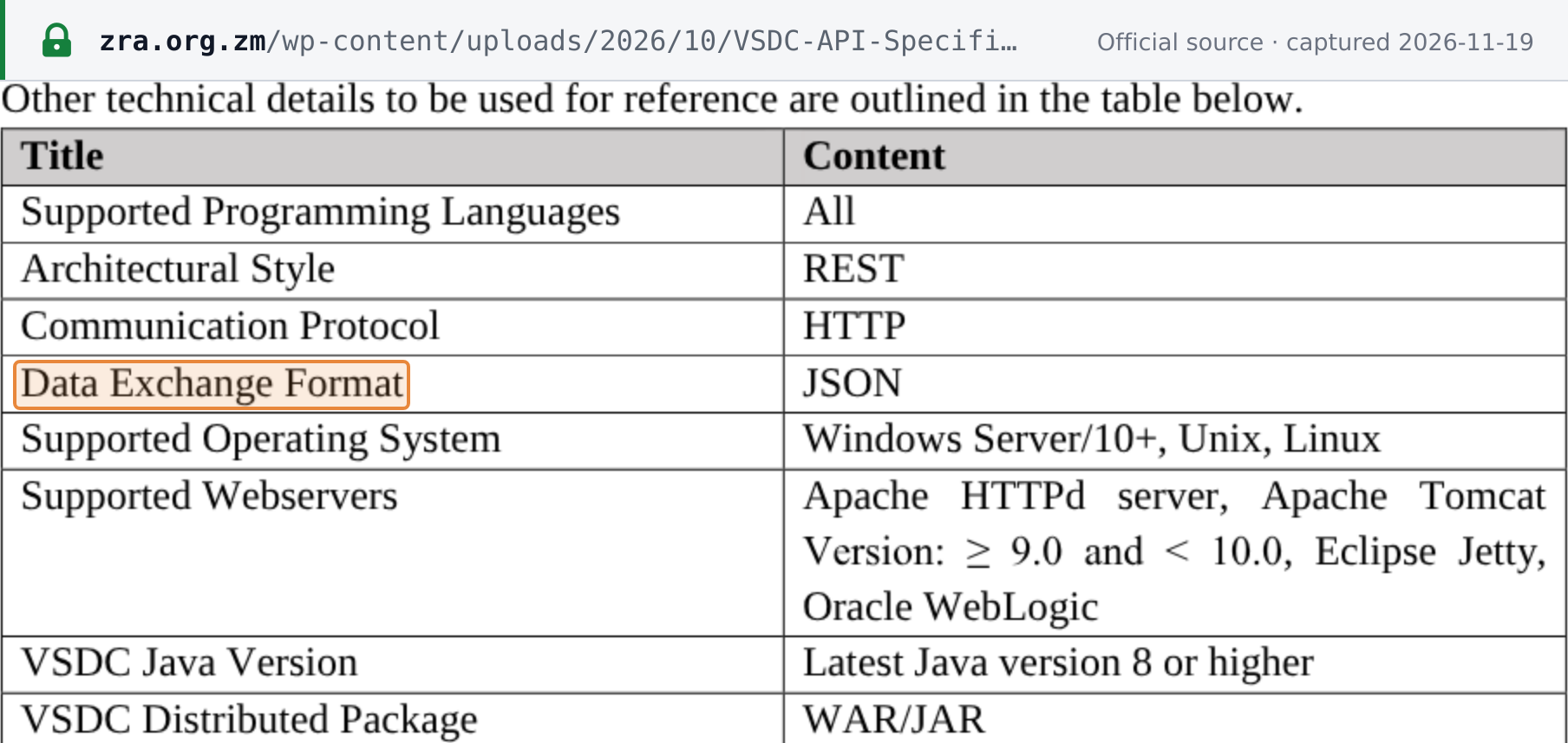
The format: JSON over a REST API, through the VSDC. Certified Invoicing Systems connect through the Virtual Sales Data Controller (VSDC), "a bridge between the Certified Invoicing System (CIS) and the ZRA Smart Invoice System" (ZRA Learn More page). ZRA issues the VSDC to the taxpayer as a Java WAR/JAR file that runs on the taxpayer's own server. The specification's technical table: supported programming languages "All", architectural style "REST", communication protocol "HTTP", data exchange format "JSON", operating systems "Windows Server/10+, Unix, Linux", Java "8 or higher", package "WAR/JAR", base URL "http://<hostname>:<server.port>/<vsdcpath>". Two environments, Test and Production; a system goes live after it passes user acceptance testing against the test VSDC. [9] [7]
 Source snapshot captured 2026-11-19 — original
No UBL, CII or Peppol. The 201-page VSDC API Specification defines its own JSON messages; it names no XML standard and no Peppol profile (as at 20 November 2026).
What the API carries. Eight service groups: device initialisation, code data, branch information, item information, import information, sales information (POST /trnsSales/saveSales, marked "MANDATORY"), purchase information and stock information. The purchase methods "are used to fetch purchases made by a taxpayer from another Smart invoice user from Smart Invoice, and to transmit purchase information from a non-Smart Invoice user, from a CIS to Smart Invoice." When buyer and seller both use Smart Invoice, stock moves between them automatically (FAQs). [7] [1]
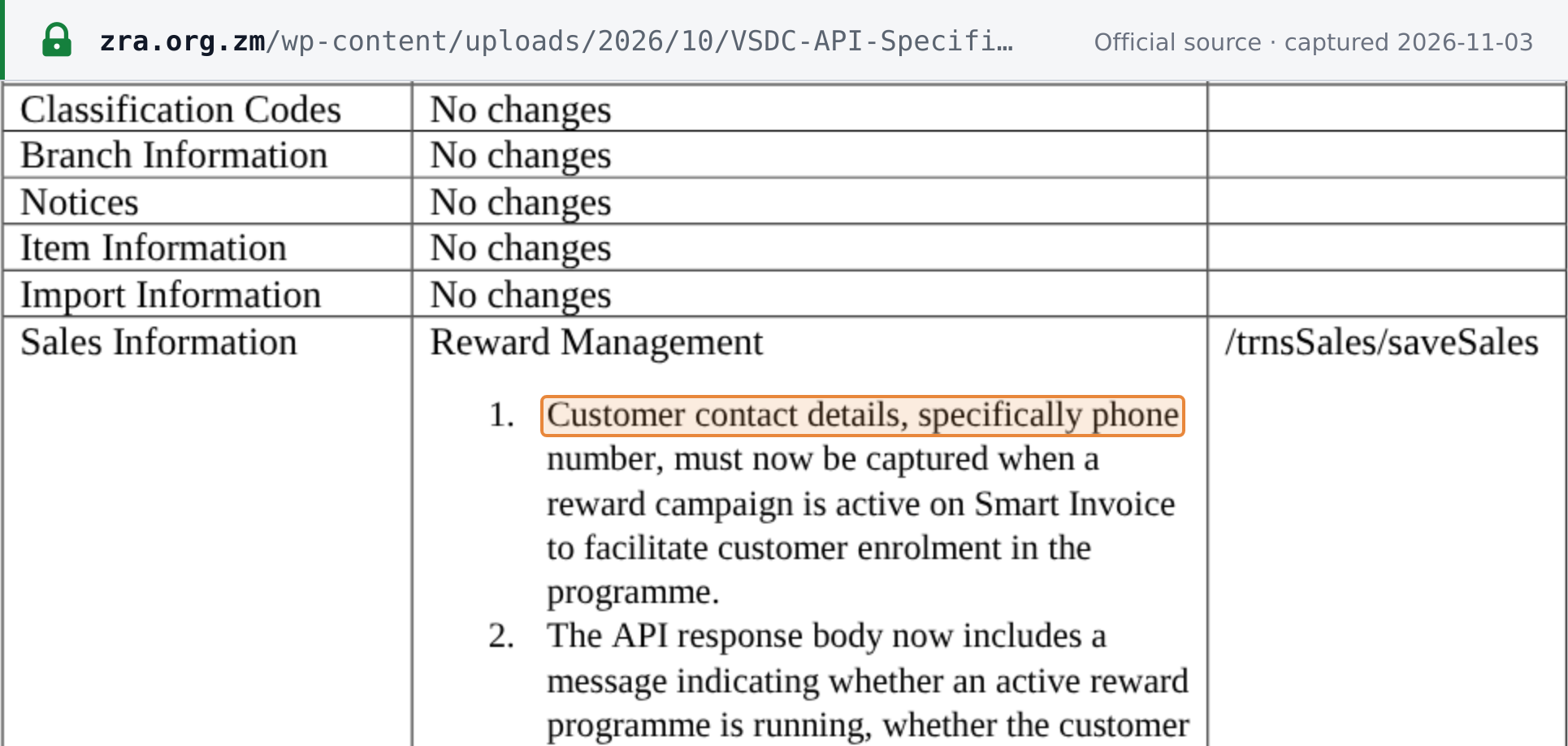
Versions are dated, not numbered. "The API version is determined by the release date of a new version. Taxpayers will receive notifications regarding the latest additions and modifications to the API version through the publication of the new specifications document on the ZRA website." The current edition is "updated 02-10-2026". Its revision table, for the Sales Information service: "Customer contact details, specifically phone number, must now be captured when a reward campaign is active on Smart Invoice to facilitate customer enrolment in the programme." The field is custMblNo ("Phone number for the customer participating in a reward"), VARCHAR, optional, length 10. The edition of 2 September 2026 asked for "phone number and email address" and gave custMblNo a length of 20; the October edition replaced both. [7] [8]
 Source snapshot captured 2026-11-03 — original
Offline and outages. The regulation sets the binding rule. Where use of the EIS "is disrupted for a continuous period of twenty-four hours", the supplier notifies the Commissioner-General (reg. 5(2)), and since 1 January 2025 "all transactions recorded manually are uploaded to the electronic invoice system within seventy-two hours of the system being restored" (reg. 5(3), substituted by SI 94 of 2024). ZRA's commentary says this covers transactions recorded "using the systems offline mode or completely off the system". ZRA's FAQs give shorter practical guidance: "Invoices issued offline must still be uploaded to the system within 3 days of issuance". The online portal needs a continuous internet connection. [2] [3] [1]
E-reporting alongside. None separate. ZRA lists the "ability to pre-fill tax returns" among Smart Invoice's benefits; VAT returns are still filed monthly (see the Zambia VAT guide). [1]
Onboarding: how to comply
Pick a channel. ZRA offers four (Learn More page): [9]
| Channel | Suits (ZRA's words) | Notes |
|---|---|---|
| Desktop and Tablet application | "suitable for all taxpayers except those with accounting packages" | Windows 10 or higher; free |
| Mobile application | "suitable for taxpayers on Turnover Tax only and not those registered for Value Added Tax (VAT)" | Android 8 or higher; free. The FAQs say Turnover Tax and Rental Tax |
| Online Smart Invoice | "taxpayers in the service industry who issue few invoices" | Web portal; free; needs a continuous connection |
| Certified Invoicing System | "taxpayers with Accounting Packages or Enterprise Resource Planning Systems" | ERP, accounting or POS software integrated through the VSDC; integration costs fall on the taxpayer |
ZRA's FAQs: "ZRA offers Mobile Applications, Desktop Applications and Online Invoicing packages to taxpayers for free. However, taxpayers using accounting packages that require integration with Smart Invoice will be responsible for the associated integration costs." Packages approved under the old regime must integrate too: "Taxpayers using Accounting packages and ERPs previously approved for invoicing are required to integrate their systems with Smart Invoice to meet the legal requirements to use Smart Invoice." Integration can be done in-house or through a vendor. [1]
Register on the taxpayer portal. ZRA's Registration Guide, in order: sign up on the Smart Invoice Taxpayer Portal; log in; click "Apply"; "Choose Smart Invoice Type. (Desktop Client, Online, Mobile or VSDC)"; download, complete and attach the Commitment Form; send; once approved, open Device management from the profile icon and download the installer "on the device that was registered". [10]
The Commitment Form (v1.3) also commits the taxpayer to return any Electronic Fiscal Device "to ZRA, within 5 working days from the date of installation of the Smart Invoice software". Its integration section offers two integration types, the Virtual Sales Data Controller (VSDC) and an "Online Sales Data Controller (OSDC)"; no other ZRA document describes the OSDC (as at 20 November 2026). [12]
Integrate through the VSDC (sandbox first). The specification: "To access the VSDC API, users are required to register on the Smart Invoice Taxpayer Portal initially. Subsequently, they must apply for a VSDC service, undergo technical and administrative verification, and await approval." The VSDC WAR/JAR is then downloaded under Device Management and deployed on the taxpayer's server. "Signup and registration take place in both the test and production environments." On the sandbox portal, sign-up is confirmed by a one-time password "sent to the registered taxpayer phone number", and ZRA's approval or rejection of the VSDC request arrives by SMS. ZRA also publishes a developer self-checklist, the UNSPSC item classification codes and a bulk item upload template. [7] [11]
Accredited software vendors. ZRA publishes a "LIST OF ZRA ACCREDITED SOFTWARE VENDORS AND SYSTEMS", updated in place. The edition "AS AT 19TH NOVEMBER, 2026" lists 61 vendors and 92 approved invoicing systems, each tied to a named system and version number. An "Approved Invoicing System" is one that has "met the integration requirements of the Smart Invoice and have been approved by ZRA" (FAQs). ZRA publishes nothing on how long an approval lasts, how it is renewed or what happens if it is withdrawn (as at 20 November 2026). [13] [1]
One installation per TPIN per device. ZRA's FAQs: "the ZRA Desktop, Tablet, Personal Digital Assistants solutions and mobile App can only have one installation of one TPIN per device." [1]
Help. smartinvoice@zra.org.zm, advice@zra.org.zm, or ZRA's call centre on 4111. [6]
Penalties
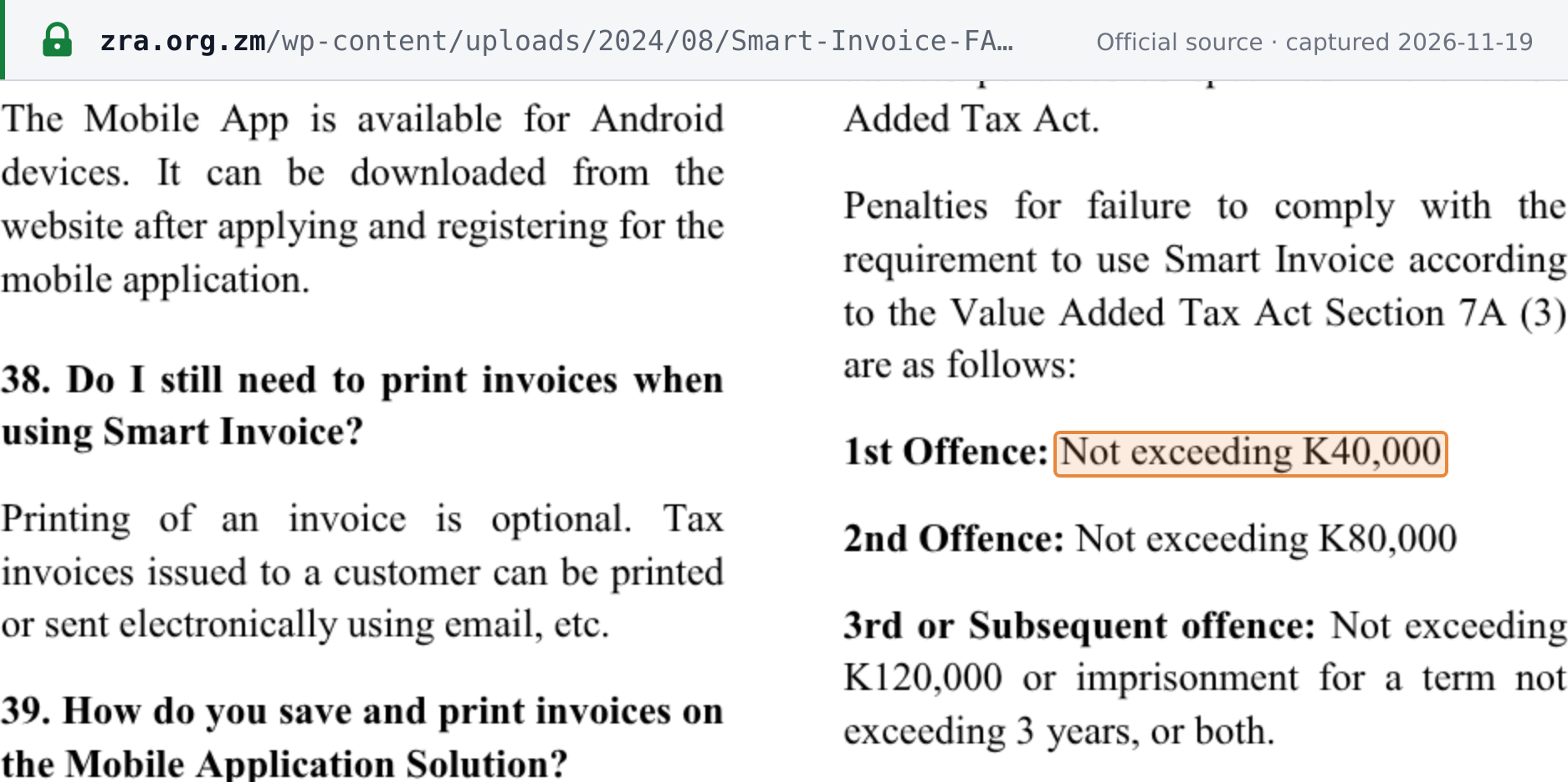
Not using Smart Invoice. VAT Act s.7A(3), as substituted by the VAT (Amendment) Act No. 44 of 2021 (in force 1 January 2022): "A taxable supplier that contravenes this section commits an offence and is liable, on conviction, in the case of a— (a) first offence, to a penalty not exceeding one hundred thousand penalty units; (b) second offence, to a penalty not exceeding two hundred thousand penalty units; and (c) third or subsequent offence, to a penalty not exceeding three hundred thousand penalty units, or to imprisonment for a term not exceeding three years, or to both." At K0.40 a penalty unit, that is K40,000, K80,000 and K120,000, the amounts ZRA's Smart Invoice FAQs give. [15] [2] [1]
 Source snapshot captured 2026-11-19 — original
Offences under the regulations. Fines are set in penalty units; ZRA's Practice Note No. 2/2024 states "A penalty Unit is K0.40". [2] [3] [4]
| Offence | Maximum | Instrument |
|---|---|---|
| VAT: modifying an approved invoicing system without authorisation, entering false data, or tampering with recorded data | 1st offence 100,000 penalty units; 2nd 200,000; 3rd or subsequent 300,000, or up to 3 years' imprisonment, or both | VAT EIS Regulations reg. 12 (SI 58 of 2023) |
| VAT: not displaying the EIS notice | 30,000 penalty units | reg. 7 |
| VAT: not asking for deactivation within 30 days of stopping use of an approved invoicing system | 30,000 penalty units | reg. 10, as substituted by SI 94 of 2024 |
| Income tax: the same tampering offences | 1st offence 30,000 penalty units; 2nd 60,000; 3rd or subsequent 90,000, or up to 3 years' imprisonment, or both | Income Tax EIS Regulations reg. 13 (SI 84 of 2025) |
Input tax. Since 1 January 2025 a buyer cannot deduct VAT on an invoice that was not issued from Smart Invoice, unless the supplier holds a Commissioner-General exemption (see timeline). [3]
Enforcement. ZRA reported on 10 August 2026 that a Lusaka trader pleaded guilty on 7 August 2026 to two charges, failing to use an electronic invoicing system to record sales and failing to issue a tax invoice through an approved system, and was fined "K125,000.00, to be paid forthwith; in default to 3 months simple imprisonment". The case followed what ZRA described as "various operations within Lusaka". [14]
Frequently asked questions
Our supplier's invoice was not issued through Smart Invoice. Can we claim the input VAT?
No, for invoices issued from 1 January 2025. Input tax is claimable only on an invoice issued from Smart Invoice or by a supplier the Commissioner-General has exempted. Non-Smart Invoice invoices issued up to 31 December 2024 stayed claimable in 2025 within the 90-day validity period. A Smart Invoice invoice carries a ZRA receipt number and a QR code, and integrated systems can fetch purchases made from other Smart Invoice users through the VSDC API. [3] [7]
We run SAP, Sage or Odoo. Do we have to change systems?
No, but the system must be integrated with Smart Invoice through the VSDC, either in-house or through a vendor. Accounting packages and ERPs approved under the old regime must also integrate. ZRA's accredited vendor list (as at 19 November 2026) names 61 vendors and 92 approved invoicing systems by version. [1] [13]
We invoiced offline. Do we have 3 days or 72 hours to upload?
The regulation requires manually recorded transactions to be uploaded within 72 hours of the system being restored (EIS Regulations reg. 5(3), from 1 January 2025), and ZRA says this covers the offline mode too. ZRA's FAQs give shorter practical guidance: upload offline invoices within 3 days of issuance. A disruption lasting 24 continuous hours must be notified to the Commissioner-General. [3] [1] [2]
Can a VAT-registered business use the Smart Invoice mobile app?
No. ZRA's Learn More page says the mobile app is suitable for taxpayers on Turnover Tax only and not those registered for VAT. VAT-registered businesses use the desktop or tablet application, the online portal or a certified invoicing system. [9]
Our integrator says the VSDC specification changed. What changed?
The edition updated 2 October 2026 requires the customer's phone number, in the field custMblNo with a length of 10, when a reward campaign is active, and the response now reports reward status. The 2 September 2026 edition had asked for phone number and email address with a field length of 20. ZRA identifies versions by release date, not by number. [7] [8]
We are not registered for VAT. Do we need Smart Invoice?
Yes, unless exempted. Since 19 December 2025 the Income Tax (Electronic Invoicing System) Regulations require every person or partnership carrying on a business to issue invoices through the electronic invoicing system to record sales for income tax, unless the Commissioner-General exempts the business by notice. [4]
What is the penalty for not using Smart Invoice?
Under VAT Act section 7A(3), as substituted by the VAT (Amendment) Act No. 44 of 2021: up to 100,000 penalty units (K40,000) for a first offence, 200,000 (K80,000) for a second, and 300,000 (K120,000) or up to 3 years' imprisonment, or both, for a third or subsequent offence. Buyers also lose input VAT on invoices not issued through Smart Invoice. [15] [1]
Recent changes
- 2026-10-02 — ZRA's VSDC API Specification "updated 02-10-2026": during an active reward campaign only the customer's phone number is captured (
custMblNo, length 10); the email address requirement of the September edition is dropped. (ZRA) - 2026-09-02 — ZRA's VSDC API Specification "updated 02-09-2026": customer contact details must be captured on sales when a reward campaign is active, and the response reports reward status. (ZRA) — see event
- 2026-08-07 — Smart Invoice conviction reported by ZRA: a Lusaka trader fined K125,000 on two charges of not using the electronic invoicing system. (ZRA)
- 2025-12-19 — Income Tax (Electronic Invoicing System) Regulations, 2025 (SI No. 84 of 2025) in force: every business invoices through the EIS to record sales for income tax. (ZRA Practice Note No. 1/2026)
- 2025-01-01 — Input tax restricted to invoices issued from Smart Invoice or by exempted suppliers (VAT (Amendment) Act No. 23 of 2024; SI No. 94 of 2024). (ZRA Practice Note No. 1/2025)
Related resources
- Zambia VAT guide — rates, registration, invoice requirements, filing
- E-invoicing status and networks by country
- CTC e-invoicing models explained
- Fiscal devices and certified cash registers
- Neighbouring systems: Malawi EIS, Kenya eTIMS, Rwanda EBM, Botswana
- Zambia tax changes on Lookuptax
Important websites
- Smart Invoice Taxpayer Portal and sandbox portal
- Smart Invoice: Learn More and Registration Guide
- Smart Invoice Commitment Form v1.3 (PDF)
- VSDC API Specification, updated 02-10-2026 (PDF) and VSDC service sign-up guide (PDF)
- Approved software vendor list
- Support: smartinvoice@zra.org.zm, call centre 4111
Reference links
- ZRA — Smart Invoice FAQs (PDF)
- ZRA — Practice Note No. 2/2024, The Value Added Tax – Electronic Invoicing System (PDF)
- ZRA — Practice Note No. 1/2025 (PDF)
- ZRA — Practice Note No. 1/2026 (PDF)
- ZRA — Smart Invoice electronic invoicing update for VAT registered taxpayers, 24 January 2024
- ZRA — Smart Invoice Deadline, 25 September 2024
- ZRA — VSDC API Specification, updated 02-10-2026 (PDF)
- ZRA — VSDC API Specification, updated 02-09-2026 (PDF)
- ZRA — Smart Invoice Learn More
- ZRA — Smart Invoice Registration Guide
- ZRA — VSDC Service Request, step-by-step guide (PDF)
- ZRA — Smart Invoice Commitment Form v1.3 (PDF)
- ZRA — List of accredited software vendors and systems
- ZRA — Mobile Monster convicted for non-usage of Smart Invoice, 10 August 2026
- Value Added Tax (Amendment) Act No. 44 of 2021 — Government Printer publication (PDF)
- Value Added Tax (Amendment) Act No. 23 of 2024 — Government Printer publication (PDF)