E-invoicing in Mauritania: invoice declaration on STT
Overview
Mauritania does not have an XML e-invoicing system. What applies since 1 November 2026 is a business-to-government (B2G) invoice declaration rule: a supplier of a public entity must first declare its invoice on STT, the tax administration's e-filing and e-payment platform, and the public entity must validate it there before it can pay. An invoice that has not been declared and validated on STT cannot be paid by a public entity. [1]
STT stands for Système de Télédéclaration et de Télépaiement. The Ministry of Finance (Ministère des Finances) put it in place through the Direction Générale des Impôts (DGI), and it runs at stt.e-tax.impots.gov.mr. The invoice functions are new features of that platform. [1] [4]
Legal basis in one line. A circular of the Minister of Finance dated Nouakchott, 29 September 2026, Généralisation de la télédéclaration, du télépaiement et de la déclaration des factures sur la plateforme STT. It is an administrative instruction to public entities, not a law or decree, and it binds suppliers through the payment block. A statutory version is only proposed, in the draft 2027 finance law (not adopted as of 2026-11-03). [1] [2]
| Mauritania | |
|---|---|
| System | Invoice declaration on STT (Système de Télédéclaration et de Télépaiement), run by the DGI |
| Model | Post-issuance declaration of the invoice's data on the tax portal, validated by the public-entity buyer before payment. Not clearance, not Peppol, not a fiscal device |
| B2G | In effect since 1 November 2026: suppliers of public entities declare their invoices on STT; the entity validates them; no payment without declaration and validation. Public entities that invoice also declare the invoices they issue |
| B2B | Not in scope (checked 2026-11-03). The draft 2027 finance law proposes an extension by ministerial arrêté, with no dates |
| B2C | Not in scope (checked 2026-11-03) |
| Non-residents | Not addressed by the circular |
| Format | Web form on STT (invoice lines, VAT, totals), optional attachment of the original invoice as PDF or image. No XML schema published |
| Integrity | Buyer validation on STT. No QR code, hash or cryptographic stamp in any official source found |
| Authority | Ministère des Finances, through the Direction Générale des Impôts |
| Legislation | Ministry of Finance circular of 29 September 2026 (in effect 1 November 2026). Proposed: LPF art. L.21 §3 in the draft 2027 finance law |
The standard VAT (TVA) rate is 16%, with 18% for telephony and 0% for exports by a taxable person (Code général des impôts, art. 230, DGI consolidation to the 2020 finance law; checked 2026-11-03). [3]
Mandate status & timeline
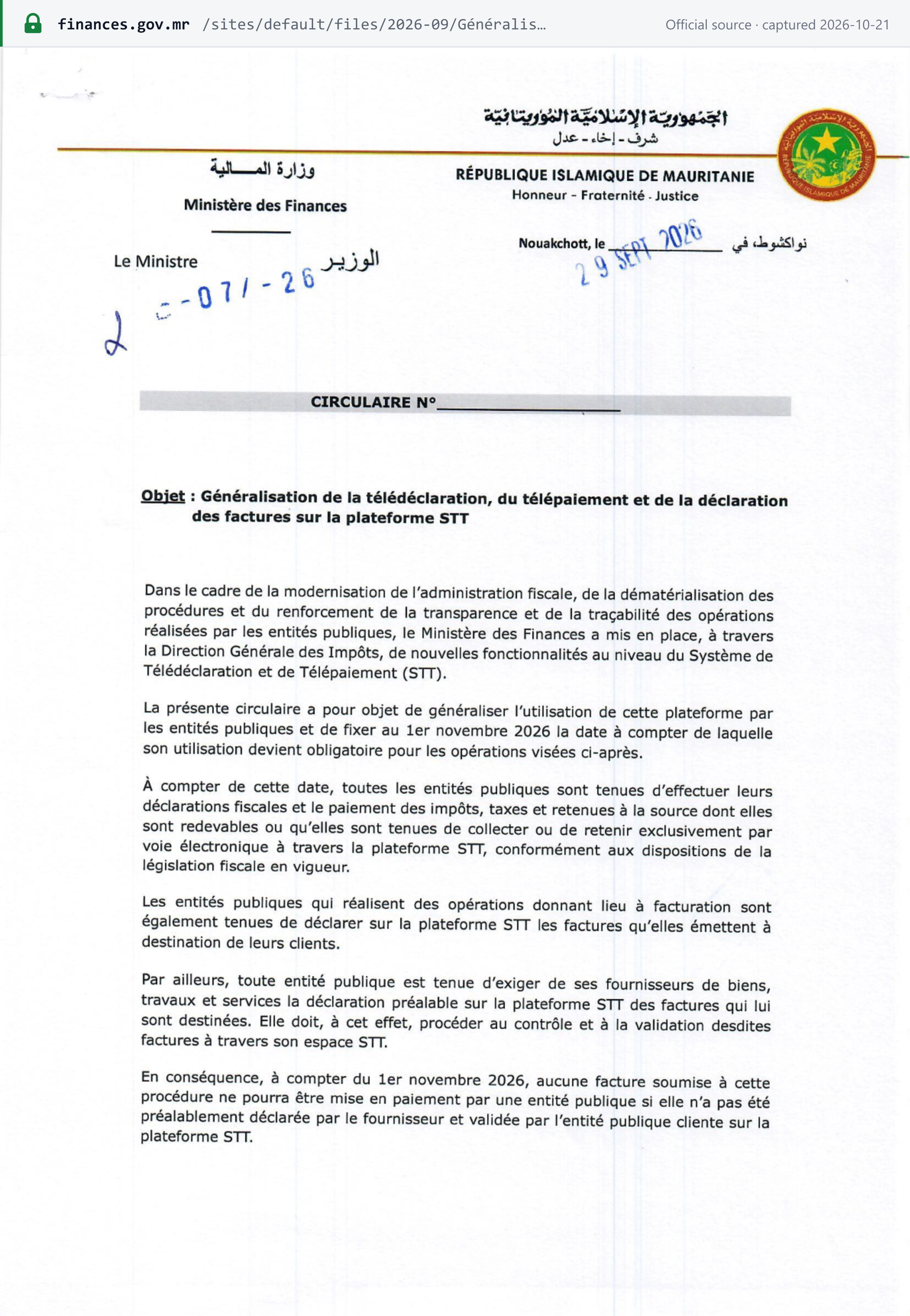
Status: in effect for public entities and their suppliers since 1 November 2026, under a ministerial circular. The circular "a pour objet de généraliser l'utilisation de cette plateforme par les entités publiques et de fixer au 1er novembre 2026 la date à compter de laquelle son utilisation devient obligatoire". From that date: [1]
- public entities file their tax returns and pay the taxes, duties and withholdings they owe or collect exclusively through STT;
- public entities that carry out operations giving rise to invoicing declare on STT the invoices they issue to their customers;
- every public entity requires its suppliers of goods, works and services to declare on STT, beforehand, the invoices addressed to it, and checks and validates them in its own STT space;
- "aucune facture soumise à cette procédure ne pourra être mise en paiement par une entité publique si elle n'a pas été préalablement déclarée par le fournisseur et validée par l'entité publique cliente sur la plateforme STT."
| Date | What applies | Who | Instrument | Status |
|---|---|---|---|---|
| 29 September 2026 | Circular signed by the Minister of Finance, fixing the 1 November 2026 start | Public entities | Ministry of Finance circular | Issued |
| October 2026 | DGI training and support sessions on STT e-filing, e-payment and electronic invoice management | Public entities concerned | Circular, p.2 | Passed |
| 1 November 2026 | Exclusive e-filing and e-payment on STT; declaration of invoices issued by public entities; supplier declaration and entity validation before payment | Public entities and their suppliers of goods, works and services | Circular | In effect (hard start) |
| Not set | Statutory declaration obligation for taxpayers designated by arrêté, then "progressively extended" to other taxpayers; 10% fine | Taxpayers named by a future arrêté | Draft 2027 finance law, proposed LPF art. L.21 §3 | Proposed (bill, not adopted as of 2026-11-03) |
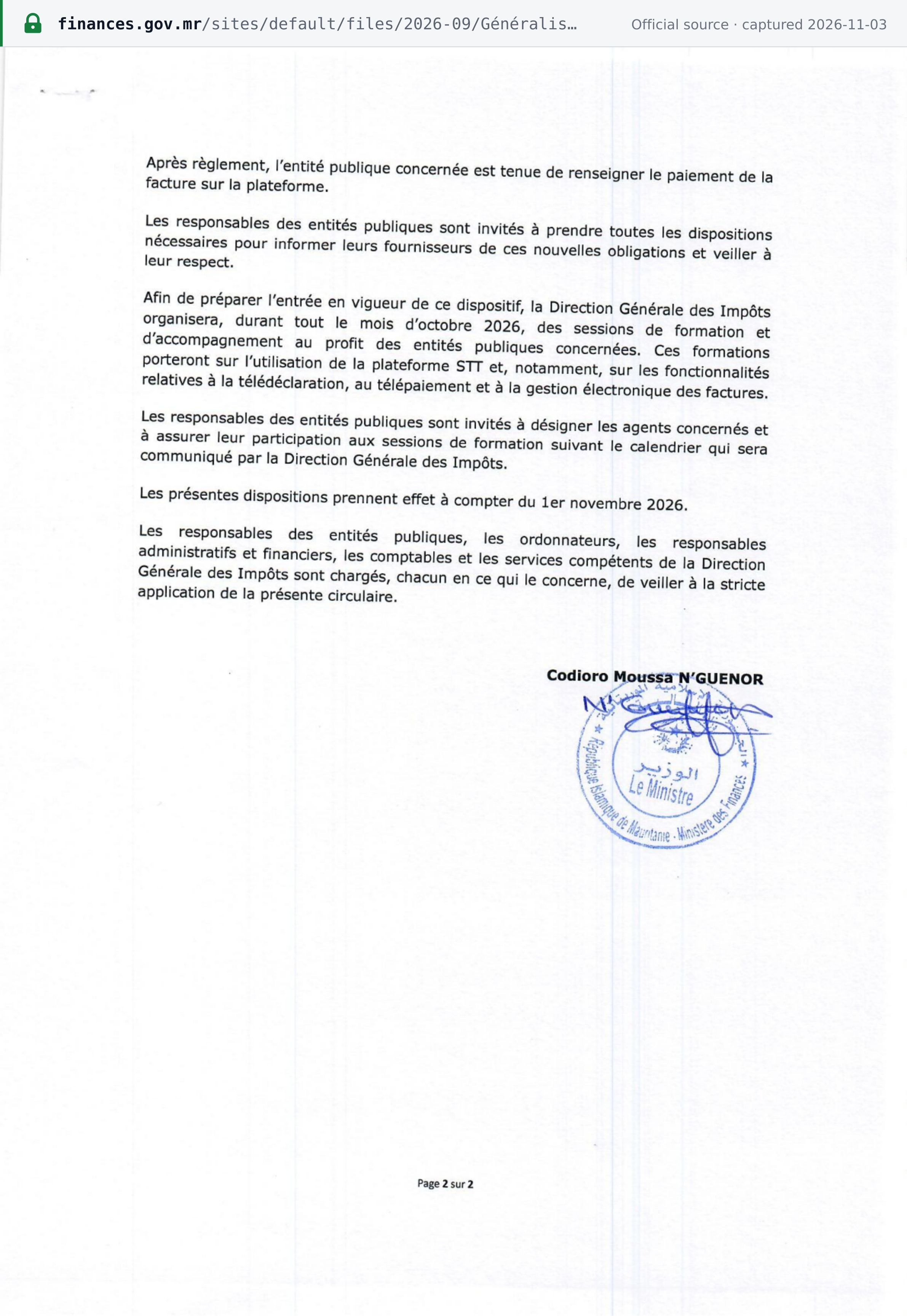
No pilot, voluntary phase or postponement. The circular sets a single start date. The October 2026 training was preparation, not a phase: "la Direction Générale des Impôts organisera, durant tout le mois d'octobre 2026, des sessions de formation et d'accompagnement au profit des entités publiques concernées", following a calendar the DGI was to communicate. The circular closes: "Les présentes dispositions prennent effet à compter du 1er novembre 2026." [1]
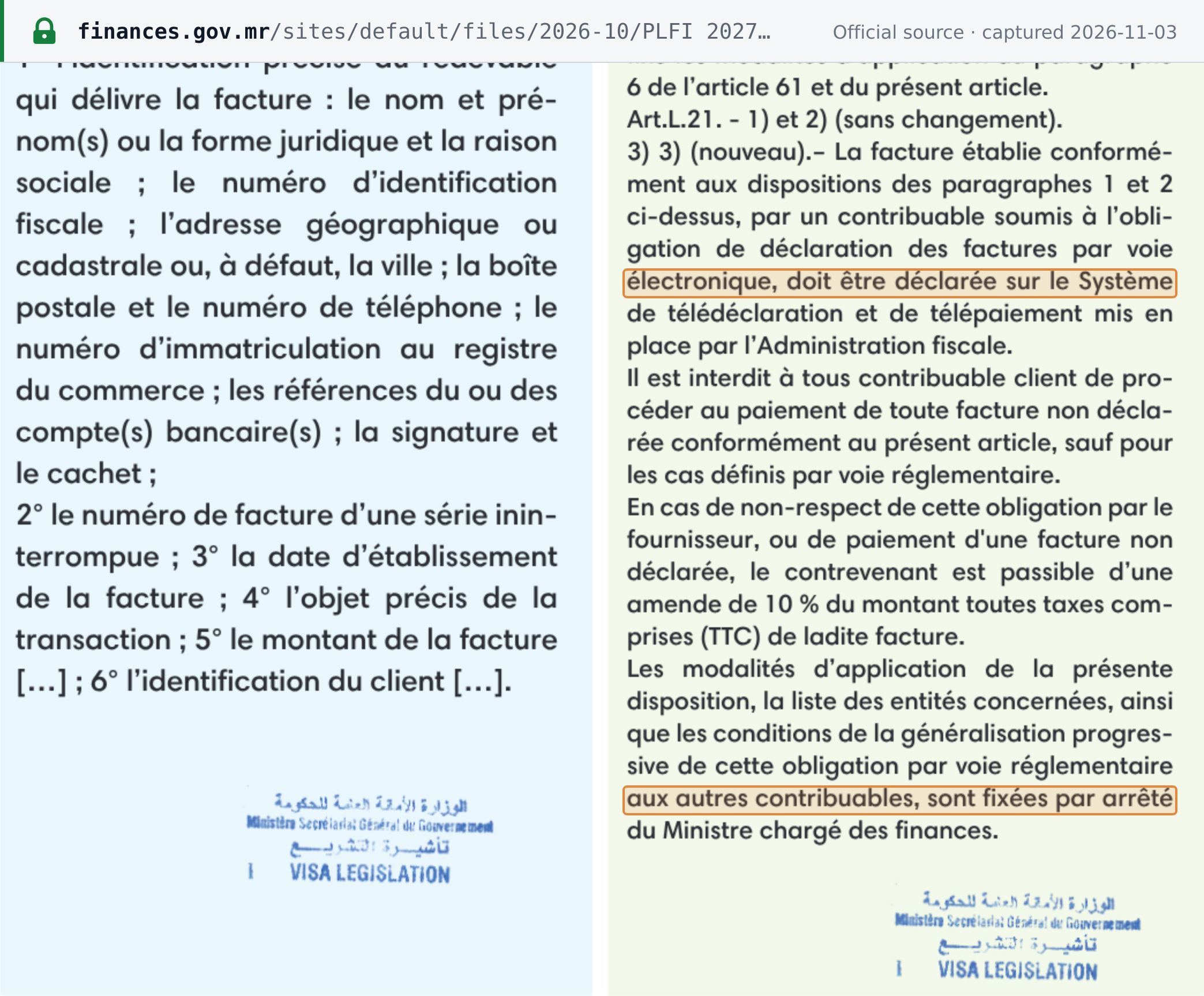
Announced: a statutory obligation for other taxpayers (draft bill only). The Projet de loi de finances pour l'année 2027, dated October 2026 and posted by the Ministry of Finance on 28 October 2026, proposes a new paragraph 3 in article L.21 of the Livre des procédures fiscales (LPF). Invoices issued by a taxpayer "soumis à l'obligation de déclaration des factures par voie électronique" would have to be declared on STT, and clients would be barred from paying an undeclared invoice, except in cases set by regulation. The list of entities concerned and the conditions for progressively extending the obligation to other taxpayers would be set by arrêté of the Minister of Finance. The bill's explanatory statement says the obligation would apply first to taxpayers designated by arrêté and "sera progressivement étendue aux autres contribuables". The bill gives no dates or waves, and no arrêté exists yet. It had not been adopted as of 2026-11-03. [2]
Postponements
None. The 1 November 2026 date has not been moved by any later instrument found (checked 2026-11-03).
Legal basis
| Instrument | Date | Status | What it does for invoice declaration |
|---|---|---|---|
| Circular of the Minister of Finance, Généralisation de la télédéclaration, du télépaiement et de la déclaration des factures sur la plateforme STT (listing) | Signed 29 September 2026; posted 30 September 2026 | In effect from 1 November 2026 | The only operative instrument: exclusive e-filing and e-payment for public entities, declaration of invoices on STT, validation by the public entity, no payment without both |
| Code général des impôts, loi n° 2019-018 du 29 avril 2019 (DGI consolidation to the 2020 finance law) | 29 April 2019 | In force | LPF art. L.21: the duty to issue an invoice and its mandatory mentions (as amended by the 2021 supplementary finance law). LPF art. L.3 §3: e-filing under conditions set by arrêté |
| Projet de loi de finances pour l'année 2027 (listing) | October 2026; posted 28 October 2026 | Bill, not adopted (as of 2026-11-03) | Proposes LPF art. L.21 §3 (statutory declaration on STT, payment ban, 10% fine, scope by arrêté), L.1 §3 (electronic documents have the same legal value as paper) and L.143 3° (criminal penalties for STT invoice fraud) |
The printed number field is blank; a handwritten reference ending "071-26" appears beside the Minister's title, and the circular is sometimes cited by that number. It does not cite a specific article; it refers to "dispositions de la législation fiscale en vigueur" for e-filing and e-payment. No arrêté, decree or Journal Officiel text on STT invoice declaration was found (checked 2026-11-03). [1]
The invoice itself is still governed by LPF art. L.21. Industrials, traders and service providers, and public establishments with industrial or commercial activities, "sont tenus de délivrer une facture à leur client, quel que soit leur régime d'imposition". The mandatory mentions include the NIF (tax identification number), an invoice number from an uninterrupted series, and the VAT rate and amount. Article L.21 as in force does not mention electronic invoices or STT. [3] [2]
Technical standards. None of these instruments names an XML schema, UBL, CII, EN 16931 or Peppol. [1] [2]
Scope
B2G, inbound (supplier to public entity). In scope since 1 November 2026. Every supplier of goods, works and services to a public entity must declare the invoice on STT first; the entity checks and validates it in its STT space before paying. [1]
B2G, outbound (public entity to its customers). Public entities that carry out operations giving rise to invoicing must declare on STT the invoices they issue to their customers. [1]
What counts as a public entity is not defined. The circular does not say whether "entités publiques" covers State administrations only, or also public establishments, state-owned companies and local authorities. Nor does it define "facture soumise à cette procédure": it sets no value threshold and lists no excluded categories. No DGI guidance defining either was found (checked 2026-11-03). Confirm with the buying entity or the DGI.
B2B and B2C. Not in scope. No official source imposes STT invoice declaration on business-to-business or business-to-consumer invoices (checked 2026-11-03). The draft 2027 finance law would allow an extension by arrêté, first to designated taxpayers and then progressively to others, but that is a proposal with no dates. As of 2026-11-03, the invoice form on STT rejects a buyer NIF that is not registered as a public establishment ("Ce NIF ne correspond pas à un établissement public"), which matches the B2G-only scope. [2] [5]
Non-established businesses. Not addressed. The circular speaks of suppliers of public entities generally. STT enrolment asks for a NIF and a commercial-register number, and the platform asks for a valid attestation de régularité fiscale before an invoice can be declared, so a foreign supplier without a Mauritanian NIF has no visible route onto the platform. No official statement either way was found (checked 2026-11-03); ask the buying entity or the DGI. [4] [5]
Exempt or excluded transactions; simplified invoices. Not addressed. The circular refers only to "toute facture soumise à cette procédure". The draft 2027 finance law would leave exceptions to "cas définis par voie réglementaire". No simplified-invoice regime is tied to STT (checked 2026-11-03).
Format & network
The model: declaration on the tax portal, then buyer validation before payment. The supplier issues its invoice as usual, outside STT, then declares the invoice's data on STT. The public entity validates or rejects it, pays it, and records the payment on the platform: "Après règlement, l'entité publique concernée est tenue de renseigner le paiement de la facture sur la plateforme." In the terms of the CTC models explainer, this is post-issuance reporting with a payment block, limited to B2G. The supplier issues the invoice itself; STT records a declaration of it, from which a "Déclaration de facture" PDF can be downloaded. [1] [5]
What the platform's invoice form asks for. The invoice module sits behind the STT login and has no published user guide. Its public French interface file shows the following (as of 2026-11-03): [5]
- buyer NIF (which must be a registered public establishment), invoice date, and the object type: "Marchés publics" or "Autre", with an optional contract reference;
- invoice lines: designation, unit price, quantity, VAT %, discount %; totals before tax, VAT and including tax;
- an optional withholding-at-source line giving the net amount payable;
- an optional attachment of the original invoice: "Joignez le PDF ou la photo de votre facture (5 Mo maximum)."
Invoice statuses on STT (as of 2026-11-03): Brouillon (draft), Déclarée, Validée or Rejetée, Payée, and Annulée. A rejected invoice can be corrected and resubmitted. When marking an invoice paid, the public entity enters the effective payment date, which can be "ni dans le futur, ni avant la date de la facture". [5]
No XML, Peppol or integrity mechanism. The circular, the draft 2027 finance law, the Tax Code and the STT user guide publish no XML or UBL/CII schema, no Peppol profile, no QR code, hash or cryptographic stamp, and no certified-software or fiscal-device requirement (checked 2026-11-03). No taxpayer API is published; declaration is through the STT web interface. [1] [2] [4]
E-filing and e-payment alongside. Since 1 November 2026, public entities also file all their tax returns and pay their taxes, duties and withholdings exclusively through STT. [1]
Onboarding: how to comply
1. Enrol on STT (NTD). The DGI's STT user guide (May 2023) sets the enrolment steps: [4]
- On stt.e-tax.impots.gov.mr, click "s'inscrire" and request an NTD (numéro de télé déclarant). The form asks for the taxpayer's NIF, company name, trade name, commercial-register number and contact details, and for the identity of the head of the business.
- Download the pre-filled NTD request, sign and stamp it, and file it with your manager (gestionnaire) at the DGI.
- Once the DGI manager validates the request, the platform emails a secure link to set your password.
- The administrator then completes the profile and can add users.
2. Hold a valid tax-compliance certificate. As of 2026-11-03 the STT invoice form states: "Vous devez disposer d'une attestation de régularité fiscale valide pour déclarer une facture." [5]
3. Issue the invoice, then declare it. Issue the invoice with the LPF art. L.21 mentions, declare its data on STT before asking for payment, and attach the original if you wish. Follow its status until the public entity validates and pays it.
Public entities. The circular asks heads of public entities to inform their suppliers of the new obligations and see that they are met. Heads of entities, authorising officers (ordonnateurs), administrative and financial managers, accountants and DGI services are each responsible for applying the circular. [1]
Providers, testing and connection modes. None published. The 2023 user guide predates the invoice module and covers only e-filing and e-payment; no invoice-module guide, sandbox, accredited-provider list or API was found on the Ministry of Finance or DGI sites (checked 2026-11-03). The only connection mode is the STT web portal. [4]
Penalties
In effect: the invoice is not paid. Under the circular, a public entity cannot pay an invoice under the procedure that the supplier has not declared and the entity has not validated on STT. No fine specific to STT invoice declaration is in force (checked 2026-11-03). [1]
Proposed in the draft 2027 finance law (not adopted as of 2026-11-03): [2]
| Proposed provision | Obligation breached | Proposed exposure |
|---|---|---|
| LPF art. L.21 §3 | Supplier does not declare the invoice on STT, or client pays an undeclared invoice | Fine of 10% of the invoice amount including all taxes (TTC) |
| LPF art. L.143 3° | Using STT to validate, as client, a declared invoice for a fictitious operation or a knowingly wrong amount; falsifying an electronic invoice or attestation after STT issues it; obtaining an attestation through false information; fraudulent use of another person's access rights | Criminal penalties under the LPF |
These are proposals in a bill. They apply only if Parliament adopts them. The declaration duty would cover only suppliers a later arrêté designates, but any client that pays such a supplier's undeclared invoice would also be exposed to the 10% fine.
Frequently asked questions
I supply goods or services to a ministry. Will my invoice be paid if I don't declare it on STT?
No. Since 1 November 2026, under the Ministry of Finance circular of 29 September 2026, a public entity cannot pay an invoice under the procedure unless the supplier has declared it on STT and the entity has validated it there. Declare the invoice before you ask for payment. [1]
What do I need before I can declare an invoice on STT?
An STT account: request an NTD (numéro de télé déclarant) on stt.e-tax.impots.gov.mr, then sign, stamp and file the pre-filled request with your DGI manager, who validates it before you receive a password link. As of 2026-11-03 the platform's invoice form also asks for a valid attestation de régularité fiscale before you can declare an invoice. [4] [5]
The public entity has not validated my declared invoice. What happens?
It cannot be paid until the entity validates it on STT. The entity can also reject it; as of 2026-11-03 the platform shows a rejected invoice with a reason, and the supplier can correct and resubmit it. The circular leaves checking and validation to the public entity and sets no deadline for it. [1] [5]
Does this apply to my invoices to private companies or consumers?
Not as of 2026-11-03. The circular covers only public entities and their suppliers. The draft 2027 finance law proposes a statutory obligation for taxpayers designated by a future arrêté of the Minister of Finance, progressively extended to other taxpayers, but it gives no dates and had not been adopted as of 2026-11-03. [1] [2]
Do I still need to issue a normal invoice, or is there an XML format?
You still issue a normal invoice with the mentions LPF article L.21 requires, then declare its data on STT through a web form, with the option to attach the original as a PDF or photo of up to 5 MB. No XML schema, Peppol profile, QR code or certified software is required by any official source found (checked 2026-11-03). [3] [5]
Is there a fine for not declaring an invoice on STT?
No fine specific to STT invoice declaration is in force as of 2026-11-03; the consequence is that the public entity cannot pay the invoice. The draft 2027 finance law proposes a fine of 10% of the invoice amount including all taxes (TTC) for a supplier who does not declare or a client who pays an undeclared invoice, but it is a bill, not law. [1] [2]
Which bodies count as public entities, and does a state-owned company count?
The circular does not define entités publiques, and no DGI guidance defining it was found (checked 2026-11-03). As of 2026-11-03 the STT invoice form accepts only a buyer NIF registered as a public establishment. Ask the buying body or the DGI whether it is covered. [5]
We are a foreign supplier without a Mauritanian NIF. How do we declare?
The circular does not address non-resident suppliers. STT enrolment asks for a NIF and a commercial-register number, so there is no visible route for a supplier without a Mauritanian NIF. No official statement either way was found (checked 2026-11-03); ask the buying entity or the DGI. [4]
Recent changes
- 2026-11-01 — The Ministry of Finance circular of 29 September 2026 took effect: public entities file and pay taxes only through STT, declare the invoices they issue, and may pay a supplier's invoice only once it has been declared on STT and validated by the entity. (Ministère des Finances) — see event
- 2026-10-28 — The draft 2027 finance law was posted. It proposes a statutory STT invoice-declaration obligation for taxpayers designated by arrêté, a ban on paying undeclared invoices and a 10% TTC fine; not adopted as of 2026-11-03. (Ministère des Finances)
- 2026-09-29 — The Minister of Finance signed the circular generalising e-filing, e-payment and invoice declaration on STT for public entities. (Ministère des Finances)
Related resources
- E-invoicing status and networks by country
- CTC e-invoicing models explained
- VAT on digital services supplied by non-residents — includes Mauritania's 2026 rules
- E-invoicing in Burkina Faso — a regional comparison with a certified-device model
- Validate a Mauritanian NIF
- Mauritania tax changes on Lookuptax
Important websites
- STT — Système de Télédéclaration et de Télépaiement — enrolment and invoice declaration
- STT user guide (DGI, May 2023) — NTD enrolment, e-filing and e-payment
- Ministry of Finance circulars
- Draft 2027 finance law (PLFI 2027)
- Code général des impôts (DGI consolidation to 2020)