E-invoicing in Eswatini: TaxCore and electronic fiscal devices
Overview
Eswatini's e-invoicing system is a fiscal-device model run by the Eswatini Revenue Service (ERS). [1] The law calls the central platform the "ERS e-Invoicing System": "the electronic system established, maintained or authorised by the Commissioner General for the receipt, validation, storage, verification, analysis and retrieval of fiscal data and return-supporting records". [2] Readers will meet three names for it:
- ERS.EIS — the abbreviation in ERS's technical guidelines, which use it "to refer specifically to the accreditation environment (Sandbox)", not the production system taxpayers use to issue fiscal invoices. [4]
- EEIS — the abbreviation in ERS's enrolment FAQ. [7]
- TaxCore — the underlying technology. "TaxCore is the system ERS uses to manage taxpayer enrollment, secure elements, reporting, monitoring and related fiscalization activities." ERS launched it on 11 May 2026 and implements it "in partnership with Data Tech International, a European development and consultancy company based in Serbia". [7] [6]
Legal basis in one line. Legal Notice No. 111 of 2026 (the Minister for Finance's VAT Act (Amendment of Third Schedule) Notice, 2026) allows tax invoices, credit and debit notes and fiscal receipts to be issued through an electronic fiscal device, and the Commissioner General's Value Added Tax (Electronic Submission of Fiscal Data and Return-Supporting Records) Notice, 2026, in force since 15 July 2026, sets the rules for those who are designated. [3] [2]
| Eswatini | |
|---|---|
| System | ERS e-Invoicing System (ERS.EIS / EEIS), built on TaxCore |
| Model | Electronic fiscal devices (EFDs): each transaction is signed by an ERS-issued Secure Element and reported to ERS in real time, or within 15 days where real-time transmission is not available. No pre-issuance clearance |
| Status | Framework in force since 15 July 2026; it applies to the persons, sectors or categories the Commissioner General designates, from the dates the Commissioner General sets. No general compliance date published (as at 20 November 2026) |
| First sectors | Wholesale and retail (ERS release, 26 August 2026; no date given) |
| B2B / B2C | Both: a tax invoice with the buyer's TIN where the buyer is identified for VAT; a fiscal receipt where it is not |
| B2G | No separate rule in ERS's e-invoicing instruments |
| Non-residents | No separate provision in ERS's e-invoicing instruments |
| Format | Invoice requests to the TaxCore Sales Data Controller interface (ERS's Figure 5 shows a JSON object); no national XML schema; not UBL, CII or Peppol |
| Integrity | Secure Element digital signature, SDC invoice number, invoice counter, QR code (minimum 42×42 mm) with a verification URL |
| Authority | Eswatini Revenue Service (ERS), Commissioner General |
| Penalty | No e-invoicing-specific penalty; the VAT Act 2011 offences apply (Notice para 16) |
For the VAT rate, registration and the general tax-invoice rules, see the Eswatini VAT guide.
Mandate status & timeline
Status (as at 20 November 2026): legal framework in force; obligation attaches only on designation; no general compliance date. The Commissioner General's Notice "shall come into force on 15 July 2026", but it does not switch everyone on at once. Paragraph 13 lets the Commissioner General phase it in:
"1. The Commissioner General may implement this Notice progressively by prescribing categories or classes of persons, sectors, business activities, transaction types or other criteria. 2. The Commissioner General may specify the date from which a person, category or class of persons shall comply with this Notice. 3. A person may be required to comply with this Notice by: (a) public notice; (b) written notice; (c) category or sector designation; (d) registration condition; (e) technical guideline; or (f) any other manner determined by the Commissioner General."
The duty to use a device itself is conditional: "Where the Commissioner General prescribes the use of an EFD … a person to whom this Notice applies shall use an EFD authorised or accredited by the Commissioner General" (para 6.1). [2]
First sectors: wholesale and retail, undated. ERS's release of 26 August 2026 says: "The wholesale and retail sectors have been identified as the first industries for implementation, with ERS currently engaging businesses, software developers and technology providers to prepare for the phased rollout." It adds that "The wholesale and retail sectors are expected to be the first industries brought onto the platform before implementation expands to other sectors of the economy." The release gives no date and no turnover band. [5]
 Source snapshot captured 2026-11-20 — original
| Phase | Who | What becomes mandatory | Date | Instrument | State |
|---|---|---|---|---|---|
| Framework | — | Electronic tax invoices, credit and debit notes and fiscal receipts become valid documents; Notice rules apply to designated persons | Notice in force 15 July 2026; LN 111 in operation on gazette publication (ERS lists it as effective 7 July 2026) | LN 111 of 2026; CG fiscal-data Notice para 1.2 | In force |
| Vendor accreditation | EFD suppliers (POS, E-SDC) | Sandbox testing and accreditation before supplying, installing or supporting an EFD | Ongoing; first vendors approved 1 and 14 October 2026 | Notice para 12.1; Technical Guidelines | Open |
| Taxpayer enrolment | Taxpayers ERS invites | Enrol in TAP, request Secure Elements | Ongoing (FAQ published November 2026) | ERS e-invoicing FAQ | Under way |
| First designated sectors | Wholesale and retail | Issue fiscal documents through an accredited EFD and transmit fiscal data | Not published | Designation under Notice para 13 (none published) | Announced, undated |
| Other sectors | Rest of the economy | Same | Not published | Notice para 13 | Not announced |
Where things stand. ERS's e-Invoicing Legislation page lists only the Commissioner General's Notice and its Regulations page only Legal Notice No. 111; neither, nor ERS's e-invoicing news page, carries a designation notice or a compliance date for any group. [9] [11] [12] ERS's current activities are, in its words, "stakeholder engagement, software vendor onboarding, sandbox testing, accreditation of fiscalisation solutions and sector-specific readiness programmes". [5] Whether individual taxpayers have received written designation notices (para 13.3(b)) is not public.
Transitional arrangements. The Notice lets the Commissioner General prescribe "(a) accreditation periods; (b) phased onboarding; (c) temporary reporting procedures" and other arrangements (para 15.2). None has been published. [2]
Postponements. Not applicable: ERS has announced no dated phase, so none has moved.
Reported target dates. Some press coverage of the May 2026 launch gave a target year for full mandatory fiscalisation. ERS has published no such date: none appears in its releases, the Notice, the Technical Guidelines or its e-invoicing FAQ.
Legal basis
| Instrument | Issuer | Date / in force | What it does |
|---|---|---|---|
| Value Added Tax Act, 2011 (Act No. 12 of 2011) | Parliament | In force | s.29 tax invoices, s.30 credit and debit notes, s.32 returns, s.51 records, s.56 and s.60 offences; Third Schedule invoice particulars |
| Legal Notice No. 111 of 2026 — VAT Act (Amendment of Third Schedule) Notice, 2026 | Minister for Finance | "on the date of publication in the gazette" (ERS lists it as effective 7 July 2026) | Inserts clause 1bis "Electronic fiscal documents" in the Third Schedule |
| VAT (Electronic Submission of Fiscal Data and Return-Supporting Records) Notice, 2026 | ERS Commissioner General (Brightwell S. Nkambule), July 2026 | 15 July 2026 | EFD use, fiscal documents, transmission, supplier accreditation, phasing |
| ERS e-Invoicing System Technical Guidelines for the Accreditation of EFD Solutions (versions 26 May, 23 July and 29 July 2026) | ERS Commissioner General | On publication on the ERS website (ERS lists it as effective 1 August 2026) | Accreditation process, EFD architecture, invoice content and layout |
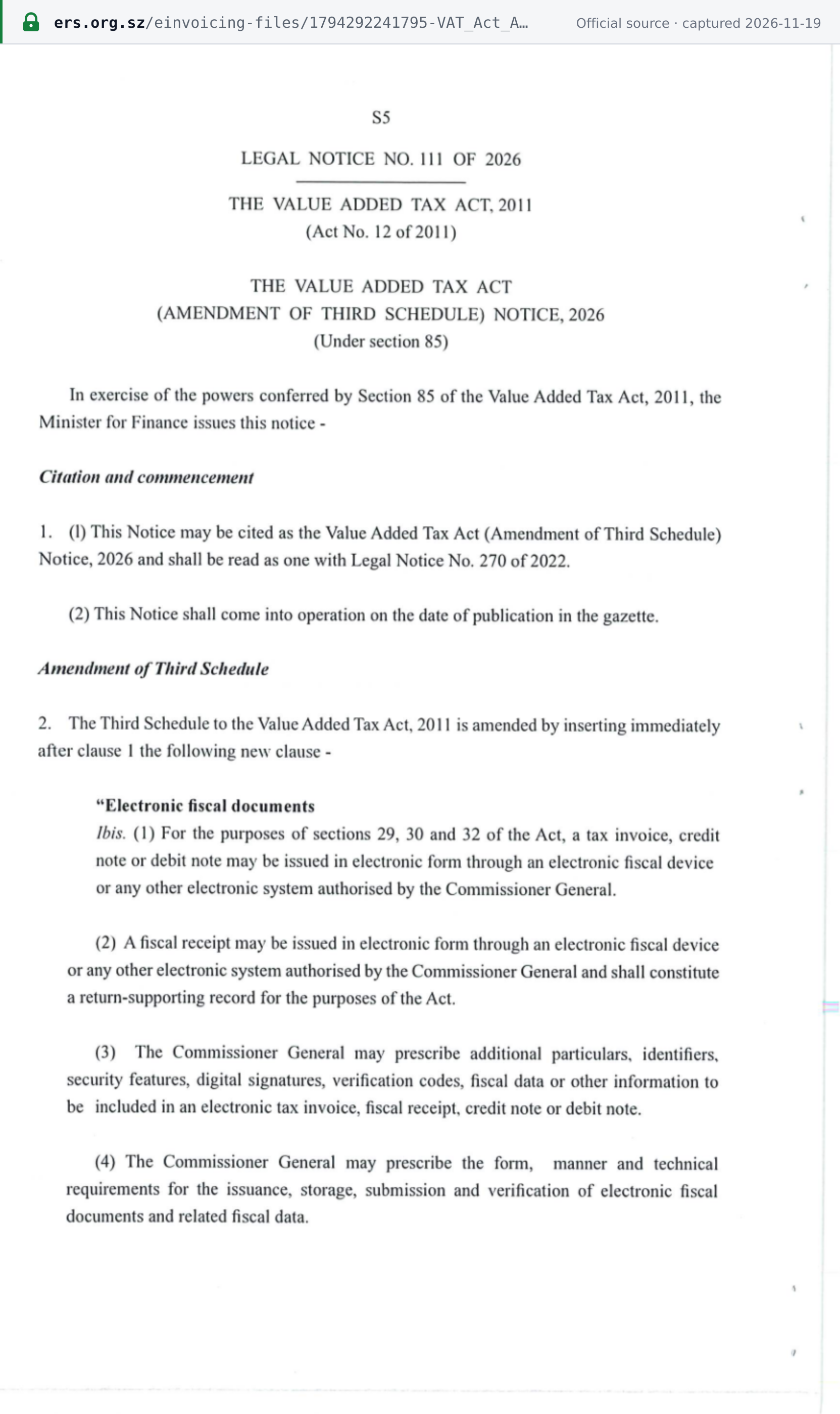
Legal Notice No. 111 of 2026. Issued by the Minister for Finance under the VAT Act 2011 and "read as one with Legal Notice No. 270 of 2022", it is subsidiary legislation made by notice. Its new clause 1bis provides:
- "(1) For the purposes of sections 29, 30 and 32 of the Act, a tax invoice, credit note or debit note may be issued in electronic form through an electronic fiscal device or any other electronic system authorised by the Commissioner General."
- "(2) A fiscal receipt may be issued in electronic form through an electronic fiscal device or any other electronic system authorised by the Commissioner General and shall constitute a return-supporting record for the purposes of the Act."
- (3) and (4) let the Commissioner General prescribe additional particulars, "security features, digital signatures, verification codes", and the form, manner and technical requirements.
- Documents issued in accordance with it "shall be valid for the purposes of the Act" (1bis(6)).
The copy ERS publishes (Government Gazette supplement pages S5–S6) does not print the gazette number or publication date. [3]
 Source snapshot captured 2026-11-19 — original
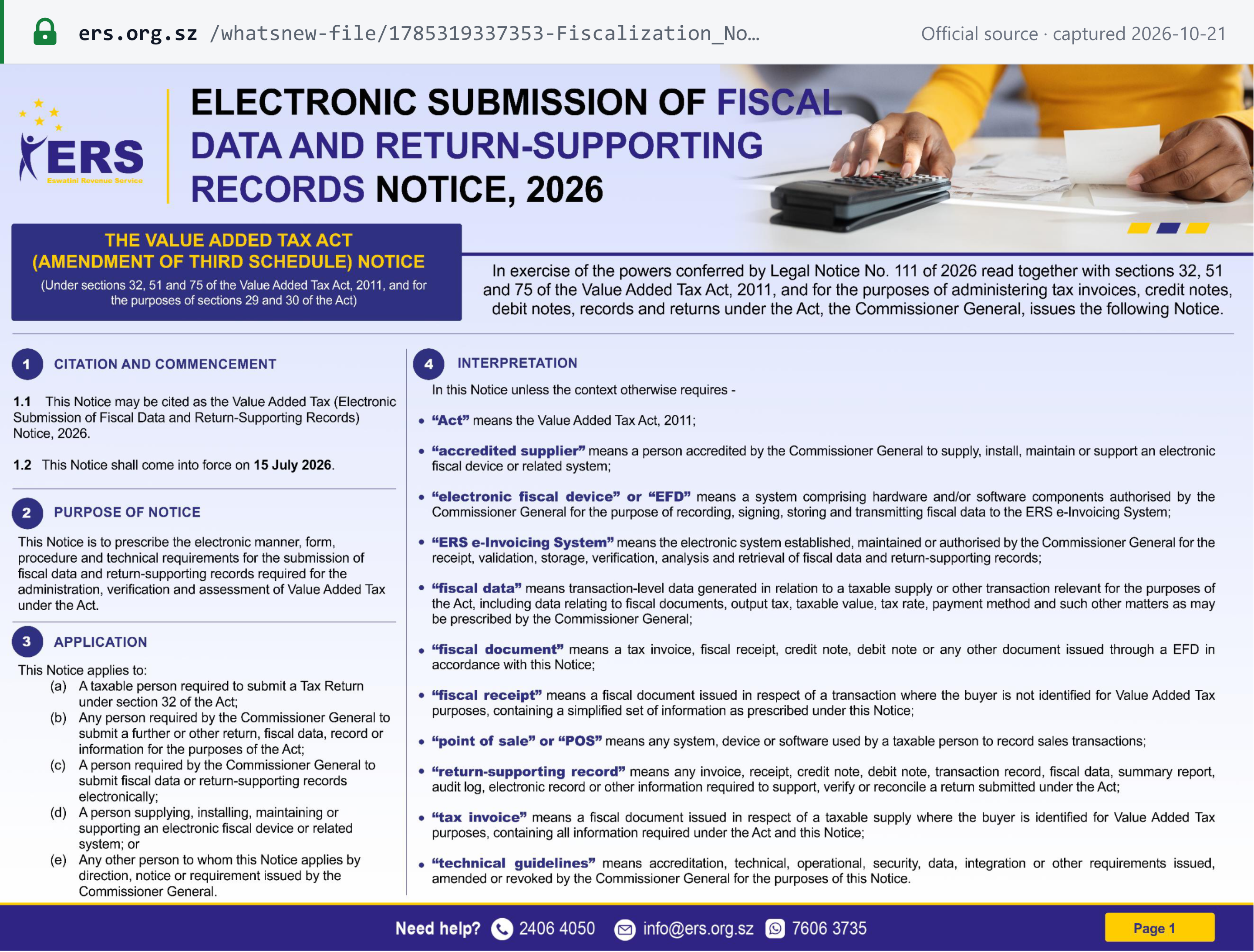
The Commissioner General's fiscal-data Notice. Issued "In exercise of the powers conferred by Legal Notice No. 111 of 2026 read together with sections 32, 51 and 75 of the Value Added Tax Act, 2011", it "may be cited as the Value Added Tax (Electronic Submission of Fiscal Data and Return-Supporting Records) Notice, 2026" (para 1.1) and "shall come into force on 15 July 2026" (para 1.2). The copy ERS publishes carries no Legal Notice number; its page-1 banner repeats the title of the Third Schedule amendment, but paragraph 1.1 gives its own citation. [2]
 Source snapshot captured 2026-10-21 — original
Technical Guidelines. They "shall come into effect on the date of publication on the official website of the Eswatini Revenue Service"; ERS's Technical Guide listing gives an effective date of 1 August 2026. [14] The Guidelines state that "Compliance with these Technical Guidelines is required for the accreditation, continued accreditation, use, supply, installation, maintenance or support of Electronic Fiscal Device components, including Point of Sale systems and Sales Data Controllers." Where they conflict, "the Act, the amended Third Schedule and the Commissioner General Notice shall prevail according to their legal hierarchy." [4]
Scope
Who the Notice applies to. "(a) A taxable person required to submit a Tax Return under section 32 of the Act; (b) Any person required by the Commissioner General to submit a further or other return, fiscal data, record or information for the purposes of the Act; (c) A person required by the Commissioner General to submit fiscal data or return-supporting records electronically; (d) A person supplying, installing, maintaining or supporting an electronic fiscal device or related system; or (e) Any other person to whom this Notice applies by direction, notice or requirement issued by the Commissioner General" (para 3). In practice the device duty bites only once the Commissioner General prescribes it for you (paras 6.1 and 13). [2]
- B2B — in scope. "A person required to use an EFD shall issue a fiscal document in respect of each transaction" (para 8.1). Where the buyer is identified for VAT, that document is a tax invoice, and "Where the fiscal document is a tax invoice, the buyer's TIN shall be included" (paras 8.2(b), 8.4). [2]
- B2C — in scope. Where the buyer is not identified for VAT, the document is a fiscal receipt (para 8.2(a)), "containing a simplified set of information as prescribed under this Notice" (para 4). [2]
- Credit and debit notes are fiscal documents too (para 8.2(c)–(d)).
- B2G. ERS's e-invoicing instruments (LN 111, the Notice, the Technical Guidelines and the FAQ) contain no separate rule for sales to government bodies. A supplier designated to use an EFD issues the same fiscal documents whoever the buyer is.
- Non-established businesses. The same instruments make no separate provision for non-resident suppliers. Under the VAT Act every taxable person, including a non-resident, must have a resident nominated person (s.77); see the Eswatini VAT guide.
- Excluded transactions. None listed: the instruments name no exclusion for exports, imports or reverse-charge supplies. The Commissioner General may set "transaction types" when designating (para 13.1).
- Simplified invoices. Outside the device regime, the VAT Regulations still let retailers issue an abridged tax invoice up to E3,000 (see the Eswatini VAT guide). Under the device regime, the fiscal receipt is the simplified document.
Format & network
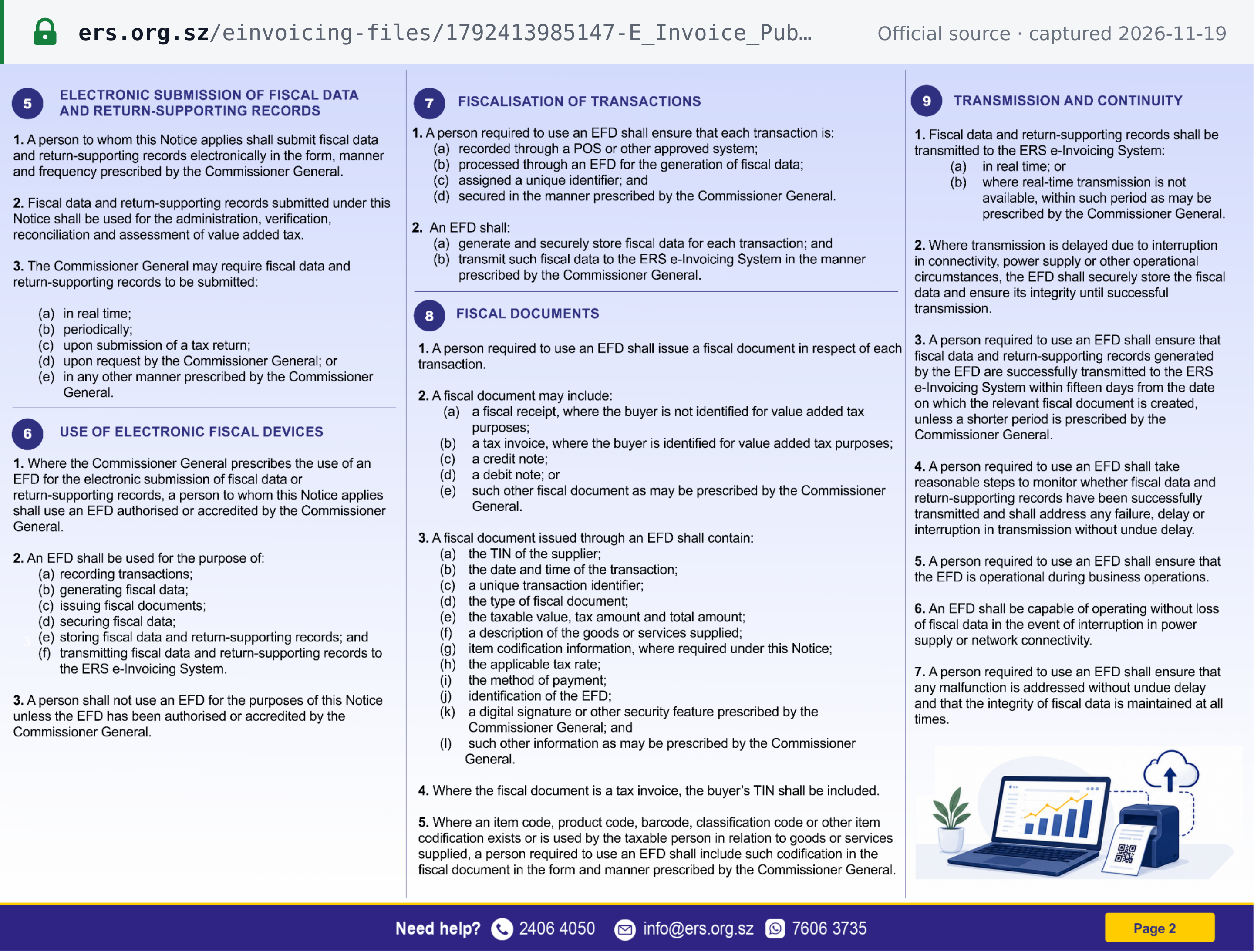
CTC model: fiscal devices with real-time reporting. Each transaction must be "(a) recorded through a POS or other approved system; (b) processed through an EFD for the generation of fiscal data; (c) assigned a unique identifier; and (d) secured in the manner prescribed by the Commissioner General" (para 7.1). The fiscal data then goes to the ERS e-Invoicing System "(a) in real time; or (b) where real-time transmission is not available, within such period as may be prescribed by the Commissioner General" (para 9.1), and in any case "within fifteen days from the date on which the relevant fiscal document is created, unless a shorter period is prescribed by the Commissioner General" (para 9.3). The device signs the invoice locally (or ERS's virtual SDC signs it online); there is no step in which ERS approves an invoice before it is issued. [2]
 Source snapshot captured 2026-11-19 — original
Architecture. "EFD is an electronic fiscal device that is a hardware and/or software solution used by the taxpayers to issue fiscal invoices and transmit fiscal data to the ERS e-Invoicing System (ERS.EIS), consisting of one Sales Data Controller and one POS, approved by the ERS CG, as well as a Secure Element issued by the ERS." [4]
- Sales Data Controller (SDC) — "exchanges data with the POS and Secure Element, analyzes turnover data, formats data into fiscal invoices, creates an electronic signature, forwards the fiscal data to the POS, stores turnover data, and transmits fiscal data to the ERS.EIS". [4] Two kinds: the E-SDC, "A hardware or software solution operating at a taxpayer's premises and capable of supporting both online and offline fiscalisation", and the V-SDC, "A free web-based service operated by ERS to facilitate online fiscalisation". [5]
- Secure Element (SE) — contains the taxpayer's electronic certificate, "is issued by ERS and is used by the Sales Data Controller to digitally sign invoices". ERS issues it as a smart card (with a PIN) or a digital PFX file (with a PAC). [4] [7]
- POS — any accredited system used to enter transactions. ERS says large businesses can integrate accredited fiscalisation software into their existing POS, and smaller ones can use free web-based and mobile applications. [5]
 Source snapshot captured 2026-11-20 — original
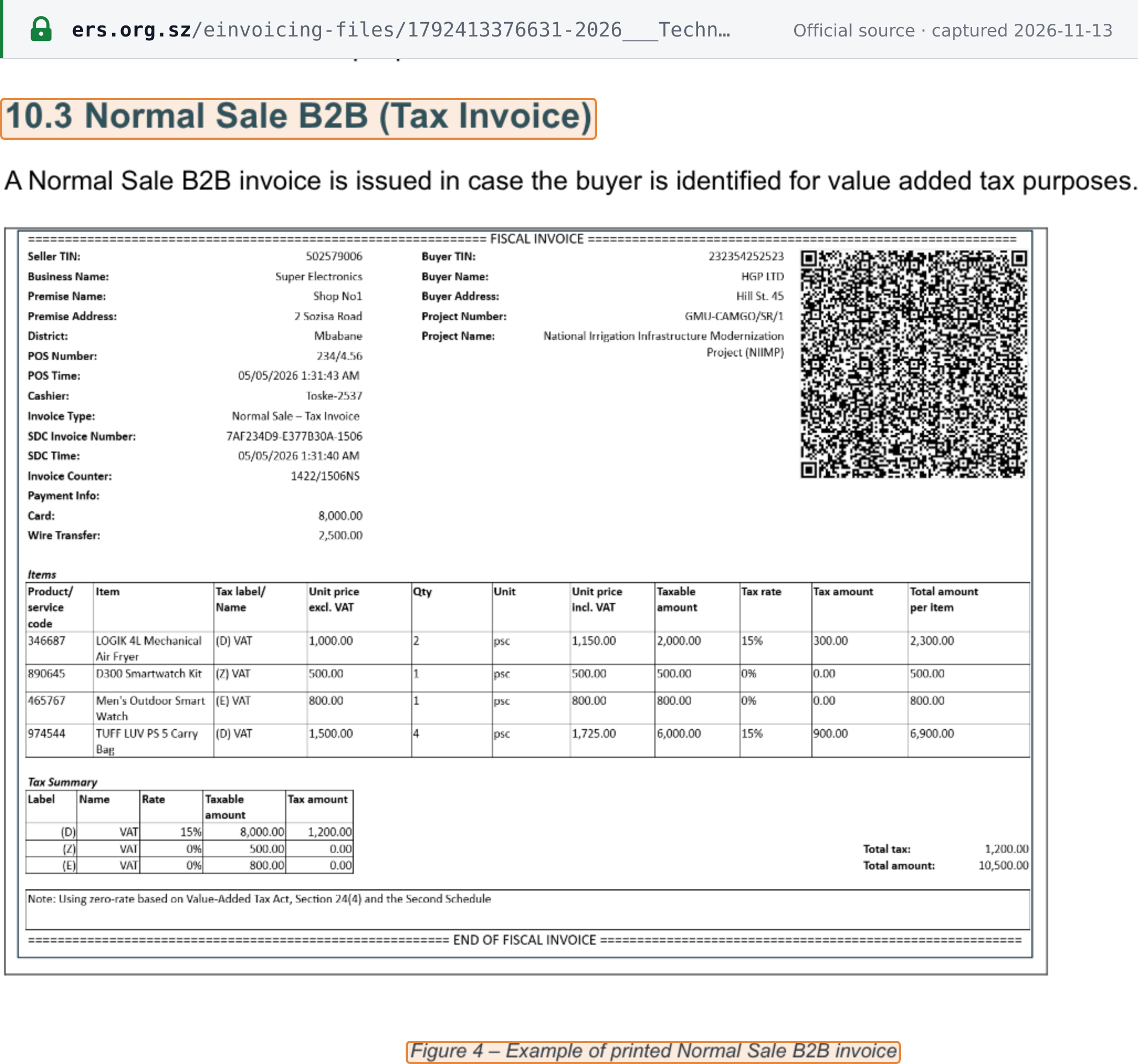
Data format. ERS publishes no national XML schema. The POS sends invoice requests to the SDC's TaxCore interface; the Technical Guidelines' Figure 5, "Corresponding invoice request for Figure 4", shows the request as a JSON object with fields such as invoiceType, transactionType, invoiceCategory and buyerId. For a B2B tax invoice, fields "marked as SDC API optional in the technical documentation, are mandatory": buyerId (the buyer's TIN), invoiceCategory set to "B2B", unitPriceTaxExcluded, taxableAmount, the buyer's name and address, and each item's unit and itemCode. The field-level documentation for suppliers is on the TaxCore sandbox help site the guidelines link to. No ERS e-invoicing instrument mentions UBL, CII or Peppol. [4]
Mandatory content of a fiscal document (Notice para 8.3): "(a) the TIN of the supplier; (b) the date and time of the transaction; (c) a unique transaction identifier; (d) the type of fiscal document; (e) the taxable value, tax amount and total amount; (f) a description of the goods or services supplied; (g) item codification information, where required under this Notice; (h) the applicable tax rate; (i) the method of payment; (j) identification of the EFD; (k) a digital signature or other security feature prescribed by the Commissioner General; and (l) such other information as may be prescribed by the Commissioner General." Item, product or barcodes the business already uses must be included (para 8.5). [2]
Integrity: signature, SDC number and QR code. Each fiscal invoice carries SDC metadata: the "SDC Invoice No - a combination of RequestedBy-SignedBy-Ordinal Invoice Number (for example, 7AF4D923- E3B30A31-234)", the SDC time and an invoice counter. It also carries a QR code that "contains Invoice verification URL"; on an emailed invoice the QR code is replaced by the verification URL as a clickable link. "Important: Minimum QR Code size is 42x42mm." The printed invoice ends with "END OF FISCAL INVOICE". [4] ERS says the QR code lets "consumers to verify that invoices issued to them are valid and properly recorded". [6]
 Source snapshot captured 2026-11-13 — original
Offline operation. "An EFD shall be capable of operating without loss of fiscal data in the event of interruption in power supply or network connectivity" (para 9.6); while transmission is delayed, the EFD "shall securely store the fiscal data and ensure its integrity until successful transmission" (para 9.2). [2]
E-reporting alongside. VAT returns are still filed in TaxEase with invoice schedules. ERS presents TaxCore as replacing the manual work: "Currently, many businesses are required to prepare invoice schedules manually, upload them into Excel templates, and subsequently upload them into the TaxEase system monthly." It speaks of "the possibility of pre-populated VAT schedules and returns as the system matures". No date or instrument for pre-population has been published. [6]
Onboarding / how to comply
Taxpayer enrolment. ERS runs enrolment from its own taxpayer registry; there is no self-registration. Per ERS's e-invoicing FAQ: [7]
- Fix your registry details first. "The existing ERS taxpayer registry is the sole source of taxpayer registration details, contact information and business locations for enrollment." An authorised person who is not correctly recorded there cannot be invited.
- Wait for the invitation. After synchronisation, the system "automatically sends an enrollment invitation to the taxpayer's authorized person or persons by the configured electronic communication channel: (SMS and email)."
- Request Secure Elements in TAP. In the Taxpayer Administration Portal (TAP): "Sign in to TAP, select the business location, choose the required type and number of secure elements, set the PIN and/or PAC, review the details and submit the request to ERS." Head offices may be included.
- Approval and collection. "An ERS Enrollment Officer reviews requests manually in the EEIS Back Office and approves or rejects them." Smart cards are collected at the chosen ERS office "two business days after the notification", against a signed delivery note.
- Fees and renewals. "The first card and regular renewals are free. ERS charges E250 for a replacement smart card that is lost or damaged." Expiry reminders go out 60, 30 and 7 days before; "Secure-element renewal requests are approved automatically." Smart cards remain ERS property and must be returned when no longer needed.
ERS's site does not publish a production TAP address; the invitation carries the link. ERS's User Instructions page is empty.
Accredited providers. "A person shall not supply, install, maintain or support an EFD unless accredited by the Commissioner General" (Notice para 12.1), and "Only the Commissioner General may grant accreditation" (Technical Guidelines). [2] [4] ERS's register of approved vendors lists: [8]
| Vendor | Approved | Services (as listed by ERS) |
|---|---|---|
| Avalith I.T. (Pty) Ltd | 1 October 2026 | V-SDC Integration Software, E-Invoicing Fiscalization Integration POS Solution |
| MetricMaster LLC | 14 October 2026 | e-Invoicing software, fiscal device supply and integration support |
ERS's register of approved fiscal devices (elements) is empty. The Commissioner General may suspend or revoke a supplier's accreditation (para 12.3); the guidelines give no fixed accreditation period.
Testing. Vendors test on the shared TaxCore Accreditation Environment (sandbox). "Participation in the Sandbox is not optional. It is a mandatory requirement under the Value Added Tax Act, 2011 and the 2026 Notice from the Commissioner for all vendors seeking accreditation to provide fiscalisation solutions in Eswatini." [5] The sandbox is "a shared platform used by multiple jurisdictions": a product version passes technical review once and administrative review separately in each jurisdiction. [4] Vendors also sign an Undertaking of Conformity (POS or E-SDC), published on ERS's e-invoicing Forms page. [13]
Connection modes. Use ERS's free V-SDC online, or an accredited E-SDC on site where you need offline operation; either way, your POS or ERP must be integrated with an accredited solution. [5]
Cost relief. ERS states that "businesses will be allowed to claim qualifying costs associated with acquiring or upgrading electronic fiscal devices as allowable deductions for income tax purposes". The instrument giving effect to this has not been identified. [5]
Penalties
The Notice creates no penalty of its own: "A person who fails to comply with this Notice, a requirement issued under this Notice, or any technical guideline issued by the Commissioner General, shall be subject to the applicable provisions of the Act" (para 16). [2] The relevant offences in the VAT Act 2011, as published by ERS: [10]
| Failure | Provision | Penalty on conviction |
|---|---|---|
| Not providing a tax invoice, credit or debit note | s.56(1) | Fine of E2,000 to E10,000, or up to 3 years' imprisonment, or both |
| Providing a non-compliant tax invoice, credit or debit note | s.56(2) | Deliberate or reckless: E6,000 to E15,000 and/or up to 6 years; otherwise E2,000 to E10,000 and/or up to 3 years |
| Failure to maintain proper records | s.60 | Deliberate or reckless: E4,000 to E12,000 and/or up to 6 years; otherwise E2,000 to E6,000 and/or up to 3 years |
Fiscal data and return-supporting records "shall be treated as records maintained for the purposes of the Act" (Notice para 14.1). For suppliers, the Commissioner General may suspend or revoke accreditation (para 12.3). ERS has announced no grace period or tolerance policy.
Frequently asked questions
We are a wholesaler. Do we need an electronic fiscal device now?
Only once the Commissioner General designates you or your sector and sets your date. ERS has named wholesale and retail as the first sectors but has published no date, and no designation notice appears on its e-invoicing pages (as at 20 November 2026). Designation can come by public notice, written notice, sector designation or a registration condition (Notice para 13.3), so watch for an SMS or email invitation to enrol.
Our authorised person never received the enrolment invitation. What now?
The invitation goes by SMS and email to the authorised person recorded in the ERS taxpayer registry. If those details are wrong or out of date, ask ERS to correct the registry first; enrolment cannot proceed until the corrected record synchronises into the e-invoicing system.
What happens if the internet or power goes down?
An EFD must keep working "without loss of fiscal data" through power or network interruptions and store the data securely until it can be sent. An on-site E-SDC supports offline fiscalisation; ERS's free V-SDC is online only. Data must reach ERS within fifteen days of the document's creation unless a shorter period is prescribed.
Do we have to show the customer's TIN?
Yes, on a tax invoice: the Notice says "Where the fiscal document is a tax invoice, the buyer's TIN shall be included." The Technical Guidelines make the buyerId field mandatory for B2B invoices. A sale to a buyer not identified for VAT gets a fiscal receipt instead.
Our smart card was lost. Is there a charge?
Revoke it in TAP and request a new Secure Element. The first card and regular renewals are free; ERS charges E250 for a replacement smart card that is lost or damaged.
Can we keep our own POS or ERP?
Yes, if it is integrated with an accredited fiscalisation solution. ERS says businesses with existing POS systems can integrate accredited software, and smaller businesses can use free web-based and mobile options. As at 20 November 2026 ERS lists two approved vendors: Avalith I.T. and MetricMaster LLC.
Recent changes
- 2026-10-14 — ERS approves MetricMaster LLC as its second e-invoicing vendor, after Avalith I.T. (approved 1 October 2026). (ERS approved vendors)
- 2026-08-26 — ERS names wholesale and retail as the first sectors for e-invoicing, with a phased rollout and no date. (ERS)
- 2026-07-15 — The Commissioner General's VAT (Electronic Submission of Fiscal Data and Return-Supporting Records) Notice, 2026 comes into force; Legal Notice No. 111 of 2026 allows electronic tax invoices, credit and debit notes and fiscal receipts. (ERS) — see event
- 2026-05-11 — ERS launches TaxCore, its electronic invoicing system, with Data Tech International. (ERS) — see event
Related resources
- Eswatini VAT guide — rate, registration, tax-invoice particulars, filing
- E-invoicing status and networks by country
- Fiscal devices and certified cash registers
- CTC e-invoicing models explained
- Other TaxCore and fiscal-device systems: Fiji, Vanuatu, Serbia
- Eswatini tax changes on Lookuptax
Important websites
- ERS e-Invoicing hub — legislation, regulations, technical guide, forms, approved vendors, FAQ
- ERS call centre +268 2406 4050 or +268 2406 4000, WhatsApp +268 7606 3735, info@ers.org.sz
Reference links
- ERS — e-Invoicing
- ERS Commissioner General — VAT (Electronic Submission of Fiscal Data and Return-Supporting Records) Notice, 2026 (PDF)
- Legal Notice No. 111 of 2026 — VAT Act (Amendment of Third Schedule) Notice, 2026 (PDF)
- ERS e-Invoicing System Technical Guidelines for the Accreditation of EFD Solutions, version of 29 July 2026 (PDF)
- ERS — "ERS Advances Rollout of National e-Invoicing System", 26 August 2026
- ERS — "ERS Launches TaxCore Electronic Invoicing to Boost Revenue Collection", 11 May 2026
- ERS — e-Invoicing FAQ
- ERS — e-Invoicing approved vendors
- ERS — e-Invoicing news
- Value Added Tax Act, 2011 (PDF, ERS)
- ERS — e-Invoicing legislation
- ERS — e-Invoicing regulations
- ERS — e-Invoicing forms
- ERS — e-Invoicing technical guide