E-invoicing in the United Kingdom: the April 2029 mandate
Overview
The UK has no e-invoicing mandate in force. At Budget 2025 (26 November 2025) the government announced that all VAT invoices for business-to-business (B2B) and business-to-government (B2G) transactions must be issued as e-invoices in a specified electronic format from April 2029. [1] [2]
At Budget 2026 (28 October 2026) the government published an e-invoicing implementation roadmap for e-invoicing requirements for VAT-registered persons, including public bodies, from 1 April 2029, and said it will legislate in Finance Bill 2026-27 for the enabling powers. The same measure confers on HMRC the functions it needs to prepare to become the UK Peppol Authority. The Bill has not yet received Royal Assent, and the detailed requirements will be set in later regulations. [19] [20]
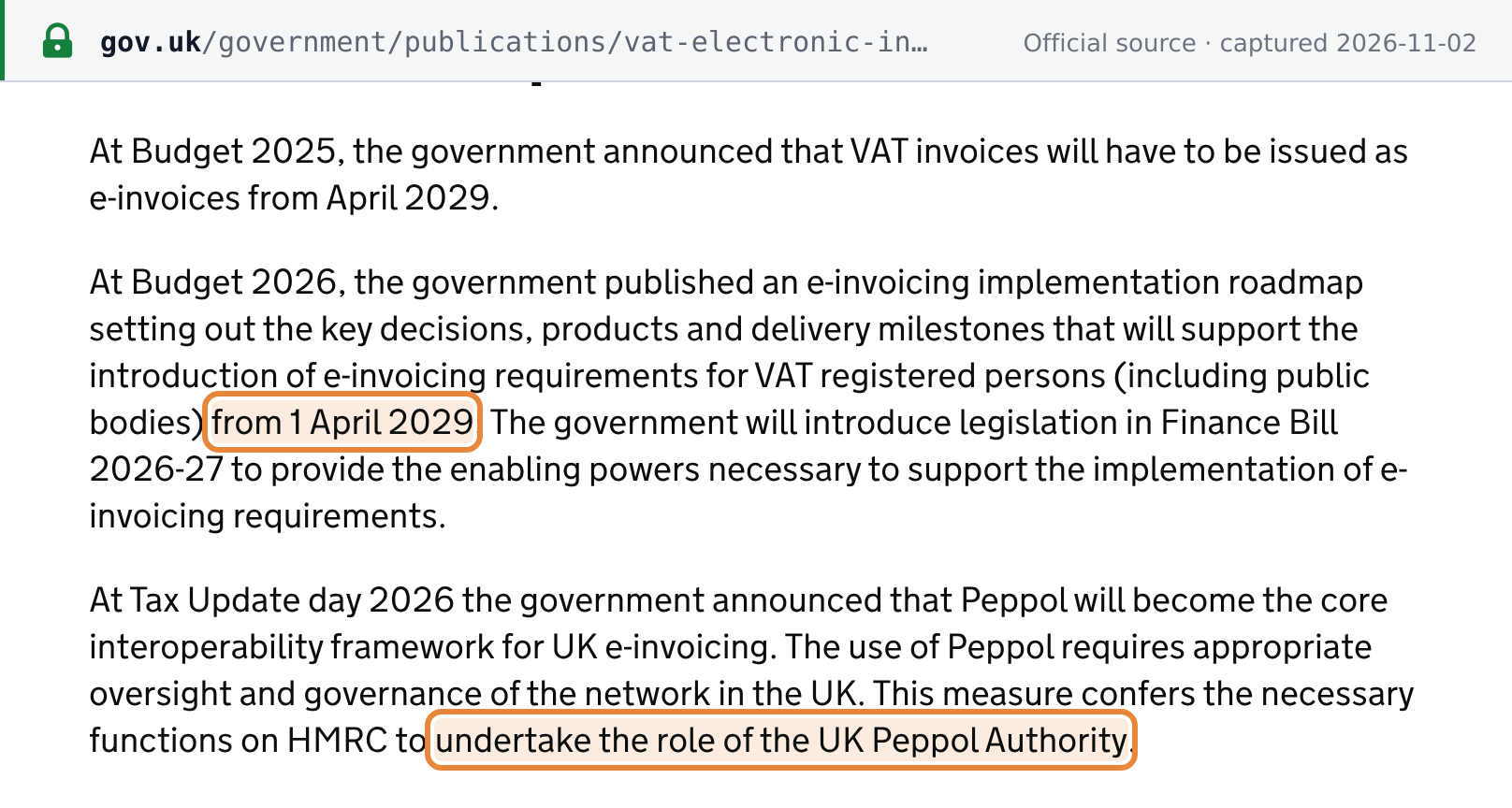 Source snapshot captured 2026-11-02 — original
The policy is owned by HM Revenue & Customs (HMRC) together with the Department for Business and Trade (DBT). The UK has chosen a decentralised model, in which businesses exchange invoices through their own software providers rather than through a government platform, and the government has named Peppol as the core interoperability network. [3] [4]
Until then, the position HMRC and DBT described in their February 2025 consultation still holds: e-invoices can be used, but the UK sets no standard for their format, content or delivery. The exception is suppliers to NHS England, who must send e-invoices over Peppol; the Department of Health and Social Care imposes this through the NHS Standard Contract, and its current guidance applies it to goods and services bought by NHS acute trusts. [5]
Legal basis in one line. The 2029 mandate is announced policy. Its enabling powers are in Finance Bill 2026-27, not yet enacted, and the detailed requirements will follow in regulations; HMRC plans to publish guidance, standards and the technical specification by the end of 2027 to 2028. Today's voluntary e-invoicing rests on VAT Act 1994 Schedule 11 paragraph 3 and HMRC's VAT Notice 700/63, and public bodies' duty to accept e-invoices rests on section 67 of the Procurement Act 2023. [19] [2] [7] [8]
| United Kingdom | |
|---|---|
| Status | No mandate in force. Mandatory e-invoicing announced for April 2029 (Budget 2025); implementation roadmap published at Budget 2026 for 1 April 2029 |
| B2B | Optional today. Announced as mandatory for all VAT invoices from April 2029 |
| B2G | Public bodies must already accept EN 16931 e-invoices (Procurement Act 2023 s.67). Issuing announced as mandatory for VAT invoices from April 2029. NHS England suppliers must use Peppol now |
| B2C | Not named in any announcement |
| Non-established businesses | Not yet announced |
| Model | Decentralised; no central clearance platform; no real-time reporting at launch |
| Network | Peppol, named as the core interoperability network (23 June 2026). HMRC to become the UK Peppol Authority (Finance Bill 2026-27; timing not yet determined) |
| Format | Not yet specified for the mandate. B2G today: EN 16931-1:2017 with a compliant syntax |
| Authority | HMRC, with the Department for Business and Trade |
| Legislation | Enabling powers in Finance Bill 2026-27 (not yet enacted; in force from Royal Assent); detailed requirements by regulations, having effect from April 2029 |
For UK VAT rates, registration and the particulars a VAT invoice must carry, see the UK VAT guide.
Mandate status & timeline
| Date | Event | Status (at 2 Nov 2026) | Source |
|---|---|---|---|
| 13 Feb – 7 May 2025 | HMRC and DBT consultation on promoting e-invoicing (342 responses) | Closed | Consultation document; outcome |
| 26 Nov 2025 | Budget 2025: all VAT invoices to be e-invoices from April 2029; consultation response confirms a decentralised model and no real-time reporting at launch | Announced | Budget 2025; consultation response |
| 23 Jun 2026 | Tax Update 2026: Peppol named as the core interoperability network | Announced | Tax Update 2026 summary |
| 2 Jul 2026 | HMRC Transformation Roadmap progress update restates April 2029 for B2B and B2G | Announced | HMRC roadmap annex |
| 28 Oct 2026 | Budget 2026: implementation roadmap published for requirements from 1 April 2029; Finance Bill 2026-27 to carry the enabling powers and confer UK Peppol Authority functions on HMRC; Digital Reporting consultation opened (closes 20 January 2027) | Published; Bill not yet enacted | E-invoicing requirements TIIN; Budget 2026 OOTLAR |
| Royal Assent of Finance Bill 2026-27 | Enabling powers and HMRC's Peppol Authority preparation functions come into force | Pending | E-invoicing requirements TIIN |
| By end of 2027 to 2028 | Full guidance, standards, technical specification and legislation | Planned | HMRC roadmap annex |
| 1 April 2029 | E-invoicing requirements for VAT-registered persons, including public bodies, have effect | Announced; enabling powers in a Bill not yet enacted | Budget 2025; HMRC roadmap annex; E-invoicing requirements TIIN |
The decision. Budget 2025 states: "The government will require all VAT invoices to be issued in a specified electronic format from April 2029." Its chapter on productivity gives the scope as "all VAT invoices for business-to-business and business-to-government transactions". [1] The Budget's overview of tax legislation (paragraph 2.34) repeats the B2B and B2G scope and says the implementation roadmap and standards will be developed with stakeholders for publication at Budget 2026. [6]
The latest restatement. HMRC's Transformation Roadmap progress update, published 2 July 2026, lists e-invoicing as a deliverable: B2B and B2G e-invoicing "will become mandatory from April 2029", and HMRC "will publish full guidance, standards, technical specification and legislation by the end of 2027 to 2028". Its 2026 to 2027 activity is to work with DBT on a roadmap, to be published at Budget 2026, setting out the milestones to implementation. [2]
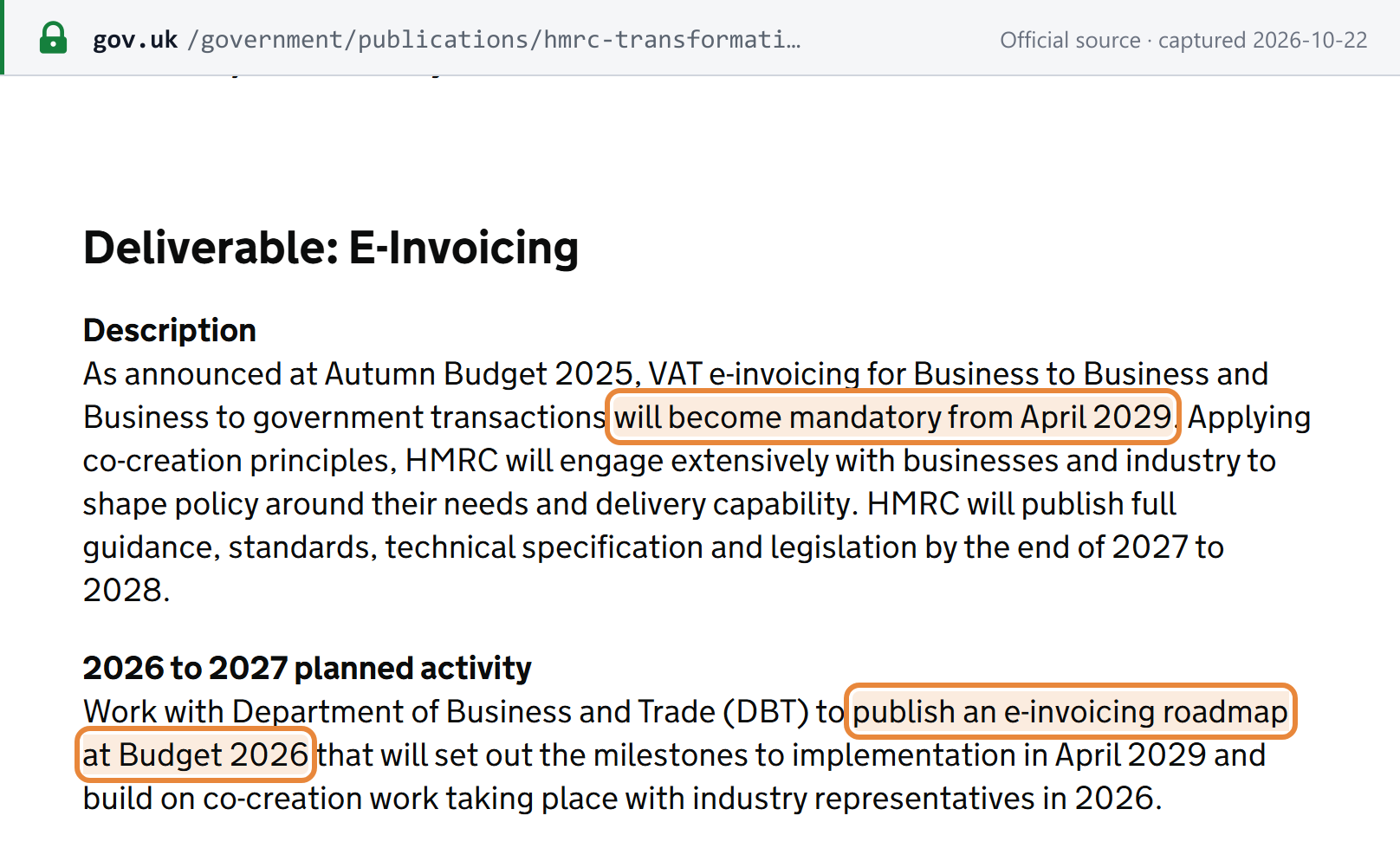
The Budget 2026 roadmap. The Chancellor set Budget 2026 for Wednesday 28 October 2026, and HMRC said the e-invoicing implementation roadmap would be published then. [14] [2] The roadmap is where the open points below (phasing, scope edges, the format, provider rules and penalties) are expected to be settled. In 2026, HMRC launched Policy Development and Technical Workshops with DBT and industry to inform it. [16]
What Budget 2026 published (28 October 2026). The government published the roadmap, setting out "the key decisions, products and delivery milestones" for e-invoicing requirements for VAT-registered persons (including public bodies) from 1 April 2029. HMRC's tax information and impact note says the measure affects VAT-registered persons and any other person required to receive a VAT invoice in order to recover input tax, including public bodies that are not VAT registered. [19]
- Enabling powers (Finance Bill 2026-27, not yet enacted). The Bill will amend Schedule 11 to VATA 1994 so that HMRC can make regulations prescribing when a VAT invoice must be provided in an electronic format, the form and structure of the invoice, and the technology, systems and networks to be used, with powers for exemptions and transitional provision. The powers come into force on Royal Assent; the requirements themselves have effect from April 2029. [19]
- UK Peppol Authority. The measure confers on HMRC the functions it needs to prepare to become the UK Peppol Authority, effective from Royal Assent. HMRC states that it is not yet determined when HMRC will become the Authority, and that the UK Peppol Authority currently sits within Supply Chain Coordination Limited, which operates NHS Supply Chain. [19]
- Digital Reporting consultation. A consultation on Digital Reporting alongside mandatory e-invoicing was launched at Budget 2026 and runs until 20 January 2027. [20]
Phases, pilots and postponements. None announced. Official sources give a single date, April 2029, with no turnover bands, pilot or voluntary window. Some consultation respondents suggested a phased rollout starting with B2G, but the government has not adopted one. [3]
"2029" or "April 2029"? Some official texts give only the year, while Budget 2025's policy-decisions chapter and HMRC's roadmap say "April 2029"; they describe the same decision.
Legal basis
The 2029 mandate. No statute or regulation is in force yet. Finance Bill 2026-27 will carry the enabling powers, amending Schedule 11 to VATA 1994 and coming into force on Royal Assent; the technical requirements will be set in secondary legislation with effect from April 2029. [19] HMRC plans to publish the legislation, with full guidance, standards and the technical specification, by the end of 2027 to 2028. [2]
What applies today.
| Instrument | Applies to | What it does |
|---|---|---|
| VAT Act 1994, Schedule 11, paragraph 3 | All VAT invoices | Lets regulations and HMRC set conditions for VAT invoices provided by electronic means, so a trader can meet the invoicing obligation by sending invoice data electronically [13] |
| VAT Notice 700/63 (last updated 26 May 2022) | All VAT invoices | HMRC's conditions for electronic invoices: optional, needs the customer's agreement, any format carrying the required data |
| Procurement Act 2023, section 67 (in force 24 February 2025) | Public contracts | Implies a term into every public contract that the contracting authority must accept and process undisputed e-invoices in the "required electronic form" [8] [18] |
| Public Procurement (Electronic Invoices etc.) Regulations 2019 | Public contracts (predecessor regime) | Transposed EU Directive 2014/55/EU: central contracting authorities with immediate effect in 2019; sub-central authorities and utilities by 18 April 2020 [11] |
| Public Contracts (Scotland) Amendment Regulations 2019 (in force 18 April 2019) | Scottish public contracts | Scotland's separate transposition of the Directive: central contracting authorities by 18 April 2019, all others by 18 April 2020 [12] |
| DHSC NHS eProcurement Strategy (May 2014) | NHS England suppliers | Mandates GS1 and Peppol standards, including Peppol invoice messaging, through the NHS Standard Contract [10] |
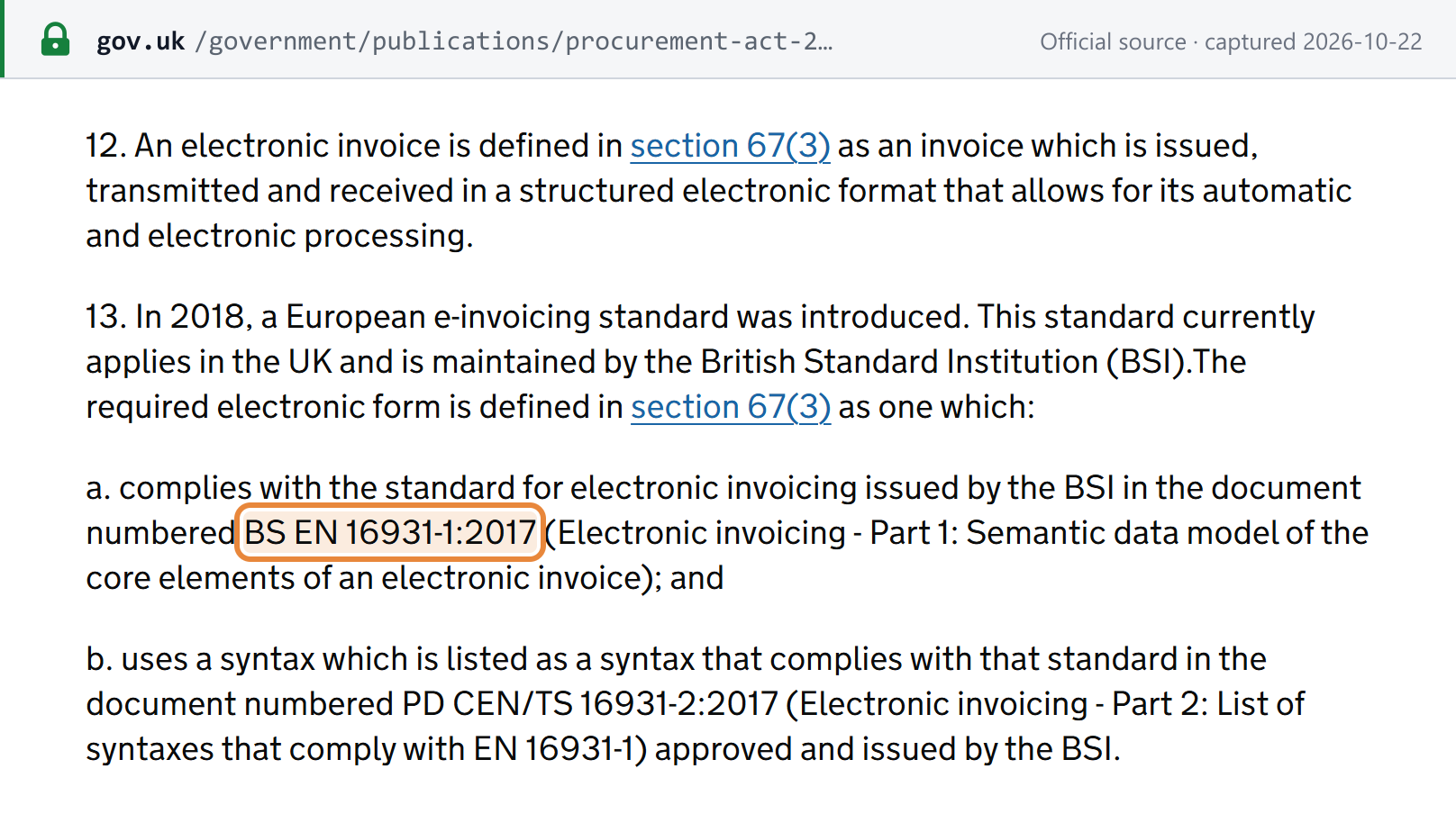
Technical standards that bind today. Only for public contracts: the "required electronic form" under section 67 is an invoice that complies with BS EN 16931-1:2017 (the semantic data model) and uses a syntax listed in PD CEN/TS 16931-2:2017. [8] No standard binds B2B invoices.
Scope
B2B. In scope from April 2029: "all VAT invoices" for business-to-business transactions. [1]
B2G. In scope from April 2029 on the same terms. Before then, public contracting authorities must already accept and process e-invoices in the EN 16931 form (see Legal basis), and NHS England suppliers must already use Peppol. Under the Procurement Act, suppliers have a right to submit an e-invoice, not a duty: an authority may require a particular invoicing system, but a supplier can always submit a compliant e-invoice and have it processed. [8] [9]
B2C. Not named. Budget 2025, the tax-legislation overview and HMRC's roadmap all describe B2B and B2G transactions only.
Businesses that are not VAT-registered. Expected to be outside the mandate. The government's consultation response says that because e-invoicing will be mandated for VAT invoices, "many of the smallest businesses who are not required and choose not to be registered for VAT will not be obliged to adopt this technology". [3] For the registration threshold, see the UK VAT guide.
Not yet announced (as at 22 October 2026). No official source yet addresses:
- whether non-established businesses registered for UK VAT are in scope;
- how Northern Ireland, which follows some EU VAT rules for goods, will be treated;
- exempt supplies, reverse-charge supplies and imports;
- the simplified (retailer) invoice regime.
The implementation roadmap published at Budget 2026 has not yet been reviewed for these points in this guide; the regulations made under the Finance Bill 2026-27 powers can provide for exemptions. [19]
Format & network
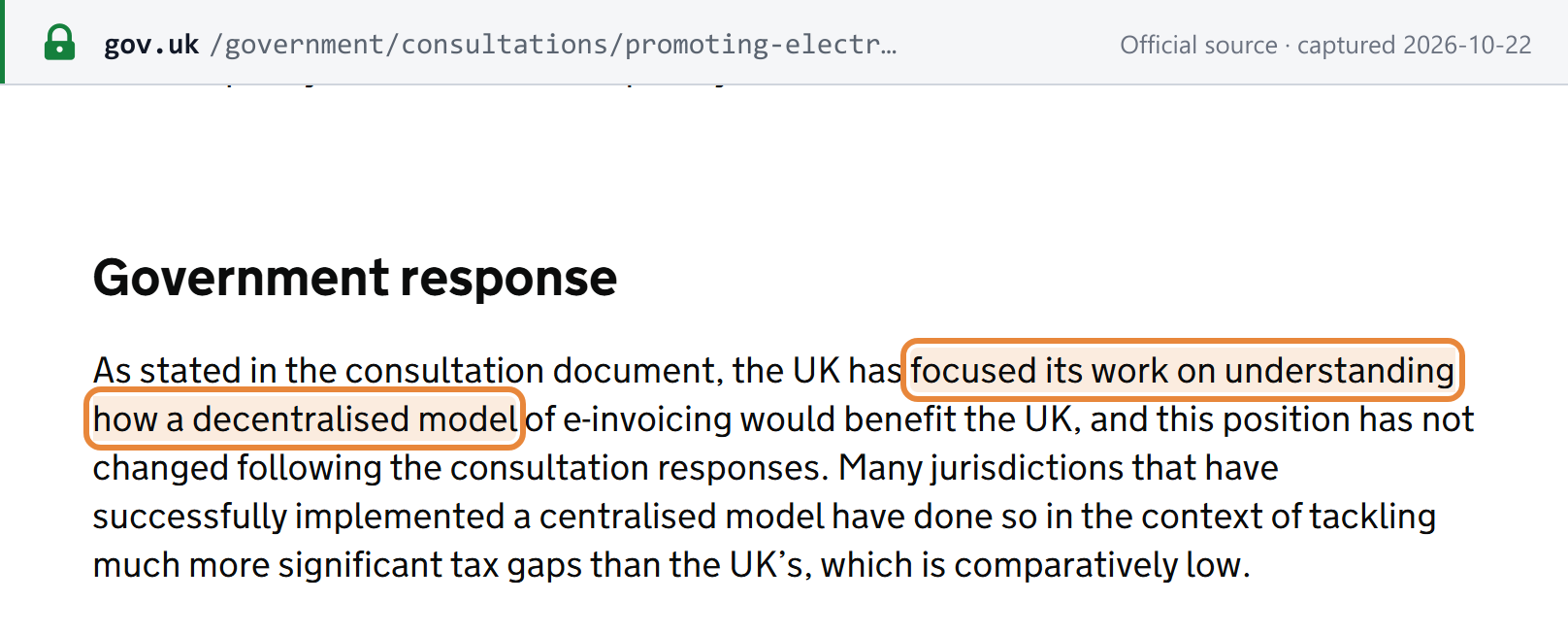
The model: decentralised, with no real-time reporting at launch. The government's response to the consultation says the UK has "focused its work on understanding how a decentralised model of e-invoicing would benefit the UK, and this position has not changed following the consultation responses". It notes that jurisdictions that chose a centralised model did so to tackle much larger tax gaps than the UK's. [3] In the consultation document's description of a decentralised system, the supplier's system sends the invoice through an invoicing network that validates key information and on to the buyer's system; HMRC calls this "sometimes known as a 4-corner model". [5] The government has not proposed any platform that validates, stamps or clears invoices, and the government has not announced any role for HMRC in receiving invoice data.
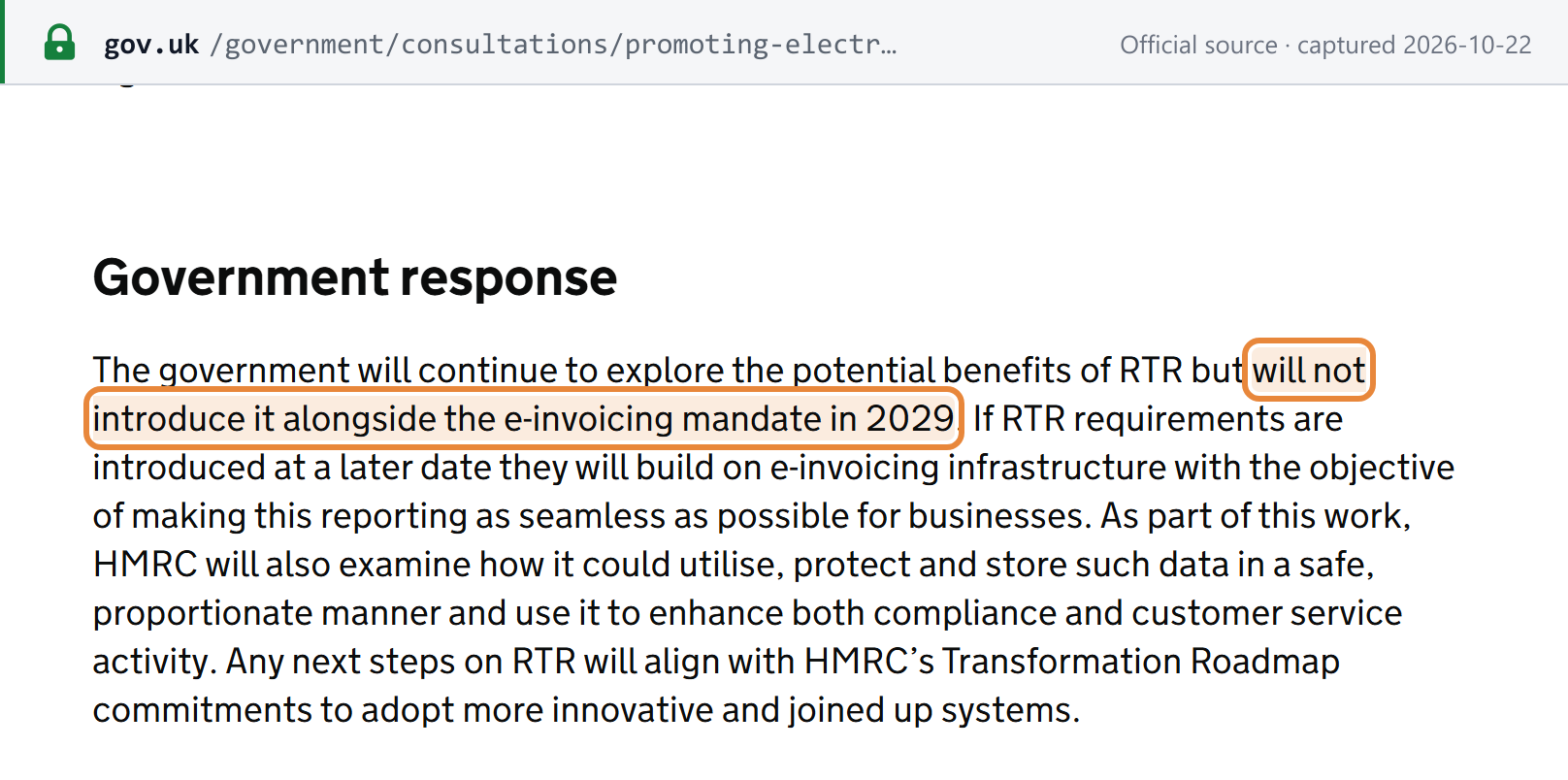
On reporting, the response says the government will continue to explore real-time reporting "but will not introduce it alongside the e-invoicing mandate in 2029". If real-time reporting comes later, it will build on the e-invoicing infrastructure. [3] A consultation on Digital Reporting alongside mandatory e-invoicing, launched at Budget 2026, runs until 20 January 2027. [20]
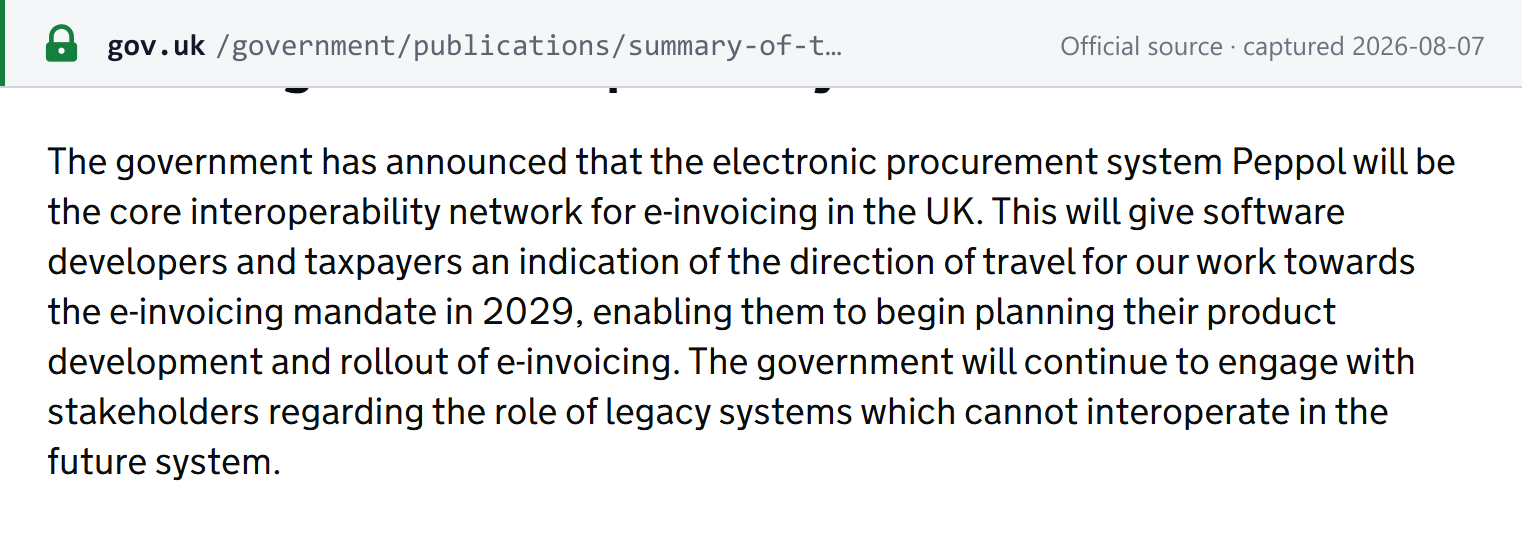
The network: Peppol. In the Tax Update of 23 June 2026, the government announced that "the electronic procurement system Peppol will be the core interoperability network for e-invoicing in the UK", so that software developers and taxpayers can start planning. It is still discussing the role of legacy systems that cannot interoperate. [4] HMRC states that the UK Peppol Authority currently sits within Supply Chain Coordination Limited, which operates NHS Supply Chain; OpenPeppol's list of Peppol Authorities has no United Kingdom entry and lists England, for the National Health Service. Finance Bill 2026-27 confers on HMRC the functions to prepare to become the UK Peppol Authority, from Royal Assent; when HMRC will take over is not yet determined. [19] [17]
The XML standard: not yet chosen. No syntax, national CIUS or Peppol profile has been fixed for the mandate. The government says it will review "the risks and benefits of adopting an existing standard or designing a UK-specific standard", and may design extensions for sector-specific needs because VAT invoices also act as commercial documents. [3] The Budget's tax-legislation overview put standards on the Budget 2026 timetable; HMRC's roadmap puts the technical specification by the end of 2027 to 2028. [6] [2] For public contracts today, the format is EN 16931-1:2017 with a syntax from CEN/TS 16931-2 (see Legal basis).
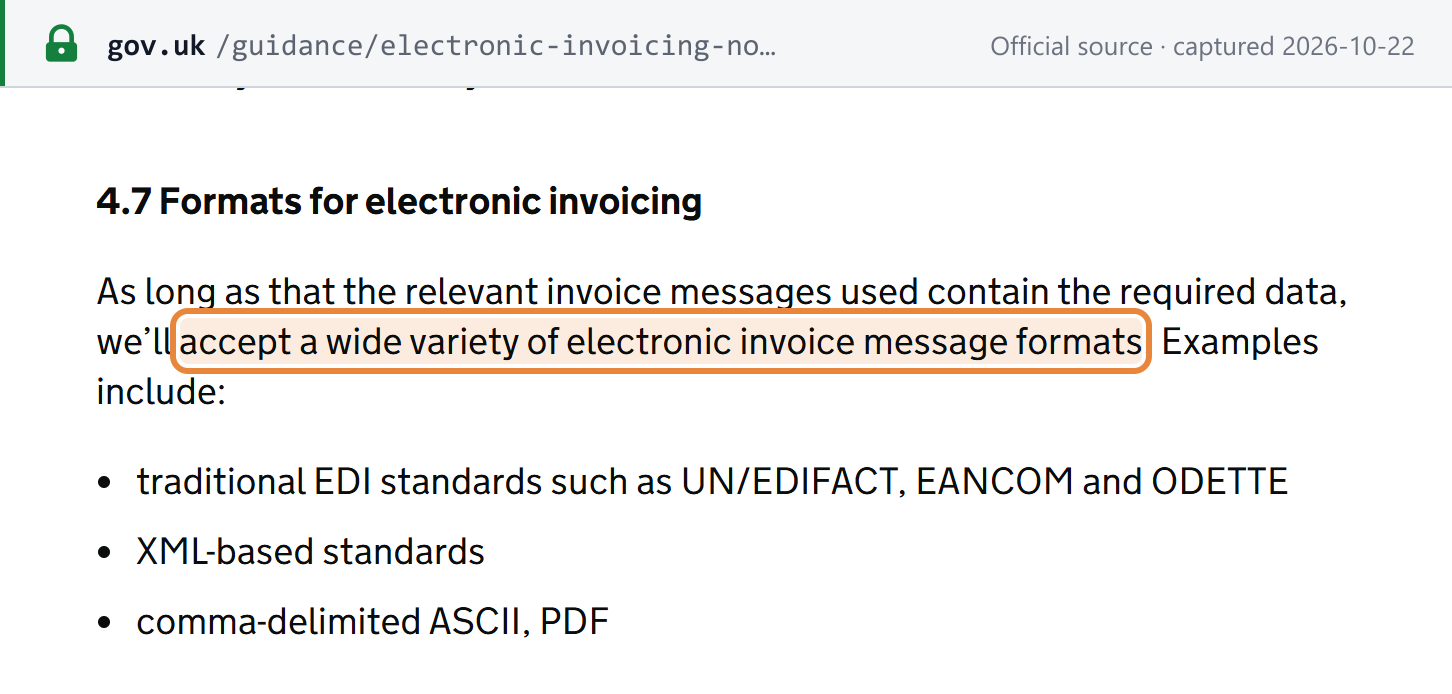
Formats accepted today. Outside public contracts, any format that carries the required data is accepted. VAT Notice 700/63 lists traditional EDI standards (UN/EDIFACT, EANCOM, ODETTE), XML-based standards, and comma-delimited ASCII and PDF; it treats both a structured format such as XML and an unstructured one such as PDF as electronic invoices. [7]
Integrity mechanics. None announced for 2029: no QR code, hash, cryptographic stamp or clearance ID. Today, a business may invoice electronically where the authenticity of origin, integrity of the data and legibility can all be ensured and the customer agrees, and it is "free to choose a method of ensuring authenticity, integrity, and legibility which suits your method of operation". [7]
Making Tax Digital. MTD for VAT already requires VAT-registered businesses to keep digital records and file VAT returns through compatible software, but invoices themselves do not have to be kept digitally under MTD. [15] HMRC's consultation document describes decentralised models as complementary to MTD. [5] The government's response calls them more compatible with MTD and notes that several MTD providers already offer e-invoicing. [3] Budget 2025 separately funds real-time digital prompts in VAT filing software from April 2027; that is not part of the e-invoicing mandate. [1]
Onboarding: how to comply
For the 2029 mandate: not yet defined. There is nothing to register for. HMRC has announced no accreditation of service providers or Peppol access points, no test environment and no connection modes. The government says it will work with the software sector, including MTD providers, so that the market offers a range of e-invoicing solutions, and invites interested businesses to contact the policy team. [3] With Peppol named as the network, exchange is expected to run through Peppol providers; the details are expected to follow from the roadmap published at Budget 2026, the regulations made under the Finance Bill 2026-27 powers, and the 2027 to 2028 publications.
E-invoicing voluntarily today. You do not need to tell HMRC. You must be satisfied that your system for issuing, receiving and storing electronic invoices meets Notice 700/63, the invoice must contain the same information as a paper invoice, and your customer must agree to receive invoices electronically. [7]
Selling to the public sector today. A contracting authority may require you to use its invoicing system, so follow the buyer's instructions. Goods and services bought by an NHS acute trust must comply with GS1 and Peppol standards. [8] [9]
Penalties
None set for the 2029 mandate. The government has not announced a penalty regime. In the consultation, respondents asked for clarity on "the nature and scale of penalties for non-compliance" and whether penalties would mirror those under MTD; the government response does not answer this. [3] Today there is no B2B e-invoicing obligation, so no e-invoicing penalty applies; the ordinary VAT invoicing rules still do. On the public-sector side, section 67 of the Procurement Act creates a contract term binding the contracting authority, not a penalty on suppliers.
Frequently asked questions
Do I have to e-invoice in the UK now?
No. Paper, PDF, EDI and XML invoices are all acceptable today, provided the invoice carries the information a VAT invoice must carry and your customer agrees to receive it electronically. The one sector exception is NHS England, whose suppliers must use Peppol. [7] [5]
When does the UK e-invoicing mandate start, and who does it cover?
1 April 2029, for VAT-registered persons including public bodies, covering VAT invoices in business-to-business and business-to-government transactions. It was announced at Budget 2025, and Budget 2026 (28 October 2026) published the implementation roadmap. The enabling powers are in Finance Bill 2026-27, which has not yet received Royal Assent; the detailed requirements will follow in regulations, and HMRC plans to publish guidance, standards and the technical specification by the end of 2027 to 2028. [19] [1] [2]
Will the UK use Peppol, and is there a government clearance platform?
Peppol will be the core interoperability network, announced in the Tax Update of 23 June 2026. The model is decentralised: invoices pass between the parties' providers, not through an HMRC platform, and the government has said it will not introduce real-time reporting alongside the mandate in 2029. [4] [3]
Who will run Peppol in the UK — is HMRC the Peppol Authority?
Not yet. HMRC states that the UK Peppol Authority currently sits within Supply Chain Coordination Limited, which operates NHS Supply Chain. Finance Bill 2026-27 will confer on HMRC the functions it needs to prepare to become the UK Peppol Authority, with effect from Royal Assent, and HMRC says it is not yet determined when it will become the Authority. [19]
Which format will be required: UBL, Peppol BIS or a UK standard?
Not decided. The government is weighing an existing standard against a UK-specific one, possibly with sector extensions, and HMRC plans to publish the technical specification by the end of 2027 to 2028. For public contracts today, e-invoices must follow EN 16931-1:2017 with a syntax listed in CEN/TS 16931-2. [3] [8]
I am not VAT-registered. Does the mandate apply to me?
The mandate attaches to VAT invoices, so the government expects that many of the smallest businesses, which are not required to register for VAT and choose not to, will not be obliged to adopt e-invoicing. [3]
What about invoicing the public sector today?
Public contracting authorities must accept and process undisputed e-invoices that follow EN 16931, under section 67 of the Procurement Act 2023, in force since 24 February 2025. An authority may ask you to use its own invoicing system. Suppliers to NHS England must use Peppol. [8] [18]
What are the penalties for not e-invoicing?
None have been announced for the 2029 mandate. Consultation respondents asked whether they would mirror Making Tax Digital penalties, and the government has not said. [3]
How does e-invoicing relate to Making Tax Digital?
MTD for VAT covers digital records and VAT returns filed through software; e-invoicing covers the exchange of the invoice itself. HMRC sees the decentralised e-invoicing model as complementary to MTD, and several MTD providers already offer e-invoicing. [15] [5] [3]
Recent changes
- 2026-10-28 — Budget 2026: the government publishes the e-invoicing implementation roadmap for requirements for VAT-registered persons, including public bodies, from 1 April 2029, and will legislate the enabling powers in Finance Bill 2026-27 (not yet enacted), which also confers on HMRC the functions to prepare to become the UK Peppol Authority. (HMRC) — see issue and event
- 2026-07-02 — HMRC's Transformation Roadmap progress update restates that B2B and B2G e-invoicing becomes mandatory from April 2029, and commits to publishing guidance, standards, technical specification and legislation by the end of 2027 to 2028, with the implementation roadmap at Budget 2026. (HMRC)
- 2026-06-23 — The government names Peppol as the core interoperability network for UK e-invoicing ahead of the 2029 mandate (Tax Update 2026). (HM Treasury / HMRC) — see event
- 2025-11-26 — Budget 2025: all VAT invoices for B2B and B2G transactions must be e-invoices from April 2029; the consultation response confirms a decentralised model with no real-time reporting at launch. (HM Treasury)
- 2025-02-13 — HMRC and DBT open a 12-week consultation on promoting e-invoicing across UK businesses and the public sector (closed 7 May 2025). (HMRC)
Related resources
- UK VAT guide — rates, registration, VAT invoice particulars and a worked invoice example
- UK tax identification numbers
- How to verify a UK VAT number, or validate one on Lookuptax
- E-invoicing status and networks by country
- Peppol guide and Peppol requirements by country
- E-invoicing models: clearance, reporting and interchange
- ViDA — VAT in the Digital Age, relevant to Northern Ireland and EU trading partners
- Decentralised Peppol neighbours: Ireland, Belgium and Australia
- UK tax changes on Lookuptax
Important websites
- HMRC/DBT e-invoicing consultation and outcome
- E-invoicing requirements (HMRC tax information and impact note, Budget 2026)
- Budget 2026: Overview of Tax Legislation and Rates
- HMRC VAT Notice 700/63: electronic invoicing
- Procurement Act 2023 guidance: electronic invoicing and payment
- Partnering with the NHS to sell goods and services
- Find software compatible with Making Tax Digital for VAT