E-invoicing in Belize: VERTX-BZ
Overview
Belize's e-invoicing system is VERTX-BZ, the Electronic Invoicing Receiving System of the Belize Tax Service (BTS). BTS describes its Orientation Manual as guidance "for businesses and software providers developing an integration with the Belize Tax Service’s VERTX-BZ Electronic Invoicing Receiving System", used to transmit "Electronic Tax Documents (ETDs) for validation and authorization". [3]
VERTX-BZ was built with the Inter-American Center of Tax Administrations (CIAT): "CIAT engaged a software developer to build the Electronic Fiscal Document Reception System which is referred to as VERTX-BZ platform." [2] Developers will meet two other names in the technical manual: "The CIAT Electronic Fiscal Documents Reception System (EFDR) is responsible for receiving all Electronic Tax Documents (ETD) sent to the Belize ETD Reception System (BETDRS)." [4]
The system handles four document types: "(1) Tax Invoices (2) Tax Receipts (3) Debit Notes and (4) Credit Notes" (Orientation Manual, p.10), matching the definition of "tax document" in the GST Regulations as amended by SI No. 140 of 2025. [4] [7]
Legal basis in one line. General Sales Tax Act, Cap. 63, s.36(7)–(9) as inserted by the General Sales Tax (Amendment) Act 2024 (Act No. 34 of 2024, in force 1 January 2025), and Part IIA of the GST Regulations inserted by SI No. 140 of 2025, with SI No. 35 of 2025. [5] [7]
| Belize | |
|---|---|
| System | VERTX-BZ (CIAT's EFDR platform; "BETDRS" in the Orientation Manual) |
| Authority | Belize Tax Service (BTS) |
| Model | Clearance ("previous authorization"): BTS validates and authorizes each document before it is given to the customer; subsequent mode for tax receipts and contingencies |
| B2B | Voluntary since September 2026; BTS expects the mandatory phase to begin in March 2027, starting with large taxpayers (as at 2026-11-19) |
| B2G | Same as B2B: BTS treats sales to the Government of Belize as part of the B2B scope |
| B2C | Not in the current phases; BTS says any inclusion "would occur in a later phase" (no date) |
| Non-residents | Not addressed by BTS's e-invoicing publications; the obligation attaches to GST-registered persons |
| Format | XML, UBL 2.4 (the UBLVersionID element carries "2.1"), national syntax BETDSM, electronic signature with an EFDR certificate, QR code |
| Network | Direct REST web services to BTS; not Peppol-based |
| Legislation | GST Act Cap. 63 s.36(7)–(9) (Act No. 34 of 2024); GST Regulations Part IIA (SI No. 140 of 2025); SI No. 35 of 2025 |
For the GST rate, the BZD 75,000 registration threshold and the paper invoice rules, see the Belize GST guide.
Mandate status & timeline
Status (as at 2026-11-19): voluntary phase open since September 2026; BTS expects the mandatory phase to begin in March 2027, starting with large taxpayers. BTS's e-invoicing FAQ: "E-Invoicing applies to GST-registered businesses conducting Business-to-Business (B2B) transactions, including Business-to-Government (B2G) transactions. The mandatory implementation phase is expected to begin in March 2027, starting with large taxpayers. Mandatory implementation dates for other taxpayer categories will be announced in due course." [1]
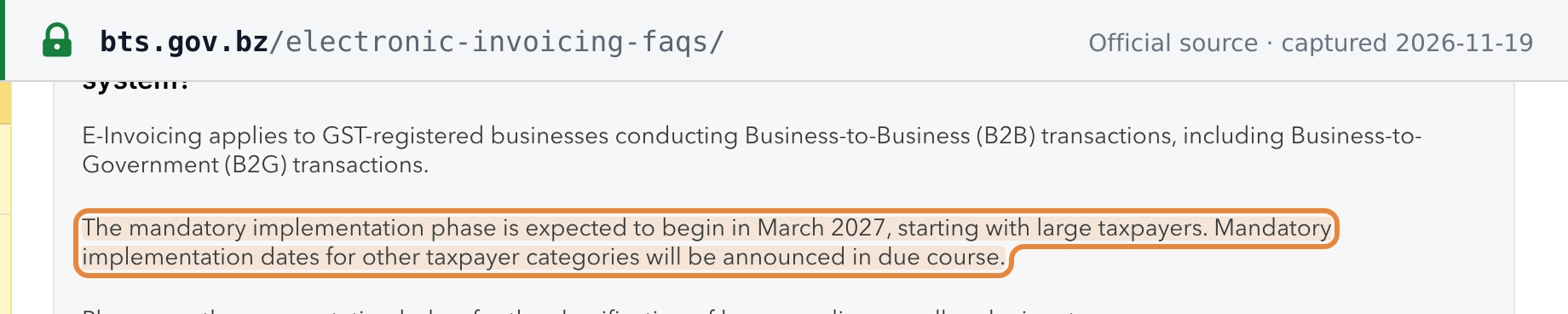 Source snapshot captured 2026-11-19 — original
March 2027 is BTS's announced date, not yet a legal one. The GST Act leaves the dates to the Commissioner: "(9) The Commissioner shall specify the dates and schedules by which all invoices and other tax documents, without exception, shall be issued electronically." Regulation 16A(3) adds that the Commissioner "shall publish a schedule of registered persons who are authorized to issue tax documents electronically along with the dates of authorisation, deadlines, transitions, coexistence with printed tax documents, and any other relevant information." BTS's news page, its GST legal resources, its two FAQs and the Orientation Manual publish no such notice or schedule (as at 2026-11-19). The March 2027 date appears only in BTS's FAQs. The main FAQ and Mixer FAQ C.8 say the mandatory phase is "expected" to begin then; Mixer FAQ F.3 states it flatly: "Large taxpayers will be the first group required to implement e-invoicing, beginning in March 2027." No day of the month is given, and without a Commissioner's notice or schedule it is not yet a legal date. [5] [7] [1] [2] [2]
| Phase | Who | Obligation | Date | Source | State |
|---|---|---|---|---|---|
| Legal basis | GST-registered persons | Tax invoices may be issued "either electronically or in printed form"; electronic documents must be authorized by BTS | In force 1 January 2025 | Act No. 34 of 2024 s.6, s.14 | In force |
| Pilot | 31 participating businesses | Issue ETDs through VERTX-BZ | Dates not published | BTS e-invoicing FAQ | Run before the voluntary phase |
| Voluntary | Any GST-registered business with B2B or B2G sales (large, medium, small; micro businesses that make B2B or B2G sales may apply) that has passed testing | Issue ETDs for B2B and B2G sales | Began September 2026 | BTS BCCI Mixer FAQ C.8, F.3, F.4 | Open |
| Mandatory, wave 1 | Large taxpayers (criteria below) | Issue B2B and B2G invoices, receipts and notes as authorized ETDs | Expected March 2027 (no day given) | BTS e-invoicing FAQ; Mixer FAQ C.8, F.3 | Announced by BTS; no Commissioner's schedule published |
| Later waves | Medium, small and micro taxpayers | Same | "will be announced in due course"; for small and micro businesses, "There is no set proposed timeline" | BTS e-invoicing FAQ; Mixer FAQ F.2 | Not announced |
| B2C | Sales to final consumers | Not yet in scope | "would occur in a later phase" | BTS e-invoicing FAQ | Not announced |
Voluntary phase. BTS's FAQ for the Belize Chamber of Commerce and Industry (BCCI) mixer: "E-invoicing is expected to become mandatory for large taxpayers beginning in March 2027. Businesses are encouraged to participate in the voluntary phase, which began in September 2026, to complete their integration, conduct testing and make any necessary adjustments before the mandatory deadline." Once a business has passed testing "it may begin issuing electronic tax documents during the voluntary phase. There is no need to wait until e-invoicing becomes mandatory." The phase "is open to large, medium and small businesses that are ready to participate." [2] [2]
Pilot. "The E-Invoicing system has been operating stably and reliably during the pilot with the 31 participating businesses. There have been no system crashes." BTS gives no start or end date for the pilot. [1]
Who is a large taxpayer
BTS's e-invoicing FAQ shows its taxpayer segmentation as a table (as at 2026-11-19):
| Segment | Annual sales (BZD) |
|---|---|
| Micro | under 75,000 |
| Small | 75,000 to 999,999.99 |
| Medium | 1,000,000 to 4,999,999.99 |
| Large | BTS lists three bullets: annual sales turnover of 5,000,000 or more · operating in sectors such as financial, insurance or utilities · annual tax contributions of BZD 500,000 or more |
A footnote keeps BTS's discretion: "The classification of taxpayers is primarily based on annual sales. However, other relevant considerations may also be taken into account when determining whether a taxpayer falls within the large taxpayer category." The Mixer FAQ gives the same bands in shorter form ("Large > $5m, including financial, insurance, and utilities sectors", "Annual tax contribution of $500,000 or more"). Neither source says whether "annual sales" includes zero-rated or exempt sales, and BTS has not said whether it will notify large taxpayers individually or publish a list. A business near a boundary should confirm its classification with BTS at etdinfo@bts.gov.bz. [1] [2]
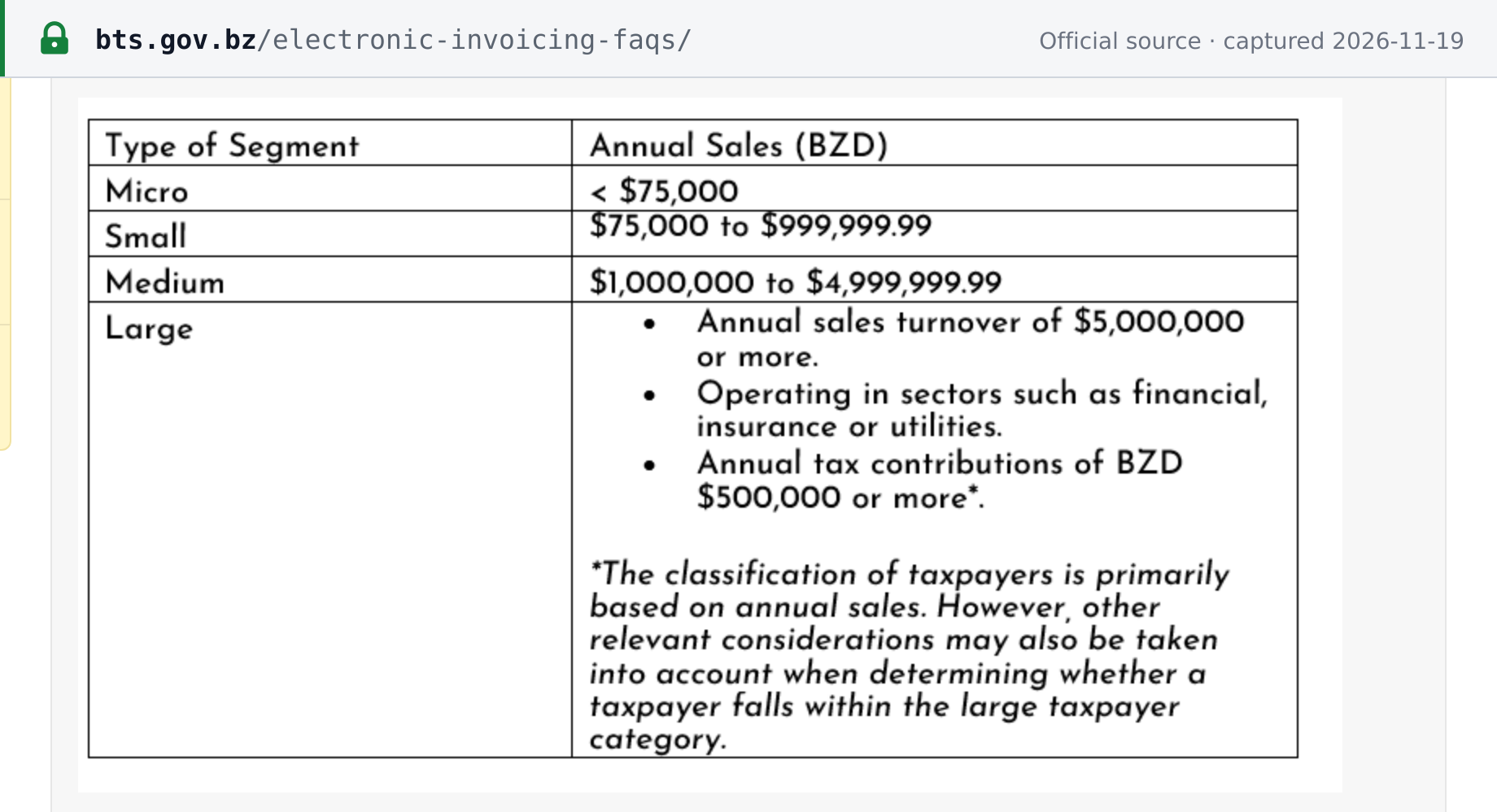 Source snapshot captured 2026-11-19 — original
Paper stays lawful until a business is mandated. Act No. 34 of 2024 amended the opening words of s.36(2) so that a tax invoice is issued "either electronically or in printed form". The Orientation Manual allows a business that is not yet mandated to fall back to paper when its e-invoicing system fails: "When the taxpayer is not mandated to use ETD, in any of the fault scenarios, it would be possible to issue the invoice on paper, in the traditional way." For a mandated taxpayer, "this contingency mode is not allowed." [5] [4]
Government commitment. The Budget Speech for FY2026/2027 (10 March 2026) said: "As part of its modernization strategy, the Belize Tax Service will oversee the full implementation of Electronic Invoicing supported by the Inter-American Development Bank and CIAT." It gives no date. [9]
Postponements. None. BTS has not moved any announced go-live date (as at 2026-11-19).
Legal basis
| Instrument | Date / publication | What it does for e-invoicing |
|---|---|---|
| General Sales Tax Act, Chapter 63, Revised Edition 2020 | Consolidated principal Act | The base text that Act No. 34 of 2024 amends |
| General Sales Tax (Amendment) Act, 2024 — Act No. 34 of 2024 | Gazetted 14 December 2024; in force 1 January 2025 (s.14) | Long title: "to enable electronic tax invoicing". s.6 amends s.36: invoices "either electronically or in printed form" (s.36(2)); s.36(4A) recipient access; s.36(7) BTS authorization of every electronic document; s.36(8) technical specifications published on BTS's website; s.36(9) the Commissioner sets the dates. s.7 inserts s.36A (tax receipts); s.8 electronic credit and debit notes; s.12 inserts the regulation power in s.96(2)(j) |
| GST (Amendment) Regulations, 2025 — SI No. 35 of 2025 | Gazetted 22 March 2025 | Electronic tax invoices, receipts and notes carry the issuer's electronic signature and a unique authorization code (regs 13(3), 14(3), 16(3)); a credit or debit note takes the same form, electronic or printed, as the invoice it adjusts (reg 16(4)–(5)) |
| GST (Amendment) (No. 2) Regulations, 2025 — SI No. 140 of 2025 | Gazetted 25 October 2025 | New Part IIA (regs 16A–16G): tests before issuing (16A), conditions incl. QR code (16B), previous and subsequent modes and validation against XML Schema UBL 2.4 (16C), delivery and graphical representation (16D), events and cancellation (16E), contingencies (16F), technical standards with at least one month's notice of updates (16G) |
| Orientation Manual for Issuers of Electronic Tax Documents, version 1.3 (May 2026) | Announced by BTS on 3 September 2026 | BTS's technical standard (s.36(8); reg 16G): operating modes, the BETDSM syntax on UBL, the ETDUI, QR code, web services, certificates and validation rules |
The core rule is s.36(7): "All electronic invoices and other electronic tax documents shall be authorized by the Tax Administration for their validity and tax recognition, in accordance with the regulations and technical standards issued for this purpose." [5]
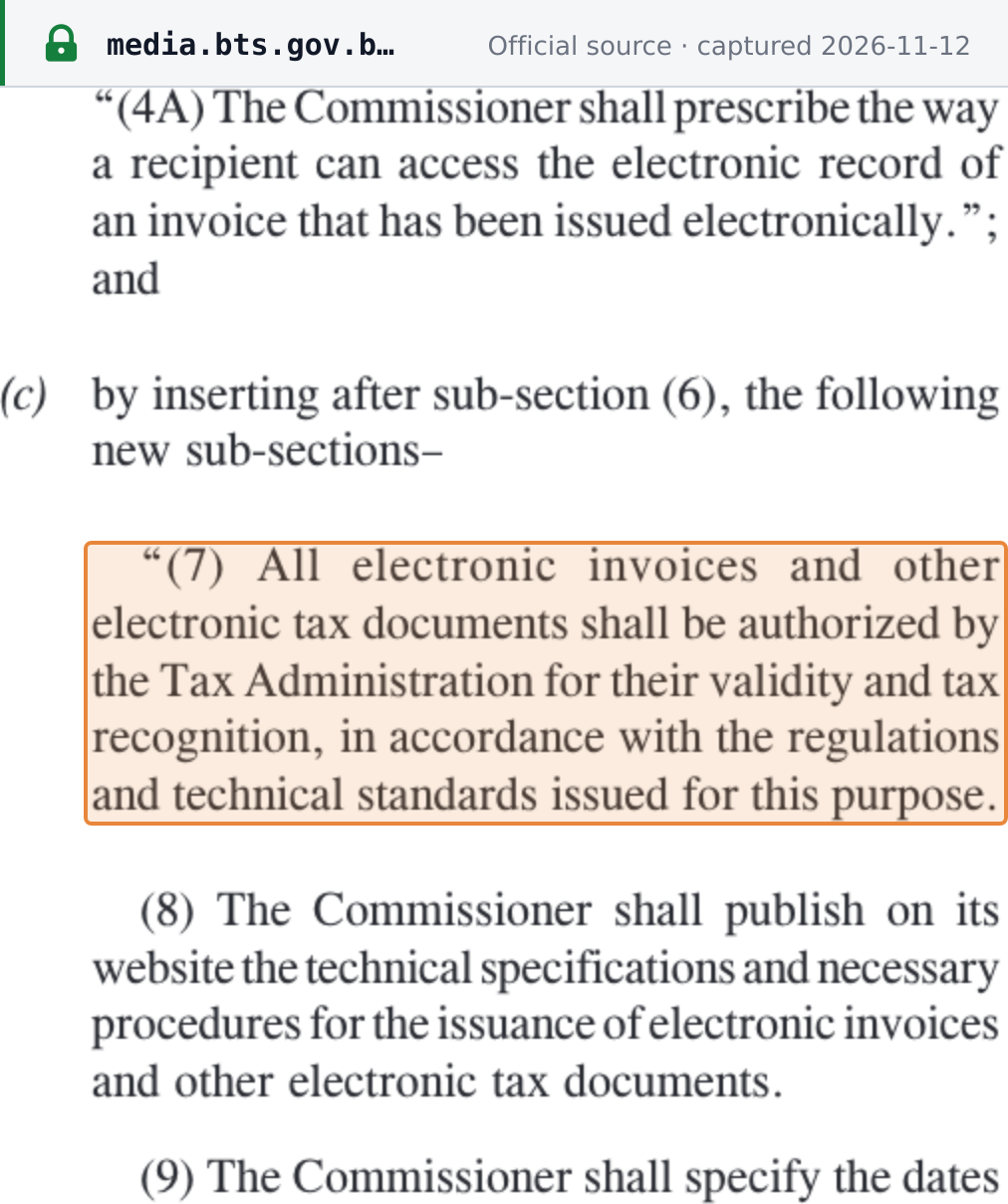 Source snapshot captured 2026-11-12 — original
The Orientation Manual cites the Electronic Transactions Act, 2021 as the basis for treating electronic invoices as equivalent to paper ones. [4]
Scope
B2B. In scope. "B2B transactions involve invoices issued from one GST registered business to another registered business. The VERTX-BZ system differentiates using the customer’s tax identification number (TIN). Transactions to unregistered individuals or consumers are not included in the current B2B scope." [1] BTS's definitions differ on a business customer that has a TIN but is not GST-registered. The brochure calls the document for a sale "from a GST registered business to a non-GST-registered business" an Electronic Tax Receipt, and the Mixer FAQ says: "If the customer is a business (B2B), an e-invoice should be issued. Businesses conducting business activities in Belize are expected to be registered with the Belize Tax Service (BTS) and therefore should have a Tax Identification Number (TIN), regardless of whether they are registered for GST." In practice, the customer's TIN decides that the sale goes through VERTX-BZ. [8] [2]
B2G. In scope, as part of B2B. The brochure: "The rollout of E-Invoicing will ONLY apply to business-to-business transactions (B2B), which includes business-to-government (B2G)." The Mixer FAQ: "B2G transaction are sales transactions from a GST-registered business to GOB. These invoices must be sent to VERTX-BZ for validation and authorization." [8] [2]
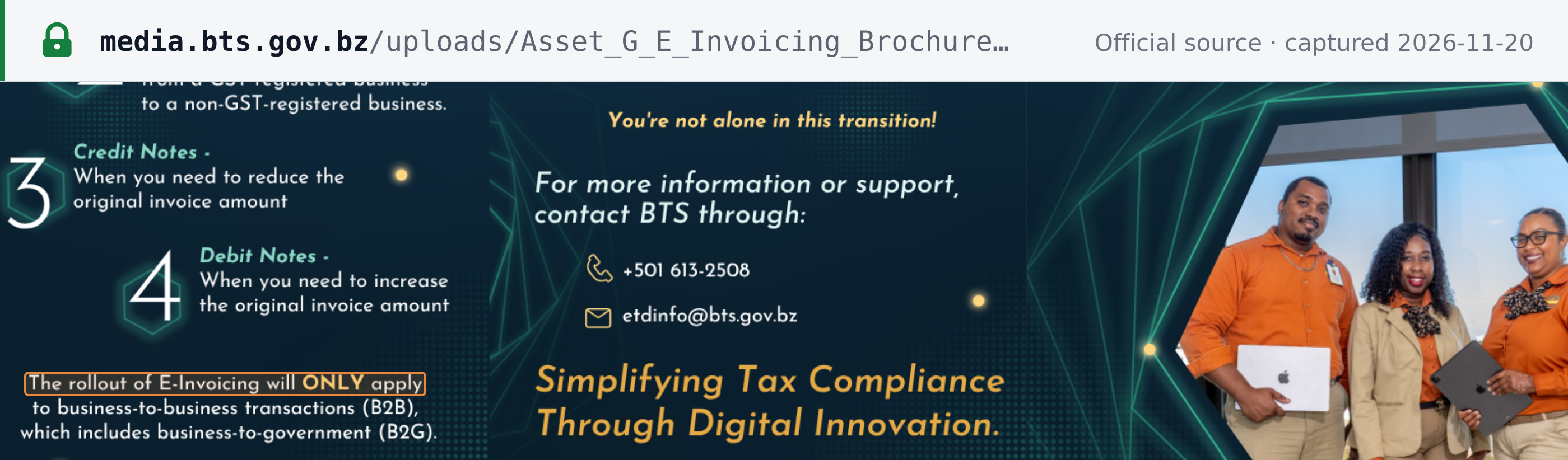 Source snapshot captured 2026-11-20 — original
B2C. Out of the current phases. "E-Invoicing applies only to B2B transactions. B2C transactions are not part of the initial rollout. Any inclusion of B2C transactions would occur in a later phase." Restaurants and retailers that sell only to consumers do not issue e-invoices "until the B2C phase is implemented", and point-of-sale sales to final consumers stay outside VERTX-BZ until then (Mixer FAQ I.3, I.5). [1] [2]
Who must issue. GST-registered suppliers only. "If a Businesses does not meet the threshold for GST, they are not required to participate in E-invoicing." Former international business companies (IBCs) and "other entities with no local business activity are not required to adopt E-Invoicing." [1] The GST registration threshold is in the Belize GST guide.
Non-established businesses. BTS's e-invoicing FAQ, the Mixer FAQ, the brochure, the Orientation Manual, Act No. 34 of 2024 and SI No. 140 of 2025 contain no rule on non-resident suppliers (as at 2026-11-19). SI No. 140 defines "issuer" as "a registered person who issues an electronic tax document in accordance with Part IIA", so the obligation follows GST registration. [7]
Special cases.
- Utilities selling to a business must put the customer's TIN on the tax invoice (Mixer FAQ F.6). [2]
- Foreign-currency invoices: "Invoices issued in foreign currency must show the conversion to BZE currency" (Mixer FAQ E.2; "BZE" as printed). [2]
- Imports and reverse-charge supplies: none of BTS's e-invoicing publications addresses them (as at 2026-11-19).
Simplified invoices. The paper rule that a tax invoice is not needed for small sales unless the customer asks (GST Act s.36(3), see the GST guide) has no counterpart in SI No. 140 of 2025 or the Orientation Manual (as at 2026-11-19). B2C sales are outside the current phases in any case.
Format & network
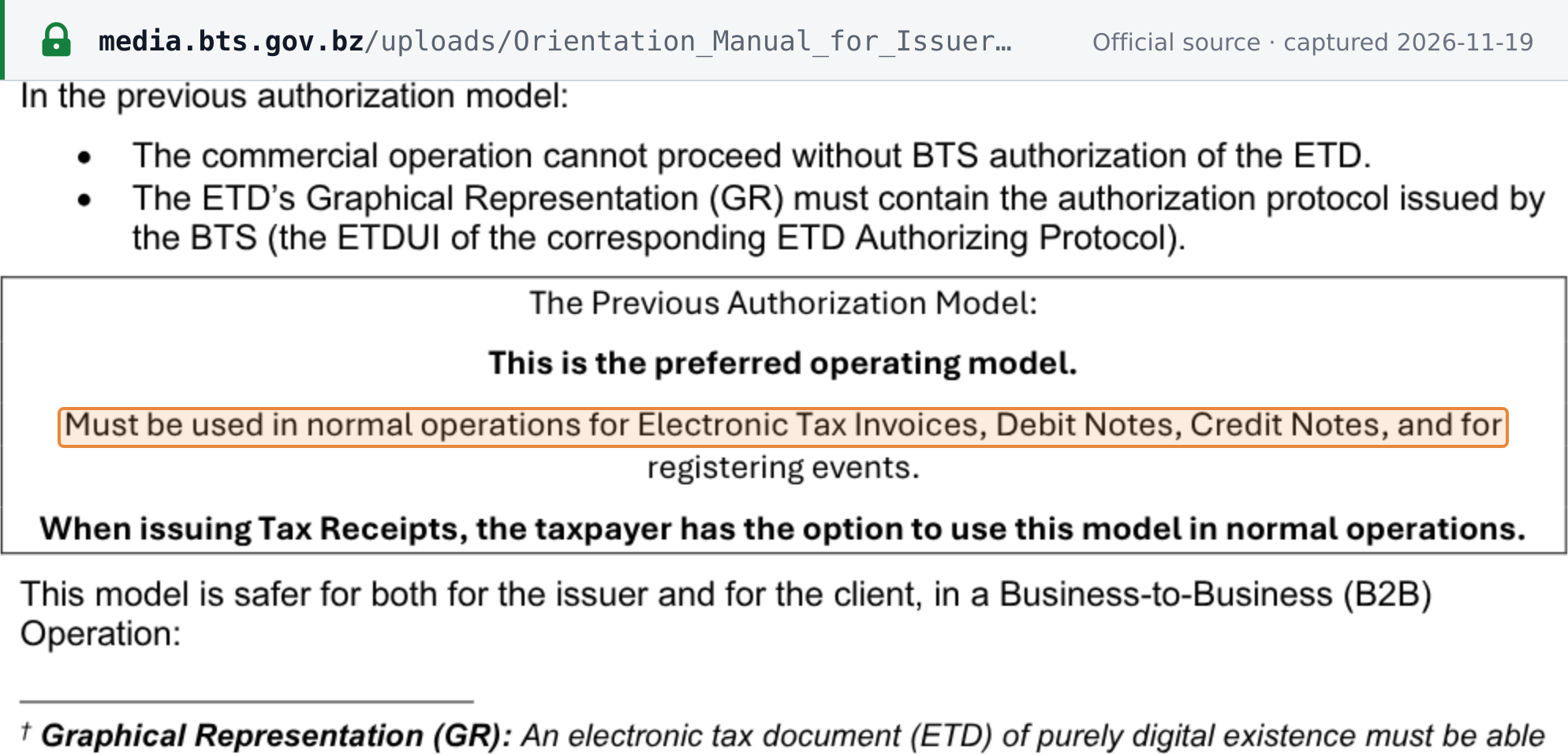
The model: clearance ("previous authorization"). Regulation 16C(1) of the GST Regulations provides two ways to transmit: "(a) previous mode which is the electronic transmission to the Commissioner prior to issuance in real time … or (b) subsequent mode which is the electronic transmission to the Commissioner after issuance". The Orientation Manual makes previous authorization the rule: it "Must be used in normal operations for Electronic Tax Invoices, Debit Notes, Credit Notes, and for registering events. When issuing Tax Receipts, the taxpayer has the option to use this model in normal operations." The subsequent mode is otherwise used only in a contingency (Table 3—1). "A tax document only exists after it has been received, validated, and authorized by BTS." See CTC e-invoicing models. [7] [4]
 Source snapshot captured 2026-11-19 — original
What VERTX-BZ does to an invoice. The issuer generates and signs the XML and sends it to VERTX-BZ. BTS validates it and, if it passes, returns an authorization; otherwise it rejects it. Regulation 16C(3): "the Commissioner shall authorize the electronic tax document with an authorization code comprising a unique code generated by an algorithm for each tax document". Responses are synchronous: "the BETDRS utilizes only synchronous conclusive responses, where a taxpayer sends a request and waits for the server to process and respond." Each document is sent on its own: "the platform does not process multiple invoices as a single batch submission." [7] [4] [2]
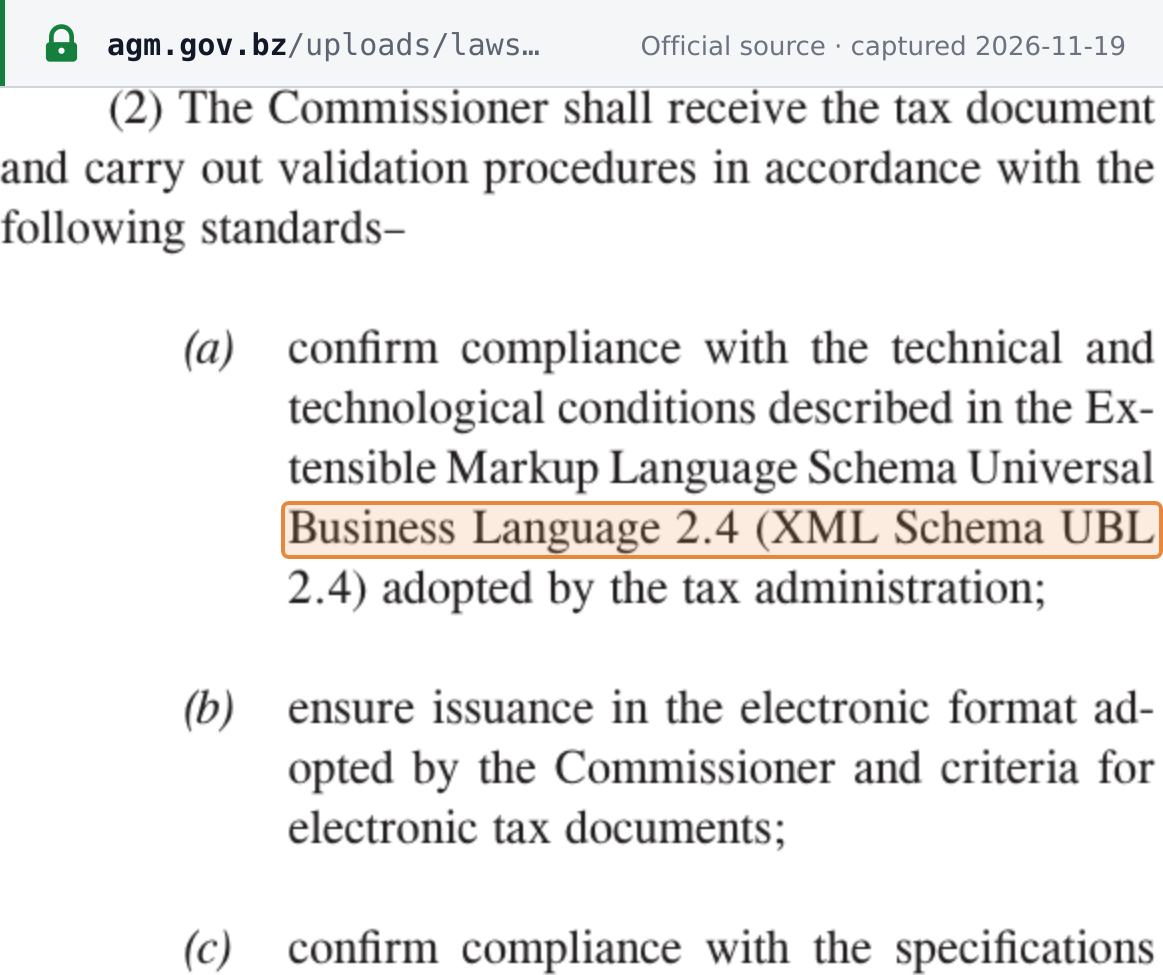
XML standard: UBL 2.4. Regulation 16C(2)(a) has BTS "confirm compliance with the technical and technological conditions described in the Extensible Markup Language Schema Universal Business Language 2.4 (XML Schema UBL 2.4) adopted by the tax administration". BTS's FAQ: "BTS requires electronic invoices to be generated and submitted in XML format using the UBL 2.4 standard." The national syntax is the Belize ETD Syntax Model (BETDSM). One quirk: the four UBL 2.4 schemas BETDSM uses are identical to UBL 2.1, so "this element must be informed with the literal “2.1” (and not 2.4, as could be expected)" in cbc:UBLVersionID (Orientation Manual §4.4). Act No. 34 of 2024, SI No. 35 of 2025 and SI No. 140 of 2025 do not mention EN 16931. The Orientation Manual refers to EN 16931 for some data types and lists it among its references, but does not describe BETDSM as a CIUS of it. [7] [1] [4]
 Source snapshot captured 2026-11-19 — original
Network: direct to BTS, not Peppol. "The technology adopted for exposing web services is WEB API with REST protocol submitting the ETD XML file in PayLoad by the POST method." The manual lists a production environment (https://prod.bz.efdrciat.org) and a tests environment (https://test.bz.efdrciat.org), with one route per document type (for example api/invoice/v1 for tax invoices) plus event, query and status services. Neither the Orientation Manual nor the Mixer FAQ mentions Peppol (as at 2026-11-19). [4]
Integrity mechanics.
- Signature. SI No. 35 of 2025 requires an electronic tax invoice to carry the "electronic signature of the issuer or their representative" and a "unique code of authorization for electronic issuance" (reg 13(3)). The manual: "Any electronic document sent to the EFDR reception environment for validation must be signed with a digital certificate, issued by the EFDR root digital certification body." The same kind of certificate authenticates the connection. [6] [4]
- ETDUI. Every document has an Electronic Tax Document Unique Identifier "in a total of 44 numeric digits", built from the document type, a reserved digit ("0"), the issuer's TIN, the issue date and time, the serial number and series, the operating mode, the reception environment, a random numerical security code and a check digit. [4]
- QR code. Required by regulation 16B(b). "The QR Code only provides a means to consult the ETD in the CIAT Electronic Fiscal Documents Reception System (EFDR), by providing its ETDUI." [7] [4]
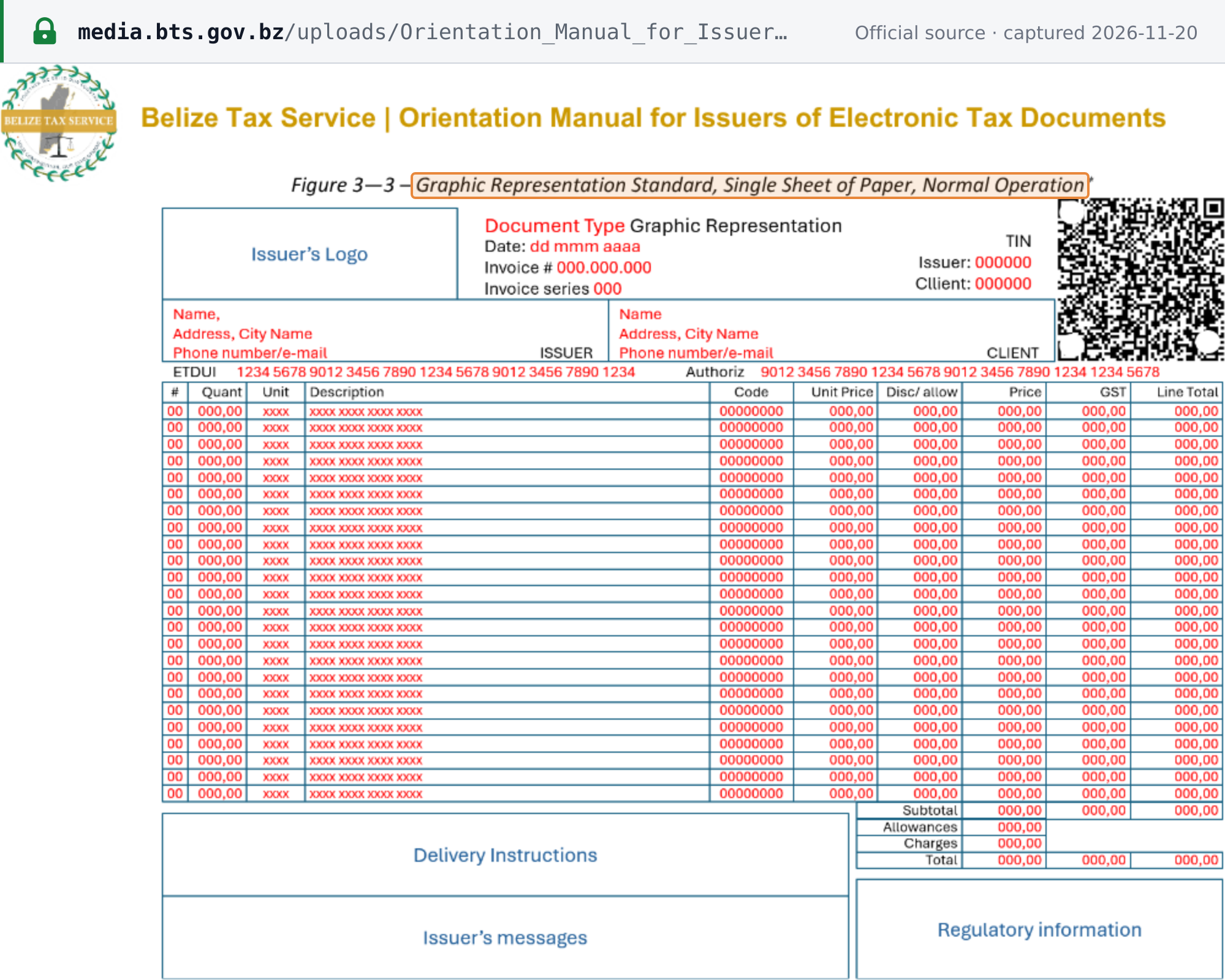
What the customer sees. The signed XML is the legal document; the printed or PDF "graphical representation" (GR) is a view of it: "Since the signed and authorized XML file is the actual document for all purposes, and GR is NOT that document, there are no restrictions for the number of printed GR for a given ETD." A GR from the tests environment must say it has no fiscal value. [4]
 Source snapshot captured 2026-11-20 — original
Corrections. An adjustment after issue is made with an electronic credit or debit note (reg 16E(1)–(2)); a document that was authorized for a sale that did not take place may be cancelled (reg 16E(3)), which the manual handles by registering a cancellation event. Under SI No. 35 of 2025, "(4) If the tax invoice to be adjusted by a credit note or debit note is an electronic tax invoice, the credit or debit note shall also be issued electronically. (5) A credit note or debit note issued to adjust a printed invoice shall also be issued in printed form." [6] [7]
Reporting alongside: none. GST returns are unchanged. "Currently this Electronic Invoicing Receiving system is not currently linked to IRIS. However, the invoicing data collected will in the future aid us to be able to implement prefilled returns. It will also eliminate the need to submit sales and purchase ledgers." Credit- and debit-note adjustments are still made "on your return when filing on IRIS Belize and not VERTX-BZ" (Mixer FAQ E.1). [1] [2]
Onboarding: how to comply
1. Pass BTS's tests first (a legal precondition). Regulation 16A: "(1) A registered person who wish to issue a tax document electronically, shall complete the electronic transmission and reception tests and procedures under regulation 16G. (2) Upon successful completion of the tests under sub-regulation (1), a registered person shall comply with regulation 16B to begin electronic issuance of his tax documents." The tests environment has no legal effect: "an ETD transmitted to the production environment has legal effects for all purposes; tests environment has no legal effects." [7] [4]
2. Get EFDR certificates. "All Belizean issuers authorized by BTS to send ETD can obtain the digital certificates described in the present section from the ETDRS, accessible in EFDR - Electronic Tax Documents (portal.prod.bz.efdrciat.org)." [4]
3. Choose a connection.
| Route | Suits | Status (as at 2026-11-19) |
|---|---|---|
| Web-service (API) integration of your own ERP or accounting system | Businesses with in-house IT | Available |
| Integration through a solution provider | Businesses using off-the-shelf software; BTS: "Several solution providers have already developed working integrations with commonly used accounting platforms, including QuickBooks Online." | Available |
| Free BTS web tool | "eligible micro and small taxpayers" | "The tool is not yet available" |
| Manual entry on BTS's system | All | Only "after the Belize Electronic Tax Documents Reception System (BETDRS) is fully operative" |
Providers: no accreditation list yet. "Businesses are not required to purchase or use a specific software product approved by the Belize Tax Service." Providers "will be required to demonstrate that their solutions meet the applicable technical, security, testing and integration requirements before connecting to the production environment. … Further details regarding the provider registration, testing and approval process will be communicated by BTS." No list of approved providers is published (as at 2026-11-19). [2] [2]
Cost. "There is no additional payment to BTS for using the E-Invoicing system itself; filing and validation remain part of regular tax compliance processes." Third-party providers set their own fees. [1]
Contingencies. If a document cannot be transmitted because of "unforeseen circumstances", it "may be delivered to the recipient without authorization", and "As soon as possible thereafter, the issuer shall transmit any tax document delivered under unforeseen circumstances to the tax administration in the XML Schema UBL 2.4 structure" (reg 16F(1)–(2)). The Orientation Manual §3.3.6 sets the procedure. BTS's FAQ says scenario-by-scenario guidance on power loss, internet disruption and system downtime "will be formally published"; it was not published as at 2026-11-19. [7] [4] [1]
Specification changes. "The Commissioner shall publish updates and provide a period of not less than one month for adoption of such updates by the registered persons" (reg 16G(4)). [7]
Contact. etdinfo@bts.gov.bz; BTS's brochure lists +501 613-2508. [1] [8]
Penalties
No e-invoicing-specific penalty. Neither Act No. 34 of 2024 nor SI No. 35 or SI No. 140 of 2025 sets a penalty for failing to issue an electronic tax document (as at 2026-11-19); the only penalty in Act No. 34 concerns late GST registration. The Act gives the Minister power to make regulations on "(iv) the obligations, prohibitions, and corresponding administrative measures; and (v) the deadlines and schedules for compliance with the obligation to issue them electronically and their coexistence with the regime of printed tax documents" (s.96(2)(j), inserted by s.12). Any e-invoicing penalty would come in a new statutory instrument. [5] [6] [7]
The practical exposure is validity. Under s.36(7) an electronic document needs BTS's authorization "for their validity and tax recognition". BTS: each sales invoice must be authorized "before it is sent to the client because it will have no legal or fiscal value without BTS’s authorization protocol." [5] [1]
Outages. BTS's Mixer FAQ: a business that follows the contingency procedure "should not be penalized solely because of a verified VERTX-BZ outage", and the proof it needs is that "the proper procedure documented in the Orientation Manual for Issuers of Electronic Tax Documents provided by BTS, on the BTS website, was followed." [2]
Frequently asked questions
When does e-invoicing become mandatory in Belize? Is March 2027 a legal deadline?
BTS's FAQs give March 2027 for the start of the mandatory phase, starting with large taxpayers; dates for other taxpayer categories will be announced later. Some BTS answers say the phase is expected to begin then, while the Mixer FAQ states it flatly; no day is given. Under GST Act s.36(9) the Commissioner specifies the dates, and no Commissioner's notice or schedule had been published as at 19 November 2026, so March 2027 is not yet a legal date. [1] [5]
Are we a "large taxpayer"?
BTS's published segmentation lists three criteria for the large category: annual sales turnover of BZD 5,000,000 or more; operating in sectors such as financial, insurance or utilities; annual tax contributions of BZD 500,000 or more. BTS does not say how the criteria combine; it says classification is primarily based on annual sales but other considerations may be taken into account, so confirm with BTS at etdinfo@bts.gov.bz. [1]
We sell mostly to consumers. Are we in scope?
Only for your B2B and B2G sales. BTS says businesses that primarily make retail B2C sales are not required to issue e-invoices for those sales, but any B2B or B2G transactions fall within e-invoicing. B2C is not part of the current phases. [1]
Can we send our invoices to BTS in a batch at the end of the day?
You may send them at the end of the day if that is when you generate them, but not as one batch. BTS's Mixer FAQ says each invoice must be submitted and authorized individually before it is issued as a valid electronic tax document; the platform does not process multiple invoices as a single batch submission. [2]
Do we still file sales and purchase ledgers with the GST return?
Yes. VERTX-BZ is not linked to IRIS, and GST returns are filed on IRIS as before. BTS says the invoice data may later support prefilled returns and remove the need for ledgers. [1]
Can we keep using QuickBooks Online?
Yes, through an integration. BTS says e-invoicing does not replace existing accounting software, and several solution providers have built working integrations with common platforms, including QuickBooks Online. BTS does not require any approved software product. [1] [2]
What if our internet or VERTX-BZ is down?
Use the contingency procedure: the document may be delivered to the customer without authorization and must be transmitted to BTS as soon as possible afterwards (GST Regulations reg 16F). BTS says a business that follows the procedure should not be penalized solely because of a verified VERTX-BZ outage. [7] [2]
We invoice in US dollars. What does the e-invoice need?
BTS's Mixer FAQ says invoices issued in foreign currency must show the conversion to Belize dollars. [2]
Recent changes
- 2026-09-04 — BTS published "GST Guidance: Debit Notes and Credit Notes": credit- and debit-note GST is reported on Lines 260 and 150 of the BTS210 return. (Belize Tax Service) — see event
- 2026-09-03 — BTS announced the Orientation Manual for Issuers of Electronic Tax Documents (version 1.3, May 2026), the technical standard for VERTX-BZ. (Belize Tax Service)
- 2025-10-25 — SI No. 140 of 2025 gazetted, inserting Part IIA (electronic tax documents) into the GST Regulations. (Attorney General's Ministry)
- 2025-03-22 — SI No. 35 of 2025 gazetted: electronic signature and authorization code on electronic tax invoices, receipts and notes. (Attorney General's Ministry)
- 2025-01-01 — Act No. 34 of 2024 in force: tax invoices may be issued electronically, and electronic tax documents must be authorized by BTS. (Belize Tax Service) — see event
Related resources
- Belize GST guide — rate, registration threshold, invoice requirements, returns
- E-invoicing status and networks by country
- CTC e-invoicing models explained
- Mexico e-invoicing (CFDI) and Dominican Republic e-invoicing (e-CF) — other clearance systems in the region
- Belize tax changes on Lookuptax
Important websites
- BTS e-invoicing FAQs — scope, rollout, taxpayer segmentation; contact etdinfo@bts.gov.bz
- Orientation Manual for Issuers of Electronic Tax Documents (PDF) — technical specification
- EFDR portal — digital certificates for authorized issuers (sign-in required)
- Belize Tax Service
Reference links
- Belize Tax Service — Electronic invoicing FAQs
- Belize Tax Service — BCCI Mixer FAQs on e-invoicing (PDF)
- Belize Tax Service — New publication: Orientation Manual for Issuers of Electronic Tax Documents (3 September 2026)
- Belize Tax Service — Orientation Manual for Issuers of Electronic Tax Documents, version 1.3, May 2026 (PDF)
- General Sales Tax (Amendment) Act 2024, Act No. 34 of 2024 (PDF)
- General Sales Tax (Amendment) Regulations 2025, SI No. 35 of 2025 (PDF)
- General Sales Tax (Amendment) (No. 2) Regulations 2025, SI No. 140 of 2025 (PDF)
- Belize Tax Service — E-Invoicing brochure (June 2026, PDF)
- Government of Belize — Budget Speech, Fiscal Year 2026/2027 (PDF)
- General Sales Tax Act, Chapter 63, Revised Edition 2020 (PDF)