E-invoicing in Fiji: the VAT Monitoring System and Electronic Fiscal Devices
Status as of 3 November 2026.
Overview
Fiji does not run a B2B e-invoice exchange. There is no Peppol network, no UBL format and no clearance XML. It runs real-time fiscalisation: every sale by a business in a gazetted group must go through an accredited Electronic Fiscal Device (EFD), which signs the receipt and sends the transaction to the tax authority as it happens.
- Electronic Fiscal Device (EFD). The taxpayer's side: an accredited point-of-sale (POS) application connected to a Sales Data Controller (SDC). FRCS's accreditation instructions describe it as "an Invoicing System (POS), an SDC and a Secure Element, all connected into one system".
- VAT Monitoring System (VMS). FRCS's side: the system that receives, verifies and stores the fiscal data. FRCS describes it as a system that "connects an approved Point of Sale (POS) application to a Sales Data Controller (SDC), enabling transactional data to be transmitted securely to FRCS in real time".
- Fiscal invoice. The output: a receipt with a sequential number, the EFD's digital signature as a QR code, and the buyer's TIN on business and government sales.
(FRCS — VMS compliance notice, 22 October 2026; FRCS — EFD accreditation instructions)
Who runs it. The Fiji Revenue and Customs Service (FRCS). "The CEO is responsible for the administration of these Regulations" (EFD reg 13(1)). The software platform behind the VMS is TaxCore, by Data Tech International; FRCS hosts its technical documentation on its own sandbox at tap.sandbox.vms.frcs.org.fj.
Legal basis in one line. The Tax Administration (Electronic Fiscal Device) Regulations 2017 (Legal Notice No. 37 of 2017, in force 1 June 2017), with the groups and deadlines set by Ministerial gazette notice under regulation 28 — currently Gazette Notice No. 61 of 2025. The full list is under Legal basis.
| Fiji | |
|---|---|
| Model | Real-time fiscalisation through accredited Electronic Fiscal Devices reporting to FRCS's VAT Monitoring System |
| Status | Mandatory for gazetted groups of businesses, phased by industry. Phase 3's last group (wholesalers, manufacturers and retailers) implements by 31 December 2026; FRCS's 22 October 2026 notice calls 31 December 2026 the final compliance date for all Phase 1–3 businesses |
| Who | Businesses in a gazetted group whose gross annual turnover exceeds FJD 50,000 (Gazette Notice No. 61 of 2025; EFD reg 2 as amended by LN 35 of 2025 from 1 January 2026). See the turnover test |
| B2B / B2G / B2C | All three. One fiscal invoice per transaction, whoever the customer; the buyer's TIN is captured on B2B and B2G sales |
| Non-residents | Not addressed by the Regulations or FRCS |
| Format | Fiscal invoice (printed receipt or emailed link) carrying the EFD's QR-code signature; data sent to FRCS as JSON over the TaxCore API. Not XML, UBL, CII or Peppol |
| Network | Direct to FRCS: the Virtual SDC (FRCS web service, online only) or an accredited External SDC (works offline). Not Peppol-based |
| Next date | 31 December 2026: Phase 3 wholesalers, manufacturers and retailers implement; FRCS ceases EFD Version 2.0 |
| Authority | Fiji Revenue and Customs Service (FRCS) |
| Legislation | Tax Administration Act 2009 s.118A(2); EFD Regulations 2017 (LN 37 of 2017) as amended to LN 35 of 2025; Gazette Notice No. 61 of 2025 |
Mandate status & timeline
Who must comply: a gazetted group plus a turnover test
The obligation does not attach to every VAT-registered business. Regulation 28 lets the Minister specify groups of businesses by notice in the Gazette, each with a date by which its members must have an EFD installed and operating. A business is caught when it is in a specified group and meets the turnover test in the notice.
Once one business is in a group, the rule spreads across the taxpayer: the EFD must operate "for each business that is a member of the group and any other business operated by the taxpayer under the same Taxpayer Identification Number as the business in the group" (reg 28(2B)). (FRCS — Tax Administration Act 2009, revised to 1 August 2025, EFD Regulations reg 28, p.176)
The turnover test: FJD 50,000 from 1 January 2026
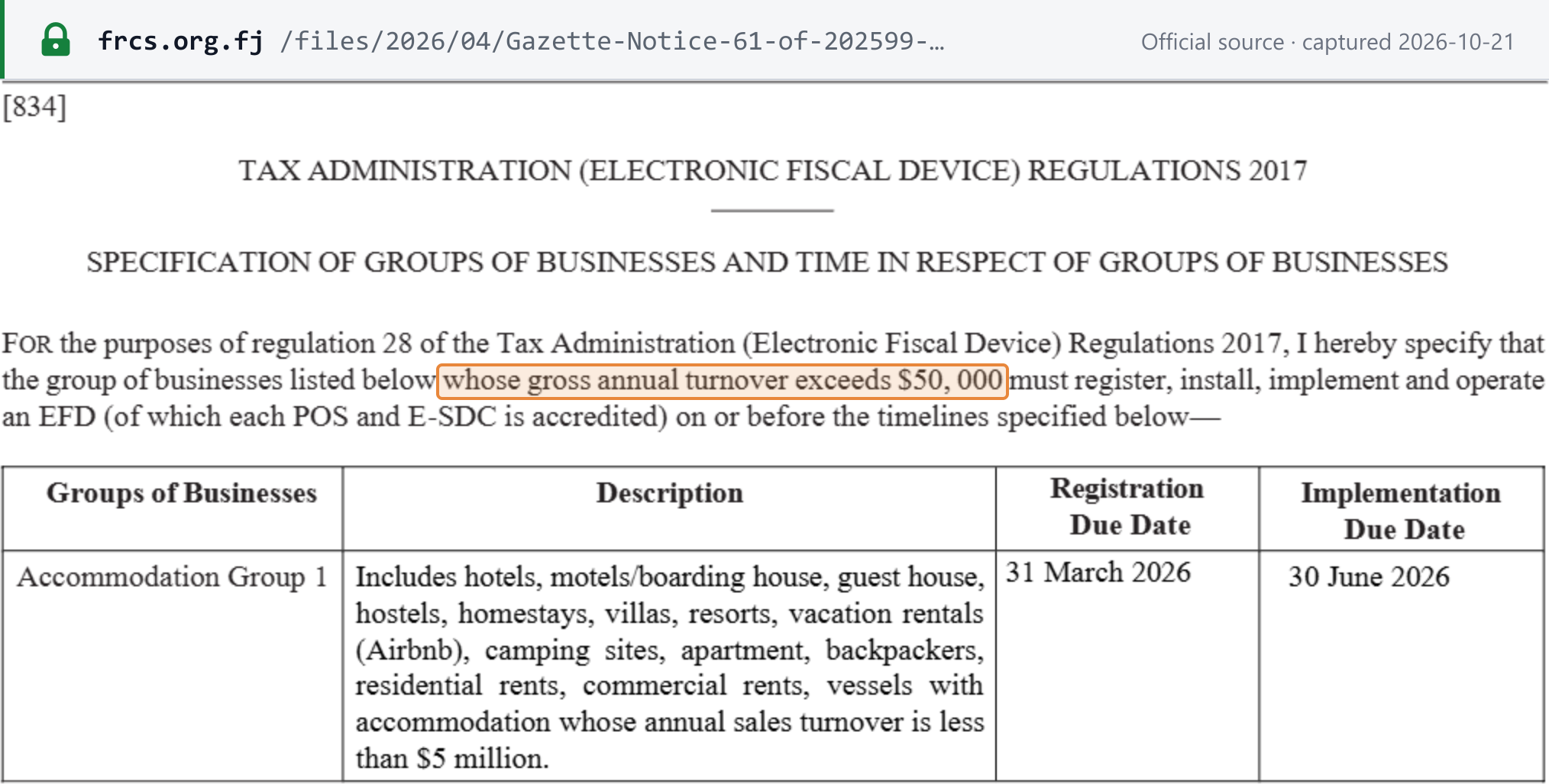
Gazette Notice No. 61 of 2025 (8 August 2025) states the test for Phase 3:
"FOR the purposes of regulation 28 of the Tax Administration (Electronic Fiscal Device) Regulations 2017, I hereby specify that the group of businesses listed below whose gross annual turnover exceeds $50, 000 must register, install, implement and operate an EFD (of which each POS and E-SDC is accredited) on or before the timelines specified below"
FRCS's VMS FAQ ties the figure to the 2025–2026 National Budget: "businesses whose gross annual turnover exceeds $50,000 must register, install, implement and operate an EFD." (Gazette Notice No. 61 of 2025; FRCS — VMS FAQs)
 Source snapshot captured 2026-10-21 — original
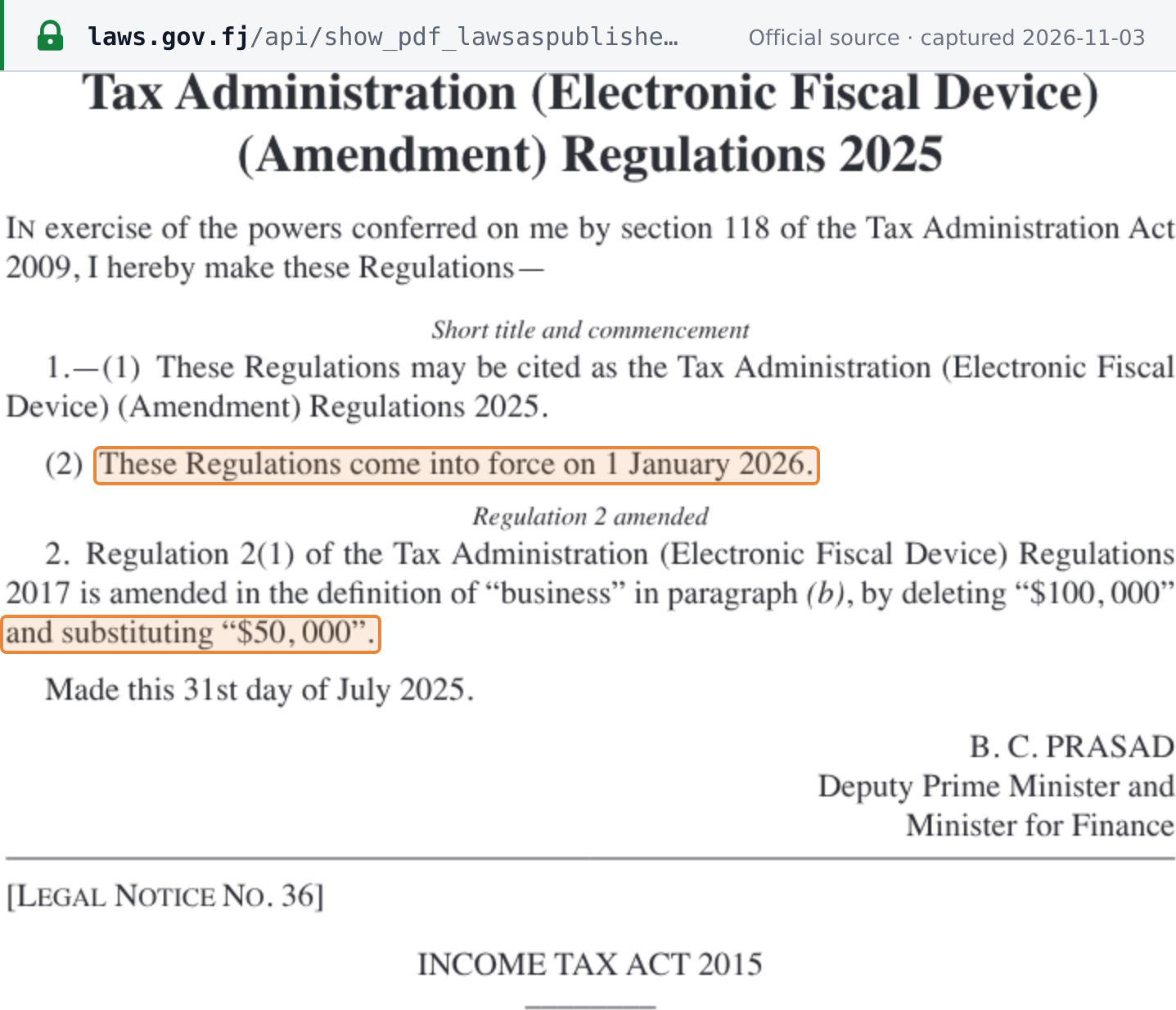
Regulation 2 now uses the same figure. The Tax Administration (Electronic Fiscal Device) (Amendment) Regulations 2025 (Legal Notice No. 35 of 2025, made 31 July 2025) amended the definition of a covered "business" in regulation 2(1)(b) "by deleting “$100, 000” and substituting “$50, 000”", with effect from 1 January 2026. Until 31 December 2025, regulation 2 still read FJD 100,000 (as set by LN 57 of 2020). FRCS's consolidated revision of the Regulations to 1 August 2025 predates the change and still prints FJD 100,000. (Laws of Fiji — LN 35 of 2025)
 Source snapshot captured 2026-11-03 — original
Businesses between FJD 50,000 and FJD 100,000. Gazette Notice No. 61 of 2025 itself provides: "Groups of businesses whose gross annual turnover is between $50, 000 to $100, 000 may seek an extension of the timelines at the discretion of the Chief Executive Officer of the Fiji Revenue and Customs Service." FRCS's Phase 3 notice repeats the point: "certain businesses below the VAT Threshold of $100,000 may face challenges in meeting the deadlines and they are advised to formally submit their requests to the CEO FRCS." An extension is discretionary, not automatic. (Gazette Notice No. 61 of 2025; FRCS — Phase 3 timelines)
Two further wording points:
- The gazette and LN 35 of 2025 say "exceeds $50, 000"; FRCS's Phase 3 notice says "$50,000 and above" and its 22 October 2026 notice "$50,000 or more". The difference matters only at exactly FJD 50,000.
- The test is not the VAT registration threshold, which is FJD 100,000.
Phases 1 and 2
| Phase | Industries | First gazetted | Compliance date stated by FRCS |
|---|---|---|---|
| Phase 1 | Supermarkets and pharmacies | Gazette notice [834] of 2017: EFD by 31 December 2017, extended to 28 February 2018 by notice [1937] | 31 December 2025 (passed) |
| Phase 2 | Medical centres, travel agencies, accounting firms, law firms, hardware companies | Gazette notice [1936] of 2017: EFD by 30 June 2018 | 31 December 2025 (passed) |
These two groups were exempt from the EFD requirement for an "exemption period" from 1 April 2020 to 31 July 2024 (reg 28(2C)–(2D), as amended by LN 53 of 2023 and LN 77 of 2024). After the 2025–2026 Budget, FRCS's FAQ says "Phase 1 & 2 taxpayers are required to comply by 31st December 2025." That date is stated by FRCS in its notices and FAQ; no gazette notice setting it is published on FRCS's EFD Gazettes page. (FRCS — Group 1 specification; Group 2 specification; FRCS — clarification notice; VMS FAQs)
A 2019 gazette (No. 38, notice [579]) had specified nine further groups with a 31 July 2019 deadline. Those dates are historical; Phase 3 is now governed by Gazette Notice No. 61 of 2025.
Phase 3: Gazette Notice No. 61 of 2025
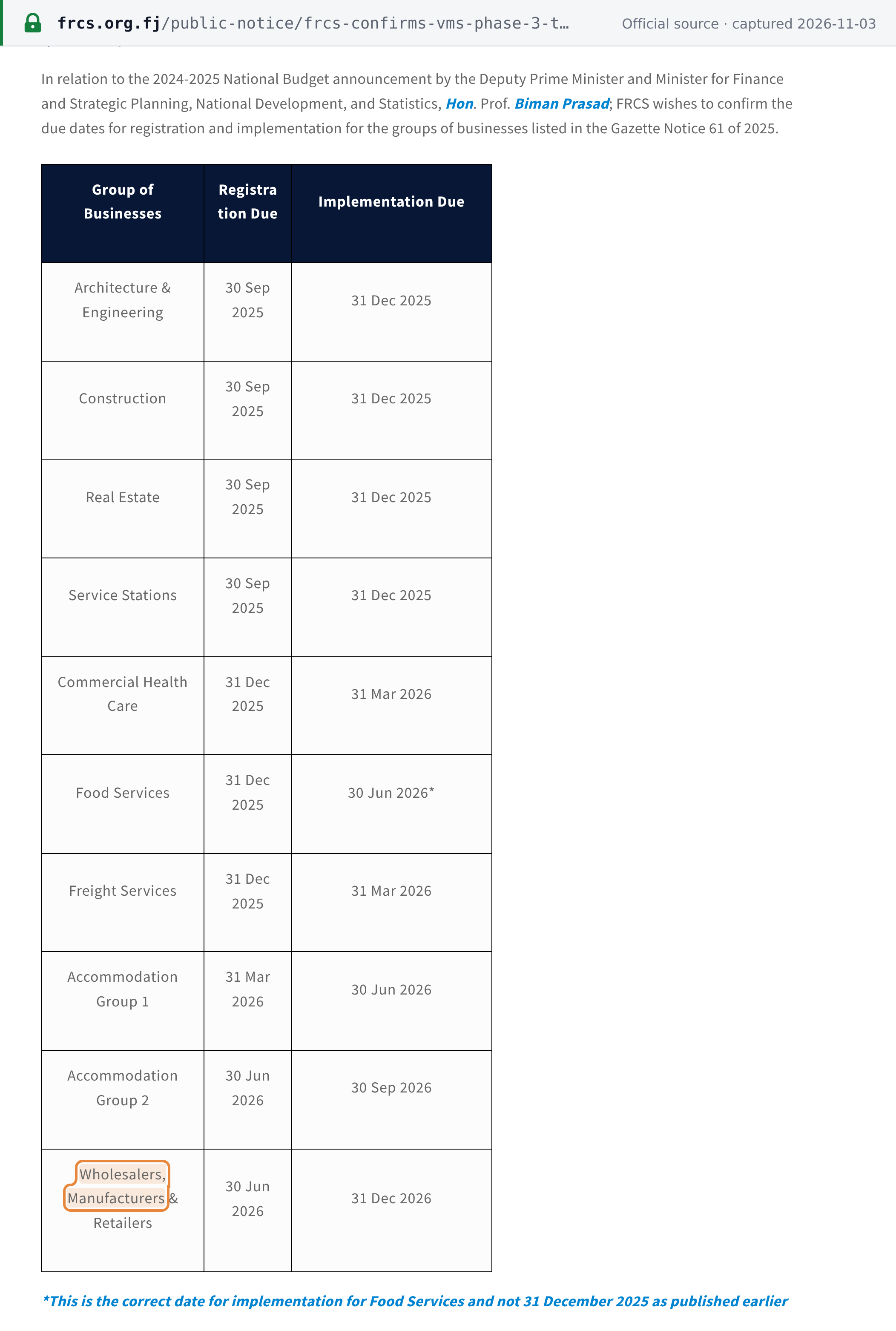
| Group | Registration due | Implementation due | Status at 2026-11-03 |
|---|---|---|---|
| Architecture and engineering | 30 Sep 2025 | 31 Dec 2025 | Passed |
| Construction | 30 Sep 2025 | 31 Dec 2025 | Passed |
| Real estate | 30 Sep 2025 | 31 Dec 2025 | Passed |
| Service stations | 30 Sep 2025 | 31 Dec 2025 | Passed |
| Commercial health care | 31 Dec 2025 | 31 Mar 2026 | Passed |
| Freight services | 31 Dec 2025 | 31 Mar 2026 | Passed |
| Food services | 31 Dec 2025 | 30 Jun 2026 | Passed |
| Accommodation Group 1 (annual sales turnover under FJD 5 million) | 31 Mar 2026 | 30 Jun 2026 | Passed |
| Accommodation Group 2 (annual sales turnover over FJD 5 million) | 30 Jun 2026 | 30 Sep 2026 | Passed |
| Wholesalers, manufacturers and retailers | 30 Jun 2026 | 31 Dec 2026 | Registration passed; implementation upcoming |
The groups are drawn widely. Accommodation includes "vacation rentals (Airbnb)" and residential and commercial rents; food services includes kava bars and liquor shops; and the last group "extends to hardware companies, supermarkets and pharmacies that are wholesalers or manufacturers". Read the gazette for the full descriptions. FRCS corrected the food-services implementation date to 30 June 2026 ("not 31 December 2025 as published earlier"). (FRCS — Phase 3 timelines)
 Source snapshot captured 2026-11-03 — original
Latest: FRCS's final reminder of 22 October 2026
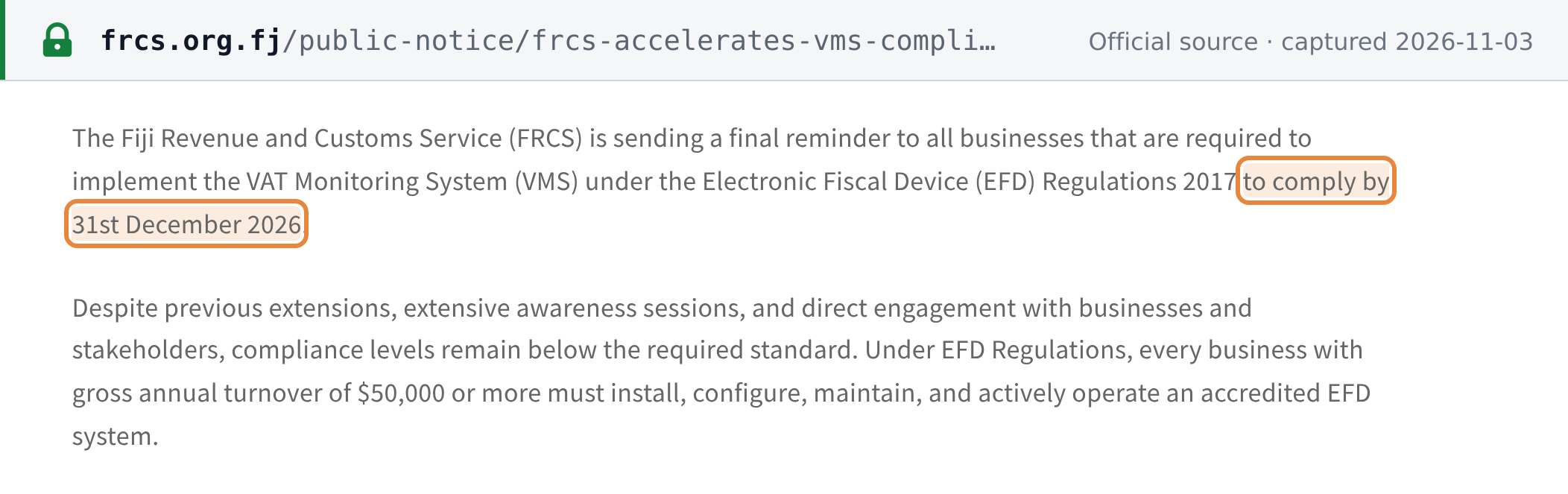
FRCS published a notice on 22 October 2026 headed "FRCS Accelerates VMS Compliance Monitoring for Phase 1 to 3". It is "a final reminder to all businesses that are required to implement the VAT Monitoring System (VMS) under the Electronic Fiscal Device (EFD) Regulations 2017 to comply by 31st December 2026". It adds that "despite previous extensions … compliance levels remain below the required standard", and that businesses that fail to install or properly operate an EFD by the applicable deadline may face "audit scrutiny or enforcement actions under the Tax Administration Act 2009".
FRCS's notice calls 31 December 2026 the final compliance date for Phase 1–3 businesses and says compliance monitoring is being accelerated. It is an FRCS notice, not a gazetted extension under reg 28(2): no gazette notice changing the Phase 3 dates is published on FRCS's EFD Gazettes page. (FRCS — VMS compliance notice, 22 October 2026)
 Source snapshot captured 2026-11-03 — original
EFD Version 2.0 ends on 31 December 2026
Phase 3 businesses under Gazette Notice No. 61 of 2025 are "Required to register on Version 3.0". Phase 1 and 2 businesses, and Phase 3 taxpayers who registered voluntarily before the notice, may stay on Version 2.0 until then, but "FRCS will cease Version 2.0 by 31 December 2026". FRCS keeps separate V3 and V2 accreditation lists on its VMS page. If your POS or E-SDC appears only on the V2 list, it needs replacing or upgrading before the end of 2026.
FRCS's "Version 2.0" and "Version 3.0" are EFD generations. They are not the same thing as the "v3" in the TaxCore API paths described under Format & network. (FRCS — Phase 3 timelines; FRCS — VAT Monitoring System)
 Source snapshot captured 2026-10-05 — original
Extensions and postponements
The Minister "may by notice in the Gazette extend the time specified by the Minister in respect of a group of businesses", and may delegate that power to the CEO (reg 28(2), (2A)). Documented uses:
- 2017: supermarkets and pharmacies, 31 December 2017 → 28 February 2018 (gazette notice [1937]).
- 2020–2024: Phase 1 and 2 groups exempt from 1 April 2020 to 31 July 2024 (reg 28(2C)–(2D), as amended by LN 53 of 2023 and LN 77 of 2024; Laws of Fiji — LN 77 of 2024).
No gazetted extension of any Gazette Notice No. 61 of 2025 date is published. No new e-invoicing mandate (structured B2B invoices, Peppol or similar) has been announced in FRCS's notices or the 2026–2027 Budget documents.
Legal basis
| Instrument | Date | What it does | Link |
|---|---|---|---|
| Tax Administration Act 2009, s.118A(2) | — | Enabling power for the EFD Regulations | TAA revised to 1 Aug 2025 |
| Tax Administration (Electronic Fiscal Device) Regulations 2017, Legal Notice No. 37 of 2017 | Made and in force 1 June 2017 | The whole regime: EFD components, accreditation, fiscal-invoice content, taxpayer duties, offences, group deadlines (reg 28) | LN 37 of 2017 · consolidated text, pp.156–176 |
| Schedules 1–3 to the Regulations | As amended | Technical guidelines for accredited POSes and E-SDCs, and the accreditation methodology (reg 20); binding through regs 7(3), 16(1) and 18(2) | Consolidated text, p.177 onwards |
| Amending instruments listed in FRCS's consolidated text | 2017–2021 | Acts 36 and 38 of 2017; LN 26 of 2019 (reg 28(2)–(2B)); LN 59 of 2019 (QR code; customer notice; reg 28(3) penalty); LN 33, 57 and 65 of 2020 (turnover definition; exemption period); Act 17 of 2020; LN 60 of 2021 | Table of Amendments, p.156 |
| Later amending regulations (not in FRCS's consolidated text) | 2022–2025 | LN 27 of 2022 (Environment and Climate Adaptation Levy removed from "tax"); LN 53 of 2023 and LN 77 of 2024 (reg 28(2D) exemption period, ended 31 July 2024); LN 35 of 2025 (reg 2 turnover test FJD 50,000 from 1 January 2026) | Laws of Fiji — Laws as Published · LN 35 of 2025 |
| Gazette notices [834], [1936] and [1937] of 2017 | June and December 2017 | Phase 1 and Phase 2 groups; Phase 1 extension | Group 1 · Group 2 |
| Gazette Notice No. 61 of 2025 | Gazette of 8 August 2025 | Phase 3 groups with turnover over FJD 50,000; registration and implementation dates to 31 December 2026 | GN 61 of 2025 |
FRCS's consolidated revision lists no amendment to the Regulations after LN 60 of 2021, so it does not show LN 27 of 2022, LN 53 of 2023, LN 77 of 2024 or LN 35 of 2025. Read it together with those notices: in particular, its regulation 2 still prints the pre-2026 turnover test.
No national technical standard such as UBL, CII or Peppol BIS applies. The technical rules are the Schedules to the Regulations and the protocols FRCS publishes; a protocol "does not have effect unless it is made available to the public" (reg 21(3)).
Scope
B2C, B2B and B2G: every transaction. "A taxpayer must issue a fiscal invoice to a customer for each transaction between the taxpayer's business and the customer", and this "applies even if a customer fails or refuses to take the fiscal invoice" (reg 18(3)–(4)). FRCS's FAQ adds that a manual invoice is not a substitute.
B2B and B2G: the buyer's TIN. "If a transaction of a business of the taxpayer is a business to business transaction or a business to government transaction, the taxpayer must— a) request the customer to provide the customer's TIN to the taxpayer; and b) on being given the TIN, enter it into the taxpayer's POS as part of the transaction data for the transaction" (reg 18(6)). The customer must provide it (reg 19(5)). (FRCS — consolidated EFD Regulations, regs 18–19, pp.170–171; VMS FAQs)
Which taxes. "Tax" for the Regulations means VAT and "any other tax that is specified by the CEO by notice in the Gazette to be part of a fiscal invoice" (reg 2, as amended by LN 27 of 2022). FRCS has introduced tax label "G" for VAT at 12.5% from 1 August 2025 and label "H" for the 5% Tourism Services Tax from 1 September 2026; both must be configured in every POS and SDC. (FRCS — tax label G; FRCS — tax label H)
Who is outside. Businesses not in a gazetted group, and those at or below the turnover test. They may join voluntarily: "Businesses not included in the above phases but wishing to voluntarily comply with VMS requirements may contact FRCS by emailing at efdenquiry@frcs.org.fj."
Non-established businesses. Not addressed. The Regulations attach the duty to a business in a gazetted group operated by a taxpayer, and FRCS has published no statement on non-resident suppliers. For export sales, the FRCS-hosted TaxCore documentation says the buyer TIN on a B2B export invoice starts with the buyer's country code; it is a generic platform convention, and the documentation notes it "might not apply in every tax jurisdictions".
Relationship to the VAT tax invoice. The fiscal invoice is a separate requirement layered on the VAT invoice rules (full tax invoice, simplified invoice for FJD 100 or less, none needed at FJD 10 or less unless requested). The EFD Regulations set no value floor: every transaction gets a fiscal invoice. FRCS has not said whether a fiscal invoice satisfies the VAT tax-invoice rules on its own. FRCS has warned that a pro-forma invoice "does not constitute a Tax Invoice and cannot be used to claim Input Tax Credits" (FRCS — tax invoices and pro-forma invoices). See the Fiji VAT guide's invoice requirements.
Format & network
CTC model: real-time fiscalisation
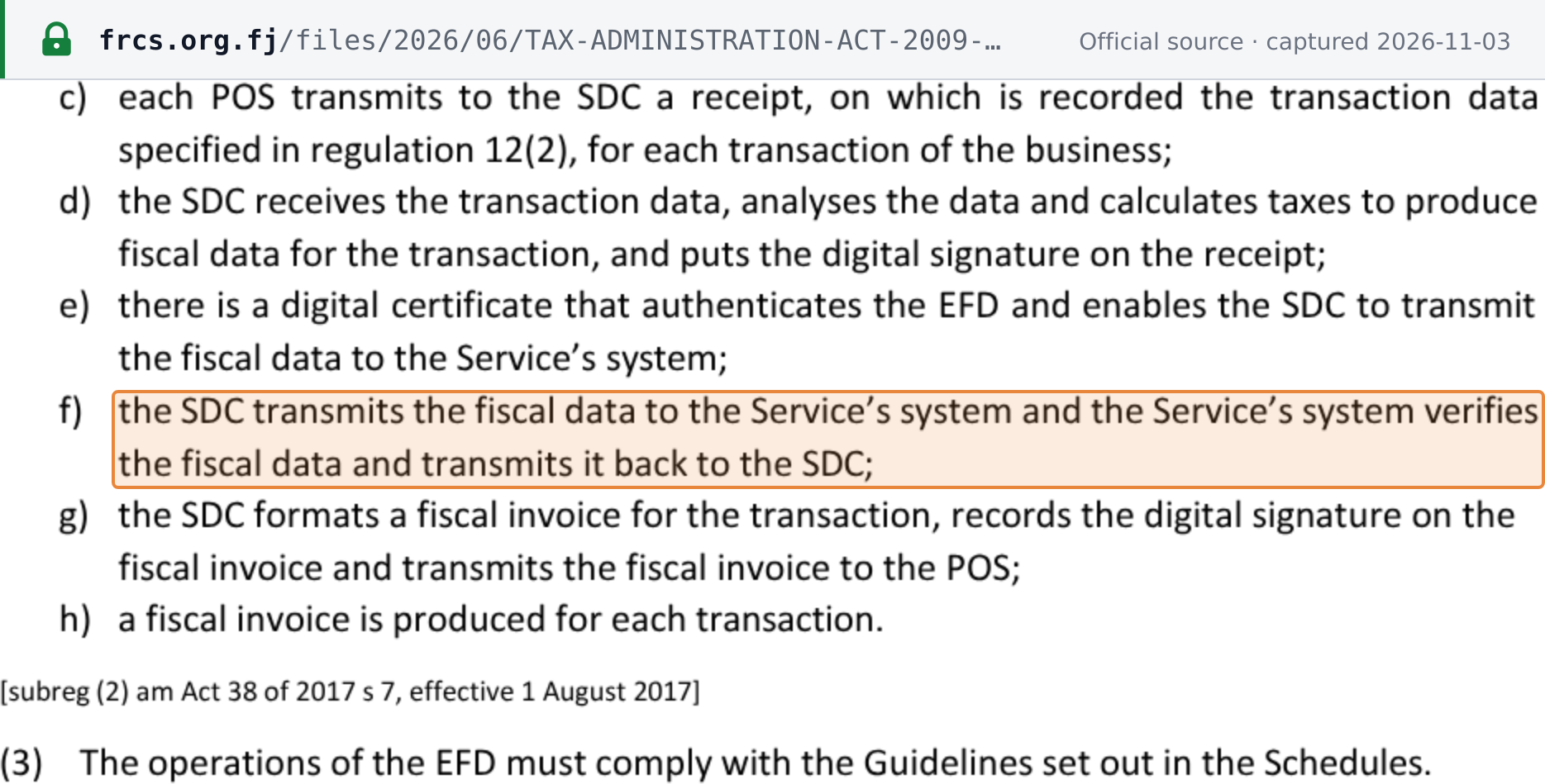
Regulation 7(2) describes the flow:
- Each POS sends the SDC a receipt with the transaction data for each transaction.
- The SDC "receives the transaction data, analyses the data and calculates taxes to produce fiscal data for the transaction, and puts the digital signature on the receipt".
- A digital certificate authenticates the EFD and lets the SDC send the fiscal data to FRCS.
- "The SDC transmits the fiscal data to the Service's system and the Service's system verifies the fiscal data and transmits it back to the SDC."
- The SDC formats the fiscal invoice, records the signature on it and sends it to the POS. "A fiscal invoice is produced for each transaction."
(FRCS — consolidated EFD Regulations, reg 7(2), p.163)
 Source snapshot captured 2026-11-03 — original
Two kinds of Sales Data Controller
| Virtual SDC (V-SDC) | External SDC (E-SDC) | |
|---|---|---|
| What it is | "a web service operated by the tax authority" | "a 'black box' type of software or hardware that communicates with a smart card secure element" |
| Connectivity | "limited to Connected Scenarios": a reliable internet connection is needed at the moment of sale | "enables semi-connected fiscalization scenarios (enables issuing fiscal invoice when the internet is down)" |
| Suits | Shops with dependable internet | Sites with patchy connectivity; outlets that cannot stop trading during an outage |
(FRCS — EFD accreditation instructions)
Data format: JSON over REST, not XML or Peppol
Invoices go to the SDC as JSON (Content-Type: application/json) by POST to
/api/v3/invoices. On the V-SDC the request is authenticated with the client digital certificate
(the FRCS sandbox endpoint is https://vsdc.sandbox.vms.frcs.org.fj/api/v3/invoices); a local
E-SDC needs no client authentication. The documentation lists API versions V3 and V4 as supported.
Invoice types are Normal, Proforma, Copy, Training and Advance; transaction types are Sale and
Refund, and a refund must reference the original invoice.
No XML, UBL, CII or Peppol format is used. The API documentation is generic TaxCore material hosted by FRCS, and some of its examples come from other jurisdictions; Fiji's binding rules are the Regulations and their Schedules. (FRCS TAP sandbox — Create Invoice; End-of-Life Policy; Invoice and Transaction Types)
The fiscal invoice and its QR code
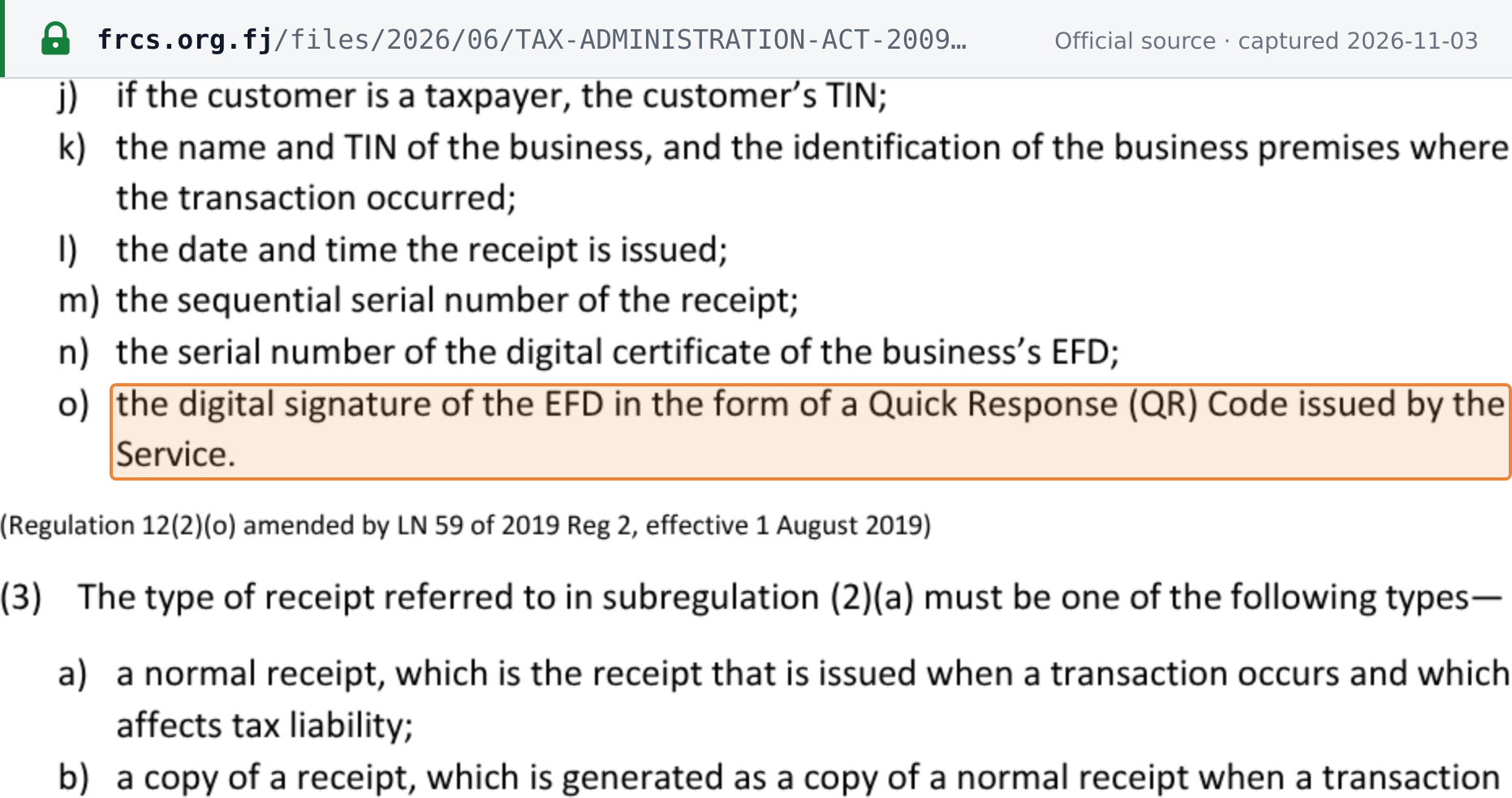
Regulation 12(2) lists 15 particulars: receipt type, transaction type, payment method, cashier, each item's name or code, unit price and quantity, total price, taxes and rates, total payable, the customer's TIN if the customer is a taxpayer, the business's name, TIN and premises, date and time, a sequential serial number, the serial number of the EFD's digital certificate, and "the digital signature of the EFD in the form of a Quick Response (QR) Code issued by the Service".
- Receipt types: normal, copy, training and pro-forma. Training and pro-forma receipts must print "THIS IS NOT A FISCAL INVOICE" in a font at least twice the size of the total (reg 12(6)–(7)).
- QR code / verification URL: the QR code encodes a verification URL; on an emailed invoice it appears as a hyperlink. The TaxCore documentation sets a minimum printed QR size of 40×40 mm.
- Digital certificate: one per EFD, issued by the CEO (reg 11). FRCS's FAQ: "The certificate must be renewed annually for continued operation."
- Customer notice: a prescribed "NOTICE TO ALL CUSTOMERS" must be displayed at the POS (reg 17).
(FRCS — consolidated EFD Regulations, regs 11, 12 and 17, pp.165–170; VMS FAQs; TaxCore — Verification URL)
 Source snapshot captured 2026-11-03 — original
Verification. "Scanning it with a QR reader app opens the FRCS verification website and displays a copy of the invoice." Customers must report a missing or inaccurate fiscal invoice (reg 19(3)), and the CEO may run a fiscal-invoice lottery (reg 26).
E-reporting. There is no separate sales-listing obligation: fiscal data reaches FRCS transaction by transaction. FRCS audits EFDs "using special methods like receipt signature verification, remote audit and copying sales data stored in the E-SDC" (VMS FAQ; reg 27).
Onboarding: how to comply
Register your business on VMS
- Update your mobile number, email and physical address in TPOS (Taxpayer Online Services); a non-individual also adds a representative.
- Email efdenquiry@frcs.org.fj with your TIN and a short description of your business activity.
- FRCS verifies the details and sends an invitation from the "VMS Messaging Service".
- Accept the invitation: choose a 4-digit PIN, the delivery office and Media Type "Full Format".
- FRCS prints your VMS card (smart card) and tells you when to collect it.
Cards are collected from FRCS offices; FRCS says "Smart cards will not be posted due to security and confidentiality reasons." A lost card means re-registering and a FJD 51.60 replacement fee. Cards and certificates are renewed through the Taxpayer Administration Portal (TAP); FRCS sends expiry notices 3 months, 1 month and 7 days before expiry. (FRCS — VMS registration process; VMS FAQs)
Choose an accredited POS and SDC
Only accredited products may be supplied or used (regs 15, 16 and 18). An accreditation "does not have effect unless the details of the brand, model and specification of the POS or E-SDC, and the date of its accreditation, are specified on the Service's website" (reg 8(6)). FRCS's VMS page carries the V3 and V2 accreditation lists; on 22 October 2026 FRCS counted "53 FRCS accredited POS Solutions".
- Supplier accreditation (reg 8): transferable; the product can be sold to any taxpayer.
- Self-built accreditation (reg 9): non-transferable; covers one taxpayer's own system.
- Revocation (reg 10): the CEO may revoke an accreditation. FRCS revoked the INSPUR E-SDC "with immediate effect", and devices in use had to be decommissioned by 31 December 2025.
(FRCS — INSPUR revocation; FRCS — accredited POS and E-SDC)
Connection options
| Option | How it works | Suits |
|---|---|---|
| Accredited POS + V-SDC | FRCS web service; online at the moment of sale | Connected retail and services |
| Accredited POS + E-SDC | Vendor device with a smart-card secure element; can issue offline and upload later | Patchy connectivity, high volume |
| FRCS free POS app (Android and iOS) | "a basic system with limited functionalities designed to assist with compliance only" | Small businesses |
| Web POS in TAP | Browser-based issuing in the taxpayer portal | Low volumes |
Any office or thermal printer works if the QR code scans; if the printer fails, the invoice can be emailed. Developers test in the TAP sandbox (Developer Portal and development E-SDC). FRCS publishes V-SDC outage notices; the latest, on 8 October 2026, said the V-SDC "is currently not operational".
To check whether an existing POS is compliant, FRCS suggests issuing one transaction and scanning the QR code: "if it guides you to the FRCS verification page, the transaction is verified."
Cost incentive (announced)
The 2026–2027 Budget Summary announced that "A 150% tax deduction will be introduced to support the installation, implementation, and operation of EFDs", and FRCS's 22 October 2026 notice says the deduction "is available". The enacting provision has not been identified in the 2026 budget bills FRCS publishes; confirm with FRCS before relying on it in a return. (FRCS — Budget Summary 2026–2027, p.3)
Penalties
| Offence | Regulation | Penalty on conviction |
|---|---|---|
| No EFD installed, implemented and operating by your group's deadline (for every business under the same TIN) | reg 28(2B), (3) | Fine up to FJD 50,000 plus FJD 100 for each day the offence continues |
| Breaching the operating rules in reg 18: no EFD or unaccredited parts, no fiscal invoice, non-compliant invoice, no buyer TIN on B2B/B2G sales, no customer notice, not cooperating with audit | reg 23 | Fine up to FJD 10,000 (turnover under FJD 500,000), FJD 25,000 (FJD 500,000 to under FJD 1.5 million) or FJD 50,000 (FJD 1.5 million or more), and/or up to 24 months' imprisonment; each director of a company is also liable to up to 24 months |
| Supplying an unaccredited POS or E-SDC | reg 22 | Same turnover-banded fines and prison terms as reg 23 |
| Tampering: false data, interfering with fiscal data, causing a malfunction, making the EFD transmit false data | reg 24 | Fine up to FJD 50,000 and/or up to 24 months' imprisonment |
The regulation 28(3) offence has applied since LN 59 of 2019 (effective 1 August 2019) and is the one tied to the 31 December 2026 deadline. The CEO may compound offences under section 59 of the Tax Administration Act (reg 13(2)(j)). (FRCS — consolidated EFD Regulations, regs 22–24 and 28, pp.173–176)
 Source snapshot captured 2026-11-03 — original
Enforcement posture. On 22 October 2026 FRCS said it is accelerating compliance monitoring and that businesses without a properly operating EFD by the applicable deadline may face "audit scrutiny or enforcement actions under the Tax Administration Act 2009". Its tax-label G notice also warned POS developers that failing to implement the 12.5% VAT label "may result in penalties under the Tax Administration Act".
Frequently asked questions
We are under the FJD 100,000 VAT threshold. Do we still need an EFD?
Yes, if your business is in a gazetted group and its gross annual turnover exceeds FJD 50,000. LN 35 of 2025 lowered the turnover test in regulation 2 of the EFD Regulations from FJD 100,000 to FJD 50,000 from 1 January 2026, matching Gazette Notice No. 61 of 2025. The EFD test is separate from VAT registration. Gazette Notice No. 61 of 2025 says groups of businesses with gross annual turnover between FJD 50,000 and FJD 100,000 may seek an extension of the timelines at the discretion of the Chief Executive Officer of FRCS; an extension is not automatic.
Our group's deadline has already passed. Is 31 December 2026 a new deadline for us?
FRCS's notice of 22 October 2026 is a final reminder that all Phase 1–3 businesses comply by 31 December 2026, and it says compliance monitoring is being accelerated. It is an FRCS notice, not a gazetted extension of the earlier group dates, so a business that missed its group's date is already exposed under regulation 28(3) and should not wait for 31 December 2026 to install an EFD.
We already run a POS or ERP. Can we keep it?
Only if the POS is on FRCS's accreditation list, and from 1 January 2027 only if it is accredited for EFD Version 3.0, because FRCS will cease Version 2.0 by 31 December 2026. FRCS suggests issuing one transaction and scanning the QR code: if it opens the FRCS verification page, the transaction was fiscalised.
What happens when the internet goes down?
It depends on the SDC. The Virtual SDC is an FRCS web service limited to connected scenarios, so it cannot fiscalise offline. An accredited External SDC uses a smart-card secure element and can keep issuing fiscal invoices while the connection is down. FRCS also publishes V-SDC outage notices, most recently on 8 October 2026.
Do B2B and government sales need anything extra?
Yes. For a business-to-business or business-to-government sale you must ask the customer for its TIN and enter it in the POS as part of the transaction (regulation 18(6)), and the customer must give it to you (regulation 19(5)). The TIN then prints on the fiscal invoice.
Only one of our businesses is in a listed group. Do the others need an EFD?
Yes. Regulation 28(2B) requires an EFD for each business in the group and any other business operated under the same TIN as the business in the group.
What is the penalty for missing the deadline?
Not having an EFD installed and operating by your group's deadline is an offence under regulation 28(3): a fine of up to FJD 50,000 plus FJD 100 for each day the offence continues. Breaching the operating rules in regulation 18, such as not issuing fiscal invoices, is a separate offence under regulation 23 with fines of FJD 10,000, 25,000 or 50,000 by turnover band and up to 24 months' imprisonment.
Can we claim the 150% tax deduction for EFD costs?
The 2026–2027 Budget announced a 150% tax deduction for installing, implementing and operating EFDs, and FRCS's 22 October 2026 notice says it is available. The enacting provision has not been identified in the 2026 budget bills FRCS publishes, so confirm with FRCS before claiming it.
Recent changes
- 2026-10-22 — FRCS final reminder: all businesses required to implement VMS under the EFD Regulations 2017 must comply by 31 December 2026, and compliance monitoring is being accelerated. (FRCS)
- 2026-09-01 — EFD tax label "H" for the 5% Tourism Services Tax takes effect and must be configured in every POS and SDC. (FRCS) — see event
- 2025-08-08 — Gazette Notice No. 61 of 2025 sets the EFD Phase 3 groups with turnover over FJD 50,000, ending with wholesalers, manufacturers and retailers on 31 December 2026, when EFD Version 2.0 also ends. (FRCS) — see event
- 2025-08-01 — EFD tax label "G" for VAT at 12.5% takes effect. (FRCS)
Related resources
- Fiji VAT country guide — VAT rate, FJD 100,000 registration threshold, tax-invoice rules and the Tourism Services Tax
- Fiscal devices and certified cash registers — how fiscal-device regimes work worldwide
- CTC e-invoicing models: clearance, reporting and interchange
- E-invoicing status and networks worldwide — Fiji in global context
- E-invoicing in Mauritius — another real-time fiscalisation model
- Fiji tax-change chronology — every tracked Fijian change, dated and sourced
Important websites
- FRCS VAT Monitoring System — hub, with the V3 and V2 accreditation lists
- VMS registration process
- VMS FAQs
- EFD Gazettes — gazette notices setting the groups and deadlines
- EFD accreditation instructions
- Taxpayer Administration Portal (TAP) — card and certificate renewal, Web POS
- TAP sandbox — developer portal and technical documentation
- FRCS free POS application