Vanuatu e-invoicing: VSMS fiscal devices
Overview
Vanuatu has no e-invoicing mandate in the Peppol or clearance sense. Its rules require sales to be recorded through fiscal devices; DCIR publishes no Peppol, UBL, CII or other structured invoice-exchange requirement. What Vanuatu does have is a fiscalisation regime: the Vanuatu Sales Monitoring System (VSMS). Under it, every sale by a VAT-registered business is recorded through an accredited electronic fiscal device (EFD), which issues a digitally signed fiscal invoice with a QR code and transmits the sale to the tax authority. [1] [6]
The system is run by the Department of Customs and Inland Revenue (DCIR). In DCIR's words, "The Vanuatu Sales Monitoring System (VSMS) was officially launched on 1 August 2025 after extensive consultations to ensure it delivers benefits for the Government, businesses, and consumers alike." [1]
Legal basis in one line. Section 61 of the Tax Administration Act No. 37 of 2018, given effect by the Vanuatu Sales Monitoring System Regulation Order No. 153 of 2025, which was made and came into force on 1 August 2025. [1] [2]

VAT context. VAT is charged at 15%. Registration is compulsory once taxable supplies in any 12-month period exceed, or are expected to exceed, VT 4 million; below that it is voluntary. VT 4 million is also the floor of the smallest VSMS rollout band. [12]
| Vanuatu | |
|---|---|
| System | Vanuatu Sales Monitoring System (VSMS) |
| Model | Fiscalisation at the point of sale: an accredited POS and Sales Data Controller (SDC) sign each fiscal invoice with a DCIR-issued Secure Element and transmit it to the VSMS, online, or stored offline and transmitted on reconnection |
| Not | Not Peppol; no structured e-invoice (UBL, CII or national XML) exchange between businesses |
| Who | VAT-registered businesses ("taxpayers" under Order No. 153 of 2025) |
| B2C / B2B / B2G | All covered: a fiscal invoice for every transaction, whatever the customer. The buyer's TIN is recorded where the buyer is a taxpayer |
| Non-residents | Not addressed in DCIR guidance |
| Rollout | Port Vila and Shefa: Very Large (VT 100m+): 30 June 2026 · Medium (VT 10m to under VT 100m): 30 September 2026 · Small and Micro (VT 4m to under VT 10m): 31 December 2026. Other provinces (DCIR rollout plan): Sanma, Malampa, Penama and Torba in 2027; Tafea in 2028; no deadlines set by notice yet |
| Integrity | Digital signature, sequential invoice counter, QR code with verification URL (minimum 42×42 mm), verifiable for at least 10 years |
| Platform | VSMS back end built on TaxCore (Data Tech International); public portal vsms.gov.vu |
| Authority | Department of Customs and Inland Revenue (DCIR) |
| Legislation | Tax Administration Act No. 37 of 2018, s.61; VSMS Regulation Order No. 153 of 2025; VSMS Technical Guidelines (23 June 2025) |
Mandate status & timeline
Status: in force since 1 August 2025, enforced in phases. Order No. 153 of 2025 commences "on the day on which it is made" (clause 23), and it was made at Port Vila on 1 August 2025. DCIR Public Notice 009 of 2025 confirms that the Order "is effective as of 1 August 2025. It affects all VAT Registered Businesses in Vanuatu." [2] [10]
The Order gave existing taxpayers a six-month grace period from commencement and lets the Director extend it case by case once it lapses (clause 22). The Order states no calendar date for the end of the grace period. [2]
DCIR then set phased deadlines by administrative public notice. Public Notice No. 006 of 2026, signed by the Director on 25 February 2026, states that the VSMS "is now in enforcement" and "will be implemented in three phases, beginning in Shefa Province and gradually extended to other provinces". The bands use each business's 2025 annual turnover, and the deadlines apply to "VAT registered businesses in Port Vila and Shefa at large": [3]
| Segment (2025 annual turnover) | Enrolment deadline (DCIR guidance) | Compliance deadline (PN 006 of 2026) | Status at 2026-11-03 |
|---|---|---|---|
| Very Large Enterprises: VT 100 million and above | 30 April 2026 | 30 June 2026 | Passed |
| Medium Enterprises: VT 10 million to under VT 100 million | 31 May 2026 | 30 September 2026 | Passed (extension round for listed TINs, two-week window from September 2026, below) |
| Small and Micro Businesses: VT 4 million to under VT 10 million | 31 July 2026 | 31 December 2026 | Pending |
| Sanma, Malampa, Penama, Torba (all segments) | — | 2027 (DCIR rollout plan; no deadline set by notice) | Planned |
| Tafea (all segments) | — | 2028 (DCIR rollout plan; no deadline set by notice) | Planned |
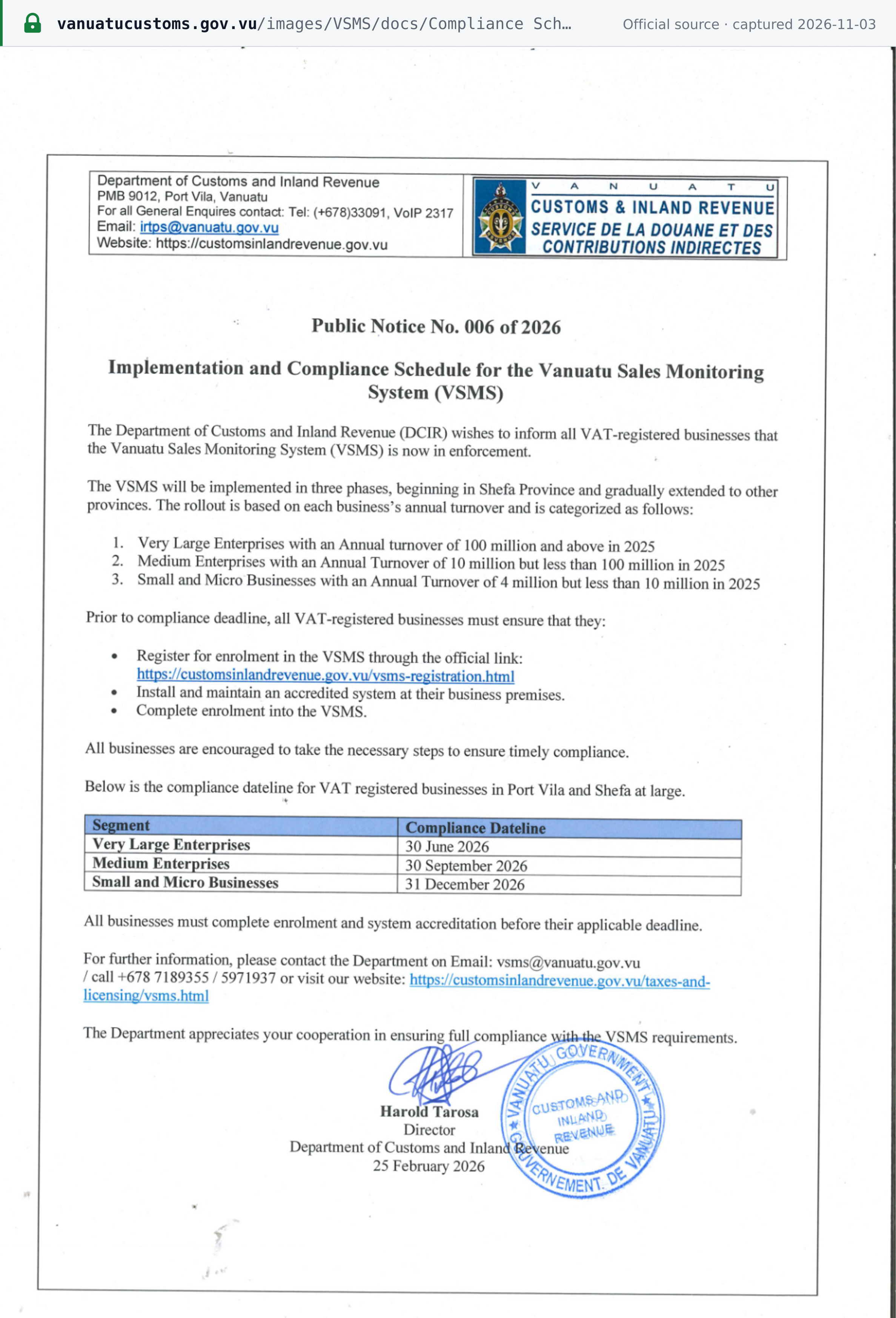
Enrolled is not the same as compliant. The enrolment deadlines come from DCIR's March 2026 awareness presentation, not a numbered notice. It warns that after enrolment "the taxpayer becomes VSMS-enrolled, but in order to become VSMS compliance Taxpayers MUST start issuing invoices using accredited solutions". PN 006 itself says: "All businesses must complete enrolment and system accreditation before their applicable deadline." [9] [3]
Initial registration. DCIR's onboarding brochure set a first deadline for all VAT-registered persons to register for the VSMS: "All registrations must be completed by September 30, 2025." The VSMS page now says "Registration is OPEN until further Notice". [13] [1]
Gaps in the published calendar:
- Provinces outside Shefa. PN 006 says the rollout will be "gradually extended to other provinces". DCIR's March 2026 awareness presentation plans Sanma, Malampa, Penama and Torba for 2027 and Tafea for 2028, all segments. That is an administrative rollout plan, not a gazetted instrument, and no public notice has yet set deadlines for these provinces. [9]
- Voluntary registrants under VT 4 million. Order No. 153 covers every VAT-registered taxpayer, but PN 006's bands start at VT 4 million and DCIR has published no deadline for VAT-registered businesses below it.
Extensions
DCIR has run two separate extension rounds. Neither pauses the underlying obligation.
- Large Segment, Public Notice 011 of 2026 (June 2026). Issued to "VSMS Large Segment Taxpayers" and available exclusively to "Businesses formally classified as Large Taxpayers under DCIR records segmentation". Extensions run "up to a maximum of three months", and the notice warns: "Lodging an extension request does not pause your compliance obligations." It adds that "A separate process may be made available to other taxpayer categories in due course." [7]
- Medium Segment, DCIR VSMS Extension page (September 2026). "Applicable to Medium Taxpayers ONLY", and only to taxpayers "whose Tax Identification Number (TIN) appears on the published eligible list" (533 TINs, current as at 16 September 2026), applying online within a two-week window. DCIR grants two months to adopt an accredited market solution, including "accredited VSMS bridging solutions", or up to three months for accreditation of an in-house solution where a valid justification is given. [8]
DCIR's extension page also defines what compliance means for the medium segment: [8]

DCIR has announced no extension round for Small and Micro businesses.
Postponements
None by instrument. The statutory grace period (clause 22) was followed by DCIR's phased deadlines in PN 006, and the extensions above are granted per taxpayer, not by moving the published dates.
Legal basis
| Instrument | Date | In force | What it does |
|---|---|---|---|
| Tax Administration Act No. 37 of 2018, s.61 | 2018 | 2018 | Lets the Director authorise, and direct a person to do, acts under a tax law electronically through a computer system or mobile device. s.8(7) lets the Regulations provide for "cash register machines and point of sale machines" |
| VSMS Regulation Order No. 153 of 2025 | Made 1 August 2025 by the Minister of Finance and Economic Management | 1 August 2025 (cl.23) | EFD obligation (cl.8), fiscal-invoice duty and particulars (cl.15–17), offences (cl.18), temporary closure (cl.20), probationary monitoring (cl.21), six-month grace period (cl.22); schedules on accreditation and the Secure Element |
| DCIR Public Notice 009 of 2025 | 2025 (undated on its face) | — | Confirms the Order is effective from 1 August 2025 and affects all VAT-registered businesses |
| VSMS Technical Guidelines for the Accreditation of EFD Solutions | Version of 23 June 2025 | Binding through Order No. 153 (Schedules 1 and 2; offence under cl.18(1)(f)) | Accreditation checklists for POS and E-SDC, invoice layout, QR code, audit packages |
| DCIR Public Notice No. 006 of 2026 | 25 February 2026 | Administrative notice | Phased compliance deadlines for Port Vila and Shefa |
| DCIR Public Notice 011 of 2026 | June 2026 | Administrative notice | Large Segment extension round; schedule of penalty-notice amounts |
The enacting words of the Order read: "In exercise of the powers conferred on me by section 61 of the Tax Administration Act No. 37 of 2018, I, the Honourable JOHNNY KOANAPO RASOU, Deputy Prime Minister and Minister of Finance and Economic Management, make the following Regulation." [2]
Section 61(4) of the Act disapplies a direction to act electronically where the Director "is satisfied that the taxpayer does not have the capacity to receive or make communications or payments electronically". DCIR has not said that this provision exempts anyone from the VSMS. [4]
Technical standard. The VSMS Technical Guidelines open: "In accordance with the Value Added Tax Act [CAP 247], the Tax Administration Act No. 37 of 2018, the Tax Administration Regulation Order No. 154 of 2019, and the Vanuatu Sales Monitoring System (VSMS) Regulation, VAT-registered retailers in Vanuatu are required to use Electronic Fiscal Devices (EFDs) at each business location." The Order requires every accredited product to be "Compliant with Technical Guideline published by the Department". [5] [2]
Scope
Who. Order No. 153 defines a taxpayer as "a person who is registered under the Value Added Tax Act [CAP 247] and is liable to pay value added tax or is required by the Director to issue a receipt or an invoice". Clause 8(1): "A taxpayer must operate an EFD for each business, in particular those businesses who have a business licence under the Business Licence Act [CAP 249]." VSMS registration is "ONLY For VAT Registered Taxpayer". [2] [1]
Businesses not yet registered for VAT. Clause 21 lets the Director place a business licensed under the Business Licence Act but not yet a VAT taxpayer under probationary monitoring, and require selected categories of business to register under the VSMS. The Director must give written notice, and the monitoring period can only start after the grace period has lapsed. [2]
B2C, B2B and B2G. All covered by the same rule. A taxpayer must ensure "a fiscal invoice is issued to a customer for each transaction between the business and the customer, in all its business branches" (clause 15(1)(a)). DCIR's FAQ: "Q: Can we continue to issue manual invoices now that we have the VSMS? A: No. All transactions must be recorded through an accredited EFD, and a fiscal invoice must be issued for each transaction." There is no separate B2B or B2G channel. [2] [6]
Buyer TIN in B2B and B2G. The fiscal invoice shows the customer's TIN "if the customer is a taxpayer" (clause 17(2)(j)), and a customer asked for its TIN "must provide the TIN to the taxpayer so it may be entered into the taxpayer's POS" (clause 16(4)). Failing to request the TIN, or to record it, in a business-to-business or business-to-government transaction is an offence (clause 18(1)(i)). [2]
Non-established businesses. Not addressed. Order No. 153, the VSMS FAQ, the onboarding procedure and the public notices say nothing about non-resident suppliers. The obligation attaches to VAT-registered taxpayers and to businesses with premises and a point of sale in Vanuatu.
Exempt or excluded transactions. DCIR guidance lists no exempt transaction types (imports, exempt supplies or otherwise) from the fiscal-invoice duty.
Format & network
Model: fiscalisation, not interchange. The VSMS validates and signs each sale at the point of sale; it does not route invoices between businesses. DCIR's FAQ: "The POS sends transaction data to the SDC, which signs and formats the invoice using the SE. The invoice is returned to the POS for printing, while the SDC simultaneously transmits data to the VSMS." DCIR "operates a Back Office portal to monitor the activity of EFDs in near real time". [6]
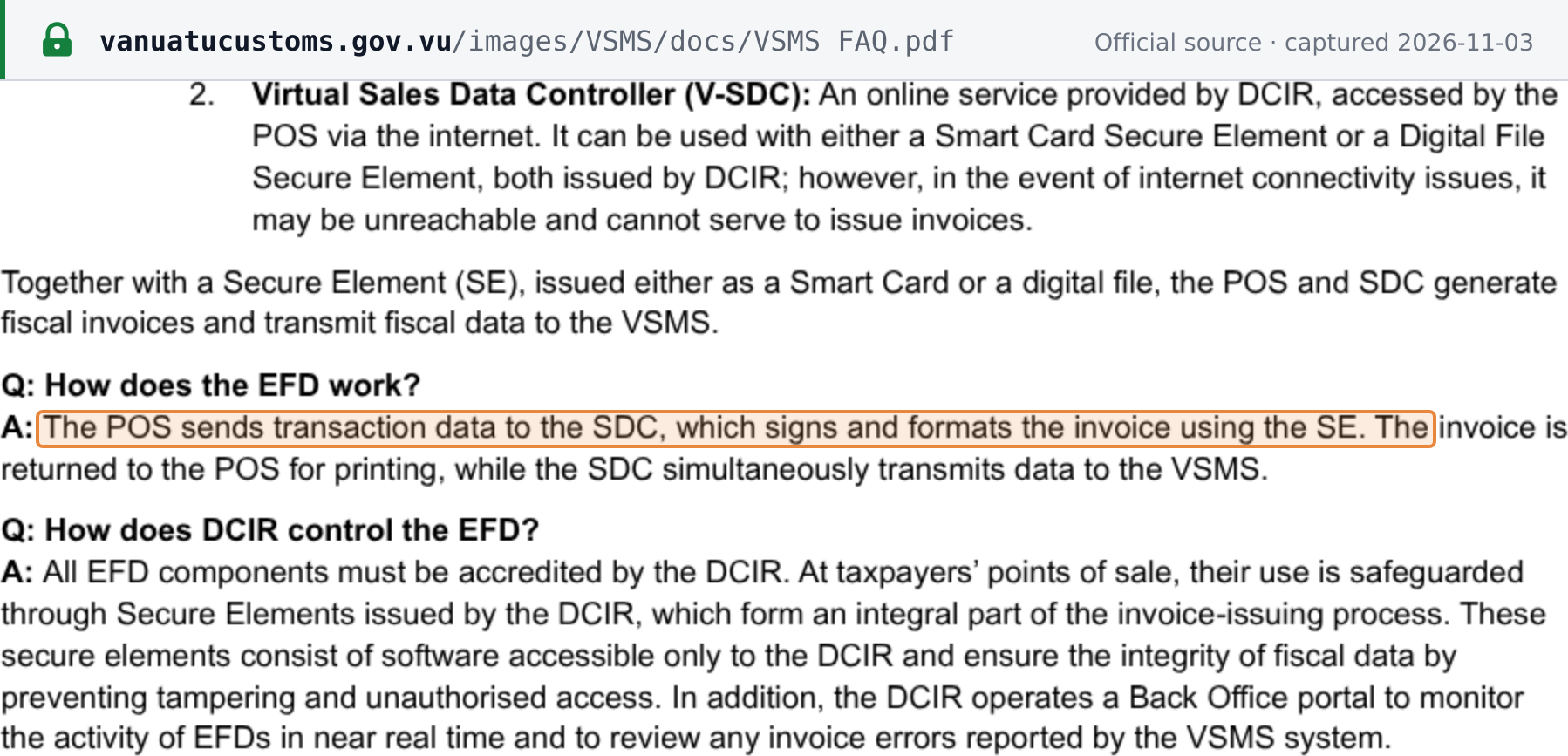
The pieces of an EFD:
- POS. The business's accredited point-of-sale software.
- Sales Data Controller (SDC), one of two kinds:
- V-SDC, "Provided by DCIR, the Virtual Sales Data Controller requires a stable Internet connection to process transactions and generate fiscal invoices."
- E-SDC, "Produced and supplied by accredited vendors, the External Sales Data Controller can operate independently of a continuous Internet connection, ensuring fiscal invoices can still be issued during connectivity disruptions." DCIR's FAQ: "Accredited External Sales Data Controllers (E-SDCs) can temporarily store invoices offline and automatically transmit them once internet connectivity is restored." [6]
- Secure Element, issued by DCIR as either a "Smart Card – Functions both offline and online" or a "PFX Digital Certificate – Functions online only".
Protocols and data. The POS talks to an E-SDC over HTTP and to a V-SDC over HTTPS, "as documented in the Technical Instructions for EFD Suppliers". An E-SDC authenticates to the TaxCore.API with the digital certificate on its Secure Element. Audit data is sent as JSON files and "encrypted using AES-256". Supplier documentation is at tap.sandbox.taxcore.online/help. The VSMS back end is TaxCore, by Data Tech International. [5]
XML standard and Peppol. The rules require a signed fiscal invoice produced by an accredited EFD, printed or emailed by the POS. DCIR's Order, FAQ, Technical Guidelines and notices set no UBL, CII, Peppol or national XML invoice format.
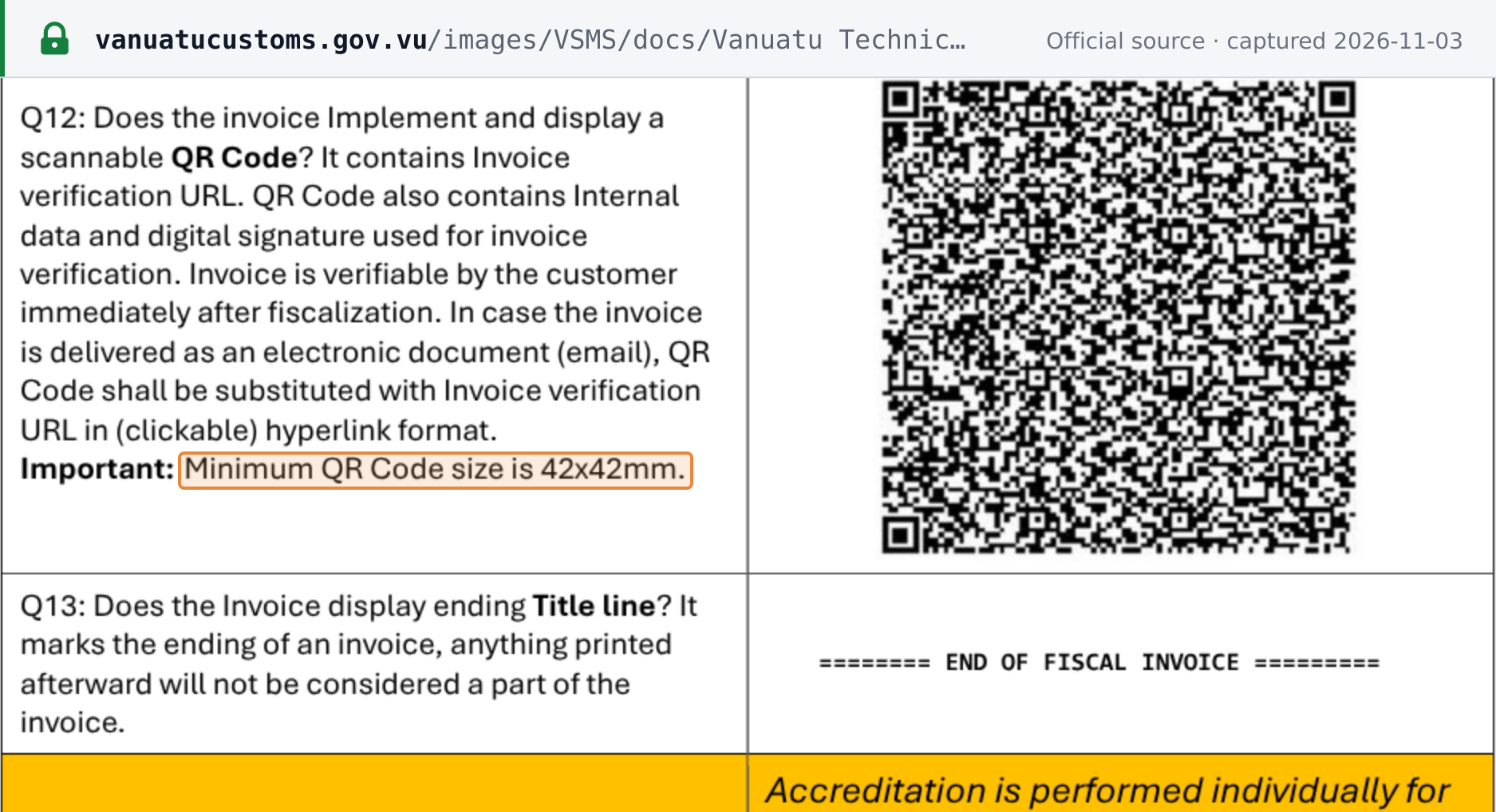
Integrity: signature, counter and QR code. Every fiscal invoice carries the EFD's digital signature, a sequential serial number and a QR code. The Technical Guidelines: the QR code "contains Invoice verification URL. QR Code also contains Internal data and digital signature used for invoice verification." When the invoice is emailed, the QR code is replaced by a clickable verification URL. "Minimum QR Code size is 42x42mm." A fiscal invoice is verifiable for a minimum of 10 years, by scanning the QR code or on the VSMS public portal. [5] [6]
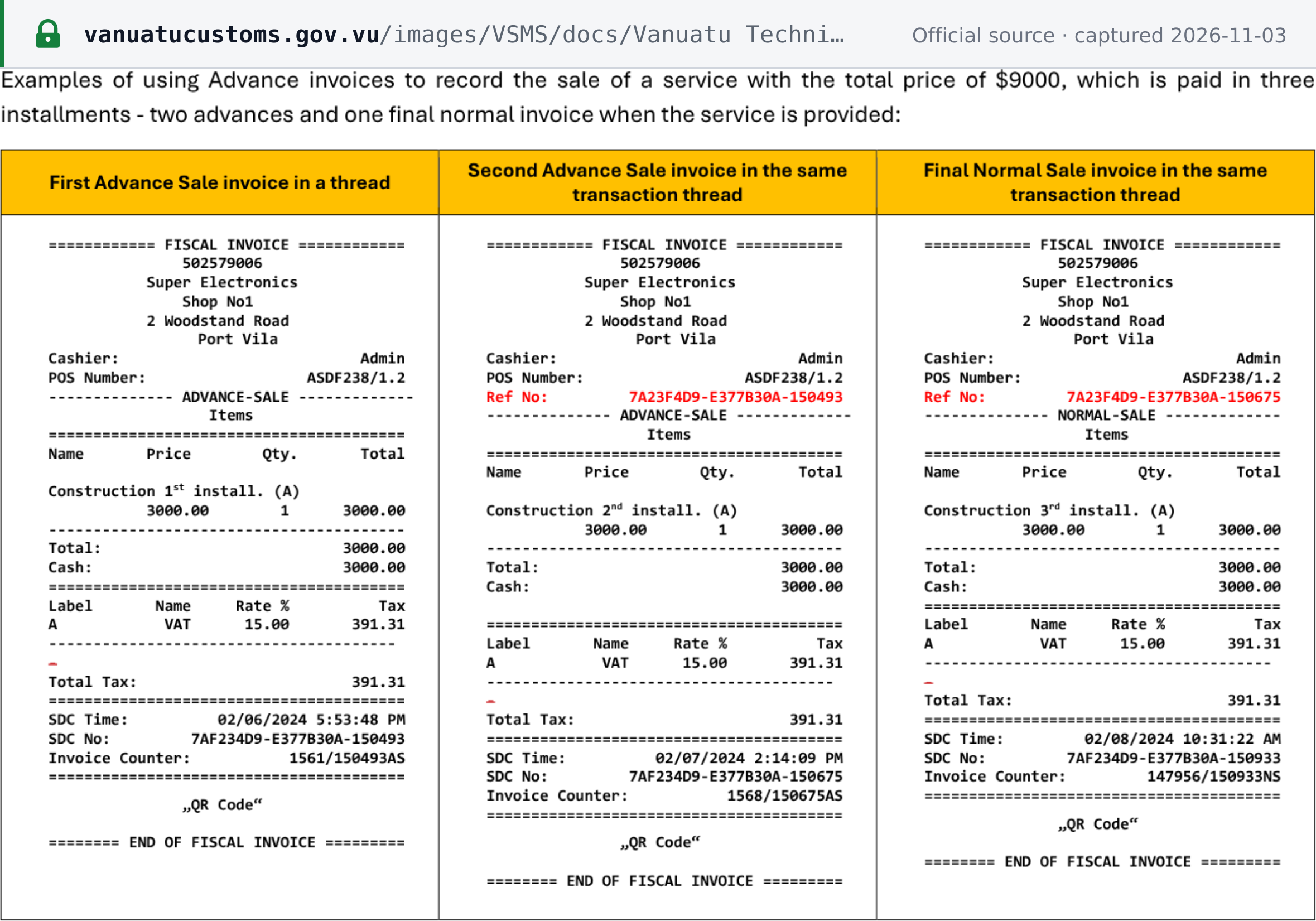
Mandatory particulars (Order No. 153, clause 17(2)). The fiscal invoice must show: the type of receipt; the type of transaction; the method of payment; the cashier and accredited POS identification; item name or code; unit price and quantity; total; taxes and rates; total payable; the customer's TIN if the customer is a taxpayer; the business's name, TIN and premises; date and time; the sequential serial number; the serial number of the EFD's digital certificate; the EFD's digital signature; and it "must be in English". Receipt types are normal, copy, training, pro-forma and advance; transaction types are sale and refund. Training and pro-forma receipts must carry "This is not a Fiscal Invoice" (clause 17(6)); the Technical Guidelines require the same legend on copies too. [2] [5]
DCIR's specimen invoices. The Technical Guidelines include worked specimens. This one records a 9,000 service paid in three instalments: two ADVANCE-SALE invoices, then a NORMAL-SALE invoice, each with VAT label A at 15.00%. [5]
Onboarding: how to comply
DCIR's standard operating procedure sets five steps: [11] [14]
- Register for the VSMS online or at a tax office, giving the number of POS and the authorised person.
- Get an accredited EFD. Buy an accredited vendor solution, have an in-house system accredited (non-transferable accreditation, tested in the TaxCore sandbox), or use DCIR's free web-based POS: the V-SDC "is already accredited and functions exclusively online".
- Enrol on the Taxpayer Administration Portal from the emailed invitation, setting a username, password and two-factor authentication with an authenticator app.
- Request a Secure Element from the portal: a smart card or a PFX certificate.
- Personalisation and issue of the Secure Element. DCIR: "Upon completing all the steps outlined above, the taxpayer becomes fully compliant with the VSMS."
Accreditation of vendors. Accreditation is either transferable (vendor products sold to taxpayers) or non-transferable (one taxpayer's own system), and runs as a technical review per product version followed by an administrative review. DCIR: "Every new POS or E-SDC product — as well as every new version of an existing product — MUST undergo the accreditation process", and "any change made to an accredited product voids its accreditation." Products are listed on the VSMS accredited-products page. If accreditation is revoked, "the supplier is required to immediately cease the further sale of the model or product". [1] [5]
Testing. Developers register for the sandbox through the TaxCore accreditation form. [1]
Penalties
Two layers apply, and they should not be confused.
Statutory offences, Order No. 153 clause 18. Fines of VT 1,000,000, several with imprisonment of up to 12 months. The key limbs: [2]
| Clause | Offence | Penalty |
|---|---|---|
| 18(1)(a) | Selling or supplying a non-accredited POS or E-SDC | VT 1,000,000 or up to 12 months' imprisonment, or both |
| 18(1)(d) | Failing to register the business for EFD use as prescribed | VT 1,000,000 and up to 12 months' imprisonment |
| 18(1)(e) | Operating a business without an accredited EFD | VT 1,000,000 and up to 12 months' imprisonment |
| 18(1)(f) | Not complying with the Technical Guidelines | VT 1,000,000 and up to 12 months' imprisonment |
| 18(1)(g) | Failing to issue a fiscal invoice for each transaction | VT 1,000,000 |
| 18(1)(h) | Fiscal invoice missing required particulars | VT 1,000,000 or up to 12 months' imprisonment |
| 18(1)(i) | Failing to request or record the customer's TIN in a B2B or B2G sale | VT 1,000,000 or up to 12 months' imprisonment |
| 18(4) | Failing to comply within the grace period | VT 1,000,000 or up to 12 months' imprisonment |
Temporary closure (clause 20). If a taxpayer does not comply with a written notice, the Director or a taxation officer obtains a court order closing the business, or part of it, for up to 14 working days. [2]
DCIR penalty notices (Public Notice 011 of 2026). DCIR's schedule of penalty-notice amounts runs from VT 250,000 to VT 500,000 for a first notice, depending on the offence. "The 2nd notice penalty is calculated as the 1st notice amount plus a 10% surcharge. The 3rd notice penalty is calculated as the 2nd notice amount plus a further 5% surcharge. Failure to comply with all three penalty notices will result in the matter being referred to court as a civil proceeding." Operating without an accredited EFD or POS (clause 18(1)(e)) "will be treated as a priority enforcement matter". [7] [8]
| Clause | Offence | 1st notice | 2nd notice | 3rd notice |
|---|---|---|---|---|
| 18(1)(a) | Use or supply of non-accredited systems | VT 500,000 | VT 550,000 | VT 577,500 |
| 18(1)(b) | Failure to report defect or misuse | VT 300,000 | VT 330,000 | VT 346,500 |
| 18(1)(c) | Director or company liability | VT 250,000 | VT 275,000 | VT 288,750 |
| 18(1)(d) | Failure to register for EFD | VT 450,000 | VT 495,000 | VT 519,750 |
| 18(1)(e) | Operating without accredited EFD or POS | VT 500,000 | VT 550,000 | VT 577,500 |
| 18(1)(f) | Non-compliance with technical guidelines | VT 400,000 | VT 440,000 | VT 462,000 |
| 18(1)(g) | Failure to issue a fiscal invoice | VT 450,000 | VT 495,000 | VT 519,750 |
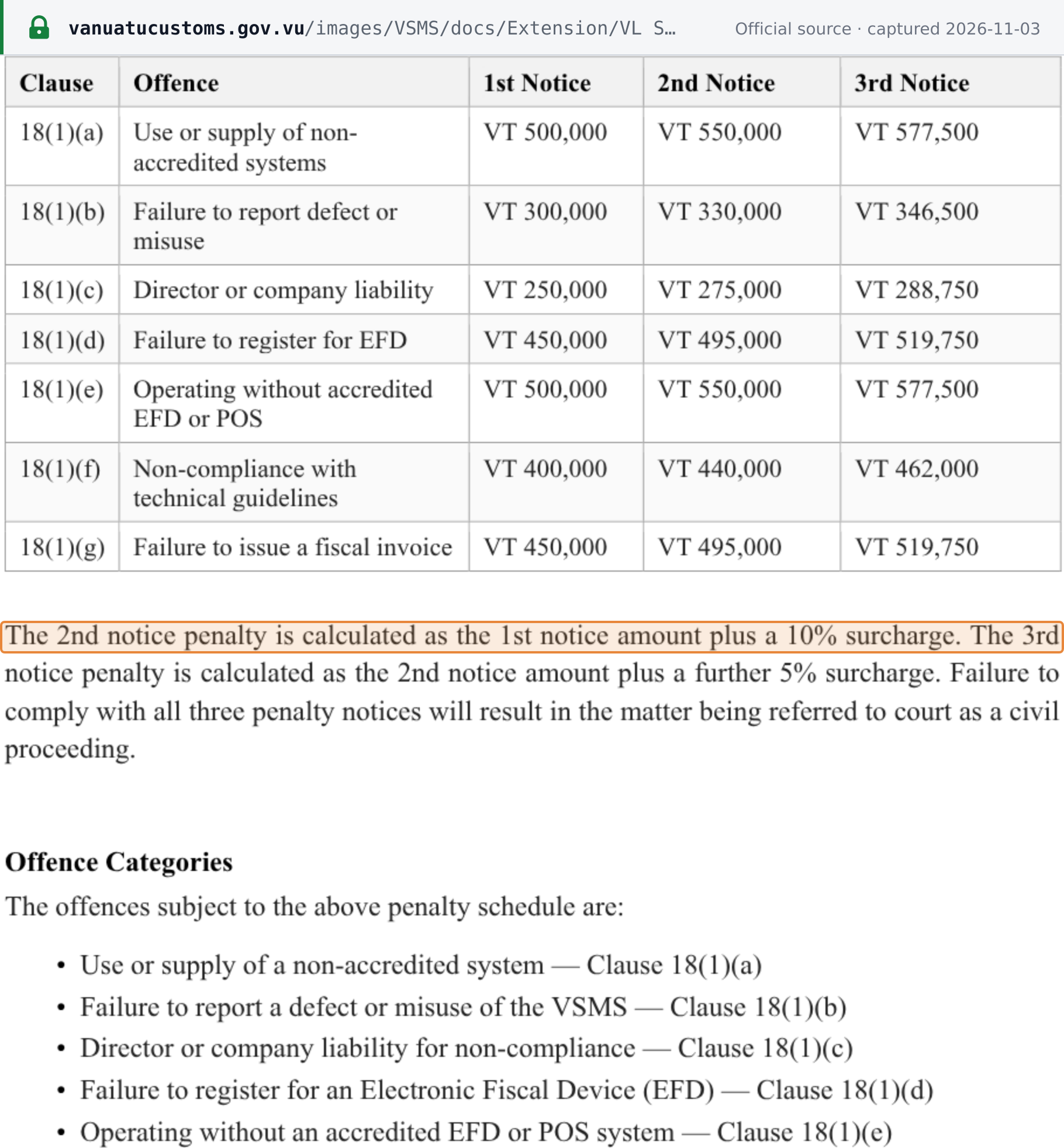
VT 500,000 is the top of the first-notice schedule, not the maximum exposure: the statutory fine under the Order is VT 1,000,000.
Frequently asked questions
Does Vanuatu have a Peppol or e-invoicing mandate?
No. DCIR publishes no Peppol or clearance e-invoicing requirement, and sets no UBL, CII or national XML invoice format. What applies is the Vanuatu Sales Monitoring System (VSMS): since 1 August 2025, under Regulation Order No. 153 of 2025, VAT-registered businesses issue a digitally signed fiscal invoice for every sale through an accredited electronic fiscal device, which also transmits the sale to DCIR. [2] [6]
We are VAT-registered but our turnover is under VT 4 million. What is our deadline?
DCIR has set no deadline for this group. Order No. 153 of 2025 covers every VAT-registered taxpayer, but the bands in Public Notice No. 006 of 2026 start at VT 4 million of 2025 turnover, the floor of the Small and Micro band with its 31 December 2026 deadline. Registration for the VSMS is open to all VAT-registered taxpayers. [2] [3]
Our business is outside Port Vila and Shefa. Which deadline applies?
No public notice has set one yet. Public Notice No. 006 of 2026 sets its 30 June, 30 September and 31 December 2026 deadlines for VAT-registered businesses in Port Vila and Shefa, and says the rollout will be gradually extended to other provinces. DCIR's March 2026 awareness presentation plans Sanma, Malampa, Penama and Torba for 2027 and Tafea for 2028, all segments; that rollout plan gives years, not deadlines. [3] [9]
We are a medium business and missed 30 September 2026. Can we get more time?
Only if your TIN is on DCIR's published eligible list (533 TINs, current as at 16 September 2026) and you applied online within the two-week window. DCIR grants two months to adopt an accredited market solution, including accredited VSMS bridging solutions, or up to three months to accredit an in-house solution where a valid justification is given. Lodging a request does not pause your compliance obligations. [8] [7]
Can we keep issuing manual or handwritten invoices to business customers?
No. DCIR's FAQ says all transactions must be recorded through an accredited EFD and a fiscal invoice issued for each one. Where the customer is a taxpayer, its TIN goes on the fiscal invoice; failing to request or record it in a business-to-business or business-to-government sale is an offence under clause 18(1)(i) of Order No. 153, with a fine of VT 1,000,000 or up to 12 months' imprisonment. [6] [2]
What happens to sales when the internet is down?
It depends on the setup. DCIR's free V-SDC needs a stable internet connection and cannot issue fiscal invoices during an outage. A vendor E-SDC can keep issuing them offline: it stores invoices offline and automatically transmits them once the connection is restored. The Secure Element must suit this too: a smart card works offline and online, a PFX digital certificate works online only. [1] [11]
Can we email a fiscal invoice instead of printing it?
Yes. DCIR's Technical Guidelines say that when the invoice is delivered as an electronic document by email, the QR code is replaced by the invoice verification URL as a clickable hyperlink. On a printed invoice the QR code must be at least 42x42 mm. Either way the invoice is verifiable for at least 10 years. [5] [6]
Is the penalty VT 500,000 or VT 1,000,000?
Both figures are real. DCIR's penalty-notice schedule in Public Notice 011 of 2026 sets first notices from VT 250,000 to VT 500,000 depending on the offence, plus 10% on the second notice and a further 5% on the third, after which the matter goes to court as a civil proceeding. The statutory offences in clause 18 of Order No. 153 carry fines of VT 1,000,000, several with up to 12 months' imprisonment. [7] [2]
Recent changes
- 2026-09-30 — Compliance deadline for Medium Enterprises (2025 turnover of VT 10 million to under VT 100 million) in Port Vila and Shefa; DCIR ran an extension round for 533 listed medium-segment TINs (list current as at 16 September 2026). (DCIR) — see event
- 2026-06-30 — Compliance deadline for Very Large Enterprises (2025 turnover of VT 100 million and above) in Port Vila and Shefa; Public Notice 011 of 2026 offered Large Segment taxpayers extensions of up to three months. (DCIR — Public Notice 011 of 2026)
- 2026-02-25 — Public Notice No. 006 of 2026 set phased VSMS compliance deadlines for Port Vila and Shefa: 30 June, 30 September and 31 December 2026 by 2025 turnover. (DCIR — Public Notice No. 006 of 2026) — see event
- 2025-08-01 — VSMS Regulation Order No. 153 of 2025 made and in force; the VSMS officially launched. (DCIR)
- 2025-06-23 — DCIR published the VSMS Technical Guidelines for the Accreditation of EFD Solutions. (DCIR)
Related resources
- Fiscal devices and certified cash registers explained — how the VSMS compares with other fiscalisation regimes
- CTC e-invoicing models explained — why fiscalisation is not clearance or Peppol interchange
- E-invoicing status and networks by country
- Fiji VAT guide — a Pacific neighbour with its own electronic fiscal device regime
- Worldwide VAT rates and VAT registration thresholds
- Vanuatu tax changes on Lookuptax
LookupTax has no Vanuatu country guide or TIN page yet.