OIDAR services under India's GST
OIDAR — online information and database access or retrieval services — is the Indian GST term (IGST Act section 2(17)) for services delivered over the internet or an electronic network whose supply is impossible to ensure without information technology, such as cloud services, internet advertising, e-books, streaming and digital data storage. When an overseas supplier sells them to an unregistered person in India, the supplier itself pays the integrated tax (IGST) under section 14.
The concept belongs to the Government of India: it is defined in the Integrated Goods and Services Tax Act, 2017 and administered by the Central Board of Indirect Taxes and Customs (CBIC), with the procedural rules made on the recommendations of the GST Council (CBIC — IGST Act s.2).
Definition
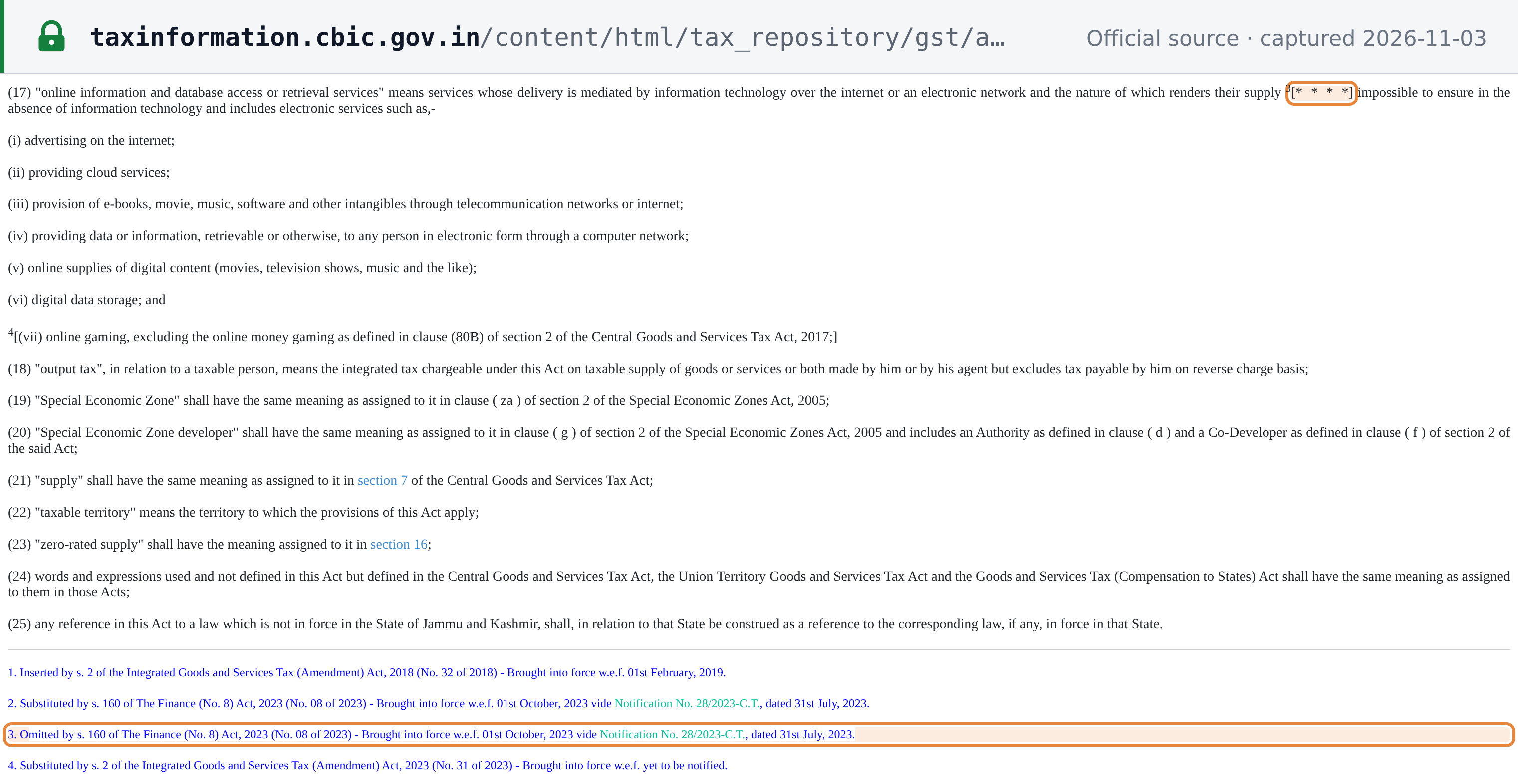
Section 2(17) of the IGST Act defines OIDAR as "services whose delivery is mediated by information technology over the internet or an electronic network and the nature of which renders their supply [* * * *] impossible to ensure in the absence of information technology", and lists, as examples of "electronic services such as":
- advertising on the internet;
- providing cloud services;
- provision of e-books, movie, music, software and other intangibles through telecommunication networks or internet;
- providing data or information, retrievable or otherwise, to any person in electronic form through a computer network;
- online supplies of digital content (movies, television shows, music and the like);
- digital data storage; and
- online gaming, excluding the online money gaming as defined in clause (80B) of section 2 of the CGST Act.
The list is inclusive ("includes electronic services such as"), so services not named in it fall within OIDAR if they meet the two-part test: delivery mediated by IT over a network, and supply impossible without IT. The GST Council's OIDAR flyer gives a longer indicative list that includes "Website hosting and webpage hosting" and "use of search engines and Internet directories" (GST Council — GST Flyer, Chapter 42: OIDAR services).
Two tests, not four. Until 30 September 2023 the definition also required the supply to be
essentially automated and to involve minimal human intervention. The [* * * *] in the current
text marks those omitted words: CBIC's consolidated Act records that they were "Omitted by s. 160"
of the Finance Act, 2023, "Brought into force w.e.f. 01st October, 2023 vide Notification No.
28/2023-C.T., dated 31st July, 2023"
(CBIC — IGST Act s.2, footnote 3).
A service with substantial human involvement can therefore still be OIDAR from that date, provided
it is delivered over a network and cannot be supplied without IT.
The current OIDAR definition and its omission footnote, as CBIC publishes them:
 Source snapshot captured 2026-11-03 — original
Online money gaming supplied from outside India is not OIDAR: item (7) excludes it, and it has its own special provision, IGST section 14A, which borrows section 14's Simplified Registration Scheme (CBIC — IGST Act s.14A). One difference: where an online money gaming supplier has no physical presence or representative in India, section 14A says it "shall appoint" a person in India to pay the tax, whereas section 14 says an OIDAR supplier "may appoint" one. Both provisions came from the IGST (Amendment) Act, 2023 and apply from 1 October 2023 (see Current status).
How it works
Place of supply: where the customer is
For cross-border supplies — where the supplier or the recipient is outside India — section 13 applies, and section 13(12) says: "The place of supply of online information and database access or retrieval services shall be the location of the recipient of services." The recipient is deemed to be in India "if any two of the following non-contradictory conditions are satisfied" — the seven indicators are:
- (a) the address the customer presents over the internet;
- (b) the card used to pay was issued in India;
- (c) the billing address;
- (d) the IP address of the device used;
- (e) the bank holding the account used for payment;
- (f) the country code of the SIM card used;
- (g) the location of the fixed landline through which the service is received.
Where both supplier and recipient are in India, section 13 does not apply; the general rule in section 12(2) does. A supply to a registered person is placed at that person's location; a supply to anyone else at "the location of the recipient where the address on record exists" and otherwise at the supplier's location (CBIC — IGST Act s.12). A domestic OIDAR supplier registers and files like any other Indian supplier — the REG-10 registration and GSTR-5A return below apply only to supplies "from a place outside India".
Who pays the IGST
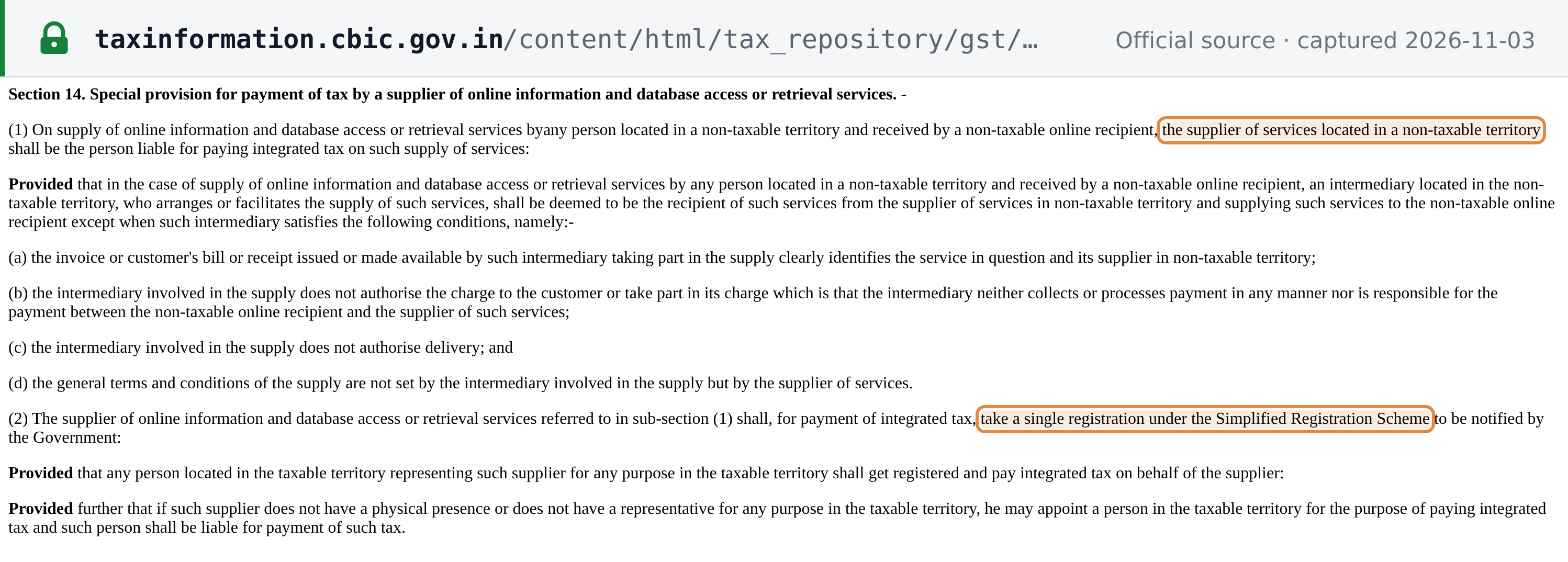
Overseas supplier → unregistered person in India. Under section 14(1), "the supplier of services located in a non-taxable territory shall be the person liable for paying integrated tax" on OIDAR received by a non-taxable online recipient. Since 1 October 2023 a non-taxable online recipient is any unregistered person in India — consumers and unregistered businesses alike (see Who it affects).
Overseas supplier → GST-registered business in India. The registered recipient pays the IGST on reverse charge. Notification No. 10/2017-Integrated Tax (Rate), serial 1, covers "Any service supplied by any person who is located in a non-taxable territory to any person other than non-taxable online recipient", with the tax payable by "Any person located in the taxable territory other than non-taxable online recipient" (GST Council — Notification 10/2017-IT(R) as amended up to 1 April 2019). How the recipient self-invoices and reports is covered in the India GST guide and the reverse charge explainer.
The IGST rate is the rate that applies to the particular service under the IGST rate notifications; OIDAR has no rate of its own.
App stores and other intermediaries
The proviso to section 14(1) makes an intermediary located outside India that "arranges or facilitates" OIDAR for a non-taxable online recipient the deemed recipient and supplier — so it, not the underlying developer, pays the IGST — unless it satisfies all four conditions:
- (a) its invoice, bill or receipt clearly identifies the service and its supplier outside India;
- (b) it does not authorise the charge to the customer or take part in it — it neither collects or processes payment nor is responsible for payment between customer and supplier;
- (c) it does not authorise delivery; and
- (d) the general terms and conditions are set by the supplier, not the intermediary.
(CBIC — IGST Act s.14) A typical app store that takes payment fails condition (b) and is therefore the liable supplier. See also the marketplace deemed-supplier rules explainer. Section 14 as CBIC publishes it — the supplier's liability, the intermediary conditions and the single registration:
 Source snapshot captured 2026-11-03 — original
Registration: one registration under the Simplified Registration Scheme
Section 14(2) requires the overseas supplier to "take a single registration under the Simplified Registration Scheme". Two provisos follow: a person in India "representing such supplier for any purpose" must register and pay the IGST on the supplier's behalf; and a supplier that "does not have a physical presence or does not have a representative" in India "may appoint" a person in India to pay the tax, who "shall be liable for payment of such tax" (CBIC — IGST Act s.14). Appointing someone is a permission, not a requirement.
There is no turnover threshold. CGST section 24 makes registration compulsory "Notwithstanding anything contained in sub-section (1) of section 22" — the general threshold — for, at clause (xi), "every person supplying online information and database access or retrieval services from a place outside India to a person in India, other than a registered person" (CBIC — CGST Act s.24). The obligation therefore arises from the first such supply.
The procedure is CGST Rule 14:
- Application — the supplier "shall electronically submit an application for registration, duly signed or verified through electronic verification code, in FORM GST REG-10, at the common portal".
- Grant — the applicant "shall be granted registration, in FORM GST REG-06 … by such officer as may be notified by the Central Government". Registration is granted by an officer, not issued automatically.
The officer is the Principal Commissioner of Central Tax, Bengaluru West: Notification No. 2/2017-Integrated Tax, in force from 22 June 2017, notifies that officer "and all the officers subordinate to him as the officers empowered to grant registration" for OIDAR supplied from a non-taxable territory to a non-taxable online recipient (CBIC — Notification 2/2017-IT). CBIC's integrated-tax notification page still lists 2/2017-IT. A separate Notification No. 04/2023-Integrated Tax, dated 29 September 2023 and in force from 1 October 2023, empowers the same officer to grant registrations for online money gaming supplied from outside India; it does not amend 2/2017-IT (Gazette of India, 29 September 2023, G.S.R. 710(E)).
What the GST portal's REG-10 form asks for, according to GSTN's user manual (GSTN — Non-Resident Online Services Provider registration manual):
- legal name of the business as per the PAN database, and the tax identification number or unique number of the country of origin (PAN is not mandatory);
- the authorised signatory's name and e-mail — "Mobile Number of Authorized Signatory is optional"; and "Authorized Signatory must be a resident of India with a valid PAN Card", although the manual's Part A marks the signatory's PAN field as "not a mandatory field";
- details of any representative appointed in India;
- country of incorporation, date of commencement of the online service in India, website URLs, and an upload under "Proof of Non-Resident Online Service Provider";
- the type of supply — OIDAR, online money gaming, or both.
On submission with EVC an ARN is generated and the status "changes to Pending for Processing" while the officer considers the application. The declaration on the form, as substituted by Notification No. 51/2023-Central Tax, is that the signatory is authorised and will "charge and collect tax liable from the non-taxable online recipient … and deposit the same with Government of India" (GST Council — Notification 51/2023-CT).
Monthly return: FORM GSTR-5A by the 20th
CGST Rule 64 requires every registered person "providing online information and data base access or retrieval services from a place outside India to a non-taxable online recipient … or to a registered person other than a non-taxable online recipient" — and every overseas supplier of online money gaming — to "file return in FORM GSTR-5A on or before the twentieth day of the month succeeding the calendar month or part thereof" (CBIC — CGST Rule 64). Until 30 September 2023 the rule covered only supplies "to a person in India other than a registered person"; Notification No. 51/2023-CT substituted it, so a registered overseas supplier now also reports its reverse-charge supplies to registered businesses (GSTR-5A Table 5B). Rule 64 as substituted, with the earlier wording in its footnote:
 Source snapshot captured 2026-11-03 — original
GSTN's GSTR-5A FAQ, as at 2026-11-03, adds the mechanics (GSTN — GSTR-5A FAQ):
- Pay first, then file — "Form GSTR-5A can be filed only after, making full payment of taxes and other liabilities for the return period."
- Nil returns — the return "needs to be filed even if there is no business activity".
- No input tax credit — "OIDAR services provider cannot claim any ITC in Form GSTR-5A", and there is no Electronic Credit Ledger for OIDAR taxpayers.
- Late fee — "At present, there is no late fee in case of delayed filing of Form GSTR-5A"; interest on late payment is a separate matter.
Worked example
The figures below are illustrative; the rules are those cited above.
A software company established only in Singapore sells a monthly subscription to two customers in India:
- An individual in Pune who signs up with an Indian billing address and pays with a card issued in India. Two of the seven section 13(12) indicators point to India, so the place of supply is India. The individual is unregistered, so is a non-taxable online recipient, and the Singapore company is liable for the IGST under section 14(1). It registers once in FORM GST REG-10, charges IGST at the rate for the service, pays the tax through the cash ledger, and only then files GSTR-5A for the month by the 20th of the following month.
- A GST-registered company in Mumbai. The Mumbai company pays the IGST on reverse charge (Notification 10/2017-IT(R), serial 1). Because the Singapore company is already registered for its consumer sales, it also reports this supply in GSTR-5A Table 5B, with no tax payable by it.
Who it affects
The non-taxable online recipient
Section 2(16), as substituted from 1 October 2023, reads: "non-taxable online recipient" means "any unregistered person receiving online information and database access or retrieval services located in taxable territory", and "unregistered person" includes "a person registered solely in terms of clause (vi) of section 24" of the CGST Act — a body registered only to deduct tax at source (CBIC — IGST Act s.2(16)). CBIC's footnote records the substitution "by s. 160" of the Finance Act, 2023, in force from 1 October 2023 vide Notification No. 28/2023-CT. The change widened the definition. As the GST Council's OIDAR flyer reproduces it, the original clause covered persons "not registered and receiving online information and database access or retrieval services in relation to any purpose other than commerce, industry or any other business or profession" (GST Council — GST Flyer, Chapter 42). An unregistered business customer is now a non-taxable online recipient too. The current non-taxable online recipient definition and its Explanation:
 Source snapshot captured 2026-11-03 — original
Taxpayer classes
| Who | Obligation | Basis |
|---|---|---|
| Supplier outside India selling to unregistered persons in India (consumers, unregistered businesses, TDS-only registrants) | Pays the IGST; single registration in FORM GST REG-10 from the first supply; GSTR-5A monthly | IGST s.2(16), s.14(1)–(2); CGST s.24(xi); CGST Rules 14 and 64 |
| GST-registered business in India buying from a supplier outside India | Pays the IGST on reverse charge | Notification 10/2017-IT(R), serial 1 |
| Registered supplier outside India selling to registered businesses | Reports those supplies in GSTR-5A (Table 5B); no tax payable by the supplier | CGST Rule 64; GSTN GSTR-5A FAQ |
| Intermediary outside India (app store, platform) arranging OIDAR for unregistered persons | Treated as the supplier unless it meets all four conditions | IGST s.14(1) proviso |
| Representative of the overseas supplier located in India | Must register and pay the IGST on the supplier's behalf | IGST s.14(2), first proviso |
| Person in India appointed by a supplier with no presence or representative | Liable for payment of the tax | IGST s.14(2), second proviso |
| Supplier located in India | Ordinary GST registration and returns, not REG-10 or GSTR-5A | IGST s.12(2); CGST Rules 14 and 64 apply to supplies "from a place outside India" |
| Overseas supplier of online money gaming | Separate regime under IGST s.14A, using the same registration and return; must appoint a person in India where it has no presence or representative | IGST s.14A; Notification 51/2023-CT |
CGST section 24(xi) covers supplies to "a person in India, other than a registered person", and IGST section 14 and Rule 14 tie the REG-10 registration to supplies to non-taxable online recipients (and to online money gaming). None of them states a registration obligation for an overseas supplier whose Indian customers are all GST-registered.
Current status and dates
As at 2026-11-03, the OIDAR rules in force are those in place since 1 October 2023:
- In force since 1 October 2023 — the two-part definition in section 2(17) and the widened section 2(16), both from section 160 of the Finance Act, 2023. Notification No. 28/2023-Central Tax appoints "the 1st day of October, 2023, as the date on which the provisions of sections 137 to 162 (except sections 149 to 154) of the said Act shall come into force" (GST Council — Notification 28/2023-CT).
- In force since 1 October 2023 — the IGST (Amendment) Act, 2023 (No. 31 of 2023): its section 2 substituted item (vii) of section 2(17) (online gaming, excluding online money gaming) and its section 5 inserted section 14A. Notification No. 02/2023-Integrated Tax (G.S.R. 708(E), 29 September 2023) "appoints the 1st day of October, 2023, as the date on which the provisions of the said Act, shall come into force" (Gazette of India, 29 September 2023; Act No. 31 of 2023). CBIC's consolidated pages for section 2 (footnote 4) and section 14A still read "Brought into force w.e.f. yet to be notified", as at 2026-11-03; the Gazette notification above is the commencement instrument.
- In force since 1 October 2023 — the CGST (Third Amendment) Rules, 2023 (Notification No. 51/2023-CT, dated 29 September 2023): Rule 14 and FORM GST REG-10 extended to online money gaming, Rule 64 substituted, and FORM GSTR-5A substituted to cover OIDAR supplies "to non-taxable online recipient … and to registered persons in India" and online money gaming. The rules "shall come into force on the 1st day of October, 2023" (GST Council — Notification 51/2023-CT).
- No later amendment observed. CBIC's consolidated IGST Act shows no amendment to sections 2(16), 2(17), 13(12) or 14 after 1 October 2023, as at 2026-11-03, although the same repository already records a Finance Act, 2026 change elsewhere in section 13.
- Adjacent change, 30 March 2026 — the Finance Act, 2026 omitted section 13(8)(b), the place of supply of intermediary services. The GST Council's newsletter states that with the Act's assent "on March 30, 2026 … the omission of Section 13(8)(b) of the IGST Act, 2017, relating to the place of supply of intermediary services, comes into effect" (GST Council — newsletter, March 2026; CBIC — IGST Act s.13, footnote 3). This concerns intermediary services generally, not the OIDAR place-of-supply rule in section 13(12).
- Nothing pending on OIDAR itself. The press release of the 57th GST Council meeting (8 October 2026) contains no item on OIDAR or GSTR-5A. Two of its recommendations touch nearby ground and are recommended, not enacted, as at 2026-11-03: "extending e-invoicing to domestic supplies received from an unregistered person where the tax is payable under reverse charge mechanism, as well as to the import of services, for taxpayers having aggregate annual turnover of Rs. 5 crore and above" — which would reach a registered Indian business's reverse-charge OIDAR purchases — and the "omission of clause (a) of section 13(3) of IGST Act, 2017" (GST Council — 57th meeting press release).
Timeline
| Date | Event | Status as at 2026-11-03 | Source |
|---|---|---|---|
| 22 Jun 2017 | Principal Commissioner of Central Tax, Bengaluru West empowered to grant OIDAR registrations (Notification 2/2017-IT, dated 19 Jun 2017) | In force; still listed by CBIC | CBIC |
| 1 Jul 2017 | Reverse charge on services from a non-taxable territory to persons other than non-taxable online recipients (Notification 10/2017-IT(R), dated 28 Jun 2017, serial 1) | In force | CBIC |
| 31 Jul 2023 | Notification 28/2023-CT appoints 1 Oct 2023 for Finance Act, 2023 ss.137–162 (except 149–154) | Commencement notified | GST Council |
| 1 Oct 2023 | s.2(16) widened to any unregistered person; s.2(17) automation and minimal-human-intervention test omitted (Finance Act, 2023, s.160) | In force | CBIC |
| 1 Oct 2023 | IGST (Amendment) Act, 2023: s.2(17)(vii) excludes online money gaming; s.14A inserted (Notification 02/2023-IT, dated 29 Sep 2023) | In force | Gazette of India |
| 1 Oct 2023 | Bengaluru West officer also empowered for online money gaming registrations (Notification 04/2023-IT, dated 29 Sep 2023) | In force | Gazette of India |
| 1 Oct 2023 | Rule 14, Rule 64, REG-10 and GSTR-5A amended; GSTR-5A covers OIDAR to registered persons and online money gaming (Notification 51/2023-CT, dated 29 Sep 2023) | In force | CBIC |
| 30 Mar 2026 | Finance Act, 2026 omits IGST s.13(8)(b) (intermediary services); OIDAR provisions unchanged | In force | GST Council |
| 8 Oct 2026 | 57th GST Council recommends e-invoicing for import of services (turnover Rs 5 crore and above) and omitting IGST s.13(3)(a) | Recommended, not enacted | GST Council |
Related changes from the feed
No feed changes tagged OIDAR as at 2026-11-03. Every tracked change for India is in the India tax-change chronology.
Frequently asked questions
All our customers in India are GST-registered businesses. Do we have to register?
The registered customer pays the IGST on reverse charge under Notification 10/2017-IT(R), serial 1. CGST section 24(xi) makes registration compulsory, whatever the turnover, for a person supplying OIDAR from outside India to a person in India other than a registered person, and IGST section 14 and CGST Rule 14 tie the REG-10 registration to supplies to non-taxable online recipients; none of them states a registration obligation for an overseas supplier whose Indian customers are all registered. If you are registered because you also sell to unregistered customers, report the business supplies in GSTR-5A Table 5B. (CBIC, GST Council)
Our Indian customer is a business but is not GST-registered. Who pays the tax?
You do. Since 1 October 2023 a non-taxable online recipient is any unregistered person receiving OIDAR services in India, including an unregistered business and a body registered only to deduct tax at source, so the overseas supplier is liable for the IGST under IGST section 14(1). (CBIC, IGST Act sections 2(16) and 14)
How do we decide whether a customer is in India?
Under IGST section 13(12) the customer is deemed to be in India if any two of seven non-contradictory indicators point there: the address given online, the country of issue of the payment card, the billing address, the device IP address, the bank holding the paying account, the SIM country code, and the location of a fixed landline used to receive the service. (CBIC, IGST Act section 13)
We sell through an app store. Who is liable for the IGST?
An intermediary outside India that arranges or facilitates the supply to an unregistered customer in India is treated as the supplier unless it meets all four conditions in the proviso to IGST section 14(1): its invoice identifies the service and the actual supplier, it neither collects nor processes payment, it does not authorise delivery, and it does not set the general terms. A store that takes the customer's payment fails the second condition. (CBIC, IGST Act section 14)
Can we file GSTR-5A now and pay later? Can we claim input tax credit?
No on both. GSTN's FAQ states that GSTR-5A can be filed only after full payment of taxes and other liabilities for the period, that a nil return is still required, and that an OIDAR supplier cannot claim input tax credit. The return is due on or before the 20th of the following month under CGST Rule 64. GSTN's FAQ also states that, at present, no late fee applies to a delayed GSTR-5A. (GSTN, CBIC)
Do we need a person or an office in India?
No office is required, and appointing a person in India to pay the tax is optional where you have no physical presence or representative there (IGST section 14(2)). If you do have a representative in India, it must register and pay on your behalf. In practice the REG-10 application names an authorised signatory, and GSTN's manual states that the signatory must be a resident of India with a valid PAN, although the same manual marks the signatory's PAN field in Part A as not mandatory. (CBIC, GSTN)
Related resources
- India GST guide — rates, registration, invoicing and the cross-border rules
- India tax ID (GSTIN) guide — GSTIN format, including foreign digital-services suppliers
- How to verify a GSTIN — checking a customer's registration before treating a sale as B2B
- VAT on digital services by non-resident suppliers — how India's regime compares worldwide
- Reverse charge — the B2B self-accounting leg
- Marketplace deemed-supplier rules — when the platform owes the tax
- India tax-change chronology — every tracked change for India
Reference links
- CBIC — IGST Act, section 2 (definitions 2(16) and 2(17))
- CBIC — IGST Act, section 13 (place of supply, cross-border)
- CBIC — IGST Act, section 14 (OIDAR special provision)
- CBIC — CGST Rule 14 (REG-10 registration)
- CBIC — CGST Rule 64 (GSTR-5A)
- GSTN — Registration as a Non-Resident Online Services Provider (user manual)
- GSTN — GSTR-5A FAQ