Zero-rated vs exempt supplies — the difference is input tax recovery
A zero-rated supply and an exempt supply both leave the customer paying no VAT or GST. The difference is on the supplier's side. A zero-rated supply is a taxable supply charged at 0%, so the supplier can recover the input tax on the costs of making it. An exempt supply carries no VAT charge and is not a taxable supply, so the supplier generally cannot recover that input tax, which becomes a cost built into its price.
Canada's tax authority puts it in one paragraph: "For the consumer, there is no difference between zero‑rated and exempt supplies of property and services because tax is not collected in either case. However, one of the differences for you, as the registrant, is that although you do not collect the GST/HST on zero‑rated or exempt supplies of property and services, you can only claim ITCs for the GST/HST paid or payable on purchases purchased to make zero‑rated supplies of property and services." (Canada Revenue Agency, Guide RC4022)
 Source snapshot captured 2026-11-03 — original (Canada Revenue Agency)
HMRC's VAT guide makes the same point for the UK. On zero-rating: "Zero-rated supplies are treated as taxable supplies in all other respects, including the right of the person making the supply to recover the VAT on their own business expenditure (subject to certain restrictions — see paragraph 4.6 )." On exemption: "Some supplies are exempt from VAT, which means that no tax is payable — but, equally, the person making the supply cannot normally recover any of the VAT on their own expenses." (HMRC, VAT guide (VAT Notice 700), paras 3.5 and 3.6)
There is no single owner of the concept. Each VAT or GST law sets its own lists of zero-rated and exempt supplies, and the labels differ. The EU VAT Directive does not use "zero rate" in the operative text discussed below, and Australia calls the two categories "GST-free" and "input taxed" (see the terminology table).
| Zero-rated supply | Exempt supply | |
|---|---|---|
| VAT/GST charged to the customer | None (0%) | None |
| Is it a taxable supply? | Yes | No |
| Input tax on related costs | Recoverable | Generally not recoverable |
| Counts towards registration turnover | Yes, in the UK, South Africa and Canada (see Who it affects) | Generally no |
| Typical examples | Exports; in many countries basic food, books, children's clothing | Financial services, insurance, residential rent, health and education |
How it works
The EU rule: deduction follows taxed transactions (Articles 168 and 169)
The EU's right of deduction is tied to how the purchases are used. Article 168 of the VAT Directive gives the right only for inputs used for the taxable person's taxed transactions: "In so far as the goods and services are used for the purposes of the taxed transactions of a taxable person, the taxable person shall be entitled, in the Member State in which he carries out these transactions, to deduct the following from the VAT which he is liable to pay: (a) the VAT due or paid in that Member State in respect of supplies to him of goods or services, carried out or to be carried out by another taxable person;"
Article 169 then adds a closed list of transactions that are exempt but still carry deduction. Point (b) covers "transactions which are exempt pursuant to Articles 136a, 138, 142 or 144, Articles 146 to 149, Articles 151, 152, 153 or 156, Article 157(1)(b), Articles 158 to 161 or Article 164", which takes in intra-Community supplies of goods (Article 138) and exports (Article 146). Point (c) covers "transactions which are exempt pursuant to points (a) to (f) of Article 135(1), where the customer is established outside the Community or where those transactions relate directly to goods to be exported out of the Community." (VAT Directive 2006/112/EC, consolidated version of 14.04.2025, Arts 168 and 169)
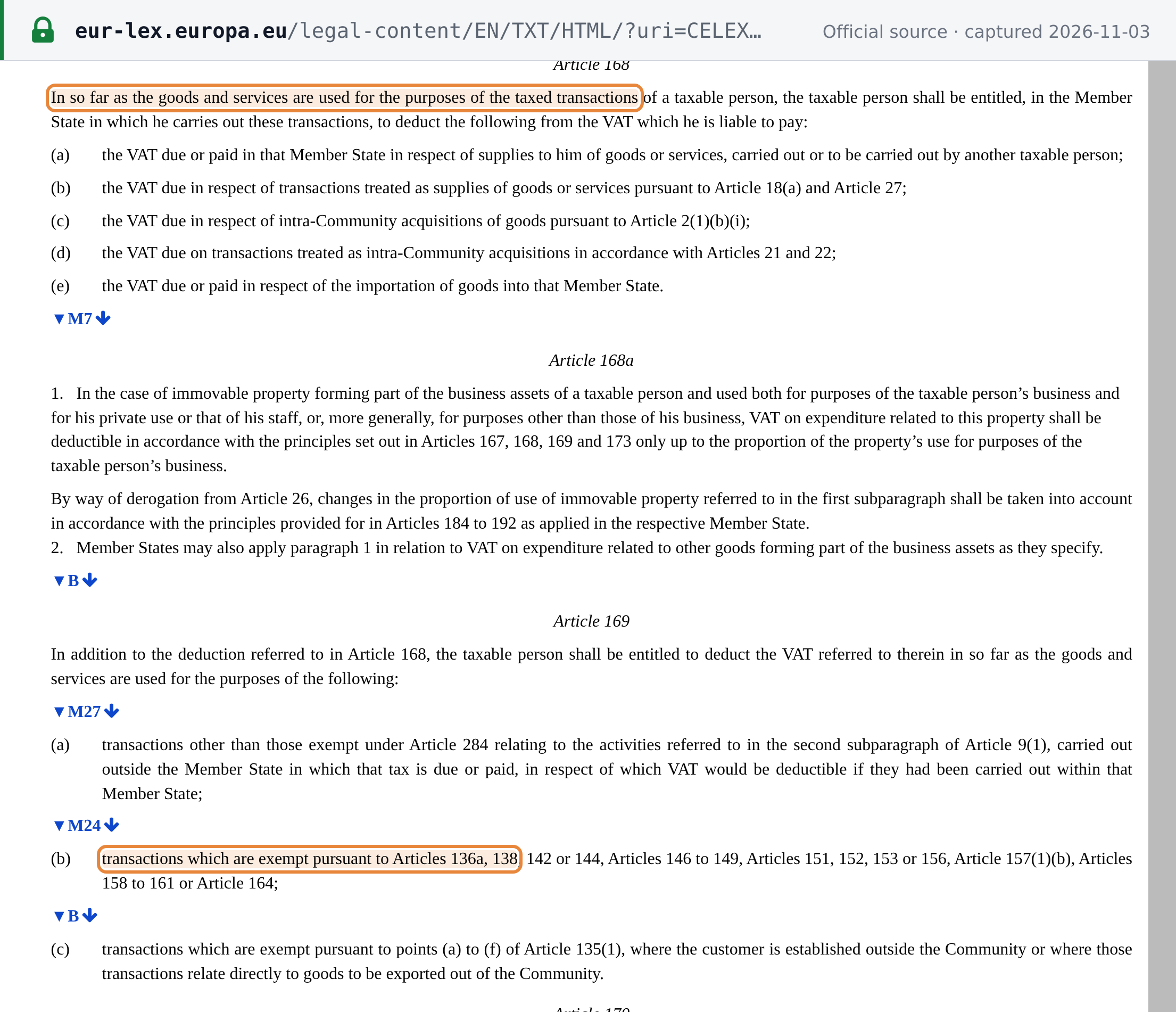 Source snapshot captured 2026-11-03 — original (EUR-Lex, consolidated text of 14.04.2025)
Read together, the two Articles create two kinds of exemption:
- Exemptions with a right of deduction — exports, intra-Community supplies and the other transactions listed in Article 169. EU law calls an export "exempt", but it works like a UK or Canadian zero rate. Article 146(1)(a) reads: "Member States shall exempt the following transactions: (a) the supply of goods dispatched or transported to a destination outside the Community by or on behalf of the vendor;" (see also intra-Community supply).
- Exemptions without a right of deduction — the public-interest exemptions in Article 132 and the financial, insurance and property exemptions in Article 135, which Article 169 does not list (except point (c) above). The Directive itself uses this shorthand: Article 221(3) refers to supplies "which are exempt, with or without deductibility of the VAT paid at the preceding stage", and Article 374 to Member States which "exempted, without deductibility of the VAT paid at the preceding stage" certain travel agents' services (VAT Directive, Arts 221 and 374). Recital 9 of Directive (EU) 2022/542 speaks of "the exemptions without the right to deduct input VAT" (Directive (EU) 2022/542). Article 135(1) begins: "Member States shall exempt the following transactions: (a) insurance and reinsurance transactions, including related services performed by insurance brokers and insurance agents; (b) the granting and the negotiation of credit and the management of credit by the person granting it;" and point (l) covers "the leasing or letting of immovable property."
For domestic supplies, the EU's legal name for a zero rate is "an exemption with deductibility of the VAT paid at the preceding stage". Article 98(2), as replaced by Directive (EU) 2022/542, lets Member States apply it "to supplies of goods or services covered in a maximum of seven points in Annex III." Member States that went beyond seven points on 1 January 2021 must comply "by 1 January 2032 or by the adoption of the definitive arrangements referred to in Article 402, whichever is the earlier." (Directive (EU) 2022/542, Art 1(6)) The EU VAT rate rules explainer covers Article 98 in depth.
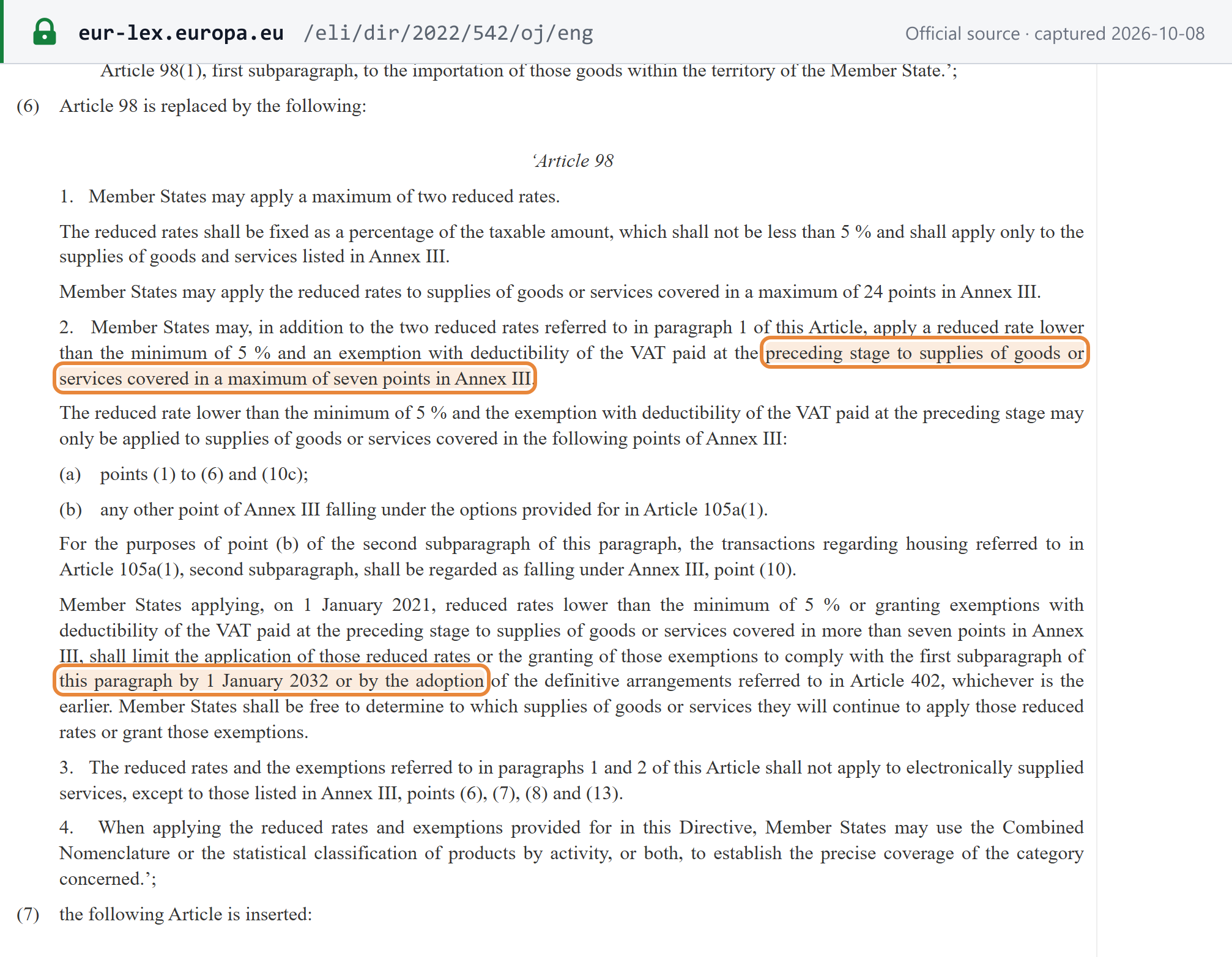 Source snapshot captured 2026-10-08 — original (EUR-Lex)
Some exemptions can be switched off. Article 137 lets Member States allow "a right of option for taxation" for the financial transactions in Article 135(1)(b) to (g), supplies of buildings and land and "the leasing or letting of immovable property". In the UK this is the option to tax: "It’s possible to choose to standard rate some supplies of property which would otherwise be exempt, by opting to tax" (HMRC, VAT Notice 700, para 3.6). A business opts to tax when recovering input tax on a property is worth more than keeping the rent VAT-free.
The UK rule: Schedule 8 zero-rates, Schedule 9 exempts
In the UK, the Value Added Tax Act 1994 states the distinction directly. Section 30(1): where a supply is zero-rated, "(a) no VAT shall be charged on the supply; but (b) it shall in all other respects be treated as a taxable supply; and accordingly the rate at which VAT is treated as charged on the supply shall be nil." Zero-rated supplies are those listed in Schedule 8. Section 31(1): "A supply of goods or services is an exempt supply if it is of a description for the time being specified in Part 2 of Schedule 9 and it is not of a description specified in Part 3 of that Schedule" (VATA 1994 s.30; s.31, legislation.gov.uk).
Section 26 limits input tax credit to input tax attributable to "(a) taxable supplies; (b) supplies outside the United Kingdom which would be taxable supplies if made in the United Kingdom; (c) such other supplies outside the United Kingdom and such exempt supplies as the Treasury may by order specify" (VATA 1994 s.26). HMRC's summary: "As a registered person, you can reclaim from HMRC as much of the VAT on your purchases and imports, as relates to the standard-rated, reduced-rated and zero-rated supplies you make. In principle, you cannot reclaim VAT which is for any non-business activity or to any exempt supplies you make." (HMRC, VAT Notice 700, para 4.1)
Schedule 9's Part I index lists the exempt groups, including Land (Group 1), Insurance (Group 2), Postal services (Group 3), Finance (Group 5), Education (Group 6) and Health and welfare (Group 7).
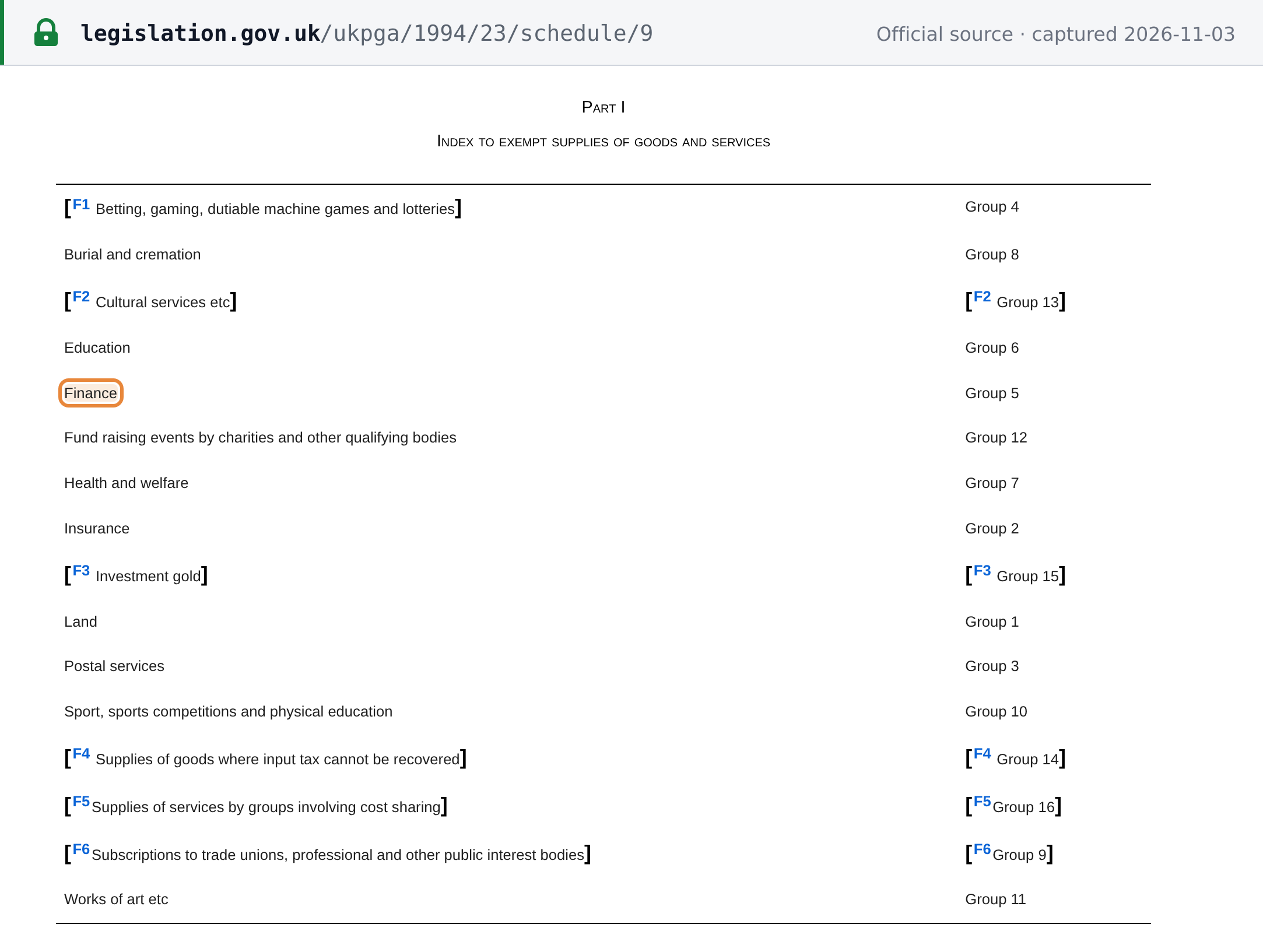 Source snapshot captured 2026-11-03 — original (legislation.gov.uk)
The Schedule 8 zero-rate index, with its current temporary changes, is under Current status and dates.
Mixed businesses: partial exemption and apportionment
A business that makes both taxable (including zero-rated) and exempt supplies must split its input tax. Tax on purchases used only for taxable supplies is recoverable. Tax on purchases used only for exempt supplies is not. Tax on shared costs (overheads, IT, premises) is apportioned.
In the EU, Article 173(1) sets the principle: "In the case of goods or services used by a taxable person both for transactions in respect of which VAT is deductible pursuant to Articles 168, 169 and 170, and for transactions in respect of which VAT is not deductible, only such proportion of the VAT as is attributable to the former transactions shall be deductible." The default fraction (Article 174(1)) is annual turnover from deductible transactions over that turnover plus non-deductible turnover, both exclusive of VAT. Article 174(2) leaves out disposals of capital goods and incidental real-estate and financial transactions. Under Article 175(1), "The deductible proportion shall be determined on an annual basis, fixed as a percentage and rounded up to a figure not exceeding the next whole number." Member States may also allow sector-by-sector or actual-use methods (Article 173(2)), and may "provide that, where the VAT which is not deductible by the taxable person is insignificant, it is to be treated as nil" (Article 173(2)(e)). (VAT Directive, Arts 173 to 175)
National versions of the same idea:
- United Kingdom — the standard method in VAT Notice 706: "Value of taxable supplies in the period (excluding VAT) ÷ total value of supplies in the period (excluding VAT) × 100 = recoverable percentage of residual input tax". The result is rounded up to the next whole number "unless you incur more than £400,000 of residual input tax each month on average in which case you must round to 2 decimal places" (paras 4.3 and 4.7). Under the de minimis rule, a business is treated as fully taxable if its exempt input tax is not more than "£625 per month on average" and "half of your total input tax in the relevant period"; both conditions must be met (paras 11.2 and 11.6). (HMRC, Partial exemption (VAT Notice 706))
- South Africa — "The only pre-approved method which may be used to apportion VAT incurred for mixed purposes without specific prior written approval from the Commissioner is the turnover-based method." and "Where the formula yields an apportionment ratio/percentage of 95% or more, the full amount of VAT incurred on mixed expenses may be deducted (referred to as the de minimis rule)." (SARS, VAT 404 Guide for Vendors, Issue 15, para 8.4.3)
- Canada — input tax credits follow the extent of use in commercial activities (Excise Tax Act s.169(1)). CRA: "You can claim an ITC equal to 100% of the GST/HST paid or payable by you for a particular operating expense (property or service) if substantially all (90% or more) of your consumption or use of that property or service is (or is intended to be) in the course of your commercial activities and all the other ITC criteria are satisfied." (CRA, Guide RC4022; ETA s.169)
- India — "Where the goods or services or both are used by the registered person partly for effecting taxable supplies including zero-rated supplies under this Act or under the Integrated Goods and Services Tax Act and partly for effecting exempt supplies under the said Acts, the amount of credit shall be restricted to so much of the input tax as is attributable to the said taxable supplies including zero-rated supplies." (CGST Act s.17(2), CBIC)
Worked example 1: the same costs, two different outcomes
An illustrative comparison (arithmetic only, using the UK rules above). Two UK traders each buy £10,000 of goods and services plus £2,000 VAT, and each sells its output for £15,000.
| Zero-rated trader (e.g. books, Schedule 8 Group 3) | Exempt trader (e.g. lending, Schedule 9 Group 5) | |
|---|---|---|
| Output VAT charged to customers | £0 | £0 |
| Input VAT paid on costs | £2,000 | £2,000 |
| Input VAT recovered from HMRC | £2,000 | £0 |
| Net cost of inputs | £10,000 | £12,000 |
| Price paid by the customer | £15,000 | £15,000 |
The customer pays the same price, but the exempt trader carries £2,000 of VAT it cannot recover. It must absorb that cost or build it into its prices. The zero-rated trader reclaims the full £2,000 and, with no output VAT to set against it, is in a repayment position.
Worked example 2: HMRC's partial-exemption calculation
VAT Notice 706 para 4.11 works through a partly exempt business using these figures:
- input tax exclusively for taxable supplies: £12,500
- input tax exclusively for exempt supplies: £7,500
- input tax on business entertainment: £500 (blocked; excluded before the calculation)
- residual input tax (shared costs): £15,000
- value of all taxable supplies (excluding VAT): £135,000
- value of exempt supplies: £55,000
- value of a machine used in the business and then sold: £20,000 (a capital item, excluded from the calculation because it would distort it)
The £20,000 machine sale sits inside the £135,000 of taxable supplies, so HMRC removes it from both the top and the bottom of the fraction: (135,000 − 20,000) ÷ (135,000 + 55,000 − 20,000) = 115,000 ÷ 170,000 × 100 = 67.65% (HMRC, Recoverable percentage of residual input tax (VAT Notice 706), PDF). HMRC rounds this up to 68% and concludes: "£15,000 × 68% = £10,200". (HMRC, VAT Notice 706, para 4.11)
Applying HMRC's figures, the business recovers £12,500 + £10,200 = £22,700. It cannot recover £7,500 + (£15,000 − £10,200) = £12,300, and the £500 entertainment VAT is blocked whatever the supplies.
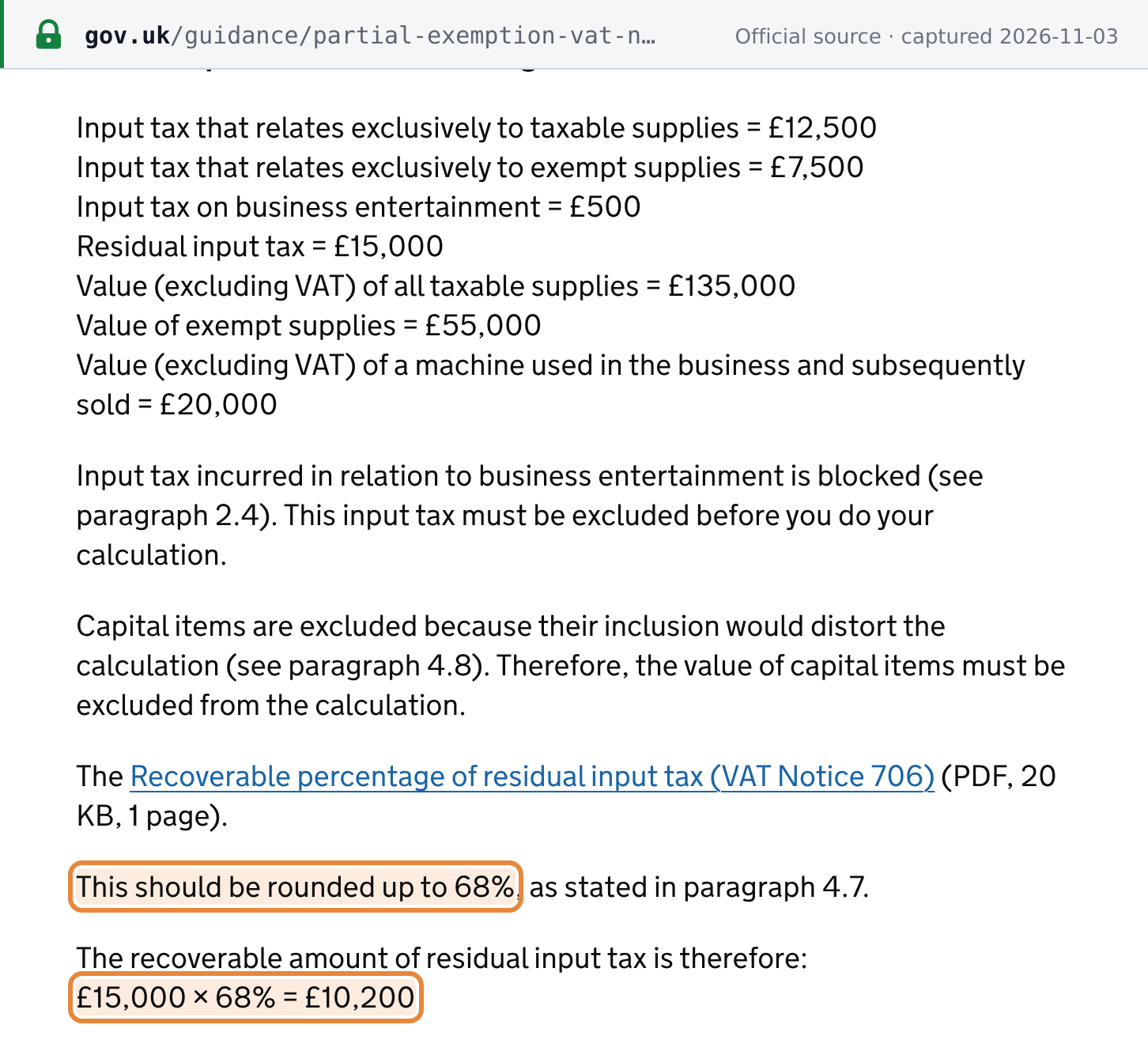 Source snapshot captured 2026-11-03 — original (HMRC)
Who it affects
Whether a supply is zero-rated or exempt changes registration, cash flow and pricing:
- Registration. Zero-rated supplies are taxable supplies, so they count towards registration; a business making only exempt supplies generally cannot register. South Africa: "A business that only makes exempt supplies does not carry on an “enterprise” for VAT purposes (see Chapter 2) and is therefore unable to register as a vendor irrespective of the number or value of the supplies made." (SARS, VAT 404, para 7.1) Canada: "Generally, you cannot register for the GST/HST if your business provides only exempt supplies; one exception is if you are a listed financial institution resident in Canada." For Canada's registration test, taxable-supply revenue "includes zero-rated supplies of property and services made in Canada, and those of your associates." (CRA, Guide RC4022) Norway: "If you only have exempt supplies, the following applies: You do not need to register the business in the VAT Register." (Skatteetaten) See VAT registration thresholds and how to register for VAT/GST.
Grouping the quoted lists by type of business (our summary, not an official classification):
- Exporters and other mainly zero-rated businesses — exports are zero-rated in the UK, South Africa, Canada, India and the UAE and exempt with deduction in the EU (Article 169(b)), so these businesses often reclaim more VAT than they charge.
- Banks, insurers, residential landlords, and health and education providers — the core exempt sectors in Article 135 and Article 132 of the EU Directive, UK Schedule 9 and the other lists below. Their irrecoverable input tax is a real cost, which is why they track the VAT on every purchase.
- Mixed businesses — anyone making both taxable and exempt supplies needs a partial-exemption or apportionment method (EU Articles 173 to 175, UK Notice 706, South Africa's turnover-based method, Canada s.169 and the 90% rule, India CGST s.17(2)).
- Public bodies and charities — in Canada, "Public service bodies that provide exempt supplies are generally eligible to claim a public service bodies’ rebate for the GST/HST paid or payable on expenses related to making exempt supplies whether or not they are registered for the GST/HST." (CRA, Guide RC4022)
- Groups — in the UK, "any supply of goods or services by a member of the group to another member of the group shall be disregarded" (VATA 1994 s.43(1)(a), legislation.gov.uk), which matters most to partly exempt groups such as banks and insurers (see VAT grouping).
Current status and dates
As at 2026-11-03, the line between zero-rating and exemption is moving in several countries. Each change below is labelled in force, enacted with a future date or proposed.
United Kingdom: Schedule 8 carries two temporary zero rates (Great Britain)
The UK's zero-rate schedule currently carries two time-limited changes:
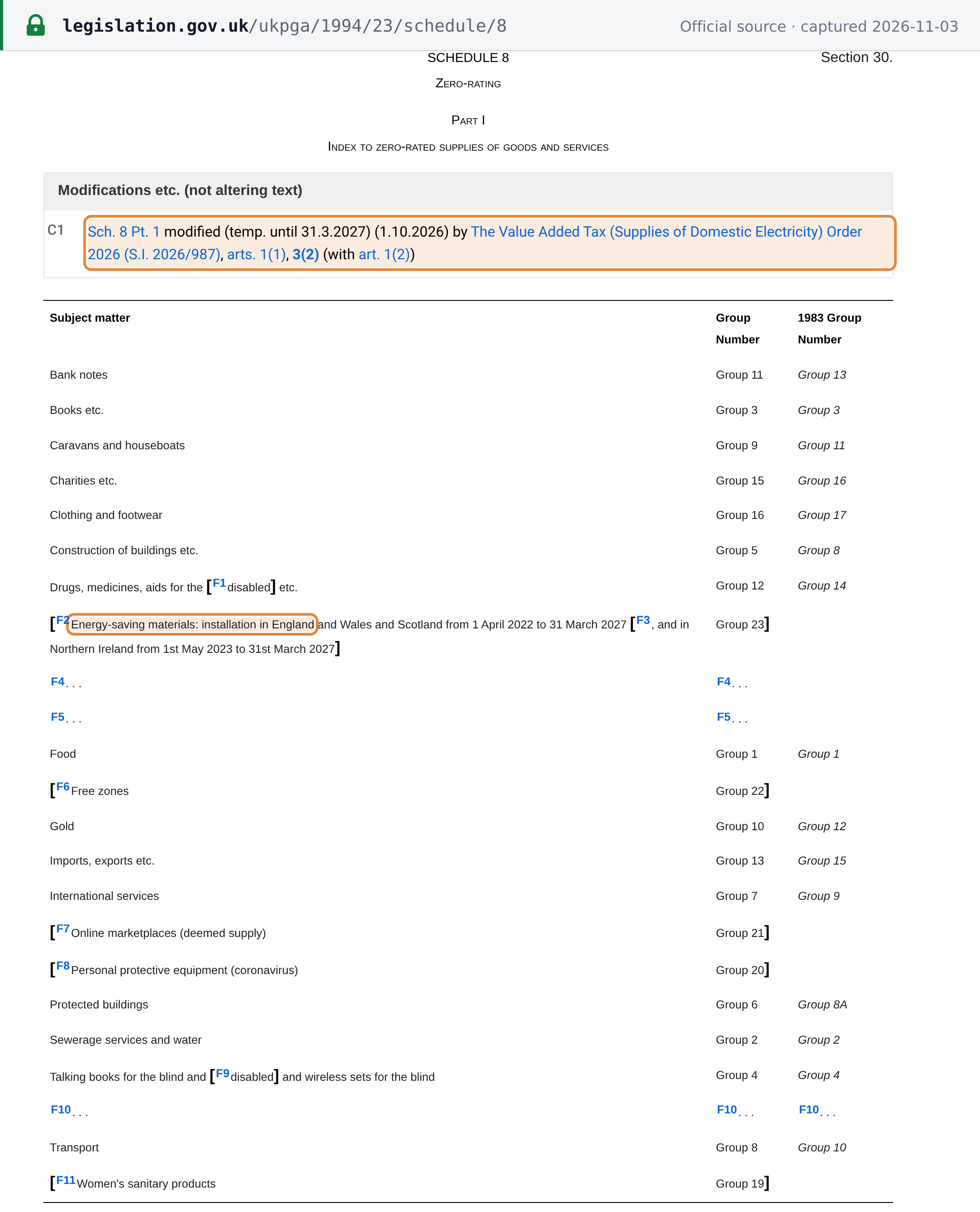
- Domestic electricity (in force). The Value Added Tax (Supplies of Domestic Electricity) Order 2026 (S.I. 2026/987) modifies Schedule 8 from 1 October 2026: "Sch. 8 Pt. 1 modified (temp. until 31.3.2027) (1.10.2026) by The Value Added Tax (Supplies of Domestic Electricity) Order 2026 (S.I. 2026/987)". The Order adds a temporary Group 24 to Schedule 8 for "Supplies in England and Wales and Scotland of electricity for qualifying use", zero-rated until 31 March 2027. It applies in Great Britain only: according to the Order's Explanatory Note, Article 4 makes consequential modifications "to maintain the reduced rate of VAT on the supply of domestic electricity in Northern Ireland", which stays at 5%. (VATA 1994 Schedule 8, legislation.gov.uk; S.I. 2026/987)
- Extension to 30 June 2027 (proposed). At Budget 2026 (28 October 2026) the government said: "As announced at Budget 2026, the government will extend the temporary VAT zero rate for domestic electricity supplies until 30 June 2027." It "will lay secondary legislation before Parliament in early 2027". The extension would continue the temporary zero rate in Great Britain; as at 2026-11-03 it is announced, not enacted. (HM Treasury, Budget 2026 OOTLAR, para 2.20)
- Energy-saving materials (enacted end date). The Schedule 8 index lists "Energy-saving materials: installation in England and Wales and Scotland from 1 April 2022 to 31 March 2027", and in Northern Ireland "from 1st May 2023 to 31st March 2027" (Group 23). The Budget 2026 OOTLAR confirms that "the rate of VAT relief for energy-saving materials will revert to 5 per cent from 1 April 2027" (para 2.22).
 Source snapshot captured 2026-11-03 — original (legislation.gov.uk)
United Kingdom: other Budget 2026 zero-rate measures (proposed)
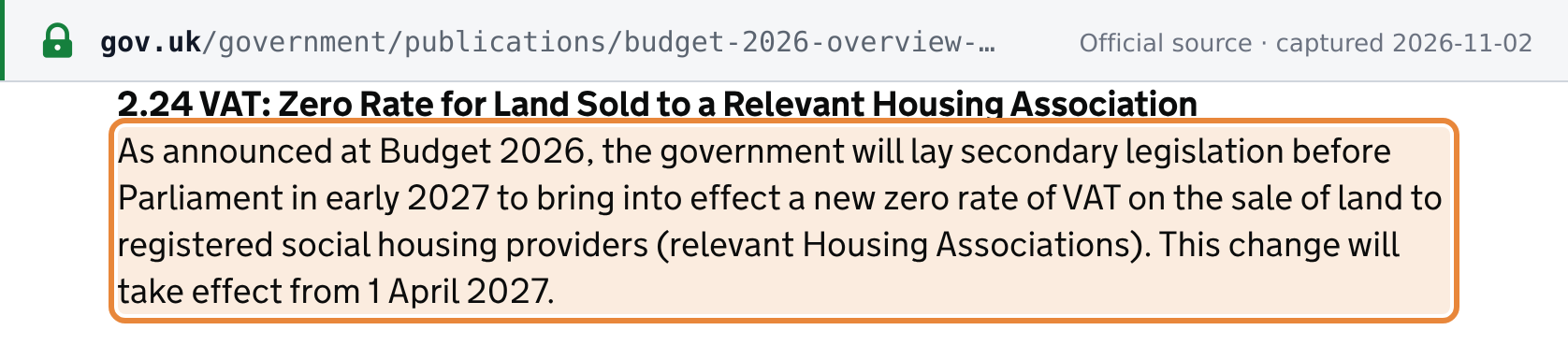
- Land sold to housing associations, from 1 April 2027 (proposed). "As announced at Budget 2026, the government will lay secondary legislation before Parliament in early 2027 to bring into effect a new zero rate of VAT on the sale of land to registered social housing providers (relevant Housing Associations). This change will take effect from 1 April 2027." (OOTLAR para 2.24)
- Donated medicines, from 23 June 2026 (proposed). The government "will introduce legislation in Finance Bill 2026-27 to introduce a VAT zero rate for medicines provided free of charge for a qualifying purpose", to "take effect from 23 June 2026" (OOTLAR para 1.57). It is not law until the Finance Bill is enacted. (HM Treasury, Budget 2026 OOTLAR)
 Source snapshot captured 2026-11-02 — original (GOV.UK)
United Kingdom: private school fees moved from exempt to standard-rated (in force)
"Since 1 January 2025, all education services and vocational training provided by private schools in the UK for a charge have been subject to VAT at the standard rate of 20%." (HMRC) Finance Act 2025 did this by adding Part 3 ("Exceptions") to Schedule 9, whose item 1 is "The provision of education by a private school, other than— (a) the provision of the teaching of English as a foreign language, (b) the provision of education in a nursery class, or (c) the provision of a higher education course." (VATA 1994 Schedule 9) The move from exempt to taxable is the trade-off in reverse: fees now carry 20% VAT, but the schools can recover the input VAT on their costs.
Oman: zero-rate list expanded (in force since 1 October 2026)
"The Tax Authority, has issued three new administrative decisions specifying the goods and products subject to a zero percent (0%) Value Added Tax (VAT) rate. The decisions cover basic food staples, human medicines and medical equipment, as well as veterinary medicines and medical supplies. The decisions will officially take effect on 1 st October, 2026." (Oman Tax Authority)
 Source snapshot captured 2026-10-05 — original (Oman Tax Authority)
Trinidad and Tobago: zero-rated items to become exempt (proposed from 1 January 2027)
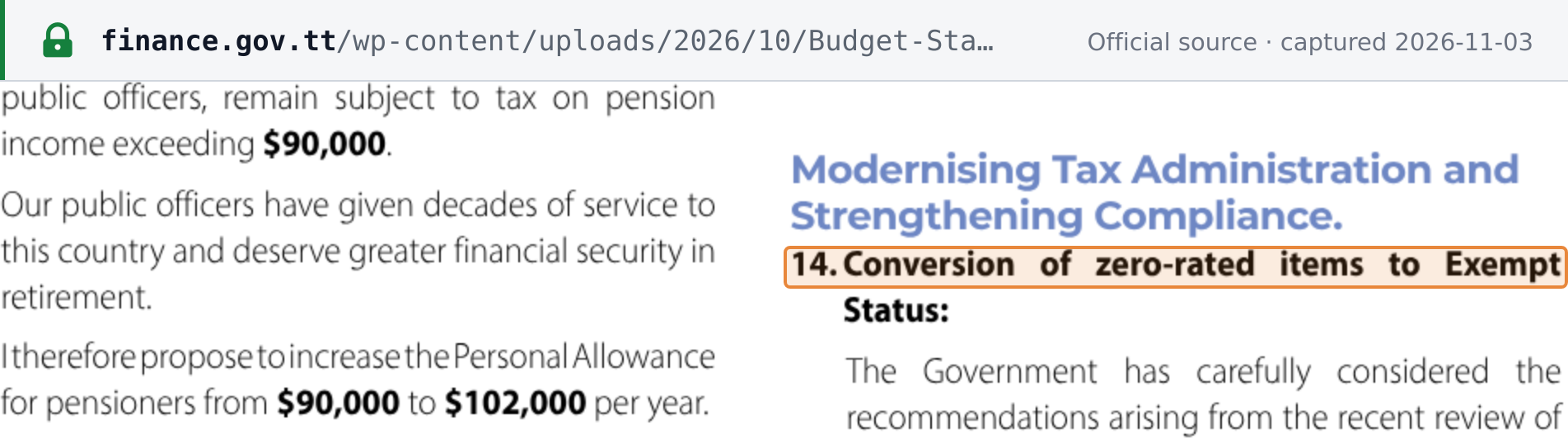
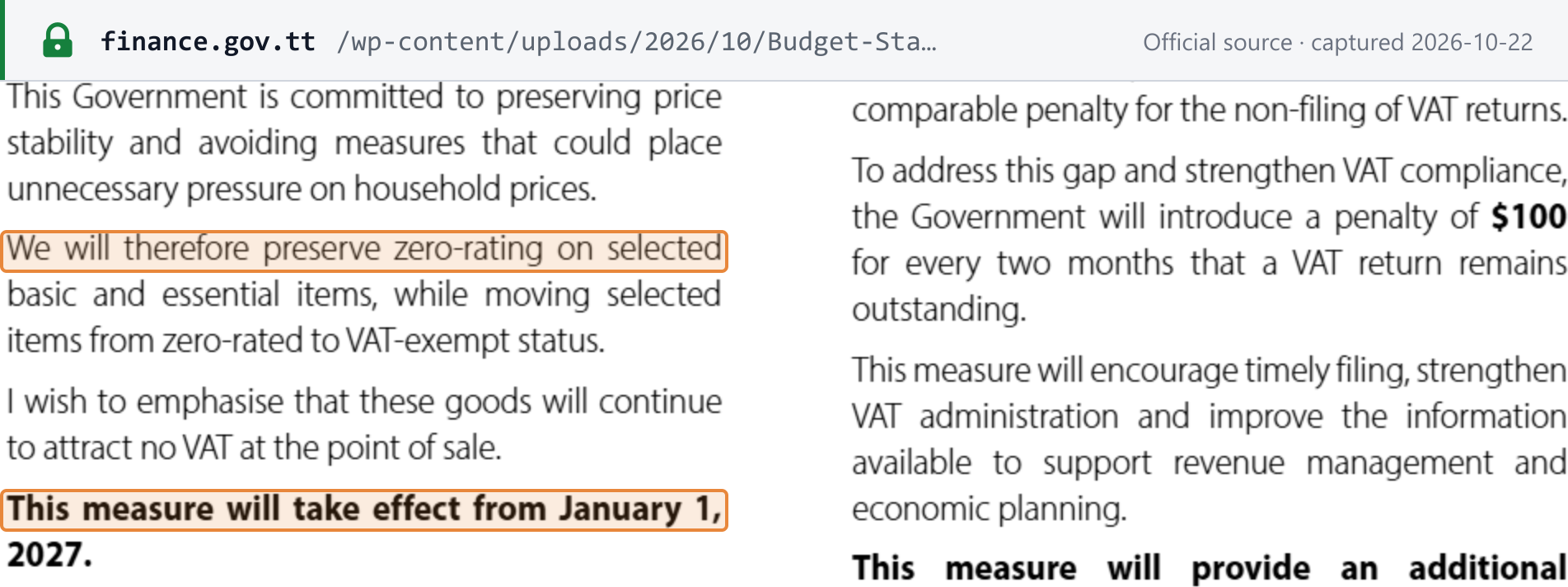
Trinidad and Tobago's Budget Statement 2027 (12 October 2026) proposes the change that shows the whole concept in one paragraph. The review behind it "makes a strong case for simplifying the VAT system, reducing the extensive use of zero-rating and broadening the VAT base", which would "reduce some of the pressures associated with VAT refunds". The Minister continued: "We will therefore preserve zero-rating on selected basic and essential items, while moving selected items from zero-rated to VAT-exempt status. I wish to emphasise that these goods will continue to attract no VAT at the point of sale. This measure will take effect from January 1, 2027." (Ministry of Finance, Budget Statement 2027) Shelf prices would not show VAT either way, but suppliers of the items moved to exempt would lose their input-VAT refunds. As at 2026-11-03 the measure is a budget proposal: the Budget Statement does not list the items and the change has not been legislated.
 Source snapshot captured 2026-11-03 — original (Ministry of Finance, Trinidad and Tobago), PDF page 30
 Source snapshot captured 2026-10-22 — original (Ministry of Finance, Trinidad and Tobago)
Timeline
| Date | Jurisdiction | Change | Status as at 2026-11-03 | Source |
|---|---|---|---|---|
| 1 Jan 2025 | United Kingdom | Private school education moved from exempt to standard-rated (20%) | In force | HMRC |
| 23 Jun 2026 | United Kingdom | Zero rate for medicines provided free of charge for a qualifying purpose | Proposed (Finance Bill 2026-27), to apply retrospectively from 23 Jun 2026 | OOTLAR 1.57 |
| 1 Oct 2026 | Oman | Zero-rate list expanded (food staples, human and veterinary medicines and medical supplies) | In force | Oman Tax Authority |
| 1 Oct 2026 to 31 Mar 2027 | Great Britain (UK) | Temporary zero rate for qualifying domestic electricity (S.I. 2026/987); Northern Ireland stays at 5% | In force | legislation.gov.uk |
| 1 Jan 2027 | Trinidad and Tobago | Selected items moved from zero-rated to exempt | Proposed | Budget Statement 2027 |
| 31 Mar 2027 | United Kingdom | Zero rate for installing energy-saving materials ends (Great Britain and Northern Ireland); 5% from 1 April 2027 | Enacted end date | legislation.gov.uk |
| 1 Apr 2027 | United Kingdom | New zero rate for land sold to relevant housing associations | Proposed | OOTLAR 2.24 |
| 30 Jun 2027 | Great Britain (UK) | Domestic electricity zero rate extended from 31 March 2027 | Proposed (announced at Budget 2026) | OOTLAR 2.20 |
| 1 Jan 2032 | EU | Member States must limit rates below 5% and zero rates ("exemption with deductibility") to seven Annex III points, or comply earlier if the definitive arrangements are adopted first | Enacted (Directive (EU) 2022/542) | EUR-Lex |
Terminology by jurisdiction
The same two categories go by different names. Two traps stand out. In Australia, the ATO uses "exempt" for GST-free supplies, which keep their credits, the opposite of the UK meaning. In India, "exempt" means no input tax credit as in the UK, but "nil-rated" supplies are legally exempt, not zero-rated. "Exempt" can also label supplies that do carry a deduction: exports under EU Article 169, Finland's "VAT-exempt sales for which VAT deductions can be claimed", and Serbia's exemptions with the right to deduct (Article 24).
Australia: "GST-free" is the zero rate; "input taxed" is the exemption. Section 38-1 of the GST Act: "If a supply is GST-free, then: • no GST is payable on the supply; • an entitlement to an input tax credit for anything acquired or imported to make the supply is not affected." Section 40-1: "If a supply is input taxed, then: • no GST is payable on the supply; • there is no entitlement to an input tax credit for anything acquired or imported to make the supply (see sections 11-15 and 15-10)." Yet the ATO's own GST-free page says "Most basic foods, some education courses and some medical, health and care products and services are GST-free. This is often referred to as exempt from GST." In Australian usage, "exempt" usually means GST-free, with credits. The no-credit category is input taxed: "The most common input-taxed sales are financial supplies (such as lending money or the provision of credit for a fee) and selling or renting out residential premises." (GST Act 1999, Compilation No. 96, legislation.gov.au; ATO, GST-free sales; ATO, Input-taxed sales)
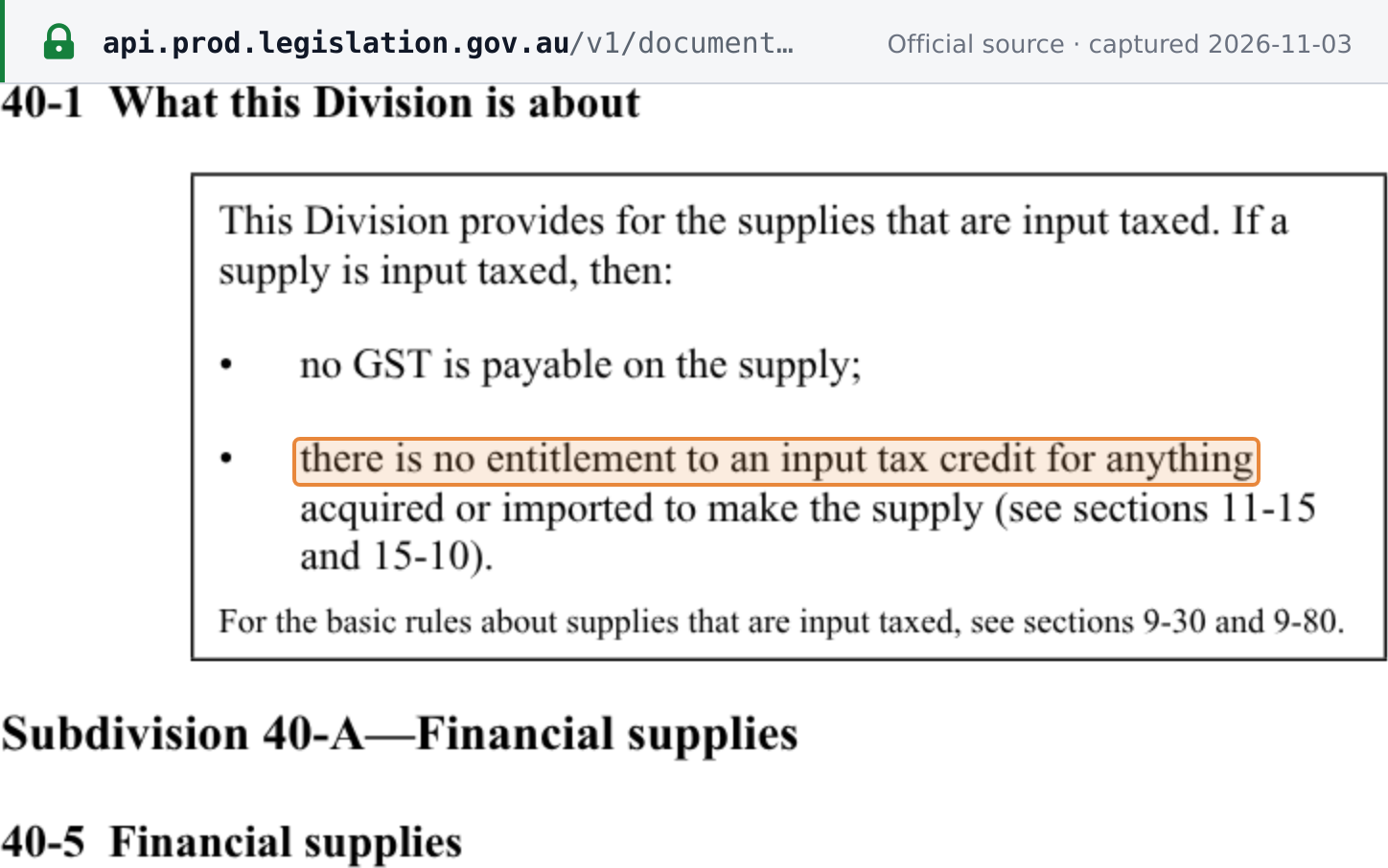 Source snapshot captured 2026-11-03 — original (Federal Register of Legislation, Compilation No. 96, 1 January 2026)
India: "nil-rated" is legally exempt. CGST Act s.2(47): "“exempt supply” means supply of any goods or services or both which attracts nil rate of tax or which may be wholly exempt from tax under section 11, or under section 6 of the Integrated Goods and Services Tax Act, and includes nontaxable supply;" A nil-rated domestic supply therefore carries no input tax credit, unlike a UK or South African zero-rated food supply. Only exports and supplies for authorised operations to a Special Economic Zone developer or unit are "zero rated" (IGST Act s.16(1)), and "credit of input tax may be availed for making zero-rated supplies, notwithstanding that such supply may be an exempt supply" (s.16(2)). (CGST Act s.2; IGST Act s.16, CBIC) See SEZs in India.
 Source snapshot captured 2026-11-03 — original (CBIC)
The table covers a selection of VAT and GST systems, not all of them. For a country not shown, see that country's guide, which carries its own last-updated date.
| Jurisdiction | 0% with input tax recovery is called | No tax and no recovery is called | Legal basis (zero / exempt / recovery) | Last confirmed | Source |
|---|---|---|---|---|---|
| EU (VAT Directive) | "exemption with deductibility of the VAT paid at the preceding stage" (Art 98(2)); exports and intra-Community supplies are "exempt" but keep deduction (Art 169(b)) | exemption; the Art 132 and Art 135 exemptions are not listed in Art 169, so no deduction | Art 98(2) and Annex III; Arts 138, 146 / Arts 132, 135 / Arts 168, 169, 173 to 175 | 2026-11-03 | EUR-Lex, consolidated 14.04.2025 |
| United Kingdom | zero-rated | exempt | VATA 1994 s.30 and Sch 8 / s.31 and Sch 9 / s.26; UK guide | 2026-11-03 | legislation.gov.uk; HMRC Notice 700 |
| South Africa | zero-rated: "Zero-rated supplies are taxable supplies on which VAT is levied at a rate of 0%" and vendors "are still able to deduct input tax in full" | exempt: "no output tax is levied and no input tax may be deducted" | VAT Act s.11 / s.12 / apportionment, as cited by SARS; South Africa guide | 2026-11-03 | SARS VAT 404, Issue 15 |
| Australia | GST-free (the ATO also calls this "exempt from GST") | input taxed | GST Act 1999 Div 38 / Div 40 / s.11-15; Australia guide | 2026-11-03 | legislation.gov.au; ATO |
| Canada | zero-rated: "zero-rated supply means a supply included in Schedule VI" | exempt: "exempt supply means a supply included in Schedule V" | Excise Tax Act s.123(1) and Sch VI / s.123(1) and Sch V / s.169; Canada guide | 2026-11-03 | Justice Laws, ETA s.123; CRA RC4022 |
| India | zero rated (exports, and supplies for authorised operations to SEZ developers or units, only) | exempt, which includes nil-rated and non-taxable supplies | IGST Act s.16 / CGST Act s.2(47) / CGST Act s.17(2); India guide | 2026-11-03 | CBIC, CGST s.2; IGST s.16 |
| United Arab Emirates | zero rate (14 categories, including exports outside the Implementing States, international transport, investment precious metals, the first supply of residential buildings within 3 years of completion, crude oil and natural gas) | exempt (specified financial services, residential buildings other than zero-rated ones, bare land, local passenger transport) | Federal Decree-Law No. 8 of 2017 Art 45 / Art 46 / Art 54(1); UAE guide | 2026-11-03 | FTA, Decree-Law (English text) |
| Norway | zero-rating: "the rules in the VAT Act apply to the supply, but the VAT rate is 0 percent" (VAT Act ch. 6) | exemption: "the rules in the VAT Act do not apply to the supply" | VAT Act; Norway guide | 2026-11-03 | Skatteetaten |
| Finland | zero-rated: "VAT-exempt sales for which VAT deductions can be claimed" | VAT-exempt | Finnish VAT Act; Finland guide | 2026-11-03 | Vero |
| Serbia | exempt with the right to deduct input tax (са правом на одбитак претходног пореза, Art 24) | exempt without the right to deduct (без права на одбитак претходног пореза, Art 25) | VAT Law Arts 24 / 25; Serbia guide | 2026-11-03 | Tax Administration (PURS) |
| New Zealand | zero-rated: "supplies that have GST charged at 0% where certain requirements are met" | exempt: "goods and services which are not subject to GST" | GST Act 1985; New Zealand guide | 2026-11-03 | Inland Revenue, zero-rated; exempt |
Notes on the table:
- UAE. Article 54(1) makes input tax recoverable for goods and services used for "a. Taxable Supplies. b. Supplies that are made outside the State which would have been Taxable Supplies had they been made in the State. c. Supplies specified in the Executive Regulation of this Decree-Law that are made outside the State, which would have been treated as exempt had they been made inside the State." Article 52(1) of the Executive Regulation limits point (c) to "supplies of financial Services, where the place of supply of these Services is treated as outside the State and the Recipient of Services is outside the State at the time when the Services are performed." Quotes are from the FTA's English text, which is marked as not an official translation. (FTA, Executive Regulation (consolidated)) See also UAE Designated Zones.
- Finland. Vero: "Note that zero-rated activity does not mean the same as VAT-exempt activity".
- Serbia. The Tax Administration's VAT summary lists two rates, the 20% general rate and the 10% special rate (Art 23), and no 0% rate; its two exemption labels map onto zero-rating and exemption.
- GCC. Of the GCC states, this page covers the UAE and Oman.
Norway's Skatteetaten states the zero-rating rule in one line: "Zero-rating means that the rules in the VAT Act apply to the supply, but the VAT rate is 0 percent (zero-rated)."
 Source snapshot captured 2026-09-29 — original (Skatteetaten)
Serbia's Tax Administration lists VAT exemptions in two groups: with the right to deduct input tax (Art 24 of the VAT Law) and without the right to deduct input tax (Art 25).
 Source snapshot captured 2026-10-14 — original (Poreska uprava Srbije)
Related changes
- 2026-10-28 — United Kingdom: Budget 2026 announces that the temporary 0% rate on qualifying domestic electricity in Great Britain will be extended from 31 March 2027 to 30 June 2027, with secondary legislation in early 2027 (proposed). (HM Treasury) — see event
- 2026-10-28 — United Kingdom: Budget 2026 announces a new zero rate on the sale of land to relevant housing associations from 1 April 2027 (proposed). (HM Treasury) — see event
- 2026-10-12 — Trinidad and Tobago: Budget Statement 2027 proposes moving selected items from zero-rated to VAT-exempt status from 1 January 2027 (proposed). (Ministry of Finance) — see event
- 2026-10-01 — United Kingdom: S.I. 2026/987 zero-rates qualifying domestic electricity in Great Britain (England, Wales and Scotland) until 31 March 2027; Northern Ireland stays at 5% (in force). (legislation.gov.uk) — see event
- 2026-10-01 — Oman: three Tax Authority decisions expanding the 0% VAT list to basic food staples, human medicines and medical equipment, and veterinary medicines and medical supplies take effect (in force). (Oman Tax Authority) — see event
Frequently asked questions
My supplies are VAT-free for the customer. Why can't I reclaim VAT on my costs?
Because they are exempt, not zero-rated. Both charge the customer no VAT, but only a zero-rated supply is a taxable supply that carries the right to recover input tax. HMRC's VAT Notice 700 says that for exempt supplies "the person making the supply cannot normally recover any of the VAT on their own expenses", and Canada's Guide RC4022 says you can only claim ITCs for purchases made to make zero-rated supplies. Check which schedule your supply sits in: in the UK, Schedule 8 is zero-rating and Schedule 9 is exemption.
The ATO calls GST-free sales "exempt from GST". Does that mean I lose GST credits?
No. In Australia, GST-free is the zero rate: under section 38-1 of the GST Act, an entitlement to an input tax credit for anything acquired or imported to make the supply is not affected. The no-credit category is input taxed (section 40-1), which mainly covers financial supplies and selling or renting out residential premises. The ATO's own page says GST-free sales are "often referred to as exempt from GST", so in Australian usage "exempt" usually means GST-free, with credits.
Are nil-rated supplies in India the same as zero-rated supplies?
No. Section 2(47) of the CGST Act defines "exempt supply" to include a supply that attracts a nil rate of tax, and non-taxable supplies. Input tax credit on purchases used for nil-rated supplies is therefore restricted under section 17(2), as for any exempt supply. Only exports and supplies for authorised operations to Special Economic Zone developers or units are zero rated (IGST Act section 16), and credit may be taken for those even where the supply is also exempt.
I make a small amount of exempt supplies. Do I lose input tax on them?
Not necessarily. In the UK, you are treated as fully taxable if your exempt input tax is not more than £625 per month on average and not more than half of your total input tax; both conditions must be met (VAT Notice 706, para 11.2). In South Africa, if the turnover-based apportionment ratio is 95% or more, the full VAT on mixed expenses may be deducted (SARS VAT 404). The EU VAT Directive lets Member States treat insignificant non-deductible VAT as nil (Article 173(2)(e)), so check the national rule.
Can a business that only makes exempt supplies register to reclaim VAT?
Generally no. SARS says a business that only makes exempt supplies does not carry on an enterprise and is unable to register as a vendor, whatever the value of its supplies. Canada's Guide RC4022 says you generally cannot register for the GST/HST if you provide only exempt supplies, with an exception for listed financial institutions resident in Canada. Norway's Skatteetaten says a business with only exempt supplies does not need to register. A business that makes zero-rated supplies can register, because zero-rated supplies are taxable supplies.
Exports are "exempt" under the EU VAT Directive. Do I lose my right to deduct?
No. Article 169(b) of the VAT Directive gives a right of deduction for transactions exempt under Article 138 (intra-Community supplies of goods) and Articles 146 to 149 (exports and related transactions), among others. These are exemptions with a right of deduction and work like a zero rate. The exemptions in Articles 132 and 135, such as health, education, insurance and lending, are not listed in Article 169 (apart from Article 135(1)(a) to (f) transactions with customers outside the EU), so no deduction follows from them.
Related resources
- EU VAT rate rules — Article 98, Annex III and the 2032 deadline for zero rates in the EU
- Intra-Community supply — the Article 138 exemption with a right of deduction
- VAT grouping — why partly exempt groups such as banks and insurers group
- EU SME scheme — another "no VAT charged, no deduction" status, for small businesses
- Reverse charge, VAT on digital services by non-resident suppliers, Marketplace deemed supplier rules and VAT withholding
- UAE Designated Zones and SEZs in India — zero-rating for special zones
- Global tables: Worldwide VAT, GST and sales tax rates, VAT registration thresholds, How to register for VAT/GST
- Tax glossary
- Country guides: United Kingdom, South Africa, Australia, Canada, India, United Arab Emirates, Oman, Norway, Finland, Serbia, New Zealand, Trinidad and Tobago
- Tax-change chronologies: United Kingdom, Oman, Trinidad and Tobago
Reference links
- VAT Directive 2006/112/EC, consolidated version of 14.04.2025 — Arts 98, 132, 135, 137, 138, 146, 168, 169, 173 to 175 (EUR-Lex); Directive (EU) 2022/542
- UK: VATA 1994 s.26, s.30, s.31, Schedule 8, Schedule 9, S.I. 2026/987; HMRC VAT Notice 700, VAT Notice 706, private school fees; Budget 2026 OOTLAR
- South Africa: SARS VAT 404 Guide for Vendors, Issue 15
- Australia: A New Tax System (Goods and Services Tax) Act 1999; ATO GST-free sales and input-taxed sales
- Canada: Excise Tax Act s.123 and s.169; CRA Guide RC4022
- India: CGST Act s.2, s.17; IGST Act s.16 (CBIC)
- UAE: Federal Decree-Law No. 8 of 2017 and amendments; Executive Regulation (consolidated) (FTA)
- Oman Tax Authority; Trinidad and Tobago Budget Statement 2027
- Skatteetaten (Norway); Vero (Finland); PURS (Serbia); Inland Revenue zero-rated supplies and exempt supplies (New Zealand)