Federation of Bosnia and Herzegovina enacts real-time fiscalisation and e-invoicing law, to apply by August 2027
- Jurisdiction
- Bosnia and Herzegovina
- Tax
- VAT
- Change type
- E-invoicing
- Status
- In force
- Impact
- Action required
- Announced
- 4 February 2026
- Effective
- 12 February 2026
- Instrument
- BA-STATUTE-Sl-novine-FBiH-9-26
- Authority
- Porezna uprava Federacije Bosne i Hercegovine
- Verified
- Fetched from official source · high confidence
Businesses issuing invoices or receipts in the Federation of Bosnia and Herzegovina (B2C, B2B and B2G); not Republika Srpska or Brčko District.
Businesses operating in the Federation of BiH must implement real-time e-invoicing and transaction reporting through the Central Fiscal Platform by 31 August 2027.
The Law on Fiscalisation of Transactions in the Federation of Bosnia and Herzegovina (Zakon o fiskalizaciji transakcija u Federaciji BiH), published in Sluzbene novine FBiH No. 9/26 on 4 February 2026, entered into force on the eighth day after publication (12 February 2026). It replaces the fiscal-cash-register regime with real-time reporting of every transaction to the FBiH Tax Administration through the Central Fiscalisation Platform (CPF) and certified electronic transaction recording systems (ESET). B2G invoices must be issued, sent and accepted as e-invoices; B2B e-invoices are mandatory where payment is non-cash or combined; B2C sales get fiscal receipts. E-invoices must follow European standard EN 16931, be secured with an electronic certificate and signature, and carry a QR code or link. The Minister must adopt bylaws within 180 days; the law applies once bylaws and technical capacity are in place and at the latest 18 months from the month it entered into force (by August 2027). Until then the 2009 Law on Fiscal Systems continues to apply.
What changed in detail
The Law on Fiscalisation of Transactions in the Federation of Bosnia and Herzegovina (Zakon o fiskalizaciji transakcija u Federaciji BiH) was published in Službene novine FBiH No. 9/26 on 4 February 2026 and, under article 90(1), entered into force on the eighth day after publication: 12 February 2026.
The law replaces the fiscal-cash-register regime with real-time reporting of every transaction to the FBiH Tax Administration through a Central Fiscalisation Platform (CPF) and certified electronic transaction recording systems (ESET):
- B2G: invoices to public bodies must be issued, sent and accepted as e-invoices.
- B2B: e-invoices are mandatory where payment is non-cash or combined.
- B2C: sales to consumers get fiscal receipts.
- E-invoices must follow European standard EN 16931, be secured with an electronic certificate and signature, and carry a QR code or link.
The Minister must adopt the bylaws within 180 days of entry into force (art. 88). Under article 90(2), the law applies only once those bylaws and the technical and administrative capacity are in place, and at the latest 18 months from the month it entered into force, which is August 2027. Until then the 2009 Law on Fiscal Systems (Službene novine FBiH 81/09) continues to apply.
Compliance periods run from the date the law starts to apply. Under article 86(1), taxpayers must bring their operations into line with the law and the rulebook on the dynamics of fiscalisation (pravilnik o dinamici fiskalizacije) within two years for B2C transactions and within three years for B2B and B2G transactions. Under article 87, the transitional period lasts three years from that date, and taxpayers already fiscalised under the 2009 law may keep using a compliant existing fiscal system for B2C until at the latest four years after the law starts to apply.
What it means
The law is in force but not yet applied: as of November 2026 businesses in the Federation still operate under the 2009 fiscal-systems regime. We have not seen the implementing bylaws published.
August 2027 is the latest date the law can begin to apply, not the date by which businesses must comply. The obligations then phase in under article 86 and the rulebook on the dynamics of fiscalisation: up to two years after application starts for B2C and up to three years for B2B and B2G. Plan against the rulebook’s schedule once it is published; August 2027 is only the latest date from which those periods can start running.
The scope is the Federation only. Republika Srpska and Brčko District have their own fiscal rules, so a business operating across entities needs to treat its FBiH outlets separately. The B2B duty turns on how the invoice is paid, not on the customer, so cash-only B2B sales stay outside it.
Proof
(1) Ovaj zakon stupa na snagu osmog dana od dana objavljivanja u "Službenim novinama Federacije BiH". (2) Ovaj zakon počinje se primjenjivati nakon donošenja svih potrebnih podzakonskih akata za njegovu primjenu i uspostave tehničkih i administrativnih kapaciteta potrebnih za njegovu primjenu, a najkasnije u roku od 18 mjeseci od mjeseca u kojem je Zakon stupio na snagu.(1) This law enters into force on the eighth day after its publication in the "Official Gazette of the Federation of BiH". (2) This law starts to apply once all the bylaws needed to apply it have been adopted and the technical and administrative capacity needed to apply it is in place, and at the latest within 18 months from the month in which the Law entered into force.
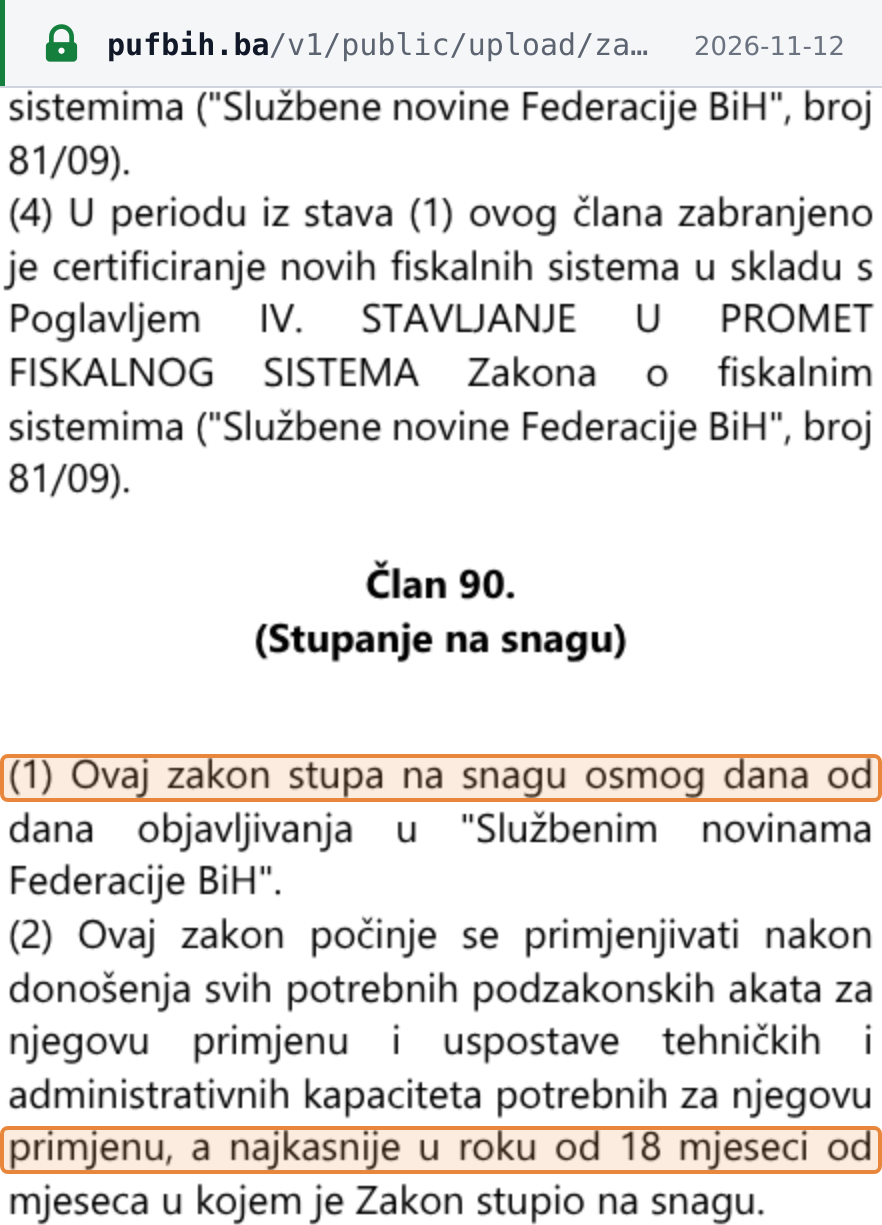 Source snapshot of the official page. Open full size ↗
Archived from the official distribution · Zakon o fiskalizaciji transakcija u Federaciji Bosne i Hercegovine (Službene novine Federacije BiH, broj 9/26) · pufbih.ba