Croatia's new Fiscalisation Act replaces the 2012 cash-fiscalisation law from 1 September 2025
This page records one dated change. For the rules in Croatia as they stand today, see the Croatia guide →
- Jurisdiction
- Croatia
- Tax
- PDV
- Change type
- E-invoicing
- Status
- In force
- Impact
- Action required
- Announced
- 13 June 2025
- Effective
- 1 September 2025
- Instrument
- HR-ZAKON-1233-2025
- Authority
- Narodne novine (Official Gazette of the Republic of Croatia)
- Verified
- Fetched from official source · high confidence
Croatian businesses that issue receipts to consumers, and, under the staggered e-invoicing articles, all domestic B2B and B2G invoice issuers.
Croatia's new Zakon o fiskalizaciji (Fiskalizacija 2.0) is in force. Phase 1 (B2C fiscalisation under HR-FISK 2.0) has applied since 1 September 2025. Businesses must comply with the new B2C electronic receipt requirements.
Croatia's Zakon o fiskalizaciji (Law 1233), published in Narodne novine NN 89/2025 on 13 June 2025, replaced the prior 2012 fiscalisation regime. Phase 1 provisions (B2C cash-register fiscalisation under the new HR-FISK 2.0 protocol) entered into force on 1 September 2025. Phase 2 (mandatory B2G and B2B e-invoicing for VAT-registered entities) enters into force on 1 January 2026 under the same Act.
What changed in detail
The Zakon o fiskalizaciji (Fiscalisation Act), item 1233 in Narodne novine 89/2025 of 13 June 2025, is Croatia’s new fiscalisation law. The Hrvatski sabor adopted it on 6 June 2025.
Article 79 repeals the Zakon o fiskalizaciji u prometu gotovinom (NN 133/12 and amendments), the 2012 act on fiscalising cash transactions, from the day the new Act enters into force.
Article 80 stages its entry into force:
- 1 September 2025: the Act as a whole, including the rules on fiscalising receipts issued to consumers (B2C).
- 1 January 2026: a listed set of provisions, among them Articles 33 to 43, 45 and 47 to 57. These cover the eRačun electronic invoice, its exchange through access points and the duty to issue it.
- 1 January 2027: Article 38(1) points 2 and 3, which extend the eRačun obligation to taxpayers not registered for PDV and to budget users, and the provisions on issuing eRačuni through the MIKROeRAČUN application.
Article 36 requires every eRačun to comply with the EU standard on electronic invoicing.
What it means
The Act is in force, and its first two stages are now live: B2C fiscalisation since 1 September 2025, and eRačun for PDV-registered businesses since 1 January 2026. The third stage is due on 1 January 2027, when non-PDV-registered income-tax and profit-tax payers and budget users must start issuing eRačuni.
Two later instruments build on this Act without amending it. NN 151/2025 removed the VAT Act’s recipient-consent requirement where this Act mandates eRačun. The receipt-fiscalisation rulebook was amended in NN 97/2026.
Proof
Ovaj Zakon objavit će se u »Narodnim novinama«, a stupa na snagu 1. rujna 2025., osim članka 3.This Act shall be published in the Official Gazette and enters into force on 1 September 2025, except for Article 3.
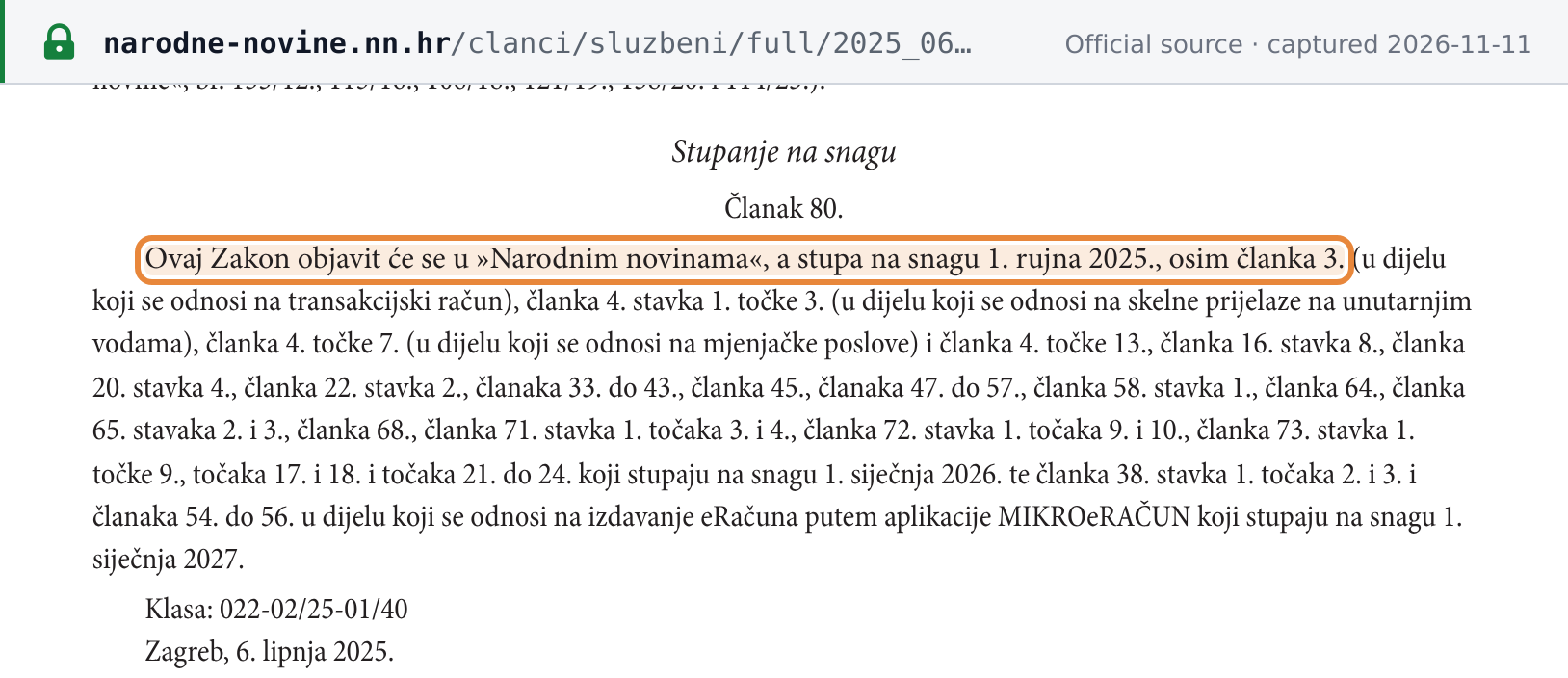 Source snapshot of the official page. Open full size ↗