EU tax authorities start pooling payment-provider data in CESOP from 1 January 2024
- Jurisdiction
- European Union
- Tax
- VAT
- Change type
- Compliance
- Status
- In force
- Impact
- FYI
- Announced
- 1 January 2024
- Effective
- 1 January 2024
- Instrument
- EU-REGULATION-2020-283
- Authority
- Official Journal of the European Union (EUR-Lex)
- Verified
- Fetched from official source · high confidence
Member State tax administrations and Eurofisc; indirectly, businesses receiving more than 25 cross-border payments a quarter through EU payment service providers.
No action — CESOP operational since 1 January 2024.
Council Regulation (EU) 2020/283 of 18 February 2020 amending Regulation (EU) No 904/2010 creates the Central Electronic System of Payment Information (CESOP) and requires Member States to transmit payment data reported by PSPs to that system for Eurofisc analysis. Applies from 1 January 2024.
What changed in detail
Council Regulation (EU) 2020/283 of 18 February 2020, published in OJ L 62 on 2 March 2020, amends Regulation (EU) No 904/2010 on administrative cooperation in VAT. Under its Article 2 it entered into force twenty days after publication and applies from 1 January 2024.
It inserts a new section on the Central Electronic System of Payment Information (CESOP):
- each Member State collects from payment service providers the payee and payment records that Article 243b of the VAT Directive requires them to keep, by the end of the month after each calendar quarter, using an electronic standard form (Article 24b(1));
- national liaison offices transmit that information to CESOP by the tenth day of the second month after the quarter (Article 24b(3));
- CESOP stores the data, aggregates it per payee, analyses it against other information, and makes it available to Eurofisc liaison officials, retaining it for a maximum of five years from the end of the year of transmission (Article 24c);
- only Eurofisc liaison officials with a personal CESOP user identification, and only in connection with suspected VAT fraud, may access it (Article 24d).
The Commission sets the technical rules by implementing act, and the Union budget bears the cost of the central system.
What it means
This is the authorities’ half of the CESOP package. The record-keeping duty sits on payment service providers under Directive (EU) 2020/284, and the data format and Commission tasks are in Implementing Regulation (EU) 2022/1504. The rule is spent as a start date and has been in force since 2024. Online sellers paid by card or transfer from EU payers should assume their cross-border receipts are visible to every Member State’s anti-fraud office, whether or not they are VAT-registered there.
Proof
This Regulation shall enter into force on the twentieth day following that of its publication in the Official Journal of the European Union. It shall apply from 1 January 2024.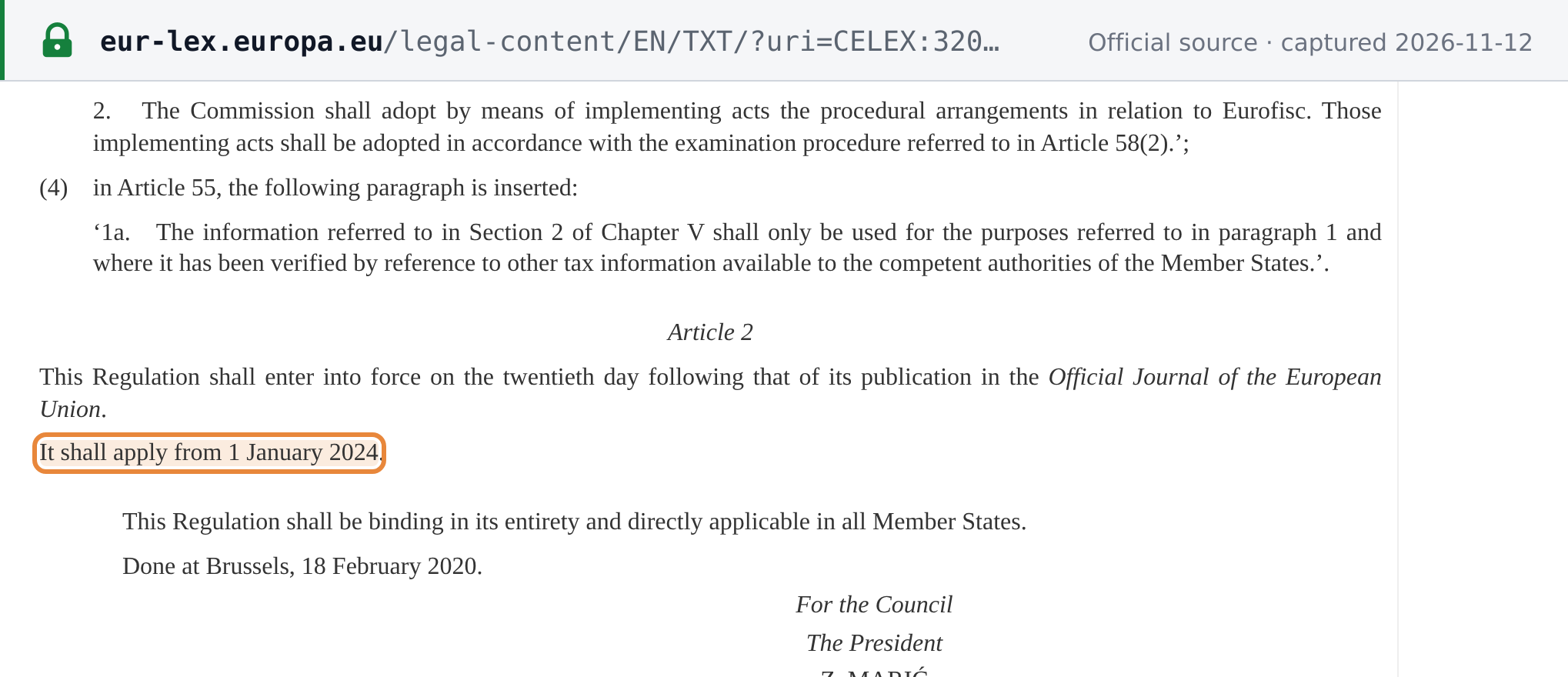 Source snapshot of the official page. Open full size ↗
Archived from the official distribution · Council Regulation (EU) 2020/283 of 18 February 2020 · OJ L 62, 2.3.2020, p. 1 · publications.europa.eu