Ghana replaces its VAT Act with Act 1151: a single 15% rate, no flat-rate schemes, and NHIL and GETFund recoupled from 1 January 2026
This page records one dated change. For the rules in Ghana as they stand today, see the Ghana guide →
- Jurisdiction
- Ghana
- Tax
- VAT
- Change type
- Rate change
- Status
- In force
- Impact
- Action required
- Announced
- 9 December 2025
- Effective
- 1 January 2026
- Instrument
- GH-ACT-1151
- Authority
- Ghana Revenue Authority
- Verified
- Fetched from official source · high confidence
All VAT-registered businesses in Ghana, especially retailers formerly on the 3% VAT Flat Rate Scheme and landlords and estate developers formerly on the 5% flat rate.
Businesses previously on the flat-rate scheme must move to the standard rate regime. NHIL and GETFund are now reclaimable as input tax. Review all VAT accounting systems before January 2026 effective date.
Ghana's Value Added Tax Act, 2025 (Act 1151), assented on 9 December 2025 (passed by Parliament on 27 November 2025) and in force from 1 January 2026, repeals and replaces the VAT Act, 2013 (Act 870) and all its amendments, including Acts 1107 and 1133. Section 3 sets a single 15% rate. The 3% VAT Flat Rate Scheme for goods and the 5% flat rate for commercial rent and estate-developer supplies are gone. According to the GRA, the NHIL (2.5%) and GETFund Levy (2.5%) are recoupled with VAT, so all three are charged on the same base and VAT-registered persons can deduct the two levies as input tax. The registration threshold change is covered separately (gh-vat-threshold-750k-2026), as is the abolition of the COVID-19 levy (gh-covid-levy-repeal-2025).
What changed in detail
Parliament passed the Value Added Tax Act, 2025 (Act 1151) on 27 November 2025, and it received assent on 9 December 2025. Section 75 brings it into force on 1 January 2026. Section 73 repeals the Value Added Tax Act, 2013 (Act 870) and all of its amendments, including Act 1107 (2023) and Act 1133.
Section 3 sets a single rate: “the rate of the Tax is fifteen per cent”, calculated on the value of the taxable supply or import. It has no flat-rate subsections. As a result:
- the 3% VAT Flat Rate Scheme for retailers of goods is gone;
- the 5% flat rate on commercial rent and estate-developer supplies, introduced by Act 1107, is gone.
The Ghana Revenue Authority describes the reform as recoupling the National Health Insurance Levy (2.5%) and the GETFund Levy (2.5%) with VAT. VAT at 15%, NHIL and GETFund are now all charged on the same base. VAT-registered persons can again claim the two levies as input tax. Before, the levies were added to the price first and VAT was charged on top.
The same reform package raises the registration threshold for goods and abolishes the COVID-19 levy; each has its own record.
What it means
Act 1151 is Ghana’s VAT law in November 2026. It superseded Act 1107, so the 5% rent and developer rates apply only to periods up to 31 December 2025.
The headline rate did not change, but the effective burden did. The old stack was levies on the price, then 15% VAT on the levy-inclusive amount, plus the 1% COVID levy. The new stack is 15% + 2.5% + 2.5% on the same base, and the levies are creditable.
Former flat-rate retailers now account at the full rate with input credits. If their turnover is below the new GHS 750,000 goods threshold, they may fall out of VAT altogether: see the threshold change and the COVID-19 levy repeal.
Proof
The 3% flat rate scheme on supply of goods and 5% flat rate scheme for supply of immovable properties have been removed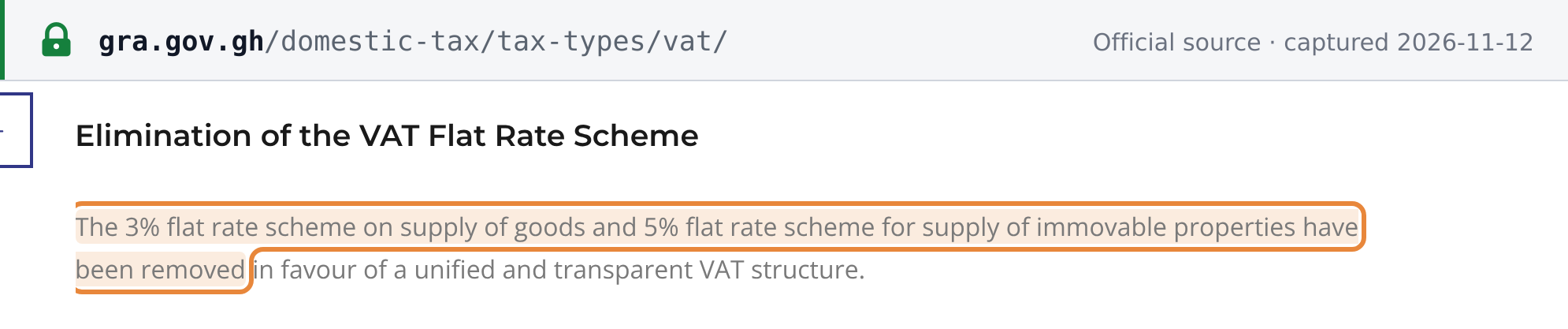 Source snapshot of the official page. Open full size ↗
3. Except as otherwise provided in this Act, the rate of the Tax is fifteen per cent and is calculated on the value of the (a) taxable supply of the goods or services; or (b) import.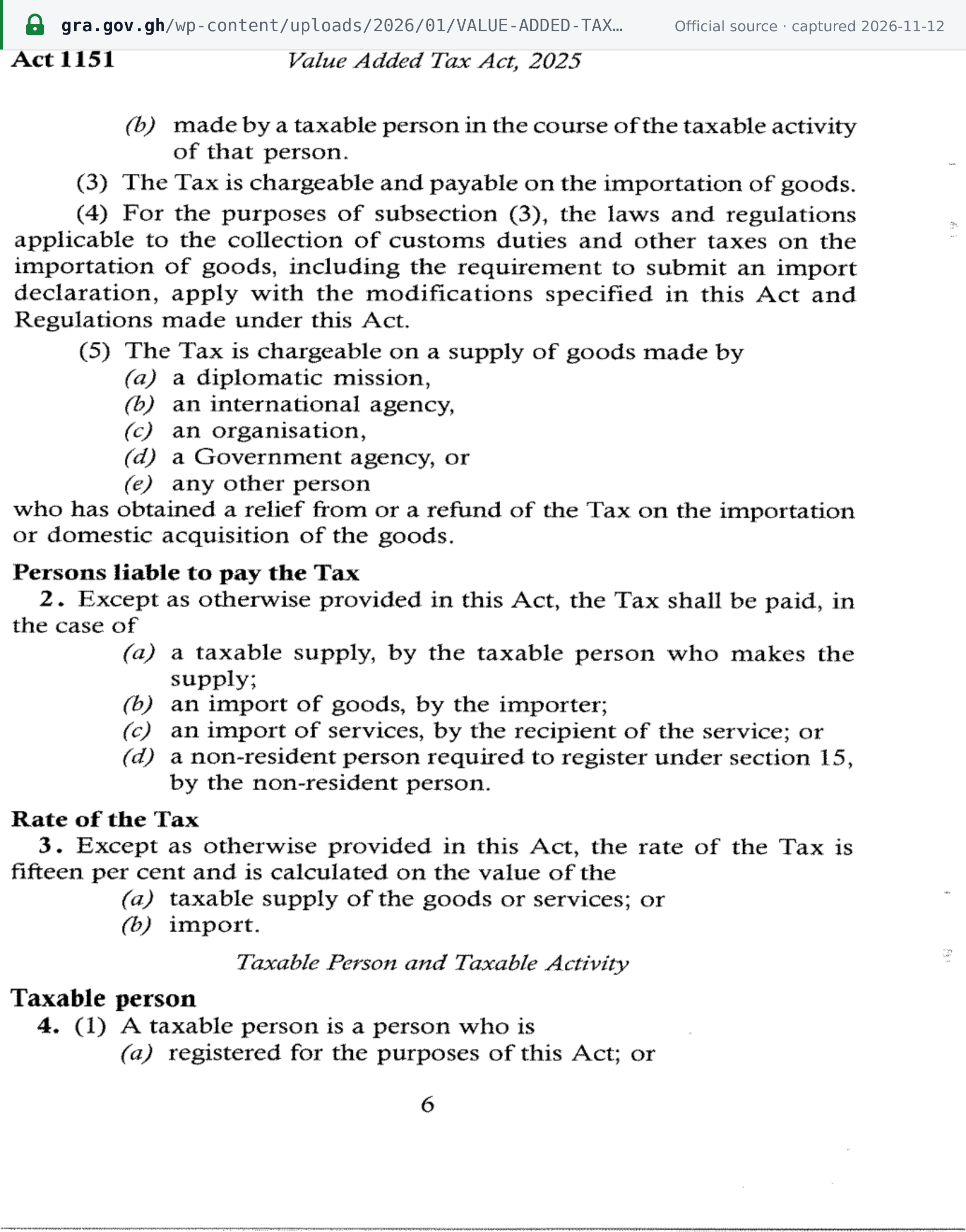 Source snapshot of the official page. Open full size ↗
Archived from the official distribution · Value Added Tax Act, 2025 (Act 1151), Date of Assent 9th December, 2025; section 3, page 6 · gra.gov.gh