Greece extends the suspension of VAT on new buildings to 31 December 2026
This page records one dated change. For the rules in Greece as they stand today, see the Greece guide →
- Jurisdiction
- Greece
- Tax
- VAT
- Change type
- Rate change
- Status
- In force
- Impact
- FYI
- Announced
- 11 November 2025
- Effective
- 1 January 2026
- Instrument
- GR-ACT-5246-2025
- Authority
- Εθνικό Τυπογραφείο (Εφημερίδα της Κυβερνήσεως)
- Verified
- Fetched from official source · high confidence
VAT-registered builders of new buildings for sale in Greece, and buyers of their unsold new properties.
Builders of new buildings for sale can apply to have VAT on their unsold properties suspended until 31 December 2026, with property transfer tax charged instead; suspensions valid to 31 December 2025 run on to 31 December 2026.
Law 5246/2025 (ΦΕΚ Α' 198, 11 November 2025), art. 12, amends the transitional art. 70(1)-(2) of the VAT Code (Law 5144/2024) to extend the suspension of VAT on new buildings to 31 December 2026, from 1 January 2026 (art. 47(5)). On the builder's application, VAT on all its unsold new buildings is suspended and property transfer tax is charged instead. Suspensions valid to 31 December 2025 are extended to 31 December 2026. The previous extension, to 31 December 2025, was made by Law 5162/2024 art. 89.
What changed in detail
Law 5246/2025 was published in ΦΕΚ Α΄ 198 of 11 November 2025. Its Article 12 amends paragraphs 1 and 2 of Article 70 of the VAT Code (Law 5144/2024), the transitional provision on new buildings.
- In paragraph 1, “until 31.12.2025” becomes “until 31.12.2026”. On the application of a taxable builder of buildings for sale, VAT on the properties in Article 8(1) and (2)(a) of the Code (new buildings with their land, and transfers of bare ownership, easements or usufruct over them) is suspended until 31 December 2026, and property transfer tax is charged instead.
- The suspension covers all of the builder’s unsold properties, and the builder files a list of them with the tax attributable to each.
- Under an antiparochi (land-for-flats) arrangement, the construction contract with the landowner is not subject to VAT while the builder is under the suspension.
- In paragraph 2, suspensions granted and valid to 31 December 2025 are extended to 31 December 2026.
Under the law’s commencement article (Article 47(5)), Articles 11 and 12 apply from 1 January 2026. The same law’s Article 11 cuts VAT rates on North Aegean, Evros (Samothrace) and Dodecanese islands with up to 20,000 inhabitants; see gr-island-vat-reduction-5246-2025.
What it means
The suspension is in force in November 2026 and runs to 31 December 2026. It continues the previous extension to 31 December 2025 made by Law 5162/2024, art. 89, so existing suspensions carried over without a break.
No further extension beyond 31 December 2026 had been published at the time of writing. Builders relying on the suspension should watch for a new amendment to Article 70 before year end: without one, sales of new buildings from 1 January 2027 return to VAT. The suspension still requires an application and covers all of a builder’s unsold stock, not selected units.
Proof
«1. Με αίτηση του υποκειμένου στον φόρο κατασκευαστή οικοδομών προς πώληση, αναστέλλεται υποχρεωτικά έως την 31η.12.2026, η εφαρμογή του Φ.Π.Α. στα ακίνητα της παρ. 1 και της περ. α) της παρ. 2 του άρθρου 8 και επιβάλλεται φόρος μεταβίβασης ακινήτων.«1. On application by the taxable person who constructs buildings for sale, the application of VAT on the properties of para. 1 and point (a) of para. 2 of Article 8 is compulsorily suspended until 31.12.2026, and property transfer tax is imposed.
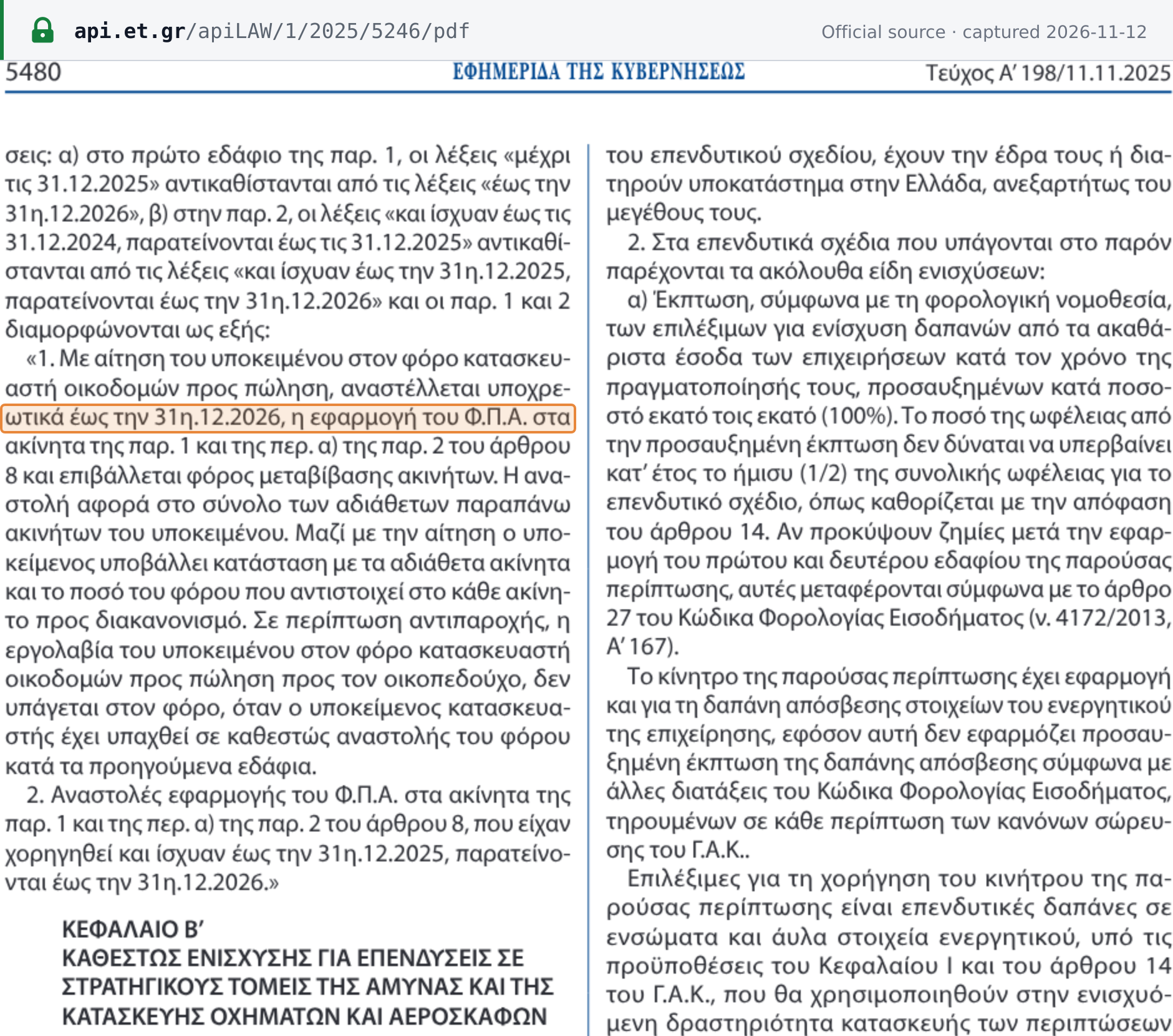 Source snapshot of the official page. Open full size ↗
Archived from the official distribution · ΦΕΚ Α΄ 198/11.11.2025: Νόμος υπ’ αριθμ. 5246, Άρθρο 12 (σ. 5480 του ΦΕΚ, σ. 12 του PDF) · api.et.gr