India extends the 30-day e-invoice reporting limit to taxpayers with AATO of INR 10 crore and above
This page records one dated change. For the rules in India as they stand today, see the India guide →
- Jurisdiction
- India
- Tax
- GST
- Change type
- E-invoicing
- Status
- In force
- Impact
- Action required
- Announced
- 5 November 2024
- Effective
- 1 April 2025
- Authority
- GSTN (Goods and Services Tax Network)
- Verified
- Fetched from official source · high confidence
GST taxpayers with Annual Aggregate Turnover (AATO) of INR 10 crore or more that issue e-invoices, credit notes or debit notes through an Invoice Registration Portal.
Taxpayers with Annual Aggregate Turnover (AATO) of INR 10 crore or more must report e-invoices (invoices, credit notes, debit notes) on the IRP within 30 days of the document date from 1 April 2025. After that the IRP rejects them. The same limit has applied to taxpayers with AATO above INR 100 crore since 1 November 2023 (GSTN advisory 13 September 2023).
GSTN advisory dated 5 November 2024 extended the 30-day IRP reporting deadline (previously applicable to AATO ≥ INR 100 crore from 1 November 2023) to taxpayers with AATO of INR 10 crore and above, effective 1 April 2025. After 30 days from the invoice date, the IRP will not permit reporting. The advisory lowered the threshold from INR 100 crore to INR 10 crore without changing the 30-day time limit itself.
What changed in detail
A GSTN advisory dated 5 November 2024, “Time Limit for Reporting e-Invoice on the IRP Portal – Lowering of Threshold to AATO 10 Crores and Above”, extended the 30-day reporting limit for e-invoices to taxpayers with an Annual Aggregate Turnover (AATO) of INR 10 crore and above.
The limit was introduced by an earlier advisory of 13 September 2023 for taxpayers with AATO of INR 100 crore and above, and applied to them from 1 November 2023. The 2024 advisory kept the 30-day window and lowered the turnover threshold.
From 1 April 2025, taxpayers in scope cannot report a document on an IRP if it is more than 30 days old. The restriction covers every document type for which an IRN is generated: invoices, credit notes and debit notes. The advisory gives an example: an invoice dated 1 April 2025 cannot be reported after 30 April 2025. The IRP’s validation rejects late documents.
What it means
The limit is still in force. For a business above INR 10 crore, an invoice not reported within 30 days cannot get an IRN, and without an IRN the e-invoice is not valid. The rule is a system check at the portal and has no late-filing route.
Businesses that batch invoices, or that report credit notes long after the original sale, need to report each document within 30 days of its date. Taxpayers between INR 10 crore and INR 100 crore were hit hardest, because they were moving from no time limit to a fixed one.
Proof
Therefore, from 1st April 2025, taxpayers with an AATO of 10 crores and above would not be allowed to report e-Invoices older than 30 days from the date of reporting on IRP portals.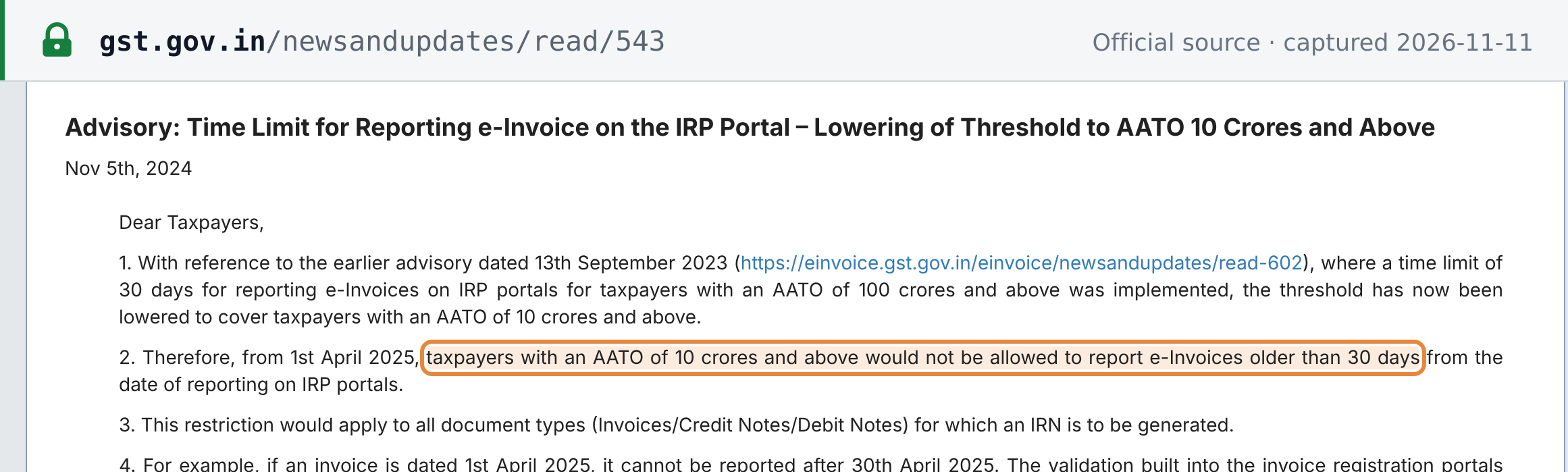 Source snapshot of the official page. Open full size ↗