India requires reverse-charge recipients to issue self-invoices within 30 days of receiving the supply
This page records one dated change. For the rules in India as they stand today, see the India guide →
- Jurisdiction
- India
- Tax
- GST
- Change type
- Invoice rules
- Status
- In force
- Impact
- FYI
- Announced
- 8 October 2024
- Effective
- 1 November 2024
- Instrument
- IN-NOTIFICATION-20-2024-Central-Tax
- Authority
- GST Council / CBIC (Ministry of Finance, Department of Revenue)
- Verified
- Fetched from official source · high confidence
Registered persons paying GST under reverse charge on supplies received from unregistered suppliers, who must issue the invoice themselves.
No action — monitoring only.
CGST (Second Amendment) Rules 2024, issued as Central Tax Notification No. 20/2024 dated 8 October 2024, inserts rule 47A requiring registered persons liable to pay tax under reverse charge (CGST ss.9(3) or 9(4)) who are required to issue a tax invoice under clause (f) of s.31(3) to issue that invoice within 30 days of receipt of supply, effective 1 November 2024.
What changed in detail
Notification No. 20/2024-Central Tax of 8 October 2024 made the Central Goods and Services Tax (Second Amendment) Rules, 2024. Rule 4 of those rules inserts a new rule 47A in the CGST Rules, with effect from 1 November 2024.
Section 31(3)(f) of the CGST Act requires a registered person who is liable to pay tax under reverse charge under section 9(3) or 9(4) to issue an invoice for goods or services received from an unregistered supplier. Until rule 47A, no time limit was prescribed for that self-invoice.
Rule 47A, “Time limit for issuing tax invoice in cases where recipient is required to issue invoice”, provides that, notwithstanding rule 47, the recipient shall issue the invoice within thirty days from the date of receipt of the supply of goods or services.
What it means
The rule is still in force. The 30-day limit matters because the reverse-charge self-invoice is the document on which the recipient claims input tax credit for the tax it paid, so a missed deadline puts a compliance breach on the record that supports the credit.
It applies most often to supplies that came under reverse charge in the same period, such as commercial rent from unregistered landlords and metal scrap bought from unregistered sellers. Accounts-payable teams should raise the self-invoice when the goods or service are received, not when the supplier’s bill is paid.
Proof
“47A. Time limit for issuing tax invoice in cases where recipient is required to issue invoice.– Notwithstanding anything contained in rule 47, where an invoice referred to in rule 46 is required to be issued under clause (f) of sub-section (3) of section 31 by a registered person, who is liable to pay tax under sub-section (3) or sub-section (4) of section 9, he shall issue the said invoice within a period of thirty days from the date of receipt of the said supply of goods or services, or both, as the case may be.”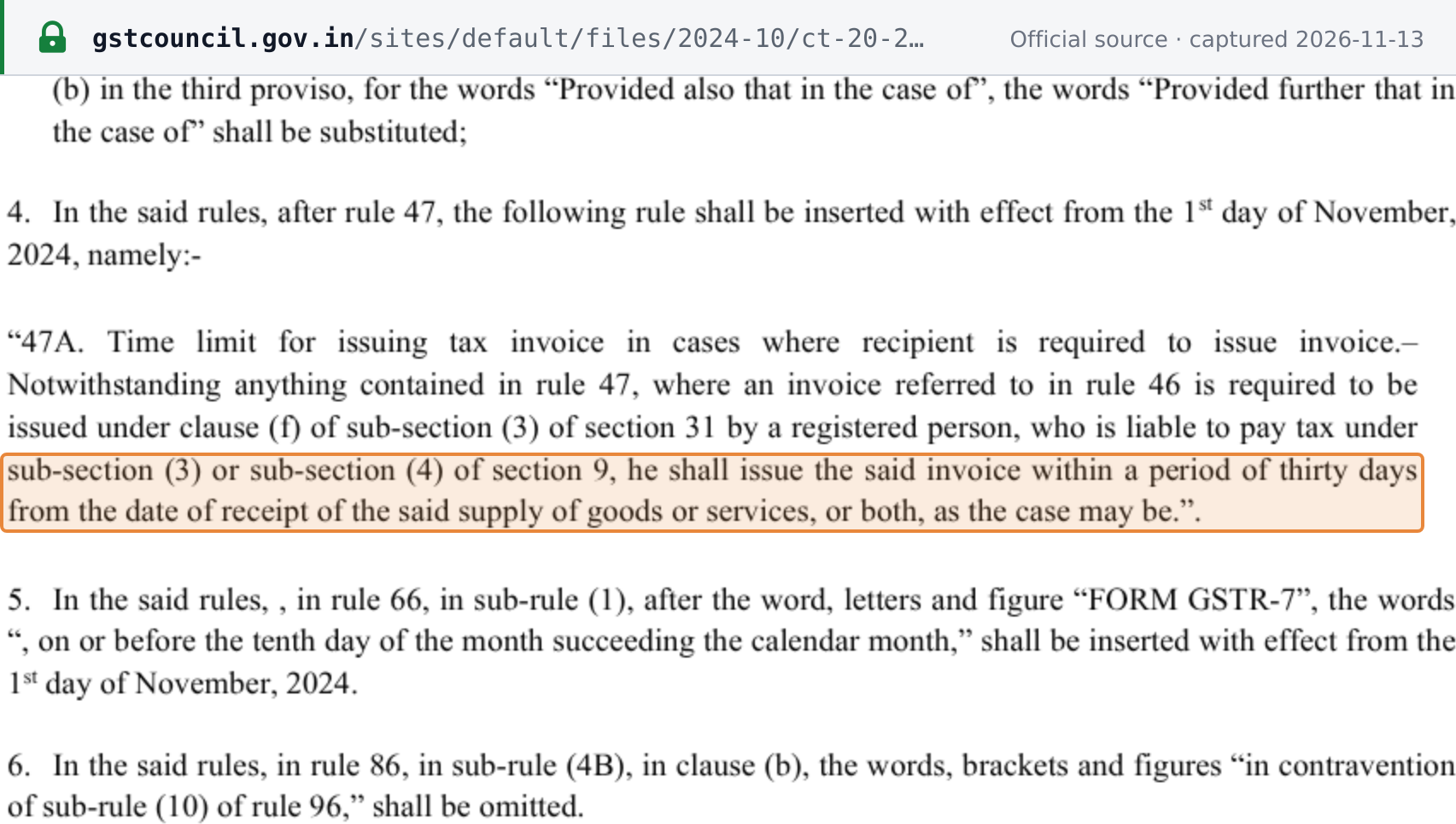 Source snapshot of the official page. Open full size ↗
Archived from the official distribution · Notification No. 20/2024-Central Tax, 8 October 2024 (Central Goods and Services Tax (Second Amendment) Rules, 2024) · gstcouncil.gov.in