India's Finance Act 2025 adds a GST track-and-trace power, a new penalty and a credit-note condition
This page records one dated change. For the rules in India as they stand today, see the India guide →
- Jurisdiction
- India
- Tax
- GST
- Change type
- Compliance
- Status
- In force
- Impact
- Plan ahead
- Announced
- 29 March 2025
- Effective
- 1 October 2025
- Instrument
- IN-ACT-No-7-of-2025
- Authority
- Parliament of India
- Verified
- Fetched from official source · medium confidence
Suppliers of goods the Government notifies for track and trace; all suppliers reducing output tax through credit notes, and their recipients.
Suppliers issuing credit notes must ensure the recipient has reversed the matching input tax credit before reducing output tax (from 1 October 2025). Track-and-trace marking applies only to goods the Government notifies under section 148A; watch for such notifications.
The Finance Act, 2025 amends the CGST Act with effect from 1 October 2025 (Notification No. 16/2025-Central Tax, 17 September 2025): new section 148A lets the Government require a unique identification marking and a track-and-trace mechanism for notified goods, new section 122B adds a penalty of the higher of Rs 1,00,000 or 10% of the tax on such goods for non-compliance, and substituted section 34 allows a supplier to reduce output tax through a credit note only if the recipient has reversed the corresponding input tax credit.
What changed in detail
The Finance Act, 2025 (Act 7 of 2025) amends the Central Goods and Services Tax Act, 2017. Under Notification No. 16/2025-Central Tax of 17 September 2025, clauses (ii) and (iii) of section 121, sections 122 to 124 and sections 126 to 134 of the Act came into force on 1 October 2025. The GST Council Secretariat’s September 2025 newsletter lists what those provisions do, including:
- Section 2(116A): a new definition of “unique identification marking”, to support track and trace;
- Section 148A: a new power for the Government to require a track-and-trace mechanism for notified goods;
- Section 122B: a new penalty for non-compliance with track and trace, the higher of ₹1,00,000 or 10% of the tax on such goods, in addition to other penalties;
- Section 34 substituted: a supplier may not reduce its output tax liability through a credit note unless the recipient has reversed the input tax credit attributable to it.
The newsletter lists other amendments brought in on the same date, including reduced pre-deposits for appeals (section 107(6) and 112(8)) and the omission of the voucher time-of-supply rules.
What it means
The amendments have been in force since 1 October 2025. The credit-note condition bites on every supplier: before reducing output tax for a discount or return, the supplier now needs evidence that the customer has reversed the matching credit, which turns a one-sided adjustment into a two-party reconciliation.
Track and trace is an enabling power. Section 148A and the section 122B penalty apply only to goods the Government notifies, so suppliers should watch for notifications naming their products.
Proof
higher of ₹1,00,000 or 10% of tax on such goods, in addition to other penalties. Inserted new Section 148A for Track & Trace mechanism.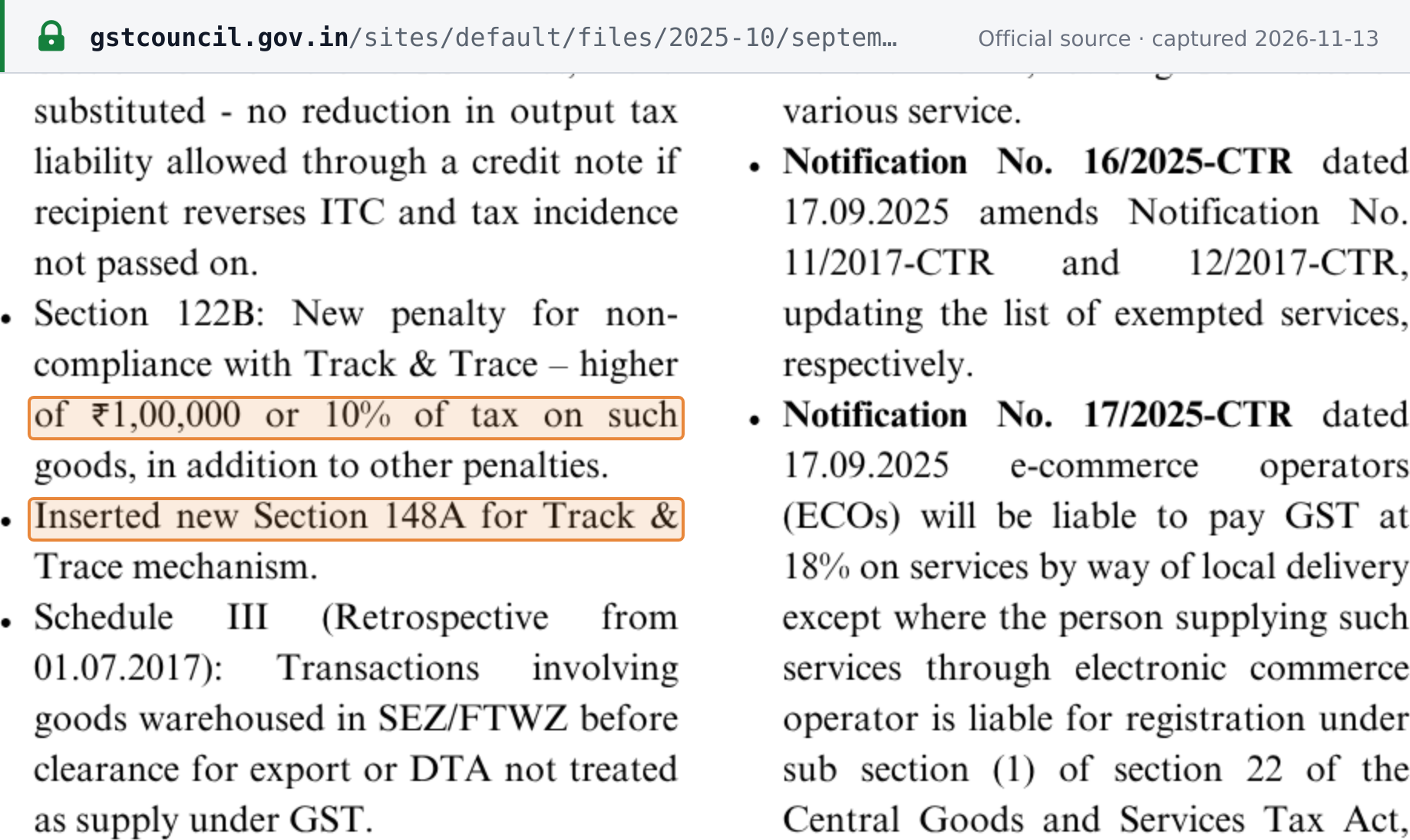 Source snapshot of the official page. Open full size ↗
Archived from the official distribution · GST Council Secretariat Newsletter, September 2025 (Notification No. 16/2025-Central Tax, 17 September 2025) · gstcouncil.gov.in
The Central Government vide this Notification, has notified that clauses (ii) and (iii) of section 121, sections 122 to 124, and sections 126 to 134 of the Finance Act, 2025 has come into force on 1st October 2025, by virtue of section 1(2)(b) of the said Act.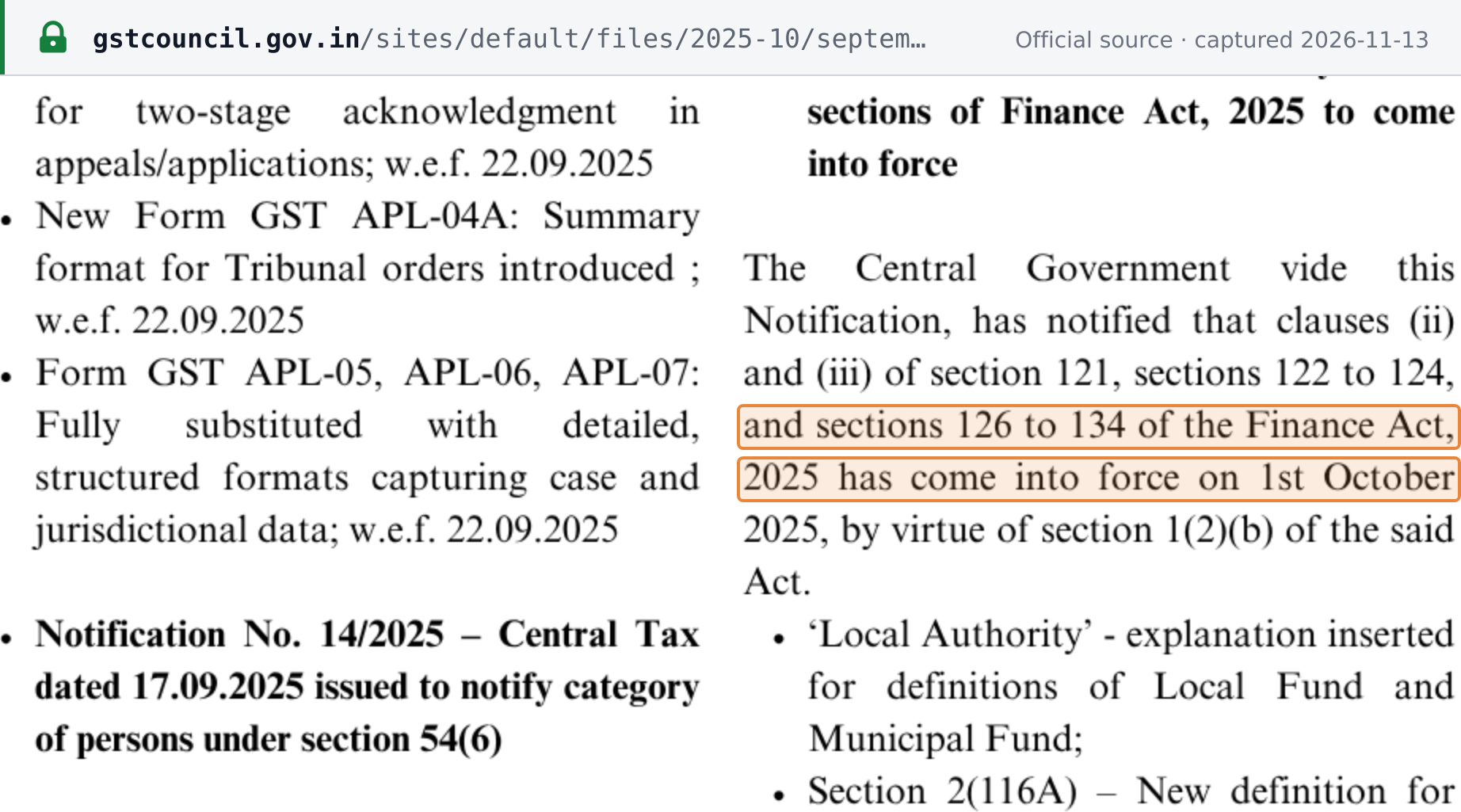 Source snapshot of the official page. Open full size ↗
Archived from the official distribution · GST Council Secretariat Newsletter, September 2025 (Notification No. 16/2025-Central Tax, 17 September 2025) · gstcouncil.gov.in