Isle of Man ends the VAT zero rate on Motability-type vehicle leases from 1 July 2026, taxing only top-up payments
This page records one dated change. For the rules in Isle of Man as they stand today, see the Isle of Man guide →
- Jurisdiction
- Isle of Man
- Tax
- VAT
- Change type
- Rate change
- Status
- In force
- Impact
- Action required
- Announced
- 7 April 2026
- Effective
- 1 July 2026
- Instrument
- IM-STATUTORY-DOCUMENT-2026-0078
- Authority
- Isle of Man Treasury
- Verified
- Fetched from official source · high confidence
Lessors of motor vehicles let to disabled people in the Isle of Man on terms paid wholly or partly from the Disability Living Allowance mobility component, and their customers.
From 1 July 2026, lessors of vehicles let to disabled people on benefit terms (Motability-type leases) no longer zero-rate the letting. They must account for VAT on any consideration other than the mobility-component payments, such as top-up or advance payments. The first sale of the vehicle after the letting stays zero-rated.
The Value Added Tax Act 1996 (Amendment) Order 2026 (SD 2026/0078) was made by the Isle of Man Treasury on 7 April 2026 and approved by Tynwald on 20 May 2026. Article 3(5) of the Order, in operation from 1 July 2026, omits item 14 of Schedule 9 Group 12, the zero rate for letting a motor vehicle to a disabled person. It substitutes item 15, which zero-rates the first sale of a vehicle after it was let on 'relevant benefit terms'. Those terms are a letting of at least three years of an unused vehicle to a person receiving the Disability Living Allowance mobility component, paid wholly or partly by the Treasury from that component. Article 3(4) adds Schedule 7 paragraph 11B, under which the benefit payments are disregarded when valuing such a letting. VAT is therefore due only on other consideration, such as top-up payments, and this valuation is ignored for registration purposes. The Order mirrors United Kingdom changes. It also takes taxi and private-hire journeys out of the Tour Operators' Margin Scheme from 2 January 2026, and relieves qualifying business donations of goods to charities from 1 April 2026.
What changed in detail
The Value Added Tax Act 1996 (Amendment) Order 2026 (SD 2026/0078) was made by the Treasury on 7 April 2026 and approved by Tynwald on 20 May 2026 under the affirmative procedure. Under article 2(1) it comes into operation on 1 July 2026.
Article 3(5) amends Schedule 9, Group 12 (zero-rating):
- it omits item 14, the zero rate for letting a motor vehicle on hire to a disabled person;
- it substitutes item 15, which now zero-rates only the sale of a vehicle that had been let on “relevant benefit terms”, where the sale is the first supply of the vehicle after the letting ends.
A vehicle is let on relevant benefit terms if it was let to a disabled person receiving the mobility component of Disability Living Allowance, for at least 3 years, the vehicle was unused at the start, and the consideration consists wholly or partly of sums paid by the Treasury to the lessor out of the mobility component.
Article 3(4) inserts paragraph 11B into Schedule 7 (valuation). For a letting on relevant benefit terms, the benefit payments are disregarded when calculating the value of the supply, so VAT is charged only on any other consideration. Paragraph 11B is ignored for registration purposes under Schedule 2.
The explanatory note says the Order mirrors United Kingdom amendments. The same Order also takes taxi and private-hire journeys out of the Tour Operators’ Margin Scheme (deemed from 2 January 2026) and relieves qualifying business donations of goods to charities (deemed from 1 April 2026); those changes are outside this record.
What it means
The change has applied since 1 July 2026 and is in force in November 2026. A lessor of Motability-type vehicles no longer treats the whole letting as zero-rated. The mobility-component payments themselves still bear no VAT, because paragraph 11B values them at nil, but advance payments, top-ups and other charges paid by the customer are now standard-rated. Lessors need to separate those amounts on invoices and in their VAT returns.
The end-of-lease sale of the vehicle stays zero-rated under the new item 15. Because paragraph 11B is ignored for registration, a lessor measures its registration turnover on the full consideration, not on the reduced taxable value.
Proof
Any amount of consideration for the letting that falls within paragraph (2)(d) of item 15 in Group 12 in Schedule 9 (payments of relevant benefits) is to be disregarded in determining the amount of consideration for the purposes of calculating the value of the supply under this Act.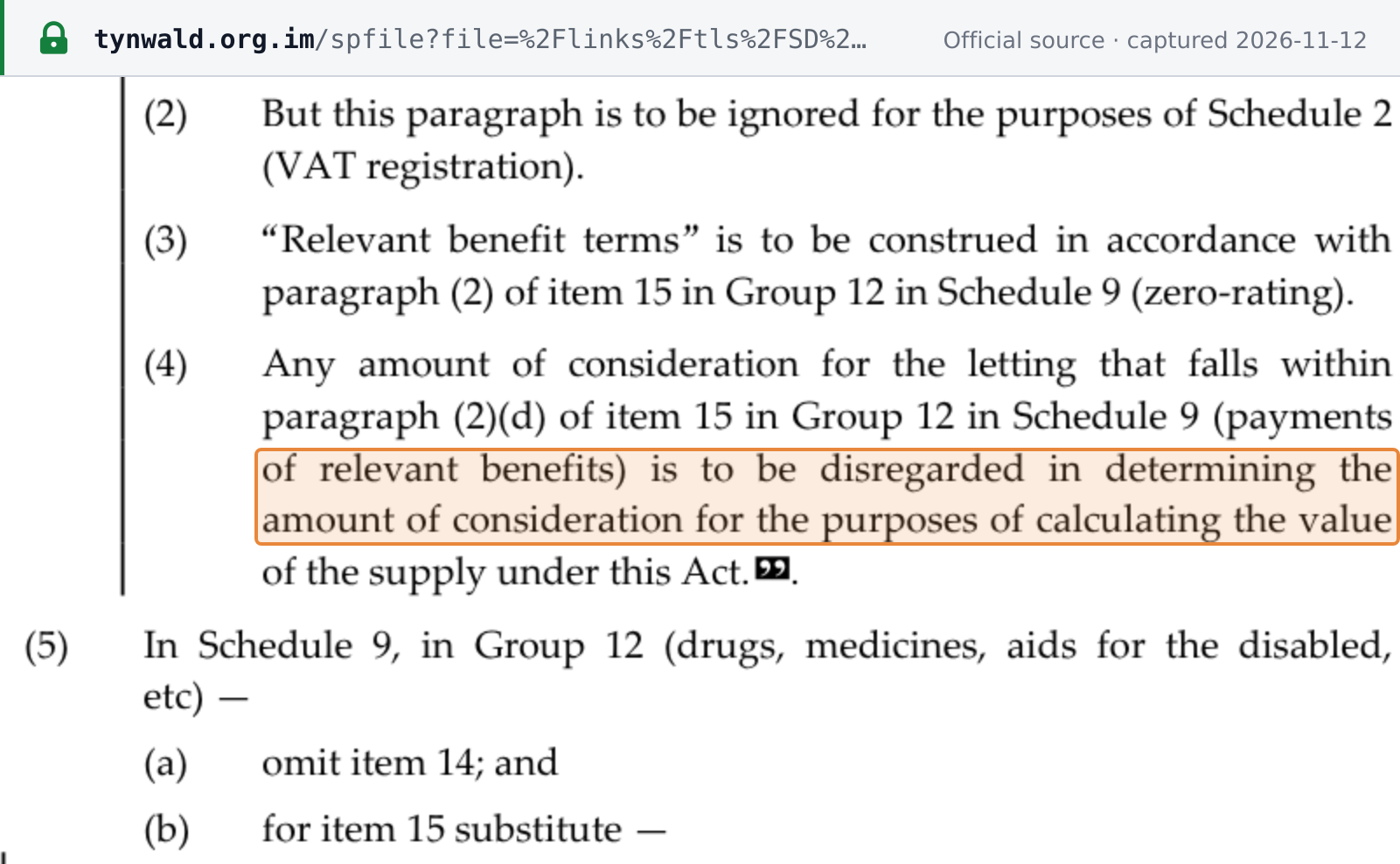 Source snapshot of the official page. Open full size ↗
Archived from the official distribution · Statutory Document No. 2026/0078, Value Added Tax Act 1996 (Amendment) Order 2026, made 7 April 2026, approved by Tynwald 20 May 2026 · tynwald.org.im