Kazakhstan adopts new electronic invoice (ESF) rules under the 2026 Tax Code
This page records one dated change. For the rules in Kazakhstan as they stand today, see the Kazakhstan guide →
- Jurisdiction
- Kazakhstan
- Tax
- VAT
- Change type
- E-invoicing
- Status
- In force
- Impact
- FYI
- Announced
- 28 October 2025
- Effective
- 1 January 2026
- Instrument
- KZ-MINISTERIAL-ORDER-Order-No-629
- Authority
- Adilet — Official Legal Information System of the Republic of Kazakhstan
- Verified
- Fetched from official source · high confidence
Taxpayers in Kazakhstan that must issue or receive electronic invoices (ESFs), including VAT payers and non-resident suppliers.
No action required — monitoring only. All VAT-registered businesses in Kazakhstan must issue ESFs under Order No. 629 rules as of 1 January 2026.
Ministry of Finance Order No. 629 of 28 October 2025 (registered with the Ministry of Justice on 28 October 2025 under No. 37241), issued under Article 207(2) of the new Tax Code, approved new Rules for issuing electronic invoices (ESFs) and the ESF form, in force from 1 January 2026. It repeals Order No. 370 of 2019 and the related amending provisions. Main points: a recipient must confirm or reject a corrected or additional ESF, or the revocation of an ESF, with the 10-calendar-day period extended if the ESF system fails; where the risk-management system flags a taxpayer, the ESF must also be certified by the issuer's biometric data; new supplier categories, including 'K' for non-resident suppliers; and the goods code from the National Catalogue of Goods where the trade-regulation law requires it.
What changed in detail
Order No. 629 of the Minister of Finance of 28 October 2025, registered with the Ministry of Justice on 28 October 2025 under No. 37241, is issued under article 207(2) of the new Tax Code of Kazakhstan. It approves the Rules for issuing an invoice (annex 1) and the invoice form (annex 2), and under annex 3 repeals Order No. 370 of 2019 and the orders that amended it. Under paragraph 4, the order enters into force on 1 January 2026.
The main changes in the Rules:
- Recipient confirmation. The recipient must confirm or reject a corrected or additional electronic invoice (ESF), or the revocation of an ESF. The 10-calendar-day period for doing so is extended where the ESF information system fails.
- Biometric certification. Where the tax authority’s risk-management system flags a taxpayer, its ESF must also be certified with the issuer’s biometric data.
- Supplier categories. New categories are added, including “K” for non-resident suppliers, a category the 2019 Rules (which stopped at “I”) did not have.
- Goods codes. The ESF must carry the goods code from the National Catalogue of Goods where the law on trade regulation requires it.
What it means
Order 629 replaced the 2019 Rules as Kazakhstan’s ESF framework when the new Tax Code took effect on 1 January 2026, and it remains in force; Adilet marks it as amended. A later Ministry of Finance order (No. 646 of 28 September 2026) amended the Rules, so the current text should be read in Adilet’s consolidated version rather than in the 2025 original. For businesses, the practical effects were operational: building in the recipient-confirmation step for corrections and revocations, preparing for biometric signing if flagged, and mapping goods to National Catalogue codes.
Proof
Настоящий приказ вводится в действие с 1 января 2026 года и подлежит официальному опубликованию.This order enters into force on 1 January 2026 and is subject to official publication.
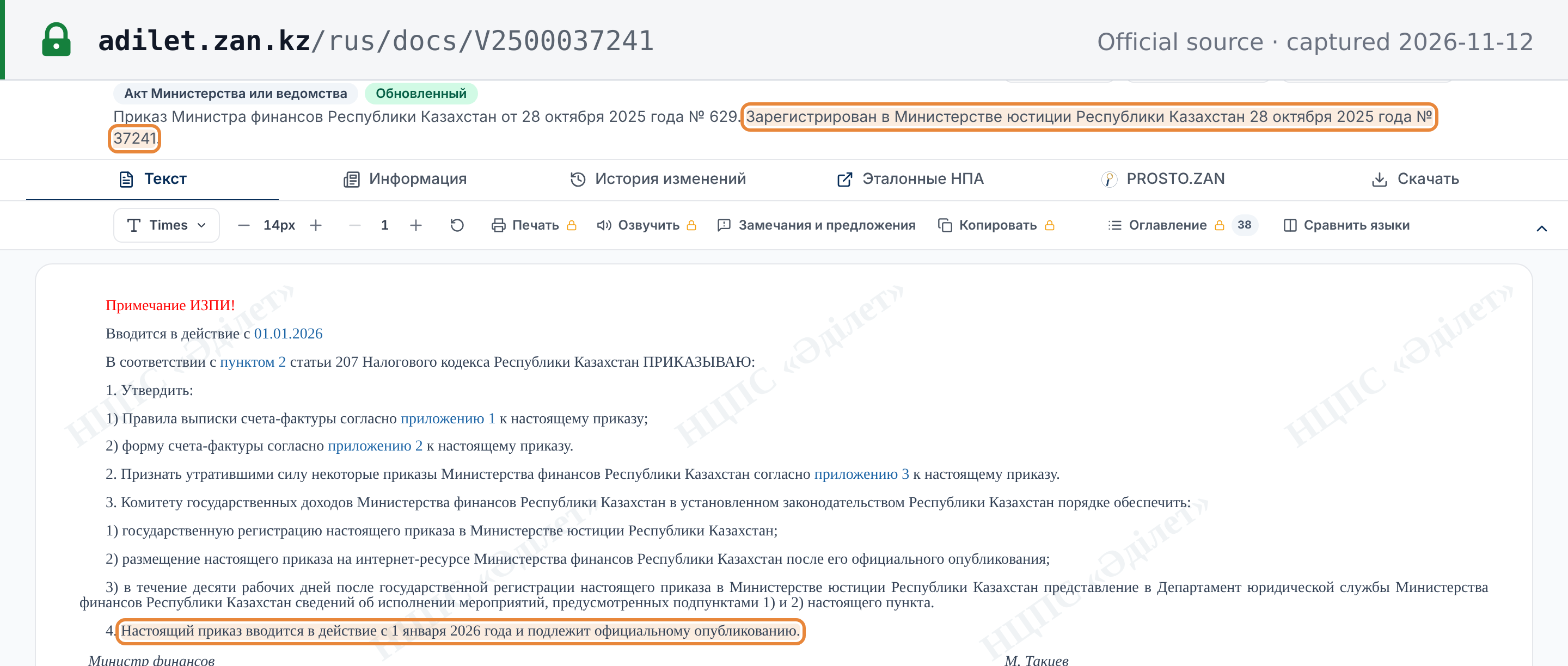 Source snapshot of the official page. Open full size ↗