Kenya charges VAT when exempt or zero-rated goods and services are used for another purpose
This page records one dated change. For the rules in Kenya as they stand today, see the Kenya guide →
- Jurisdiction
- Kenya
- Tax
- VAT
- Change type
- Compliance
- Status
- In force
- Impact
- FYI
- Announced
- 27 June 2025
- Effective
- 1 July 2025
- Authority
- National Council for Law Reporting (Kenya Law)
- Verified
- Fetched from official source · high confidence
Persons in Kenya who import or buy goods or services under a VAT exemption or zero-rating granted for a specific purpose.
No action — monitoring only.
Finance Act 2025 (effective 1 July 2025) inserts new s.66A into the VAT Act: a person who imports or purchases exempt or zero-rated goods or services and subsequently disposes of them, or uses them, in a manner inconsistent with the purpose for which the exemption or zero-rating was granted becomes liable to pay VAT at the applicable rate at the time of disposal or inconsistent use.
What changed in detail
Section 37 of the Finance Act, 2025 (No. 9 of 2025, Kenya Gazette Supplement No. 104; assented 27 June 2025; in force 1 July 2025) inserts a new section 66A into the VAT Act, CAP 476, immediately after section 66, with the marginal note “Liability to pay tax for exempt and zero-rated supplies”.
Under section 66A, where a person imports or purchases goods or services that are exempt or zero-rated, and then disposes of them, or uses them, in a manner inconsistent with the purpose for which the exemption or zero-rating was granted, that person is liable to pay VAT on the goods or services at the applicable rate at the time of the disposal or inconsistent use.
What it means
Many Kenyan exemptions are purpose-bound: goods for a named project, for a manufacturer’s inputs, for an institution’s official use. Section 66A, still in force, makes the buyer, not the supplier, liable when the goods leave that purpose, and prices the tax at the rate on the date of disposal or misuse rather than the date of purchase. Anyone holding exempt or zero-rated stock or equipment should track what it was granted for and treat a sale, transfer or change of use as a VAT event.
Proof
Where a person imports or purchases goods or services which are exempt or zero-rated and the person subsequently disposes of, or uses, the goods or services supplied in a manner inconsistent with the purpose for which the goods or services were exempted or zero rated, the person shall be liable to pay tax on the goods or services at the applicable rate at the time of disposal or inconsistent use.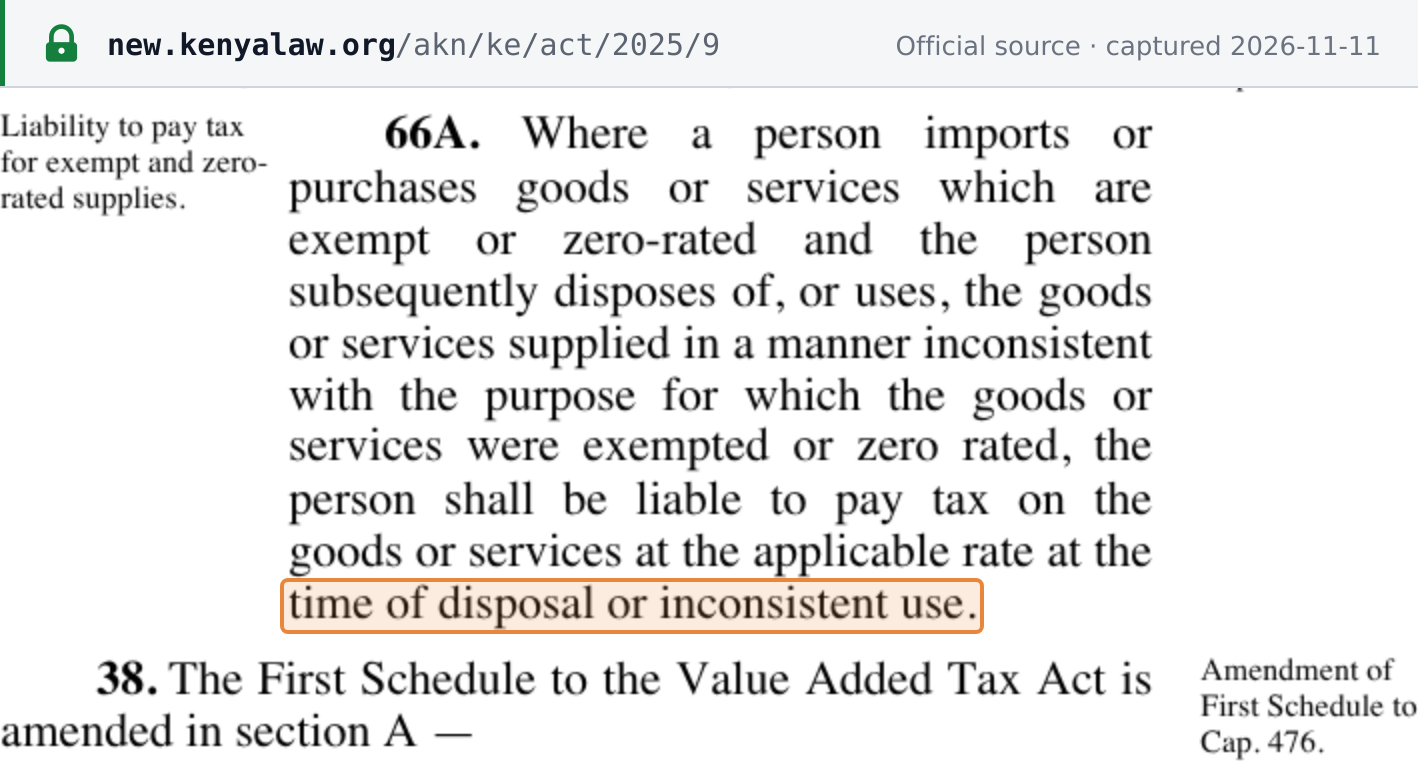 Source snapshot of the official page. Open full size ↗
Archived from the official distribution · The Finance Act, 2025 (No. 9 of 2025), Kenya Gazette Supplement No. 104, 27 June 2025 · kenyalaw.org