Latvia requires payment service providers to record and report cross-border payments to the VID from 1 January 2024
This page records one dated change. For the rules in Latvia as they stand today, see the Latvia guide →
- Jurisdiction
- Latvia
- Tax
- VAT
- Change type
- Compliance
- Status
- In force
- Impact
- FYI
- Announced
- 22 November 2023
- Effective
- 1 January 2024
- Instrument
- LV-ACT-OP-2023-226-9
- Authority
- Saeima (Parliament of the Republic of Latvia)
- Verified
- Fetched from official source · high confidence
Payment service providers operating in Latvia (credit institutions, e-money and payment institutions) whose payees receive more than 25 cross-border payments in a calendar quarter.
No action — PSP reporting under CESOP has applied since 1 January 2024.
Grozījumi Pievienotās vērtības nodokļa likumā (adopted 9 November 2023, proclaimed 22 November 2023, Latvijas Vēstnesis Nr. 226, OP 2023/226.9, in force 1 January 2024) transposes the EU CESOP Directive (2020/284). New Chapter XIX (Articles 147–148), titled 'Maksājumu pakalpojumu sniedzēju pienākumi', requires payment service providers to maintain detailed records of payment recipients and cross-border payments for each calendar quarter where payments to the same payee exceed 25, and to submit that data to the State Revenue Service. The same law amends Articles 13.1, 27 and 60(5)–(7) to align the EUR 10,000 EU-wide threshold for combined intra-EU distance sales and electronically supplied services.
What changed in detail
The law Grozījumi Pievienotās vērtības nodokļa likumā (Amendments to the Value Added Tax Law) was adopted by the Saeima on 9 November 2023, proclaimed on 22 November 2023 and published in Latvijas Vēstnesis No. 226 (OP 2023/226.9). It entered into force on 1 January 2024.
It transposes Council Directive (EU) 2020/284, the CESOP directive, by adding a new Chapter XIX, “Maksājumu pakalpojumu sniedzēju pienākumi” (obligations of payment service providers), made up of Articles 147 and 148. Under Article 147(2), a payment service provider must:
- keep detailed records, for each calendar quarter, of payment recipients and cross-border payments where the services it provides to the same payee in that quarter correspond to more than 25 cross-border payments;
- report that information to the State Revenue Service (VID); and
- keep the payee identification and payment data electronically for three calendar years from the end of the year in which the payment was made.
The same law amends Articles 13.1, 27 and 60(5)–(7) of the VAT Law to bring in the EUR 10,000 EU-wide threshold for combined intra-EU distance sales of goods and electronically supplied services, with a registration duty for suppliers from other member states that exceed it.
What it means
The obligation is still in force. Articles 147 and 148 read the same in the consolidated VAT Law on likumi.lv, and the first reports covered the first quarter of 2024. The rule is Latvia’s share of an EU-wide system: the directive behind it is recorded here, and the VID passes the data on to the central CESOP database run by the European Commission.
For payment providers, the work is in counting. The 25-payment test runs per payee and per quarter, so providers need to group payments by payee identifier, not by account. For merchants, nothing new is filed, but tax authorities can now see cross-border card and transfer receipts, so e-commerce sellers with Latvian customers should expect their payment data to be compared with their VAT returns.
Proof
veikt maksājumu saņēmēju un pārrobežu maksājumu detalizētu uzskaiti par katru kalendāra gada ceturksnito maintain detailed records of payment recipients and cross-border payments for each calendar quarter
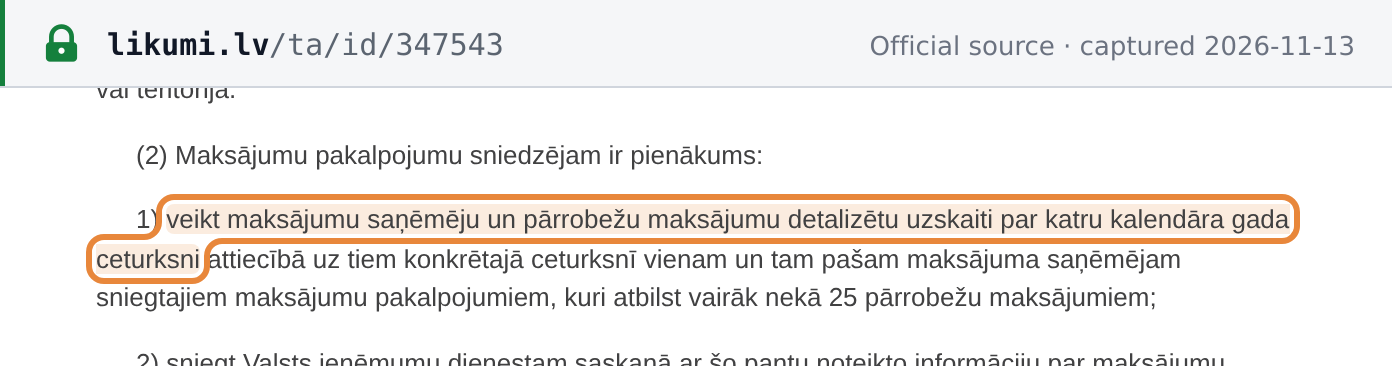 Source snapshot of the official page. Open full size ↗