Malaysia makes e-invoicing mandatory in three turnover phases from 1 October 2024
This page records one dated change. For the rules in Malaysia as they stand today, see the Malaysia guide →
- Jurisdiction
- Malaysia
- Tax
- Income Tax / e-Invoice
- Change type
- E-invoicing
- Status
- In force
- Impact
- FYI
- Announced
- 30 September 2024
- Effective
- 1 October 2024
- Instrument
- MY-SUBSIDIARY-LEGISLATION-P-U-A-265-2024
- Authority
- Attorney General's Chambers, Malaysia (Warta Kerajaan Persekutuan / Federal Gazette)
- Verified
- Fetched from official source · high confidence
Persons in Malaysia who sell goods or perform services, phased by annual sales for financial year 2022 (or year of assessment 2022 where there are no audited accounts).
No action — monitoring only. Phase 1 and 2 deadlines passed; Phase 3 deadline (1 Jul 2025) passed. See my-einvoice-amendment-pua-196-2025 for the extended Phase 4 deadline.
The Income Tax (Issuance of Electronic Invoice) Rules 2024 [P.U.(A) 265/2024], gazetted 30 September 2024 and in force from 1 October 2024, mandate the issuance of electronic invoices through the MyInvois system (LHDN) in phases by annual turnover based on FY2022 audited financials: (a) businesses with annual sales exceeding RM100 million — from 1 October 2024; (b) businesses with annual sales exceeding RM25 million but not exceeding RM100 million — from 1 January 2025; (c) all other businesses — from 1 July 2025 (later split and amended by P.U.(A) 196/2025). Electronic invoices must contain the data fields specified in the Schedule to the Rules.
What changed in detail
The Income Tax (Issuance of Electronic Invoice) Rules 2024 [P.U.(A) 265/2024] were gazetted on 30 September 2024 and came into operation on 1 October 2024. Rule 2(1) requires any person who carries out a transaction in respect of goods sold or services performed to issue an electronic invoice. The Rules do not name a channel; the Inland Revenue Board’s guidelines route e-invoices through its MyInvois system.
The obligation is phased by annual sales. Under rule 2(2), annual sales are the annual income in the audited financial statements for financial year 2022, or, without audited statements, the income reported in the return for year of assessment 2022:
| Annual sales | E-invoice required from |
|---|---|
| More than RM100 million | 1 October 2024 |
| More than RM25 million, up to RM100 million | 1 January 2025 |
| All other businesses | 1 July 2025 |
Rule 3 requires every electronic invoice to contain the particulars listed in the Schedule. Rule 4 disapplies the Rules for foreign diplomatic offices, individuals who do not carry on business, international organisations, and statutory bodies collecting payments or fees. The international-organisation and statutory-body exclusions apply only to transactions before 1 July 2025.
What it means
These Rules are the legal backbone of Malaysian e-invoicing, and they remain in force. Their third, catch-all phase did not survive as written. The Income Tax (Issuance of Electronic Invoice) (Amendment) Rules 2025 split it into three bands, with the smallest businesses starting on 1 July 2026. On top of the Rules, HASiL’s guidelines set exemption thresholds and relaxation periods. For a business today, the 2024 table settles only whether the first two phases applied. For anyone smaller, the amended Rules and the current guideline decide.
Proof
Kaedah-Kaedah ini mula berkuat kuasa pada 1 Oktober 2024.These Rules come into operation on 1 October 2024.
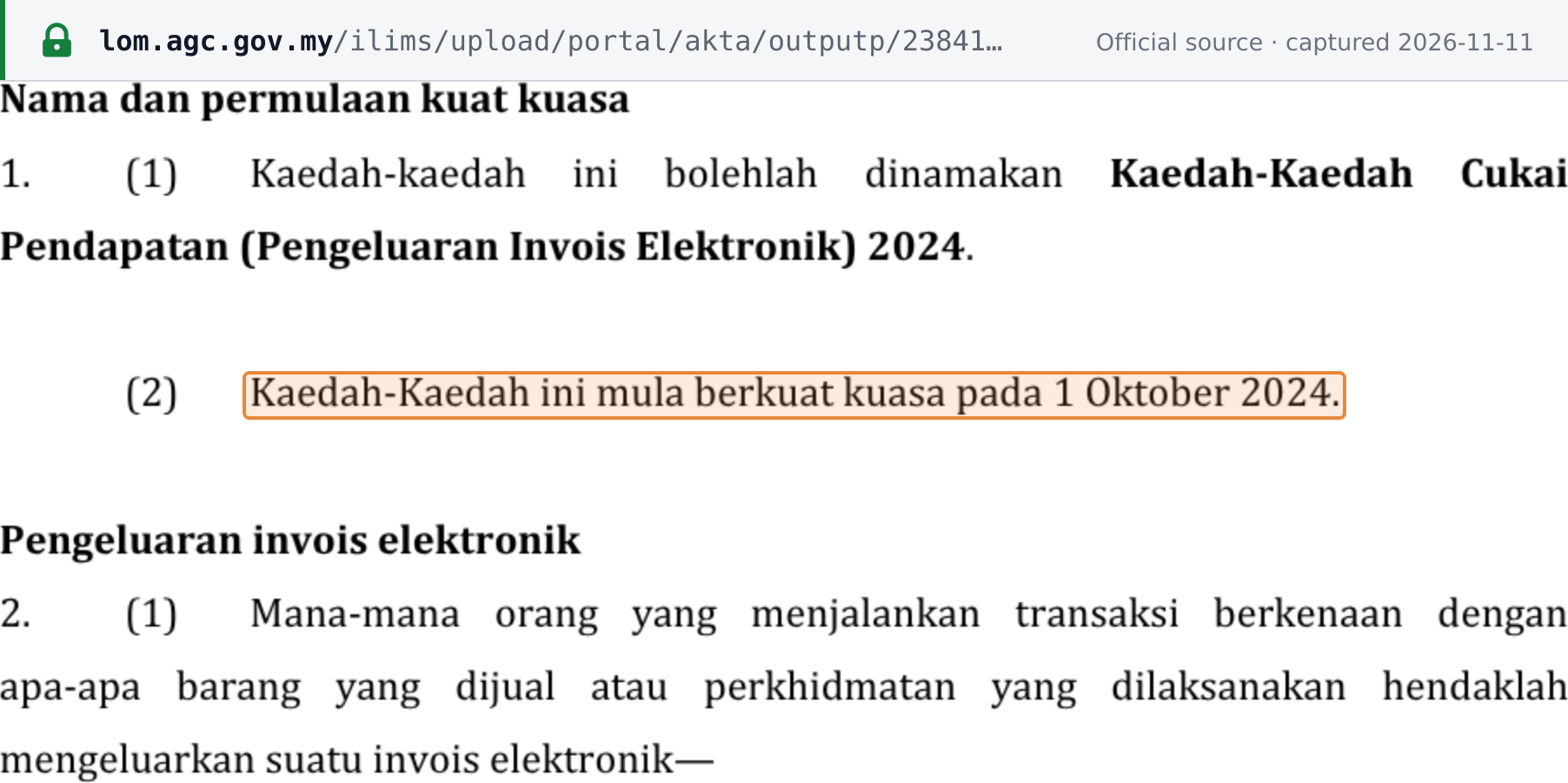 Source snapshot of the official page. Open full size ↗
Archived from the official distribution · P.U.(A) 265/2024 — Income Tax (Issuance of Electronic Invoice) Rules 2024 (Federal Government Gazette, 30 September 2024) · lom.agc.gov.my