New Zealand makes online marketplaces collect 15% GST on ride-sharing, food delivery and short-stay accommodation from 1 April 2024
This page records one dated change. For the rules in New Zealand as they stand today, see the New Zealand guide →
- Jurisdiction
- New Zealand
- Tax
- GST
- Change type
- Digital services
- Status
- In force
- Impact
- FYI
- Announced
- 1 April 2024
- Effective
- 1 April 2024
- Instrument
- NZ-ACT-Public-Act-2023-No-5
- Authority
- Inland Revenue (New Zealand)
- Verified
- Fetched from official source · medium confidence
Resident and non-resident online marketplaces facilitating ride-sharing, ride-hailing, food and beverage delivery or short-stay accommodation in New Zealand, and the sellers and listing intermediaries using them.
No action — monitoring only.
In force from 1 April 2024. Online marketplaces, whether resident or non-resident for tax purposes, that facilitate listed services must collect and pay 15% GST when the service is performed, provided or received in New Zealand, whether or not the underlying seller is GST-registered. Listed services are ride-sharing and ride-hailing, food and beverage delivery, and short-stay and visitor accommodation, plus closely connected services charged through the marketplace. The rules were enacted by the Taxation (Annual Rates for 2022–23, Platform Economy, and Remedial Matters) Act 2023. A transitional rule lets marketplaces choose not to collect GST on short-stay accommodation supplied on or after 1 April 2024 that was booked before that date, and some large GST-registered accommodation owners can opt out.
What changed in detail
From 1 April 2024, online marketplaces, whether resident or non-resident for tax purposes, that facilitate the sale of listed services must collect and pay GST at 15% when the service is performed, provided or received in New Zealand. This applies whether or not the underlying seller is GST-registered. Inland Revenue calls these the marketplace rules for listed services.
Listed services are:
- ride-sharing and ride-hailing;
- food and beverage delivery;
- short-stay and visitor accommodation;
together with closely connected services charged through the marketplace.
The rules were enacted by the Taxation (Annual Rates for 2022–23, Platform Economy, and Remedial Matters) Act 2023.
Two carve-outs apply. A transitional rule lets marketplaces (and in some cases listing intermediaries) choose not to collect GST on short-stay accommodation supplied on or after 1 April 2024 that was booked before that date. Some large GST-registered accommodation owners can opt out of the marketplace rules and collect and pay the GST themselves.
What it means
The marketplace rules are in force and still apply in November 2026; the weekly feed holds no later change to them. The GST measures in the 2026 annual rates bill deal with registration, filing and solar exports, not with listed services.
The practical shift is who accounts for the tax. A driver or host below the GST registration threshold now sees GST collected on their services by the platform. Platforms carry the registration, return and taxable-supply-information obligations. The transitional rule for pre-April 2024 accommodation bookings is in practice spent: it only covered stays booked before 1 April 2024.
Proof
Online marketplaces (resident or non-resident for tax purposes) who facilitate the sale of listed services, must collect and pay GST of 15% when the service is performed, provided, or received in New Zealand.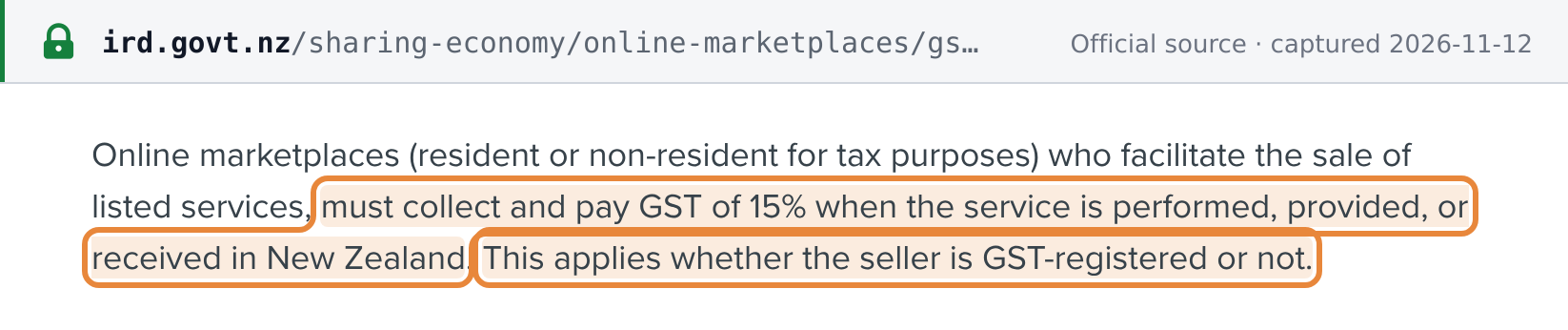 Source snapshot of the official page. Open full size ↗