Senegal writes mandatory e-invoicing for all VAT-registered persons into its tax code
This page records one dated change. For the rules in Senegal as they stand today, see the Senegal guide →
- Jurisdiction
- Senegal
- Tax
- TVA
- Change type
- E-invoicing
- Status
- Enacted
- Impact
- FYI
- Announced
- 6 January 2025
- Instrument
- SN-LOI-2025-02
- Authority
- Direction Générale des Impôts et des Domaines (DGID), Sénégal
- Verified
- Fetched from official source · medium confidence
All persons registered for TVA in Senegal, once the Minister of Finance sets the conditions and application rules (modalités) by arrêté.
No action — monitoring only.
Senegal's Finance Law for 2025 (Loi n° 2025-02 of 6 January 2025) inserted a section II into Article 447 of the Code Général des Impôts. All VAT-registered persons (assujettis) must issue electronic invoices, which are issued, transmitted and received in dematerialised form through a public invoicing portal or another dematerialisation platform set up by the administration; electronic invoicing machines may also be authorised, and invoice data is transmitted to the administration electronically. The conditions and start dates are to be set by order (arrêté) of the Minister of Finance. A new Article 667 IV penalises failure to issue, transmit or receive e-invoices with a fine of 25% of the VAT invoiced or that should have been invoiced, capped at FCFA 5,000,000 per invoice.
What changed in detail
Senegal’s Finance Law for 2025 (Loi n° 2025-02 of 6 January 2025) added a new section II, “Facturation électronique”, to article 447 of the Code Général des Impôts, the article on invoicing. It provides that:
- VAT-registered persons (assujettis) must issue an electronic invoice for the transactions they carry out. The invoice is issued, transmitted and received in dematerialised form.
- E-invoices are issued, transmitted and received through a public invoicing portal or another dematerialisation platform set up by the tax administration. Taxpayers may also be authorised to use electronic invoicing machines.
- Invoice data is transmitted to the administration electronically.
- The content requirements and other rules for ordinary invoices in article 447 I (points 2 to 7) also apply to e-invoices.
- The conditions and application rules (conditions et modalités d’application) are to be set by an arrêté of the Minister of Finance.
The same law added article 667 IV. Any breach of the e-invoicing obligations, in particular failing to issue, transmit or receive invoices electronically, carries a fine of 25% of the VAT invoiced or that should have been invoiced, up to FCFA 5,000,000 per invoice. This applies in addition to the penalties in article 671.
What it means
The obligation is law but cannot be applied until the implementing arrêté is issued. No implementing arrêté was found in the DGID’s published texts as of November 2026, so no start date has been confirmed. The DGID’s 2026 move of large and medium taxpayers to the SENTAX portal concerns tax filing, not invoicing.
The framework is a clearance-style model: invoices pass through a state portal or approved machines, and data goes to the administration. The penalty is charged per invoice. Businesses in Senegal should follow DGID communiqués for the arrêté.
Proof
Les assujettis sont tenus de délivrer, pour les opérations qu’ils réalisent, une facture électronique. La facture électronique est émise, transmise et reçue sous une forme dématérialisée.Taxable persons must issue an electronic invoice for the transactions they carry out. The electronic invoice is issued, transmitted and received in dematerialised form.
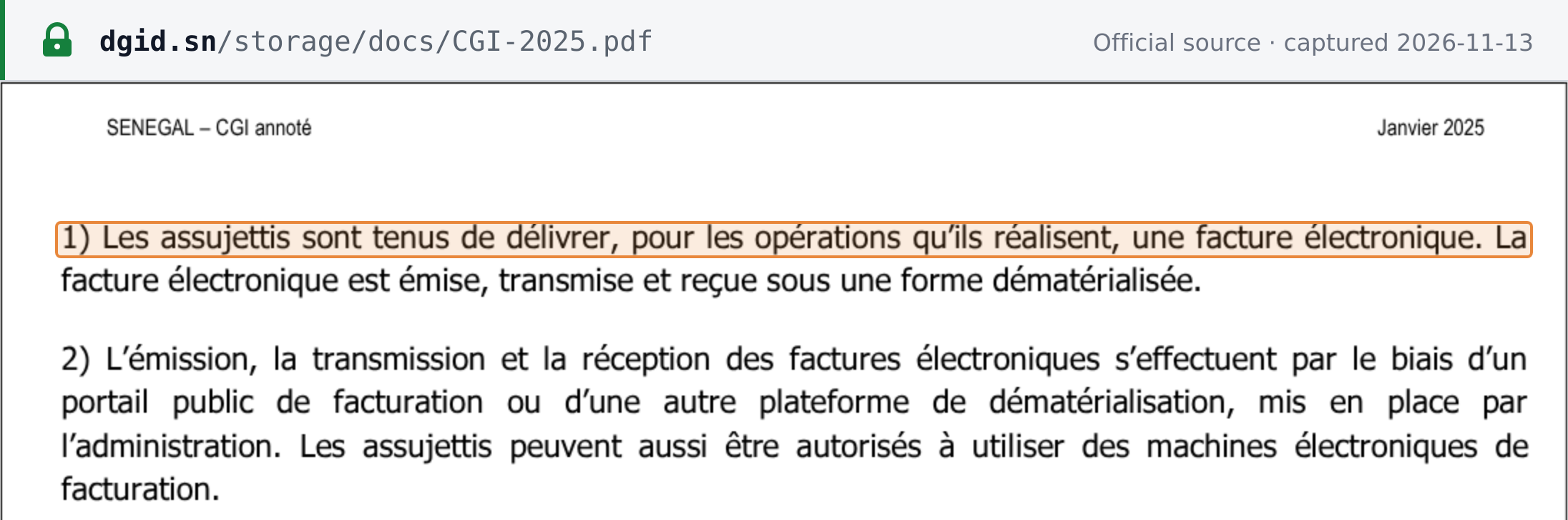 Source snapshot of the official page. Open full size ↗
Archived from the official distribution · SENEGAL – CGI annoté, Janvier 2025 (DGID), art. 447 II and art. 667 IV (Loi n°2025-02 du 06 janvier 2025 portant LFI 2025) · www.dgid.sn