Sierra Leone exempts industrial machinery and local vegetable oils and soaps from GST from 1 January 2024
This page records one dated change. For the rules in Sierra Leone as they stand today, see the Sierra Leone guide →
- Jurisdiction
- Sierra Leone
- Tax
- GST
- Change type
- Rate change
- Status
- In force
- Impact
- FYI
- Announced
- 11 January 2024
- Effective
- 1 January 2024
- Instrument
- SL-ACT-Act-No-1-of-2024
- Authority
- National Revenue Authority (Sierra Leone)
- Verified
- Fetched from official source · high confidence
Suppliers and importers of machinery, plant and equipment for agriculture, manufacturing, mining and upstream petroleum, and local producers of edible vegetable oils and vegetable-oil-based soaps in Sierra Leone.
No action — machinery for agriculture, manufacturing and upstream petroleum, and locally produced vegetable oil products, are GST-exempt since 1 January 2024.
Sierra Leone's Finance Act 2024 (Act No. 1 of 2024; passed 9 November 2023, signed 10 January 2024, Gazette Supplement Vol. CLXV No. 3 of 11 January 2024; deemed in force 1 January 2024), section 15, amends the Second Schedule of the Goods and Services Tax Act 2009 by inserting two new exempt items immediately after item 26: item 27 exempts machinery, plant and equipment designed for use exclusively in agriculture, manufacturing, and mining and upstream petroleum operations; item 28 exempts locally produced edible vegetable oils extracted from seeds or from other parts of fruits used in foods (in cooking and as supplements, including butter) and locally produced vegetable oil-based soaps.
What changed in detail
Sierra Leone’s Finance Act, 2024 (Act No. 1 of 2024) was passed by Parliament on 9 November 2023, signed on 10 January 2024 and published in the Supplement to the Sierra Leone Gazette Vol. CLXV No. 3 of 11 January 2024. Section 1 deems it in operation from 1 January 2024.
Section 15 amends the Second Schedule of the Goods and Services Tax Act 2009, the list of exempt supplies under section 9, by inserting two items after item 26:
- Item 27, machinery: machinery, plant and equipment designed for use exclusively in agriculture, manufacturing, and mining and upstream petroleum operations.
- Item 28: locally produced edible vegetable oils extracted from seeds or other parts of fruits and used in foods (in cooking and as supplements, including butter), and locally produced vegetable-oil-based soaps.
Exempt supplies carry no GST, and the supplier cannot recover input tax on the costs of making them. The zero rate is a different list, in the First Schedule.
The same Act also changed the GST registration threshold, recorded separately.
What it means
Both items are still in force. The Finance Act, 2026 amended other items of the Second Schedule (items 4, 5 and 21, and a new item 29; recorded here) but did not touch items 27 and 28.
The machinery exemption depends on equipment being designed for use exclusively in the listed sectors, so general-purpose vehicles and tools are not covered. The oils and soaps exemption covers local production only: imported cooking oil and soap remain taxable at 15%. Local producers should note the cost: as their sales are exempt, GST paid on their inputs is no longer recoverable.
Proof
The Second Schedule of the Goods and Services Tax Act 2009 is amended by inserting the following new items 27 and 28 immediately after item 26 as follows-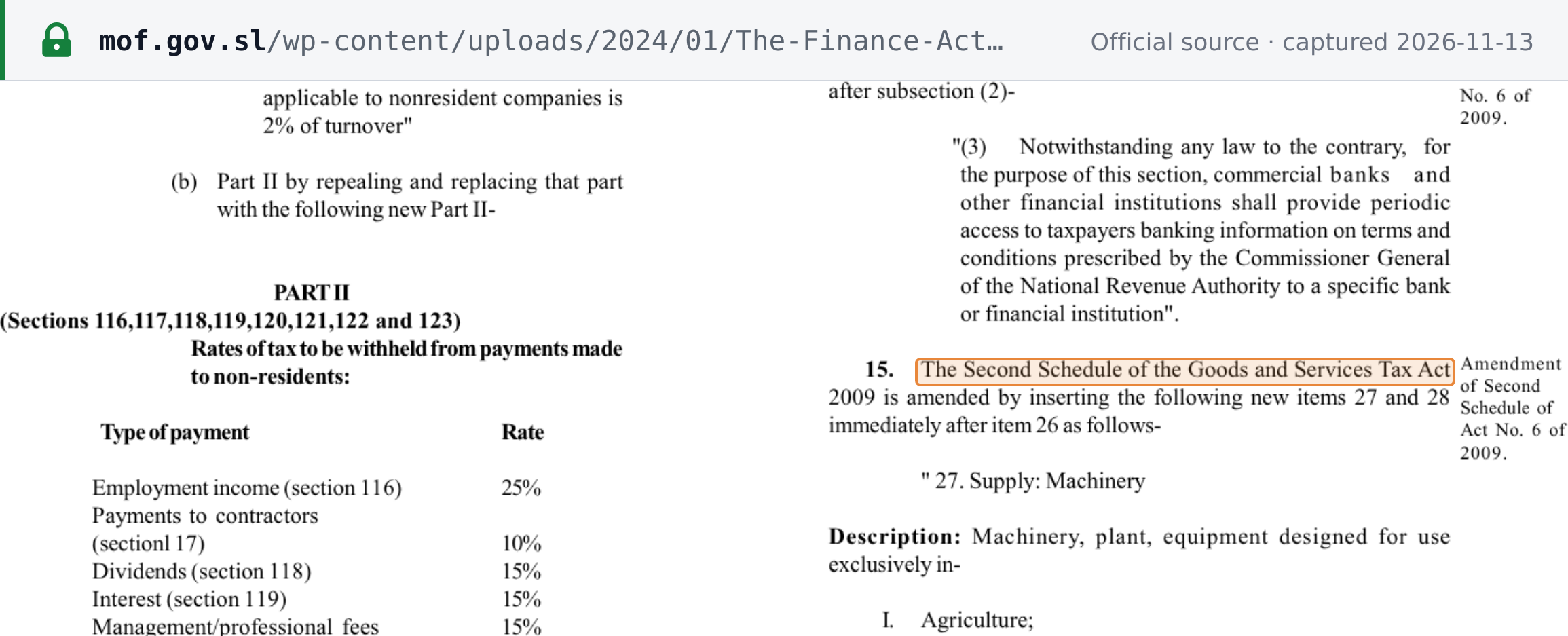 Source snapshot of the official page. Open full size ↗
Archived from the official distribution · The Finance Act, 2024 (Act No. 1 of 2024), Supplement to the Sierra Leone Gazette Vol. CLXV, No. 3 dated 11th January, 2024 · mof.gov.sl