Singapore gives prospective GST registrants two months before registration takes effect, from 1 July 2025
This page records one dated change. For the rules in Singapore as they stand today, see the Singapore guide →
- Jurisdiction
- Singapore
- Tax
- GST
- Change type
- Registration
- Status
- In force
- Impact
- Plan ahead
- Announced
- 28 February 2025
- Effective
- 1 July 2025
- Instrument
- SG-MINISTERIAL-ORDER-S-443-2025
- Authority
- Inland Revenue Authority of Singapore (IRAS)
- Verified
- Fetched from official source · medium confidence
Businesses that reasonably expect taxable turnover above S$1 million in the next 12 months (the prospective basis), where the forecast date is on or after 1 July 2025.
Businesses that forecast taxable turnover above S$1 million in the next 12 months must still apply within 30 days of the forecast date, but start charging GST from the registration date two months after the forecast date; set up GST invoicing and pricing for that date.
The Goods and Services Tax Act 1993 (Amendment of First Schedule) Order 2025 (in operation 1 July 2025) changed the effective date of GST registration on the prospective basis: where the forecast date falls on or after 1 July 2025, registration takes effect two months after the forecast date (the corresponding day of the second following month, or that month's last day if there is none), instead of on the 31st day after the forecast date. The deadline to apply for registration (within 30 days of the forecast date) is unchanged. The measure was announced by the Second Minister for Finance on 28 February 2025.
What changed in detail
Singapore requires GST registration on the prospective basis when a business can reasonably expect its taxable turnover to exceed S$1 million in the next 12 months. It must apply within 30 days after the date of that forecast.
Before the change, registration took effect, and GST had to be charged, on the 31st day after the forecast date. The Second Minister for Finance announced on 28 February 2025 that these businesses would get a two-month grace period. The Goods and Services Tax Act 1993 (Amendment of First Schedule) Order 2025, in operation from 1 July 2025, gives effect to it.
Where the prospective-basis liability arises on or after 1 July 2025, the business is registered two months from the date of its forecast. The application deadline does not change: it is still 30 days after the forecast date. IRAS’s worked examples use the same calendar date two months later: a forecast on 1 July 2025 gives registration on 1 September 2025, and one on 15 January 2026 gives registration on 15 March 2026. Where that month has no such date, the last day of the month is used: a forecast on 31 December 2025 gives registration on 28 February 2026, and one on 31 December 2027 gives 29 February 2028.
Forecasts dated before 1 July 2025 keep the old 31st-day rule. The retrospective basis, which looks at turnover for the past calendar year, is unchanged.
What it means
The change separates the deadline to apply from the date GST starts. A business that applies on time now has about a month after applying before it must issue tax invoices and charge 9% GST, instead of almost none. Use that time to reprice contracts and set up GST invoicing. The common mistake is to treat the two-month date as the deadline to apply. It is not: a late application is still late after 30 days.
The rule is still in force in November 2026, and IRAS’s registration guidance still states it. A separate change affects businesses that register voluntarily: from 1 April 2026 they must meet the GST InvoiceNow Requirement, and new compulsory registrants follow from 1 April 2028.
Proof
If your liability to register for GST under the prospective basis arises on or after 1 Jul 2025, you will be registered 2 months from the date of your forecast.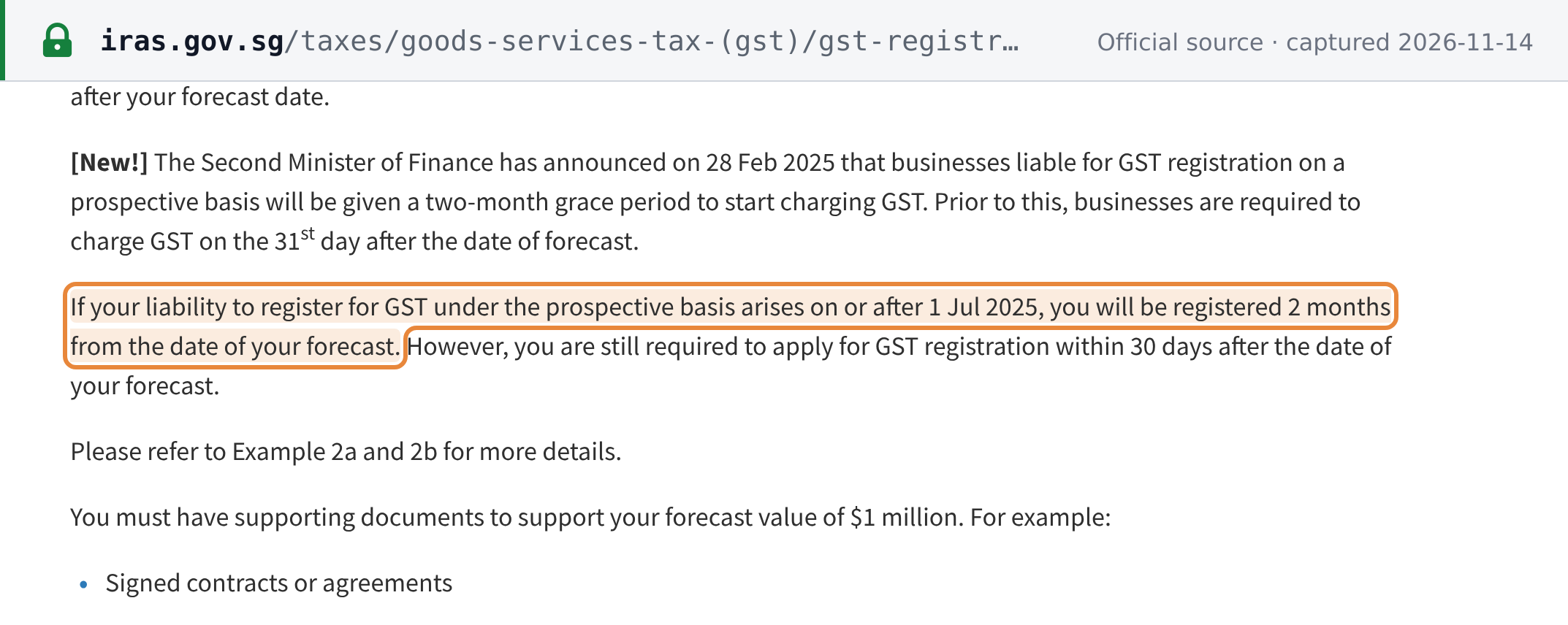 Source snapshot of the official page. Open full size ↗