South Africa narrows VAT residence so services to foreign subsidiaries managed from South Africa can be zero-rated
This page records one dated change. For the rules in South Africa as they stand today, see the South Africa guide →
- Jurisdiction
- South Africa
- Tax
- VAT
- Change type
- Rate change
- Status
- In force
- Impact
- Action required
- Announced
- 24 December 2024
- Effective
- 1 January 2025
- Instrument
- ZA-ACT-42-2024
- Authority
- Parliament of the Republic of South Africa
- Verified
- Fetched from official source · high confidence
South African vendors supplying services to foreign companies that are tax-resident in South Africa only because their place of effective management is there, and that carry on no enterprise in South Africa.
South African vendors supplying services to foreign subsidiaries that are tax-resident only because their place of effective management is in South Africa, and that carry on no enterprise in South Africa, should review zero-rating under section 11(2)(l) for supplies from 1 January 2025.
Section 45 of the Taxation Laws Amendment Act 42 of 2024 (GG 51826, 24 December 2024) substitutes the definition of 'resident of the Republic' in section 1(1) of the VAT Act 89 of 1991 so that it excludes a person that is a 'resident' under the Income Tax Act solely because its place of effective management is in the Republic and that does not carry on an enterprise in the Republic. Previously such foreign-incorporated subsidiaries of South African groups were VAT residents, so services supplied to them by their South African parent could not be zero-rated under section 11(2)(l). Effective 1 January 2025.
What changed in detail
Section 45 of the Taxation Laws Amendment Act 42 of 2024 (Government Gazette 51826, 24 December 2024) substitutes the definition of “resident of the Republic” in section 1(1) of the Value-Added Tax Act 89 of 1991.
Under paragraph (a) of the new definition, a resident as defined in section 1 of the Income Tax Act is a VAT resident unless it:
- is a “resident” solely because its place of effective management is in the Republic, under paragraph (b) of the Income Tax Act definition; and
- does not carry on an enterprise in the Republic.
Paragraph (b) keeps the rule that any other person or company is a resident to the extent that it carries on an enterprise or other activity in the Republic and has a fixed or permanent place there relating to it.
Before the change, a foreign-incorporated subsidiary of a South African group that was managed from South Africa was a VAT resident. Services supplied to it by its South African parent could therefore not be zero-rated as exported services under section 11(2)(l).
Under section 45(2), the substitution comes into operation on 1 January 2025.
What it means
The change is in force. A South African company supplying management, IT or other services to a foreign subsidiary that is resident only because it is effectively managed from South Africa, and that trades nowhere in South Africa, can now look at zero-rating those services under section 11(2)(l).
Both conditions must hold, and the other requirements of section 11(2)(l) still apply. A subsidiary that carries on any enterprise in South Africa remains a VAT resident. Groups should check each subsidiary’s facts before changing their invoicing.
Proof
(i) is a ‘resident’ solely as a result of having its place of effective management in the Republic as referred to in paragraph (b) of that definition; and (ii) does not carry on an enterprise in the Republic;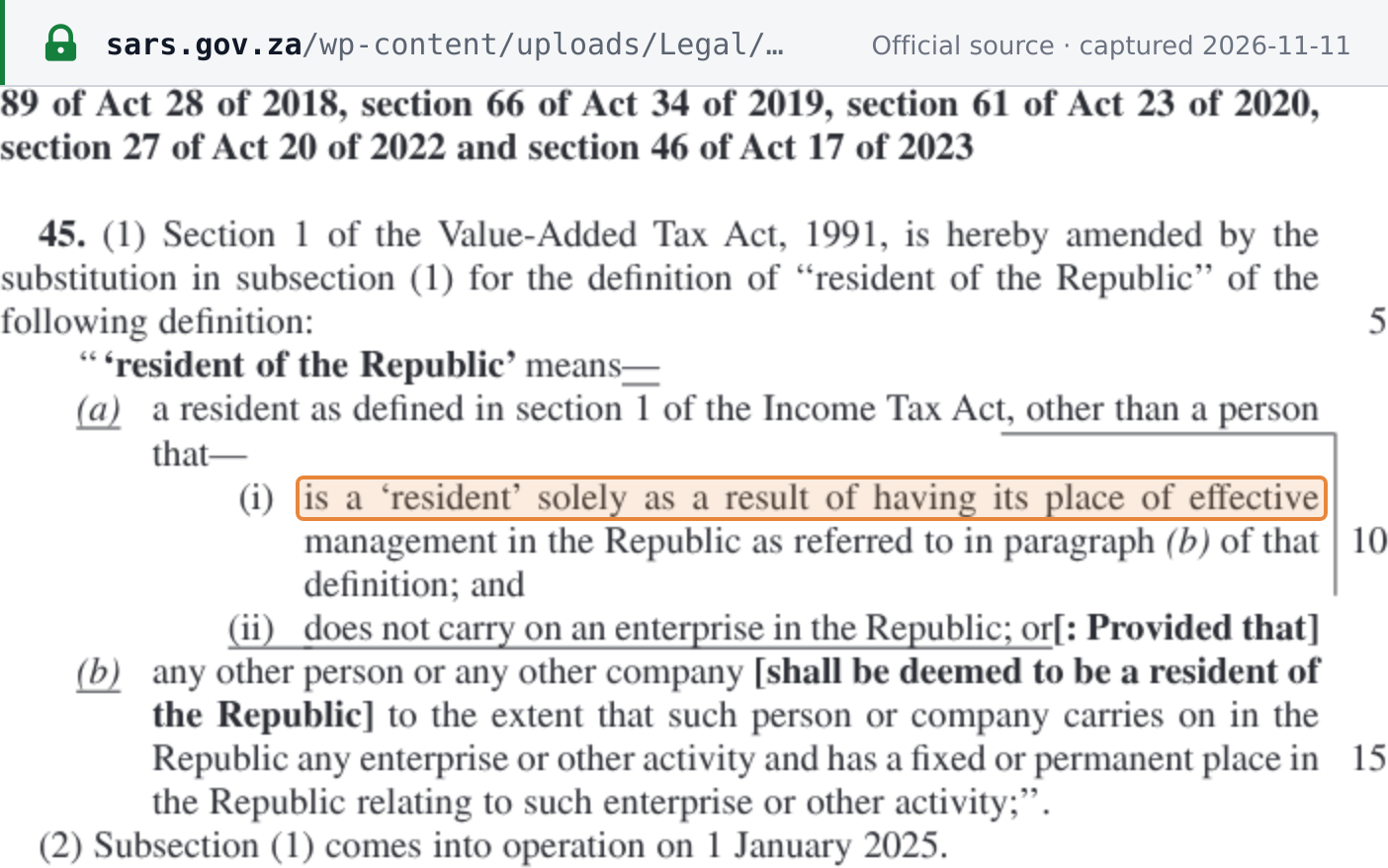 Source snapshot of the official page. Open full size ↗
Archived from the official distribution · Taxation Laws Amendment Act 42 of 2024, Government Gazette No. 51826, 24 December 2024 · www.sars.gov.za