South Korea raises the additional tax on fake tax invoices from 3% to 4% from 1 January 2026
This page records one dated change. For the rules in South Korea as they stand today, see the South Korea guide →
- Jurisdiction
- South Korea
- Tax
- VAT
- Change type
- Compliance
- Status
- In force
- Impact
- FYI
- Announced
- 23 December 2025
- Effective
- 1 January 2026
- Instrument
- KR-ACT-21218
- Authority
- 법제처 국가법령정보센터 (Ministry of Government Legislation, Republic of Korea)
- Verified
- Fetched from official source · high confidence
Anyone, registered or not, who issues or receives tax invoices or card slips without an actual supply; media-content creators filing VAT returns.
No action — monitoring only.
VAT Act amended by Law No. 21218 (promulgated 23 December 2025, in force 1 January 2026): Art. 60(3)1–2 and Art. 60(4) raise the additional tax (가산세) on issuing or receiving tax invoices without an actual underlying supply from 3% to 4% of the stated supply value. Invoices issued or received without a supply before 1 January 2026 remain subject to the 3% rate (부칙 제3조). The same Act adds media-content creators (미디어콘텐츠창작업) to the businesses that must file a cash-sales statement with their VAT returns (Art. 55(1)3의2, for returns filed on or after 1 April 2026) and lets tax offices require documents proving actual business operations at the business place (Art. 74(2)).
What changed in detail
Law No. 21218, promulgated on 23 December 2025 and in force from 1 January 2026, amended Article 60 of the Value Added Tax Act. The additional tax (가산세) on issuing a tax invoice or card slip without supplying goods or services (Article 60(3)1), and on receiving one without being supplied (Article 60(3)2), rises from 3% to 4% of the supply value stated on the document. The same rise applies under Article 60(4) to a person who is not a business operator and issues or receives a tax invoice without a supply. Under addendum Article 3, documents issued or received before 1 January 2026 stay at 3%.
The same Act made two other changes:
- It added media-content creators (미디어콘텐츠창작업) to the businesses that must file a cash-sales statement with their VAT returns (Article 55(1)3의2), for returns filed on or after 1 April 2026 (addendum Article 2).
- It lets the tax office require documents proving actual business operations at the business place, as prescribed by decree, when collecting or investigating VAT (Article 74(2)).
What it means
This change is in force. The consolidated VAT Act in force from 2 January 2026 sets 4% in Articles 60(3)1–2 and 60(4).
The 4% sits on top of the VAT itself and of input-VAT disallowance, and on the stated supply value, so on a KRW 1 billion fake invoice the surcharge alone is KRW 40 million for each side. A fake invoice also triggers ad-hoc assessment within the period under Article 57-2, added by Law No. 20614 (kr-animal-blood-exemption-2024). For media-content creators, the practical change is the cash-sales statement now due with each return.
Proof
제60조제3항제1호ㆍ제2호 및 같은 조 제4항 전단 중 "3퍼센트"를 각각 "4퍼센트"로 한다.In Article 60(3)1 and 2 and the first sentence of Article 60(4), "3 percent" is changed to "4 percent" in each occurrence.
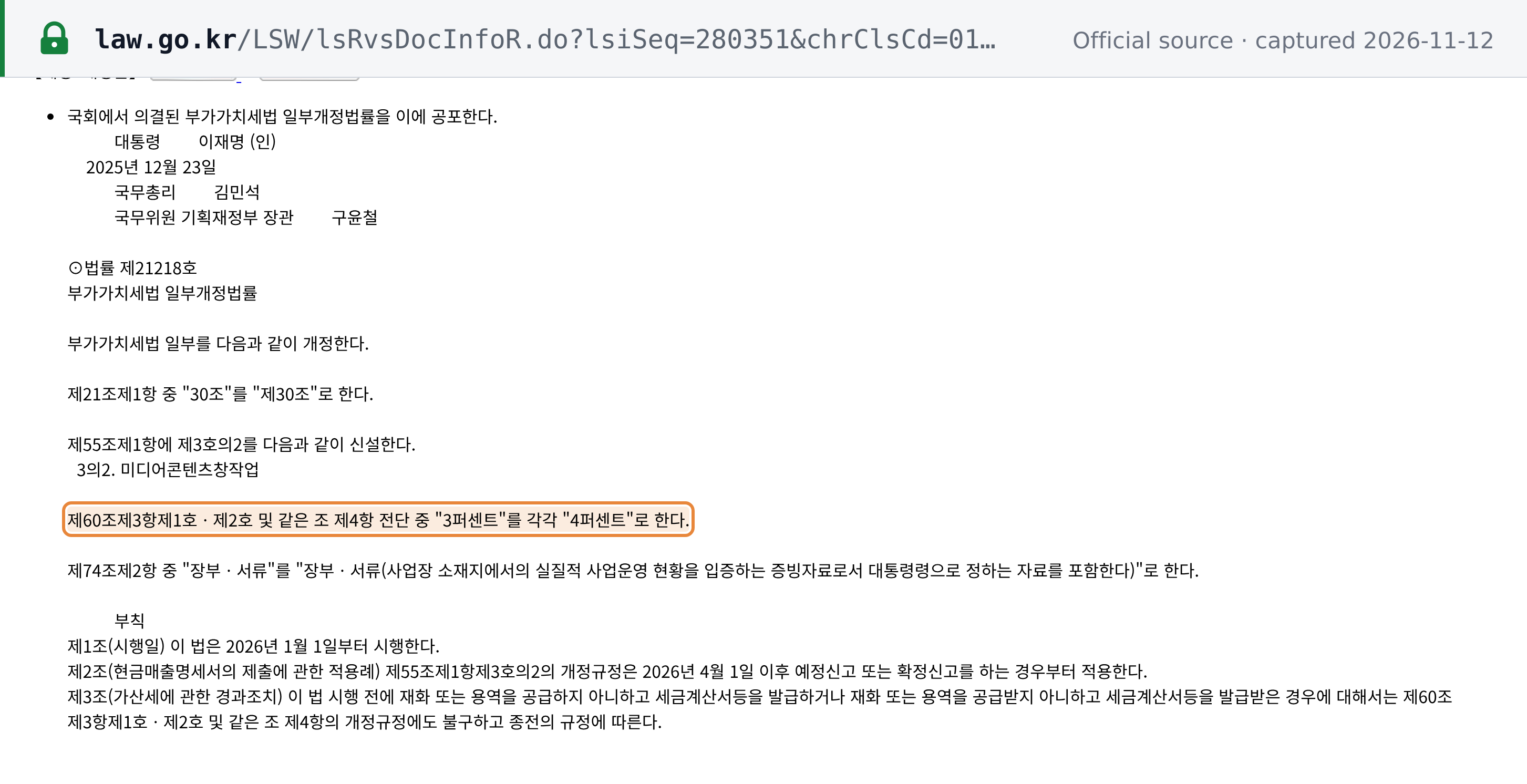 Source snapshot of the official page. Open full size ↗