Trinidad and Tobago caps EV zero-rating at TTD 400,000 and zero-rates farm inputs from 1 January 2026
This page records one dated change. For the rules in Trinidad and Tobago as they stand today, see the Trinidad and Tobago guide →
- Jurisdiction
- Trinidad and Tobago
- Tax
- VAT
- Change type
- Rate change
- Status
- In force
- Impact
- FYI
- Announced
- 31 December 2025
- Effective
- 1 January 2026
- Instrument
- TT-STATUTORY-INSTRUMENT-488-of-2025
- Authority
- Ministry of Finance, Trinidad and Tobago
- Verified
- Fetched from official source · high confidence
Importers and dealers of electric and CNG commercial vehicles, suppliers of the agricultural inputs listed in new item 53, and their farm customers in Trinidad and Tobago.
No action — changes in force since 1 January 2026; monitoring only.
Legal Notice No. 488 of 2025 — The Value Added Tax (Amendment to Schedule 2) (No. 3) Order, 2025, made 24 December 2025, published in the Trinidad and Tobago Legal Supplement Part B Vol. 64 No. 190 on 31 December 2025 and effective 1 January 2026, makes three changes to Schedule 2 (zero-rated supplies): (1) limits the zero-rating of new and used electric motor vehicles (item 8(2)(a) and (b)) to vehicles with a C.I.F. value not exceeding TTD 400,000; (2) replaces 'three years' with 'eight years' in items 43(2)(b) and 43(4)(b) (vehicle age limits in item 43); (3) inserts new item 53 zero-rating listed agricultural-sector inputs (e.g. pollen substitutes, growing media, plastic mulch, forks, rakes, cutlasses and hoes, ear tag applicators, submersible and solar water pumps, tunnel ventilated pens, irrigation systems, and agricultural solar panels).
What changed in detail
Legal Notice No. 488 of 2025, the Value Added Tax (Amendment to Schedule 2) (No. 3) Order, 2025, was made by the Minister of Finance under section 8 of the Value Added Tax Act on 24 December 2025 and published in the Legal Supplement Part B, Vol. 64, No. 190, on 31 December 2025. It came into effect on 1 January 2026. It makes three changes to Schedule 2, the list of zero-rated supplies:
- Electric vehicles (item 8(2)(a) and (b)). Zero-rating of new and used electric motor vehicles is limited to vehicles with a C.I.F. value not exceeding TTD 400,000.
- Vehicle age limit (items 43(2)(b) and 43(4)(b)). “Three years” becomes “eight years” in both places. Item 43 of the consolidated Value Added Tax Act covers motor vehicles imported for commercial use that are manufactured to use compressed natural gas (CNG); sub-items (2) and (4) are the used vehicles, which previously had to be no older than three years from the year of manufacture.
- Agricultural inputs (new item 53). Listed goods from the First Schedule to the Customs Act, to be used in the agricultural sector, become zero-rated. Examples include pollen substitutes, growing media, plastic mulch, forks, rakes, cutlasses and hoes, ear tag applicators, submersible and solar water pumps, tunnel ventilated pens, irrigation systems and agricultural solar panels.
What it means
Since 1 January 2026, an electric vehicle with a C.I.F. value above TTD 400,000 is standard-rated in full, not just on the excess, so the price of an import near the line matters. Used CNG commercial vehicles up to eight years old now qualify, which widens the pool of eligible imports. Farm suppliers need to map their stock to the item 53 tariff headings, because zero-rating attaches to the listed goods for agricultural use.
The Order remains in force. The 2027 Budget Statement proposes moving unnamed zero-rated items to exempt status from 1 January 2027 (proposal record), but nothing has been legislated.
Proof
This Order comes into effect on 1st January, 2026.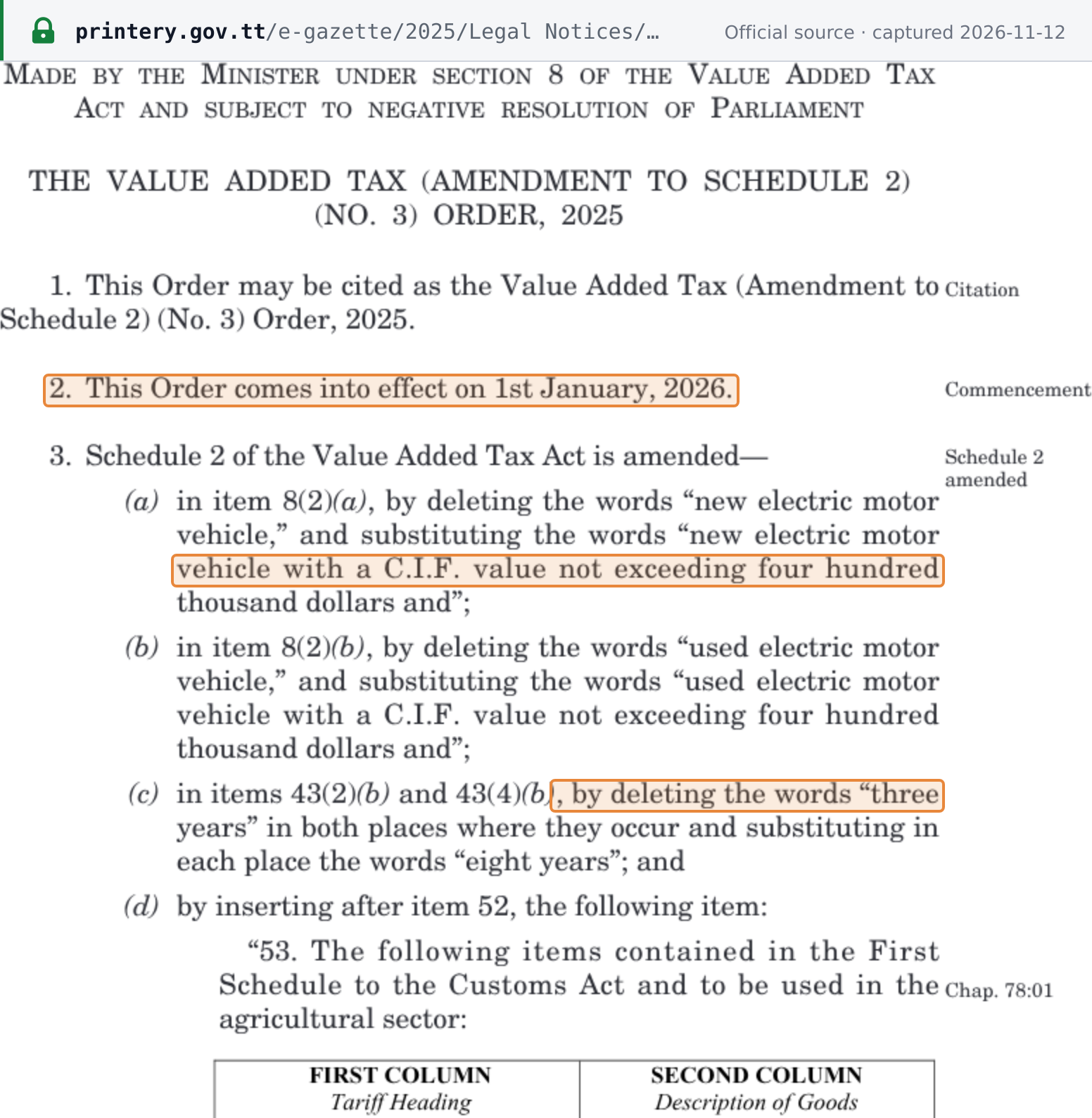 Source snapshot of the official page. Open full size ↗
Archived from the official distribution · Legal Notice No. 488 of 2025, Legal Supplement Part B, Vol. 64, No. 190, 31 December 2025 · www.printery.gov.tt