Tunisia fines paper invoices issued where e-invoicing is mandatory: TND 100–500 each from 1 July 2025
- Jurisdiction
- Tunisia
- Tax
- VAT
- Change type
- Compliance
- Status
- In force
- Impact
- FYI
- Announced
- 10 December 2024
- Effective
- 1 July 2025
- Instrument
- TN-FINANCE-ACT-48-2024
- Authority
- Journal Officiel de la République Tunisienne (JORT)
- Verified
- Fetched from official source · high confidence
Tunisian businesses whose operations fall under the mandatory e-invoicing rules of Article 18 II ter of the VAT Code.
No action — monitoring only.
Law 2024-48 (Finance Law 2025, JORT n° 149 of 10 December 2024), Article 71, adds to Article 94 of the Code des droits et procédures fiscaux a fine of TND 100 to 500 per invoice on any person who issues paper invoices for operations that must be e-invoiced under Article 18 II ter of the VAT Code, capped at TND 50,000 for all invoices found; it also extends the Article 95 penalty to paper copies of e-invoices. The fine provisions apply from 1 July 2025.
What changed in detail
Loi n° 2024-48 du 9 décembre 2024, Tunisia’s Finance Law for 2025, was published in JORT n° 149 on 10 December 2024. Article 71, headed “مزيد دعم الامتثال للواجبات المتعلقة بنظام الفوترة الالكترونية” (further support for compliance with e-invoicing obligations), tightens the penalties in the Code des droits et procédures fiscaux (CDPF):
- Paragraph 1 adds to CDPF Article 94 a fine of TND 100 to 500 per invoice on anyone who issues paper invoices for operations that must be e-invoiced under Article 18 II ter of the VAT Code. The total fine for all invoices found is capped at TND 50,000.
- Paragraph 2 rewrites CDPF Article 95(1) so that it refers to the mandatory particulars required under both paragraph II and paragraph II ter of VAT Code Article 18.
- Paragraph 3 extends CDPF Article 95(3) to transactions covered by paper invoices or paper copies of electronic invoices.
- Paragraph 4 adds a reference to paragraph II ter in VAT Code Article 18 III(3).
Under paragraph 5, paragraphs 1 and 3 apply from 1 July 2025. The rest of the law applies from 1 January 2025.
What it means
The fine is in force, and its reach grew six months later. Finance Law 2026 (Loi n° 2025-17), Article 53, extends the e-invoicing obligation in Article 18 II ter to services from 1 January 2026 (recorded here). Because the fine is tied to “operations subject to mandatory e-invoicing” under that paragraph, a business that keeps issuing paper invoices for in-scope services now faces the same TND 100–500 per invoice.
Since 1 July 2025 a paper invoice where an electronic one is required is a cost per document, not only a procedural lapse. Businesses should check which of their sales fall under Article 18 II ter and stop paper issue there.
Proof
ويعاقب بخطية تتراوح بين 100 دينار و 500 دينار عن كلّ فاتورة، كلّ شخص تولّى إصدار فواتير ورقية بعنوان عمليات خاضعة وجوبا لنظام الفوترة الإلكترونية على معنى أحكام الفقرة II ثالثا من الفصل 18 من مجلة الأداء على القيمة المضافة دون أن يفوق مبلغ الخطية المستوجب بعنوان مجموع الفواتير الواقع معاينتها 50.000 دينارA fine of TND 100 to 500 per invoice applies to any person who issues paper invoices for operations that must be e-invoiced under paragraph II ter of Article 18 of the VAT Code, without the total fine for all invoices found exceeding TND 50,000.
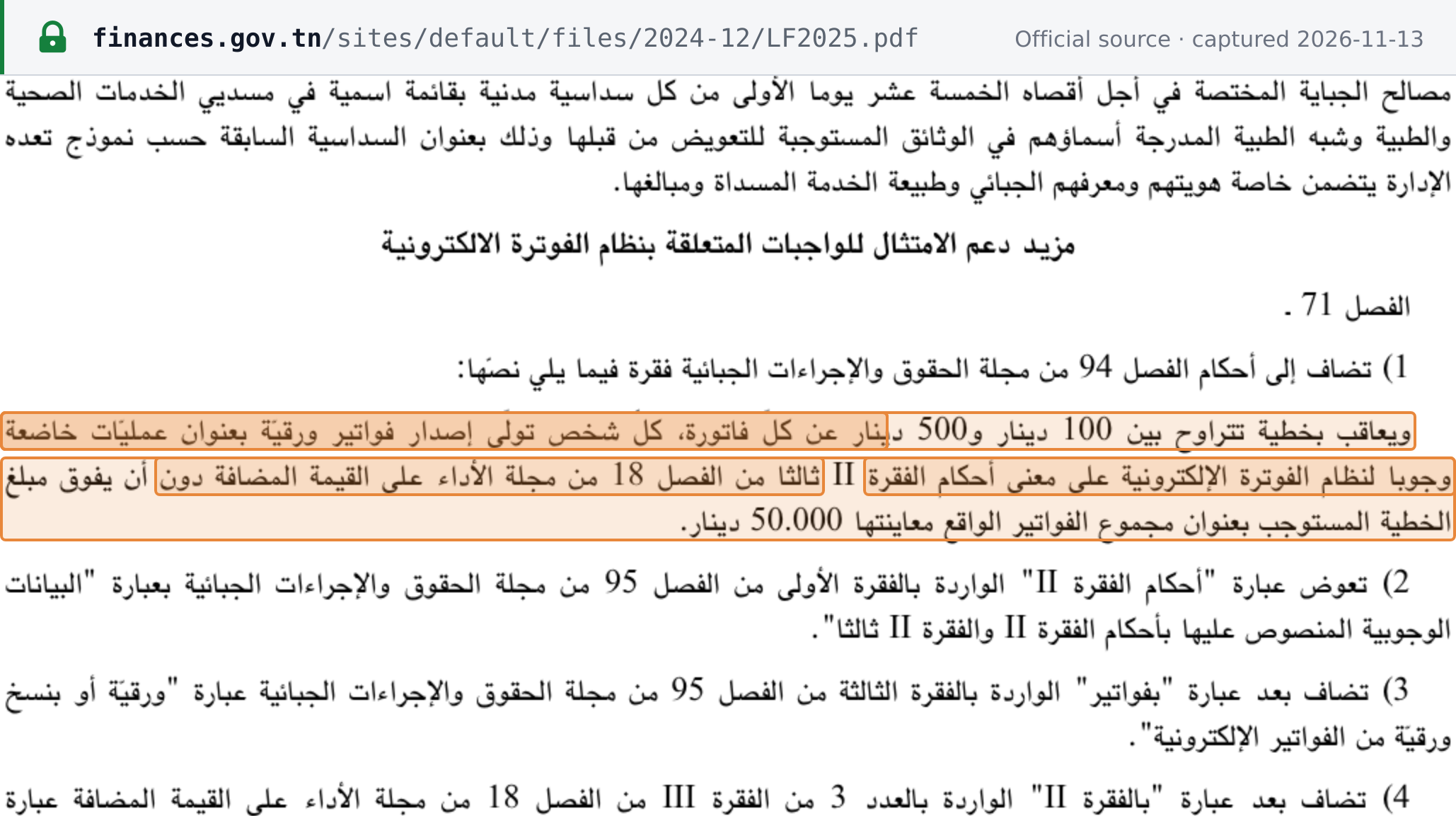 Source snapshot of the official page. Open full size ↗
Archived from the official distribution · Loi n° 2024-48 du 9 décembre 2024 portant loi de finances pour l'année 2025, JORT n° 149 du 10 décembre 2024 · www.finances.gov.tn