UAE replaces its e-invoicing penalty regime: Cabinet Decision No. 173 of 2026 repeals Decision No. 106 of 2025
This page records one dated change. For the rules in United Arab Emirates as they stand today, see the United Arab Emirates guide →
- Jurisdiction
- United Arab Emirates
- Tax
- VAT
- Change type
- E-invoicing
- Status
- Enacted
- Impact
- Plan ahead
- Instrument
- AE-CD-173-2026
- Authority
- UAE Ministry of Finance
- Systems
- Invoicing, ERP
- Verified
- Fetched from official source · high confidence
Businesses within the scope of the UAE Electronic Invoicing System, as issuers or recipients of electronic invoices and electronic credit notes.
Businesses in the AED 50m+ first wave: confirm e-invoice and credit-note transmission controls are in place before the 1 January 2027 go-live.
InvoicingERP
UAE Cabinet Decision No. 173 of 2026 on the violations and administrative penalties under the Electronic Invoicing System legislation repeals and replaces Cabinet Decision No. 106 of 2025. Penalties include AED 100 for each electronic invoice or electronic credit note not issued or not transmitted (capped at AED 5,000 per calendar month) and AED 250 per day for failing to notify the Accredited Service Provider of data changes. The decision enters into force on the day following its publication in the Official Gazette.
What changed in detail
UAE Cabinet Decision No. 173 of 2026 on the Violations and Administrative Penalties Resulting from Violation of the Legislation Regulating the Electronic Invoicing System sets the penalty regime for the Electronic Invoicing System. Under its Article 4, it repeals Cabinet Decision No. 106 of 2025 on the same subject, together with any provision that contradicts or conflicts with it.
The penalties are set out in the table annexed to the decision. They include:
- AED 100 for each electronic invoice not issued and transmitted to the recipient through the Electronic Invoicing System, up to AED 5,000 per calendar month;
- AED 100 for each electronic credit note not issued and transmitted, up to AED 5,000 per calendar month; and
- AED 250 for each day of delay in notifying the appointed Accredited Service Provider of changes to the data registered with the Authority.
Under Article 5, the decision is to be published in the Official Gazette and enters into force on the day following its publication. The Ministry of Finance copy does not state the publication date.
What it means
The per-document penalties make transmission failures a volume risk: a business whose integration silently drops invoices or credit notes can reach the AED 5,000 monthly cap on each type quickly. Controls that confirm each document actually reached the recipient through the system matter as much as the ability to generate it.
The ASP notification penalty runs per day, so a change of registered data (address, legal details, contacts) needs a routine for telling the Accredited Service Provider promptly. Because the in-force date depends on Official Gazette publication, which the Ministry’s copy does not show, check the gazette date before relying on the old Decision No. 106 rules for any period.
Proof
Cabinet Decision No. 106 of 2025 on the Violations and Administrative Penalties Resulting from Violation of the Legislation Regulating the Electronic Invoicing System shall be repealed, and any provision that contradicts or conflicts with the provisions of this Decision shall be repealed.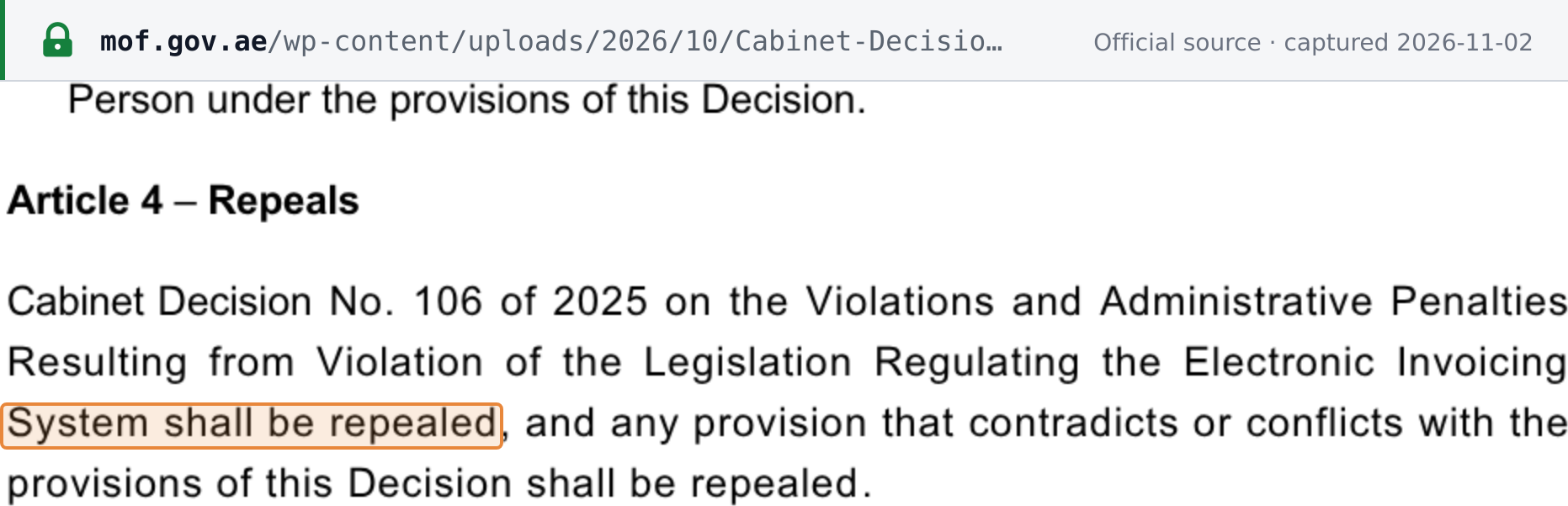 Source snapshot of the official page. Open full size ↗
Archived from the official distribution · Cabinet Decision No. 173 of 2026 (English text, UAE Ministry of Finance) · mof.gov.ae