UAE sets the scope of mandatory e-invoicing in Ministerial Decision No. 243 of 2025
This page records one dated change. For the rules in United Arab Emirates as they stand today, see the United Arab Emirates guide →
- Jurisdiction
- United Arab Emirates
- Tax
- VAT / e-invoicing
- Change type
- E-invoicing
- Status
- In force
- Impact
- FYI
- Announced
- 29 September 2025
- Instrument
- AE-MINISTERIAL-DECISION-243-2025
- Authority
- UAE Ministry of Finance
- Verified
- Fetched from official source · high confidence
Any person conducting business in the UAE, for business-to-business and business-to-government transactions, other than the excluded government, air transport and financial-services transactions.
No action — monitoring only. This is the foundational scope decision for the UAE e-invoicing system; see MD 244/2025 for phase timelines.
Ministerial Decision No. 243 of 2025 on the Electronic Invoicing System, announced by the UAE Ministry of Finance on 29 September 2025 and in force on its publication in the Official Gazette, sets the scope and obligations of the UAE e-invoicing system (OpenPeppol-based, through Accredited Service Providers). It applies to any person conducting business in the UAE for every business transaction, unless excluded. Excluded transactions are: sovereign-capacity transactions of government entities not in competition with the private sector; international passenger air transport where an electronic ticket is issued and related ancillary services under an Electronic Miscellaneous Document; international air cargo under an airway bill, for 24 months from the system's start; and financial services that are VAT-exempt or zero-rated under Article 42 of the VAT Executive Regulation. Issuers and recipients must appoint an Accredited Service Provider, and the issuer must issue and transmit the electronic invoice or credit note within 14 days of the business transaction. Phase dates are set by Ministerial Decision No. 244 of 2025, which also keeps business-to-consumer transactions out of scope until further notice. Ministerial Decision No. 197 of 2026 later amended this decision.
What changed in detail
Ministerial Decision No. 243 of 2025 on the Electronic Invoicing System was announced by the UAE Ministry of Finance on 29 September 2025. It sets the scope of the e-invoicing system, which runs on the OpenPeppol model through Accredited Service Providers, and the obligations of the persons subject to it.
The system applies to any person conducting business in the UAE, for every business transaction, unless the transaction is excluded. The excluded transactions are:
- sovereign-capacity transactions of government entities that do not compete with the private sector;
- international passenger air transport where an electronic ticket is issued, and related ancillary services under an Electronic Miscellaneous Document;
- international air cargo under an airway bill, for 24 months from the date the system becomes effective;
- financial services that are VAT-exempt or zero-rated under Article 42 of the VAT Executive Regulation.
Issuers and recipients must each appoint an Accredited Service Provider. The issuer must issue and transmit the electronic invoice or electronic credit note within 14 days of the business transaction. For VAT registrants, Article 6(4) puts the VAT-law timeline for issuing tax invoices first.
The decision comes into force on the date of its publication in the Official Gazette. That date is not stated in the Ministry of Finance sources cited here, so this record gives no effective date. Phase dates are in the companion Ministerial Decision No. 244 of 2025.
What it means
This is the rulebook for who is in scope, and it is in force, but no longer in its original form. Ministerial Decision No. 197 of 2026 amended it from 1 October 2026, adding a 24-month exclusion for transactions within a VAT Tax Group and replacing the data-storage rule, and changed the issuing window from 14 days to 14 Business Days. That window and the obligation on both sides to appoint a provider still drive implementation work. The recipient’s obligation is easy to miss: a business that only buys still needs an Accredited Service Provider.
Proof
The purpose of this Decision is to establish the scope of application of the Electronic Invoicing System in the State and prescribe the obligations of the Persons subject to the Electronic Invoicing System.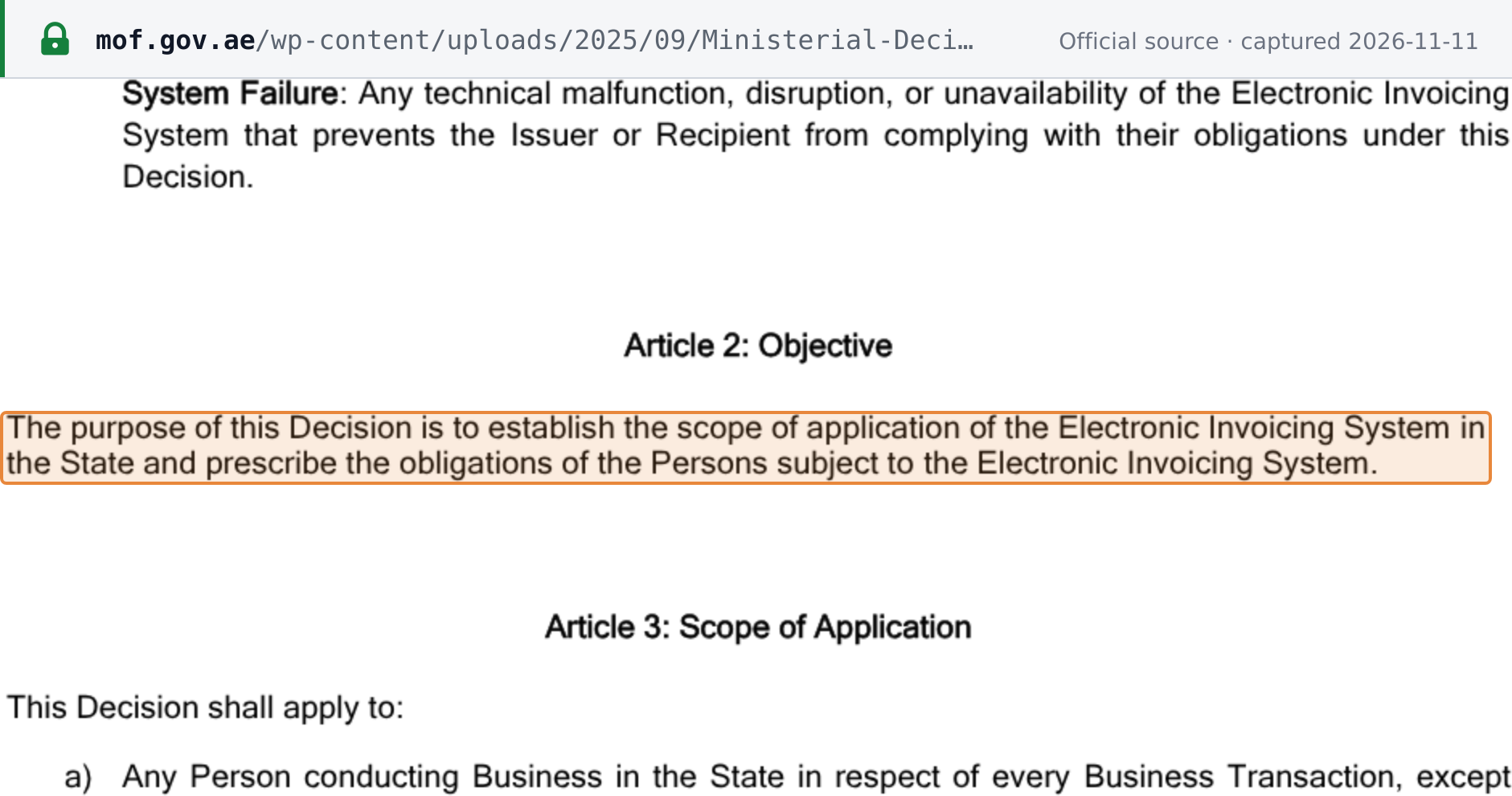 Source snapshot of the official page. Open full size ↗
Archived from the official distribution · Ministerial Decision No. 243 of 2025 on the Electronic Invoicing System (English text, UAE Ministry of Finance) · mof.gov.ae