UAE applies the VAT reverse charge to gold, silver, platinum, palladium, precious stones and jewellery traded between registrants
This page records one dated change. For the rules in United Arab Emirates as they stand today, see the United Arab Emirates guide →
- Jurisdiction
- United Arab Emirates
- Tax
- VAT
- Change type
- Update
- Status
- In force
- Impact
- Action required
- Announced
- 16 December 2024
- Effective
- 26 February 2025
- Instrument
- AE-CABINET-DECISION-127-2024
- Authority
- UAE Ministry of Finance
- Verified
- Fetched from official source · high confidence
VAT-registered suppliers and buyers of gold, silver, palladium, platinum, natural or synthetic diamonds, pearls, rubies, sapphires, emeralds, and jewellery whose metal or stone value exceeds its other components, where the buyer resells or manufactures.
VAT-registered traders in gold, silver, palladium, platinum, the listed precious stones, or jewellery made mainly of them: on supplies to registered buyers who resell or manufacture, the supplier charges no VAT and the buyer accounts for it. Collect the buyer's written declarations and verify its registration before the date of supply.
Cabinet Decision No. 127 of 2024, issued 16 December 2024 and in force 60 days after Gazette publication (26 February 2025 in the FTA's current copy; an older FTA copy gives 15 February 2025), applies the reverse charge to supplies of precious metals (gold, silver, palladium, platinum), precious stones (natural and synthetic diamonds, pearls, rubies, sapphires, emeralds) and jewellery whose metal or stone value exceeds its other components, made to a VAT-registered recipient who intends to resell them or use them in producing or manufacturing such goods. The supplier does not account for the VAT and the recipient accounts for it, subject to written declarations and a registration check before the date of supply; zero-rated supplies under Article 45(1) are excluded. The Decision repeals Cabinet Decision No. 25 of 2018 on gold and diamonds.
What changed in detail
Cabinet Decision No. 127 of 2024, issued on 16 December 2024, applies the VAT reverse charge to trade in precious metals and precious stones between UAE registrants. It takes effect 60 days after publication in the Official Gazette; the FTA’s current copy gives the effective date as 26 February 2025; an older FTA copy gives 15 February 2025, and the Gazette date could not be read.
The Decision defines its “Goods” as:
- Precious Metals: gold, silver, palladium and platinum;
- Precious Stones: natural and manufactured (synthetic) diamonds, pearls, rubies, sapphires and emeralds;
- jewellery made of them, but only where the value of the metal or stone exceeds the value of the other components.
Under Article 2(1), where these Goods are supplied to a registered recipient who intends to resell them or use them to produce or manufacture such Goods, the supplier does not account for the VAT or report it in its return. The recipient accounts for the tax and takes on all the related obligations.
The reverse charge does not apply to supplies zero-rated under Article 45(1) of the VAT Decree-Law. Before the date of supply, the recipient must give the supplier two written declarations, one of its intended use and one confirming it is registered; the supplier must keep them and verify the recipient’s registration by the means the FTA approves (Article 2(3)). A recipient that does not give the declarations falls outside the reverse charge and may not treat the Goods as used for the purposes in Article 54(1)(a) and (b) of the VAT Decree-Law (Article 2(4)).
Article 4 repeals Cabinet Decision No. 25 of 2018, which had applied a narrower mechanism to gold and diamonds only.
What it means
The Decision is still in force. On 14 November 2026 the FTA still publishes it, and no later instrument amending it has been found. It widened the old gold-and-diamond rule to silver, platinum, palladium and coloured stones. The jewellery test is value-based, so mixed pieces need a valuation call before the invoice is issued.
The paperwork is the condition, not a formality. A buyer that does not hand over its declarations loses the reverse charge and, under Article 2(4), the link to input-tax recovery, so the declarations need to be in the supplier’s file before the first delivery. Suppliers should also keep the registration check on record. The same design was later used for metal scrap in Cabinet Decision No. 153 of 2025, in force from 14 January 2026.
Proof
Where a supplier makes a supply of Goods to a registered Recipient and the intention of the Recipient of Goods was to resell or use them in producing or manufacturing Goods, the following rules shall apply: a. The supplier shall not be responsible for accounting for Tax related to the supply of the Goods, and shall not report such Tax in his Tax Return. b. The Recipient of Goods shall account for the Tax on the value of the Goods supplied to him, and shall be responsible for all Tax obligations resulting from such supply and for accounting for Due Tax thereon.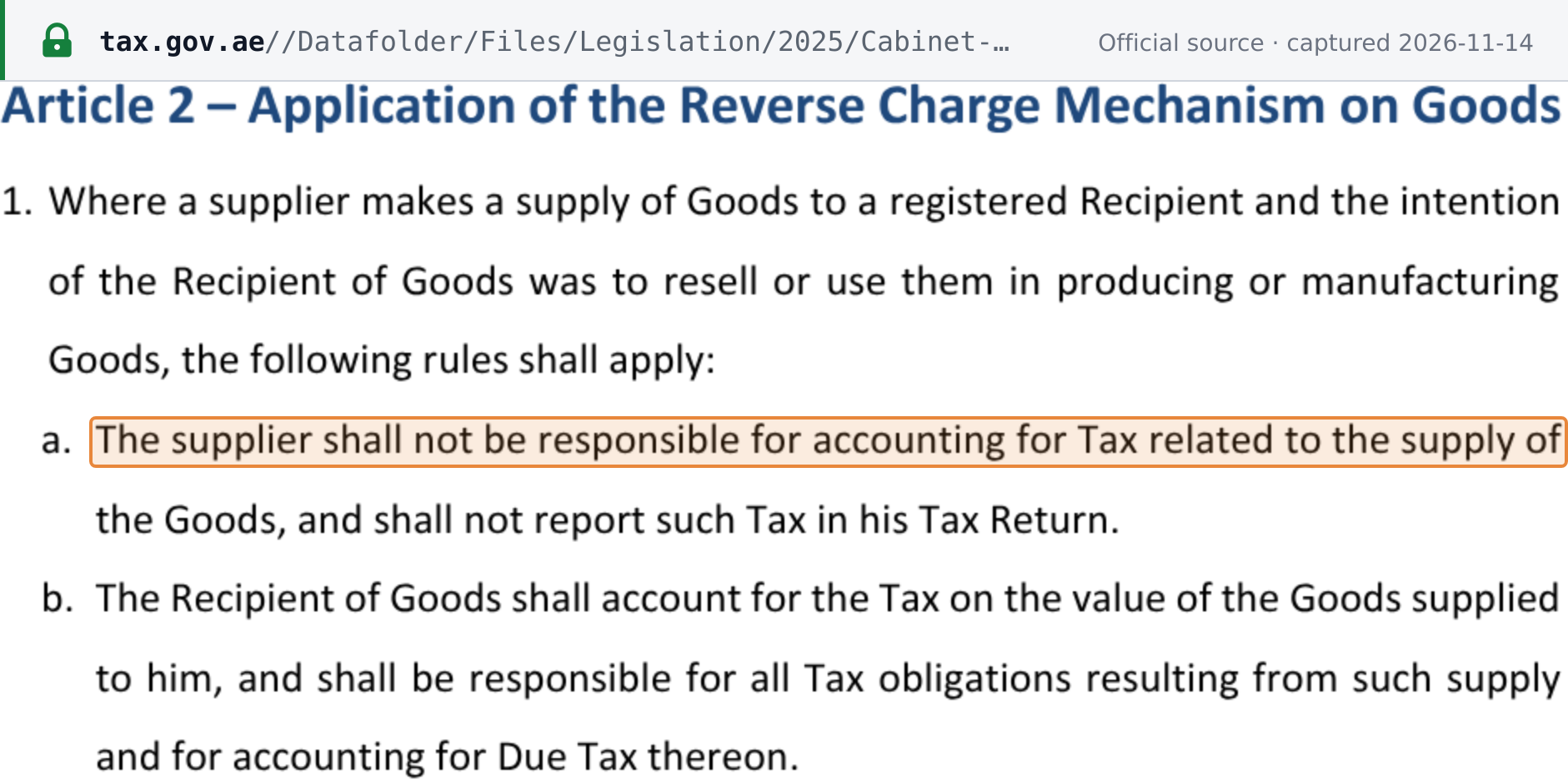 Source snapshot of the official page. Open full size ↗
Archived from the official distribution · Cabinet Decision No. 127 of 2024 – Issued 16 December 2024 – (Effective from 26 February 2025); English text as published by the Ministry of Finance, marked "This is not an official Translation" · tax.gov.ae