UK plans to limit the reverse charge on overseas services to VAT-registered recipients from 1 April 2027
This change is proposed and is not law. The rules below describe what would change if it is adopted.
This page records one dated change. For the rules in United Kingdom as they stand today, see the United Kingdom guide →
- Jurisdiction
- United Kingdom
- Tax
- VAT
- Change type
- Compliance
- Status
- Proposed
- Impact
- Plan ahead
- Announced
- 28 October 2026
- Effective
- 1 April 2027
- Authority
- HM Treasury / HMRC
- Systems
- Tax engine, Invoicing
- Verified
- Fetched from official source · high confidence
Overseas suppliers of B2B services to UK businesses that are not VAT registered, and those UK business customers.
Overseas service suppliers with non-VAT-registered UK business customers: plan to register and charge UK VAT from April 2027.
Tax engineInvoicing
The UK government will legislate in Finance Bill 2026-27 to restrict the VAT reverse charge on services supplied from overseas so it applies only where the UK business recipient is VAT registered; where the UK business is not VAT registered, the overseas supplier must charge and account for UK VAT. The change takes effect from 1 April 2027.
What changed in detail
This is a proposal, not yet law. At Budget 2026 (28 October 2026) the UK government said it will introduce legislation in Finance Bill 2026-27 to restrict the VAT reverse charge for B2B supplies of services from overseas, so that it only applies where the receiving UK business is VAT registered.
Where the UK business customer is not VAT registered, the overseas supplier would be required to charge and account for UK VAT itself. The OOTLAR states the change will take effect from April 2027; HMRC’s tax information and impact note for the measure gives the operative date as 1 April 2027. The note says the reverse charge will then only apply when the purchasing business is actually registered for VAT in the UK. The measure follows HMRC’s December 2020 call for evidence on VAT and the sharing economy, whose summary of responses was published in July 2021.
What it means
The B2B/B2C split for overseas services stops being a simple business-or-not test. An overseas supplier will need to know whether its UK business customer holds a VAT number: if it does not, the supplier charges UK VAT and will usually need to register. Supplier onboarding should start capturing and validating UK VAT numbers before 1 April 2027, and pricing for smaller UK customers will need to absorb or pass on 20% VAT.
Proof
As announced at Budget 2026, the government will introduce legislation in Finance Bill 2026-27 to restrict the VAT reverse charge for supplies of services from overseas, so that it only applies if the receiving UK business is VAT registered. This change means that where a UK business is not VAT registered, the overseas supplier will be required to charge and account for UK VAT.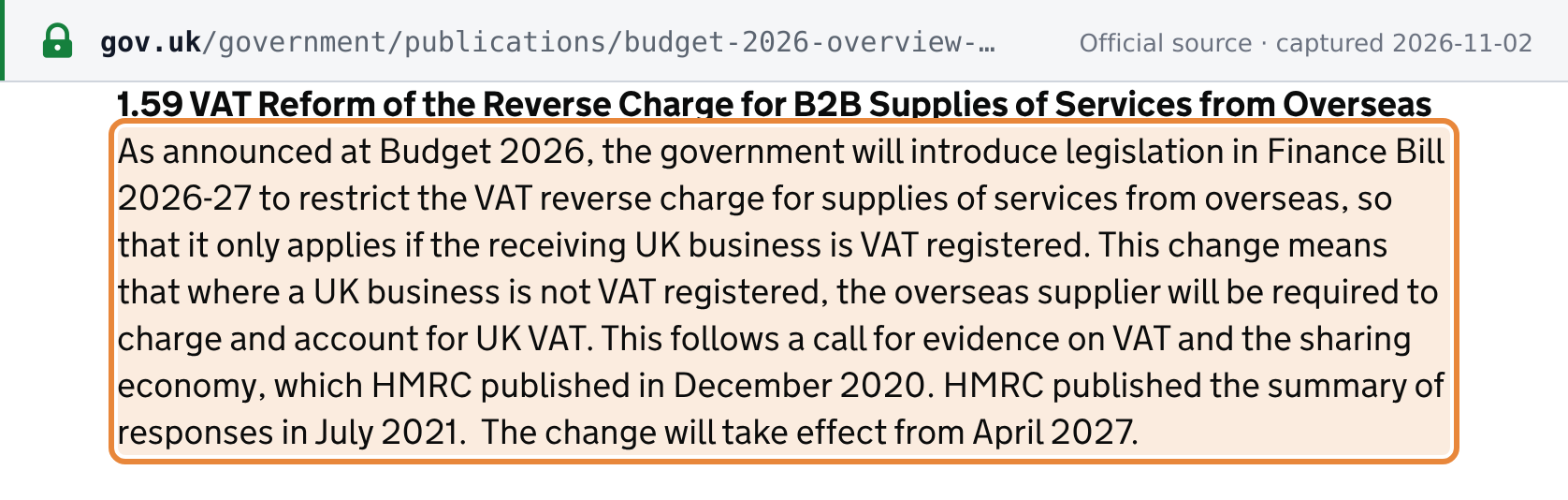 Source snapshot of the official page. Open full size ↗
The measure will take effect from 1 April 2027.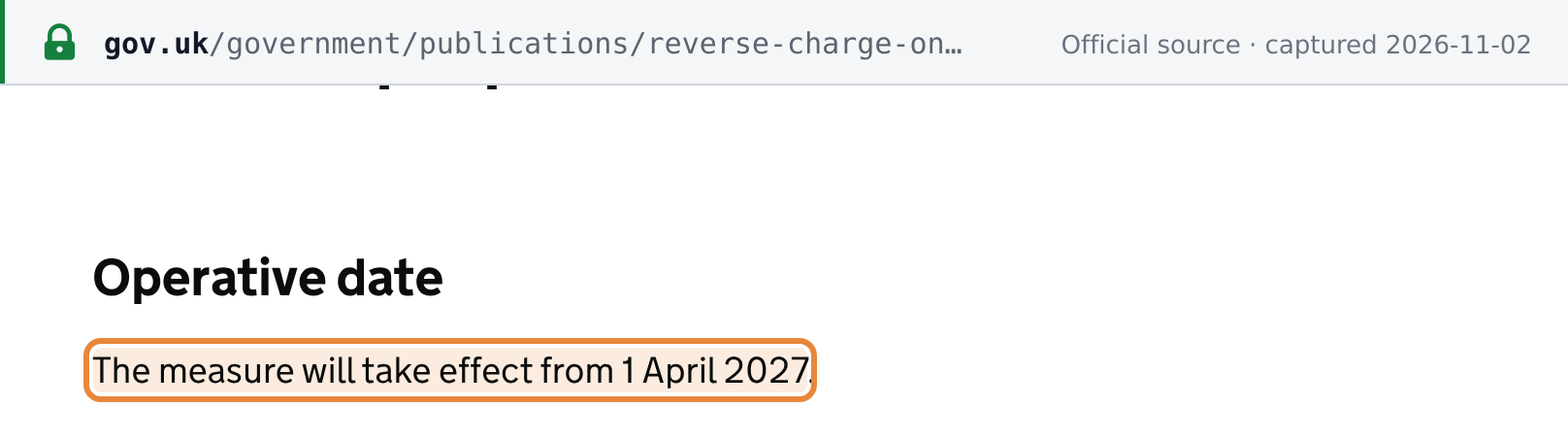 Source snapshot of the official page. Open full size ↗