Vermont ends its SaaS exemption and taxes remotely accessed software from 1 July 2024
- Jurisdiction
- United States — Vermont
- Tax
- sales-tax
- Change type
- Digital services
- Status
- In force
- Impact
- FYI
- Announced
- 17 June 2024
- Effective
- 1 July 2024
- Instrument
- US-ACT-H-887
- Authority
- Vermont General Assembly
- Verified
- Fetched from official source · high confidence
Sellers of prewritten software to Vermont customers, including software-as-a-service providers whose product is accessed remotely rather than downloaded or shipped.
No action — monitoring only.
Vermont Act 183 (H.887, 2024 session), enacted June 17, 2024 via legislative veto override, repealed the exemption for prewritten computer software accessed remotely (SaaS), making all sales of prewritten software subject to Vermont's 6% sales and use tax regardless of delivery method, effective July 1, 2024. Vermont had exempted remotely accessed software since 2015.
What changed in detail
Vermont Act 183 of 2024 (H.887) became law through the legislature’s 17 June 2024 override of the Governor’s veto. Two of its sections end the exemption for remotely accessed software:
- Sec. 3 amends the definition of tangible personal property in 32 V.S.A. § 9701(7). The definition now includes prewritten computer software “regardless of the method in which the prewritten computer software is paid for, delivered, or accessed”.
- Sec. 4 repeals 2015 Acts and Resolves No. 51, Sec. G.8, which the Act describes as the provision on “prewritten software accessed remotely”.
Under Sec. 25(e), these sections took effect on 1 July 2024. From that date, prewritten software sold to Vermont customers is subject to Vermont sales and use tax whether it is shipped on media, downloaded, or accessed remotely as software-as-a-service.
Act 183 is mainly an education-finance act. It also sets property tax rates and yields and creates a short-term rental impact surcharge. The software change is one of several revenue measures in it.
What it means
The change is in force. We have found no later Vermont act restoring the exemption.
For SaaS sellers, Vermont is now a state that taxes remotely accessed software as tangible personal property. That makes it a registration question under the economic nexus rules, not just a rate question.
The amended definition reaches only prewritten software, so custom software stays outside it. The Act does not deal with sourcing. When a business licenses software to users in several states, it has to work out the share used in Vermont from the Department of Taxes’ guidance.
Proof
“Tangible personal property” includes electricity, water, gas, steam, and prewritten computer software regardless of the method in which the prewritten computer software is paid for, delivered, or accessed.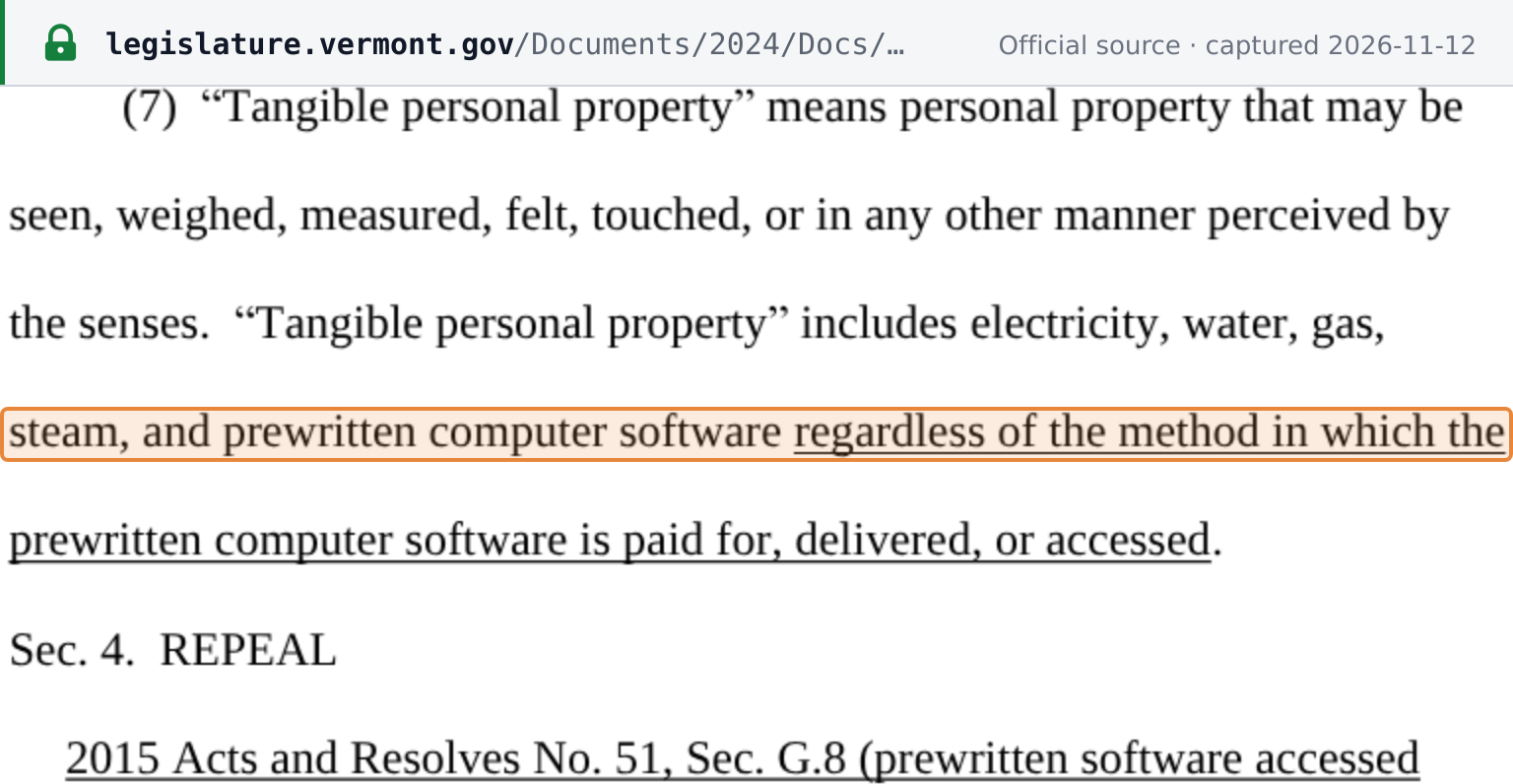 Source snapshot of the official page. Open full size ↗
Archived from the official distribution · Vermont Act No. 183 of 2024 (H.887), as enacted · legislature.vermont.gov