Vietnam adopts a new VAT Law, No. 48/2024/QH15, in force from 1 July 2025
This page records one dated change. For the rules in Vietnam as they stand today, see the Vietnam guide →
- Jurisdiction
- Vietnam
- Tax
- VAT (GTGT)
- Change type
- Rate change
- Status
- In force
- Impact
- Plan ahead
- Announced
- 26 November 2024
- Effective
- 1 July 2025
- Instrument
- VN-ACT-48-2024-QH15
- Authority
- Công Báo — Official Gazette of the Government of Vietnam
- Verified
- Fetched from official source · high confidence
All VAT payers in Vietnam, in particular household and individual businesses, foreign e-commerce and digital-platform suppliers, and businesses claiming input VAT credit.
Businesses selling basic goods in the 5% category and foreign digital-service providers should verify their rate classification under the revised schedules and comply with platform e-filing requirements.
Law No. 48/2024/QH15 on Value-Added Tax, adopted by the National Assembly on 26 November 2024 (8th session, 15th legislature) and signed by Chairman Tran Thanh Man, replaced the 2008 VAT Law (13/2008/QH12) from 1 July 2025. Main changes: (1) the annual turnover below which household and individual businesses are not subject to VAT was set at VND 200 million (Art. 5.25), to apply from 1 January 2026 (Art. 18.2); before that date, Law 149/2025/QH15 (adopted 11 December 2025, in force 1 January 2026) raised it to VND 500 million, so the VND 200 million figure never applied; (2) foreign suppliers without a permanent establishment in Vietnam doing e-commerce or digital-platform business are VAT taxpayers, with foreign digital-platform managers, deduction-method Vietnamese business buyers and e-commerce/platform managers with payment functions withholding and paying on their behalf (Art. 4.4-4.5); (3) the 5% list (Art. 9.2) covers items including clean water, fertilisers, medical equipment and medicines, children's toys, books and social housing; (4) the 10% rate expressly covers services supplied by foreign suppliers through e-commerce and digital platforms (Art. 9.3); (5) input VAT credit requires non-cash payment documents (Art. 14.2(b)), with the VND 5 million floor set by Decree 181/2025/ND-CP.
What changed in detail
The National Assembly adopted Law No. 48/2024/QH15 on Value-Added Tax on 26 November 2024, at the 8th session of the 15th legislature; it was signed by Chairman Trần Thanh Mẫn and published in Công Báo Nos. 1527–1528 of 29 December 2024. Under Article 18 it takes effect on 1 July 2025 and repeals the 2008 VAT Law (No. 13/2008/QH12, as amended).
Main provisions:
- Household threshold. Article 5(25) makes goods and services of household and individual businesses with annual turnover of VND 200 million or less not subject to VAT. Article 18(2) dates this provision, and Article 17, to 1 January 2026.
- Foreign digital suppliers. Article 4(4)–(5) makes foreign suppliers without a permanent establishment that do e-commerce or digital-platform business in Vietnam VAT taxpayers, with withholding by platform managers and deduction-method business buyers (separate record).
- Rates. Article 9(2) lists the 5% items, including clean water, fertilisers, medical equipment and medicines, children’s toys, books and social housing. Article 9(3) applies 10% to everything else, expressly including services supplied by foreign suppliers through e-commerce and digital platforms.
- Input credit. Article 14(2)(b) requires non-cash payment documents for input VAT deduction; the VND 5 million floor is set by Decree 181/2025/NĐ-CP.
What it means
The law is in force and is the base text of Vietnamese VAT today, but not in its original form. The VND 200 million threshold never applied: Law No. 149/2025/QH15, adopted on 11 December 2025 and in force from 1 January 2026 (the same day the 200 million figure was due), rewrote Article 5(25) to VND 500 million. A 2026 amendment, Law 09/2026/QH16, reportedly left the threshold to the Government, which Decree 141/2026/NĐ-CP then set at VND 1 billion, backdated to 1 January 2026. Law 149 also amended the agricultural-products rule in Article 5(1) and the scrap-rate rule in Article 9(5).
Anyone reading Law 48 now should read it with Law 149/2025/QH15, the 2026 amendment and the Decree 181 implementing rules, as amended by Decree 359/2025/NĐ-CP and Decree 144/2026/NĐ-CP.
Proof
Luật này có hiệu lực thi hành từ ngày 01 tháng 7 năm 2025, trừ trường hợp quy định tại khoản 2 Điều này. 2. Quy định về mức doanh thu của hộ, cá nhân sản xuất, kinh doanh thuộc đối tượng không chịu thuế tại khoản 25 Điều 5 của Luật này và Điều 17 của Luật này có hiệu lực thi hành từ ngày 01 tháng 01 năm 2026.This Law takes effect on 1 July 2025, except as provided in clause 2 of this Article. 2. The provisions on the turnover level of household and individual businesses not subject to tax under clause 25 of Article 5 of this Law and Article 17 of this Law take effect on 1 January 2026.
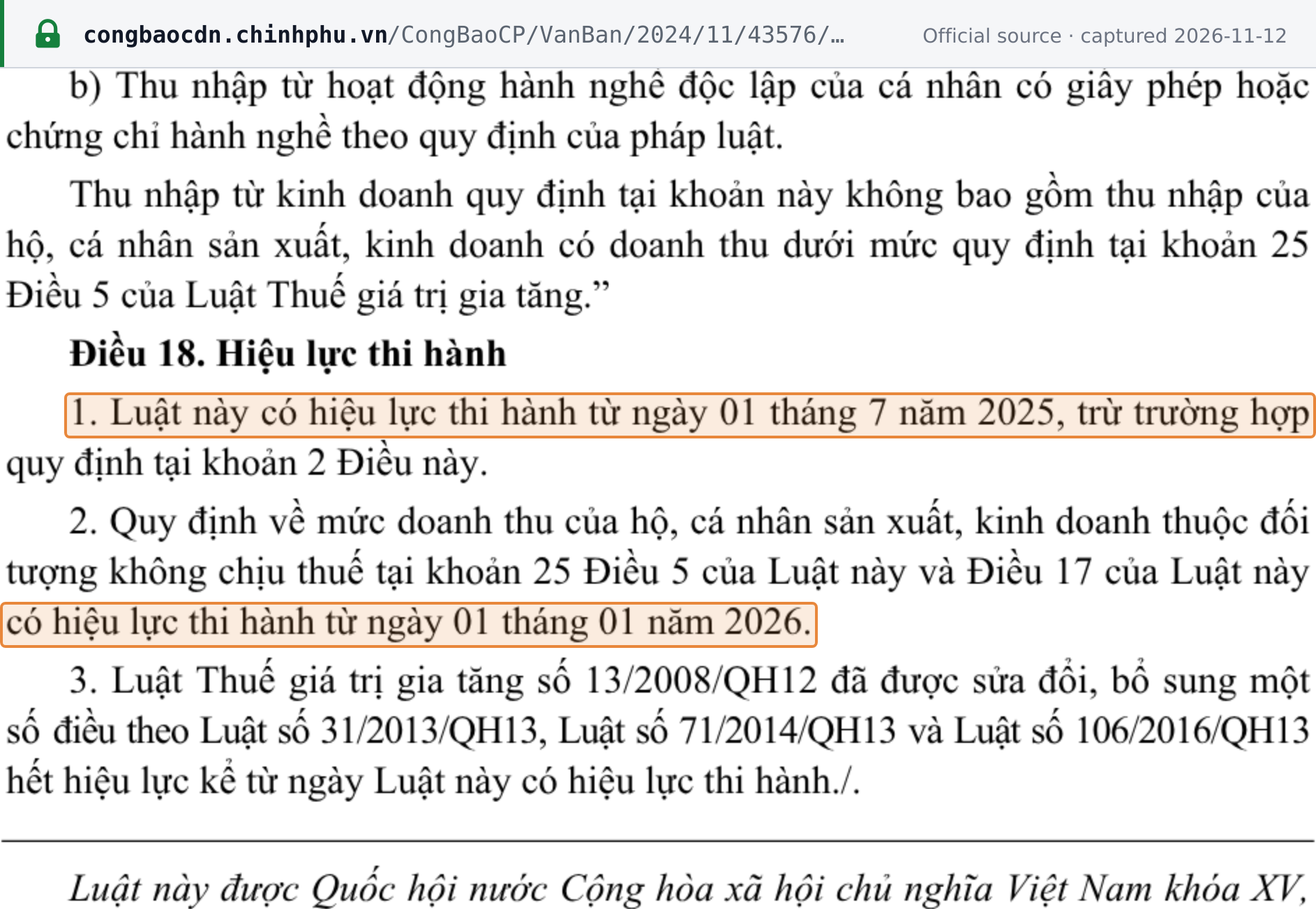 Source snapshot of the official page. Open full size ↗
Archived from the official distribution · Luật số 48/2024/QH15 Thuế giá trị gia tăng, Công báo Số 1527 + 1528, ngày 29-12-2024 · congbaocdn.chinhphu.vn