Austria raises the Kleinunternehmer VAT threshold to EUR 55,000 from 1 January 2025
This page records one dated change. For the rules in Austria as they stand today, see the Austria guide →
- Jurisdiction
- Austria
- Tax
- VAT
- Change type
- Threshold
- Status
- In force
- Impact
- FYI
- Announced
- 9 October 2024
- Effective
- 1 January 2025
- Instrument
- AT-ACT-BGBl-I-Nr-144-2024
- Authority
- Rechtsinformationssystem des Bundes (RIS)
- Verified
- Fetched from official source · high confidence
Small businesses operating in Austria with annual turnover of no more than EUR 55,000 gross (up to EUR 60,500 with the 10% tolerance in the year the limit is crossed).
No action — monitoring only. The EUR 55,000 threshold has been in force since 1 January 2025.
Progressionsabgeltungsgesetz 2025 (BGBl. I Nr. 144/2024, published 9 October 2024) raised the Kleinunternehmer VAT-exemption threshold in § 6 Abs. 1 Z 27 UStG 1994 (and in § 21 Abs. 6) from EUR 42,000 to EUR 55,000, effective 1 January 2025. Under the rules set by Abgabenänderungsgesetz 2024 (BGBl. I Nr. 113/2024), the threshold is measured gross, not on the deemed taxable base. A business exceeding it by no more than 10% (up to EUR 60,500) keeps the exemption until the end of that calendar year.
What changed in detail
Article 2 of the Progressionsabgeltungsgesetz 2025, published on 9 October 2024 as BGBl. I Nr. 144/2024, replaced the figure 42 000 with 55 000 in § 6 Abs. 1 Z 27 UStG 1994, the small-business (Kleinunternehmer) exemption, and in § 21 Abs. 6, which releases small businesses from filing an annual VAT return. Under § 28 Abs. 65, both changes apply to supplies after 31 December 2024, so from 1 January 2025.
The way the limit works was set by the Abgabenänderungsgesetz 2024 (BGBl. I Nr. 113/2024), which took effect on the same date:
- the limit is measured on gross turnover, not on a notional taxable base as if VAT were charged;
- it must not be exceeded in the previous calendar year, and not yet in the current year;
- a business that exceeds it by no more than 10%, so up to EUR 60,500, keeps the exemption until the end of that calendar year.
The Unternehmensserviceportal (USP), the government’s business portal, describes the new limit as EUR 55,000 gross per year.
What it means
The EUR 55,000 limit is still in force. The current consolidated § 6 Abs. 1 Z 27 (version in force from 1 January 2026, last amended by BGBl. I Nr. 98/2025) reads 55,000 Euro with no later change to the figure.
The EUR 42,000 limit from BGBl. I Nr. 113/2024 never applied to any supply, because this increase overtook it before 1 January 2025. A business that crosses EUR 60,500 loses the exemption from that point, not at year end, and the following year starts taxable.
Proof
Seit Jahresbeginn gilt eine neue Umsatzgrenze von 55.000 Euro brutto pro Jahr.Since the start of the year a new turnover limit of EUR 55,000 gross per year applies.
 Source snapshot of the official page. Open full size ↗
In § 6 Abs. 1 Z 27 wird die Zahl „42 000“ durch die Zahl „55 000“ ersetzt.In § 6(1) no. 27 the figure "42 000" is replaced by the figure "55 000".
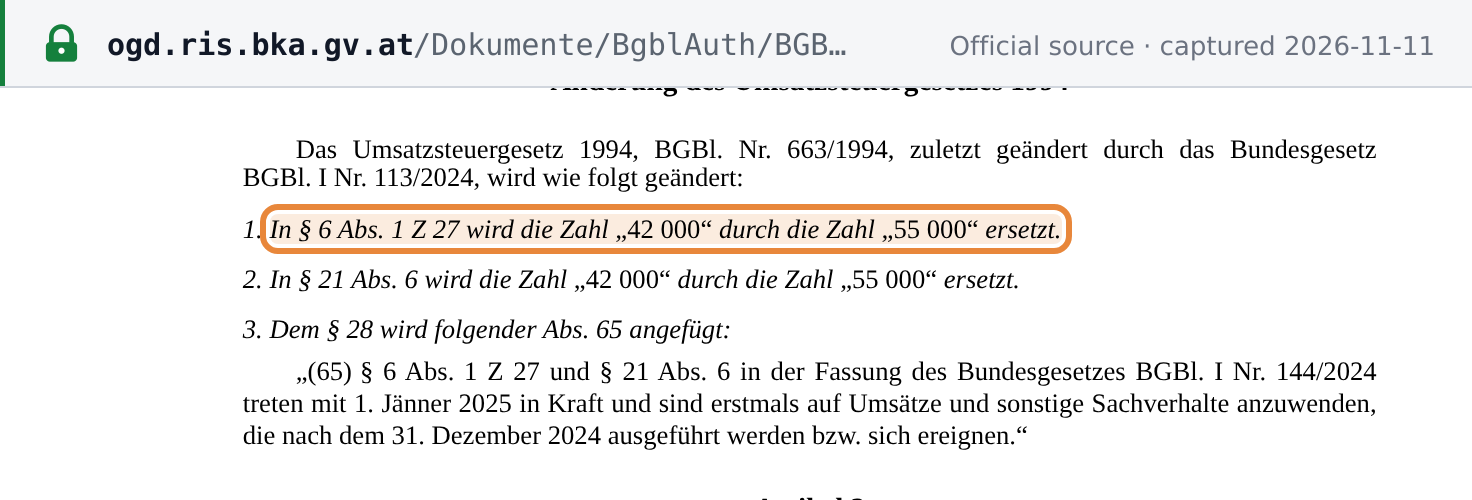 Source snapshot of the official page. Open full size ↗
Archived from the official distribution · BGBl. I Nr. 144/2024 (Progressionsabgeltungsgesetz 2025), Artikel 2 (Änderung des Umsatzsteuergesetzes 1994) · ogd.ris.bka.gv.at