Austria makes letting of residential property costing over EUR 2 million VAT-exempt with no option to tax
This page records one dated change. For the rules in Austria as they stand today, see the Austria guide →
- Jurisdiction
- Austria
- Tax
- VAT
- Change type
- Rate change
- Status
- In force
- Impact
- Plan ahead
- Announced
- 23 December 2025
- Effective
- 1 January 2026
- Instrument
- AT-FEDERAL-LAW-BGBl-I-Nr-98-2025
- Authority
- Rechtsinformationssystem des Bundes (RIS)
- Verified
- Fetched from official source · high confidence
Landlords and condominium owner associations whose residential property, acquired or built after 31 December 2025, costs more than EUR 2,000,000 per property, or per rental unit in a multi-unit building, within five years.
Landlords acquiring or building residential property after 31 December 2025 should track acquisition, construction, capitalised and major-repair costs per rental unit over five years; above EUR 2 million the letting is VAT-exempt with no option to tax, so input VAT on those costs cannot be recovered. Price this into the investment case.
The Betrugsbekämpfungsgesetz 2025 Teil Steuern (BGBl. I Nr. 98/2025, published 23 December 2025), Article 2, amended § 6 Abs. 1 Z 16 and Z 17 and § 6 Abs. 2 UStG 1994 from 1 January 2026. Residential letting normally stays taxable, but letting a "particularly representative" residential property becomes VAT-exempt with no option to tax, so input VAT on it cannot be recovered. A property qualifies if acquisition or construction costs, capitalised expenditure or major repairs exceed EUR 2,000,000 within five years of acquisition or the start of construction, measured per rental unit for multi-unit buildings. The rule covers only property the landlord acquires or builds after 31 December 2025, and also applies to services of condominium owner associations for such property.
What changed in detail
Article 2 of the Betrugsbekämpfungsgesetz 2025 Teil Steuern, published on 23 December 2025 as BGBl. I Nr. 98/2025, amended § 6 of the Umsatzsteuergesetz 1994 from 1 January 2026 (§ 28 Abs. 68).
§ 6 Abs. 1 Z 16, the exemption for letting land, lists exceptions that remain taxable. Its first dash, residential letting, is now limited: letting for residential purposes stays taxable unless the property is “particularly representative” (besonders repräsentativ). Letting such a property therefore falls under the exemption.
A residential property is particularly representative if, within five years of acquisition or the start of construction, its acquisition or construction costs, capitalised expenditure and costs of major repairs, including ancillary buildings, together exceed EUR 2,000,000. For buildings typically let as several units, such as an apartment block (Zinshaus), the test is applied per rental unit.
Further changes:
- § 6 Abs. 1 Z 17: services of condominium owner associations for such property are exempt as well;
- § 6 Abs. 2: the option to tax under Z 16 and Z 17 is excluded for particularly representative residential property.
Under § 28 Abs. 68 the rule applies only to property the landlord or association acquired or built after 31 December 2025. Costs of repairing natural-disaster damage are disregarded.
What it means
The rule is in force and has not been amended; the 2026 UStG amendments (BGBl. I Nr. 37/2026, 43/2026 and 62/2026) left § 6 Abs. 1 Z 16 and 17 unchanged.
Because the letting becomes exempt with no option to tax, the landlord cannot deduct input VAT on the purchase, construction or major repairs. On a EUR 2 million project that is a cost of several hundred thousand euros. Because costs are counted over five years, a property can cross the line after it is first let, so later capitalised spending and major repairs need tracking too. Properties held before 2026 are outside the rule, as are ordinary rental flats under the per-unit test.
Proof
die Vermietung (Nutzungsüberlassung) von Grundstücken für Wohnzwecke, sofern kein besonders repräsentatives Grundstück für Wohnzwecke vorliegt. Ein besonders repräsentatives Grundstück für Wohnzwecke liegt vor, wenn die Anschaffungs- und/oder Herstellungskosten, aktivierungspflichtigen Aufwendungen und/oder der Kosten von Großreparaturen für das Grundstück für Wohnzwecke, samt Nebengebäuden und sonstigen Bauwerken, innerhalb eines Zeitraums von fünf Jahren ab der Anschaffung bzw. des Beginns der Herstellung, mehr als 2 000 000 Euro betragen.the letting (provision for use) of land for residential purposes, unless it is a particularly representative residential property. A particularly representative residential property exists where the acquisition and/or construction costs, capitalised expenditure and/or costs of major repairs for the residential property, including ancillary buildings and other structures, exceed EUR 2,000,000 within five years of acquisition or the start of construction.
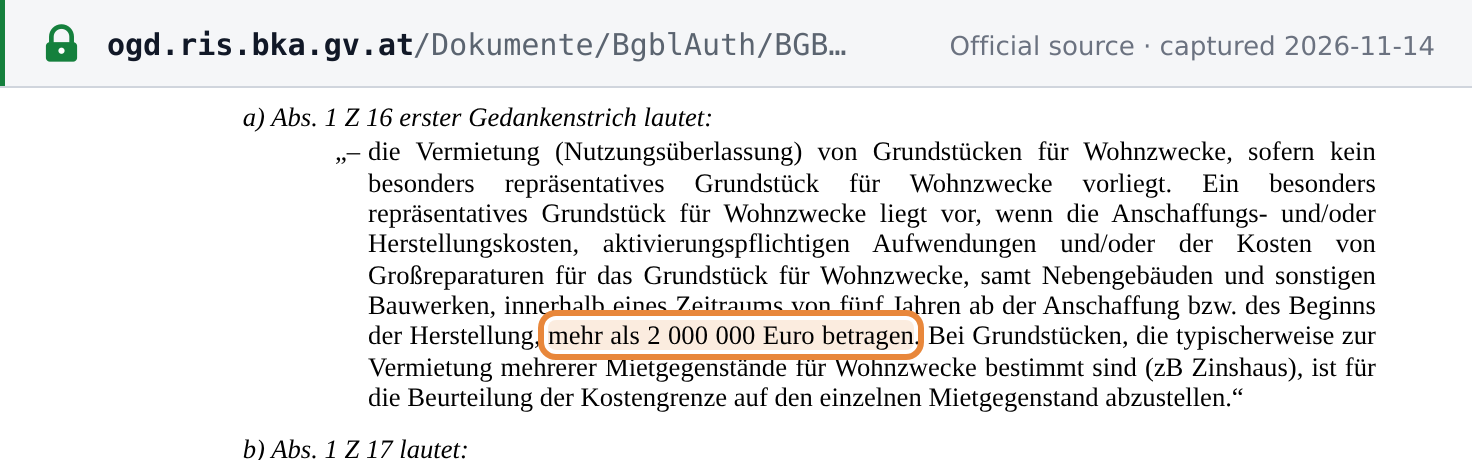 Source snapshot of the official page. Open full size ↗
Archived from the official distribution · BGBl. I Nr. 98/2025 (Betrugsbekämpfungsgesetz 2025 Teil Steuern), ausgegeben am 23. Dezember 2025, Artikel 2 (§ 6 Abs. 1 Z 16 und 17, § 6 Abs. 2 UStG 1994) · ogd.ris.bka.gv.at